

Let’s begin the week with a “good news, bad news” story about what we can do to save our planet. First, the bad news.
In the Pacific Ocean between Hawaii and California floats a massive collection of debris that has long been accumulating trash — from fishing nets to microplastics — known to be harmful to the marine environment. For years, researchers said it might not be possible to remove this Great Pacific Garbage Patch. One of the largest marine debris patches in the world, there are at least 79,000 tons of plastic inside the Patch’s 1.6 million-square-kilometer area. Microplastics (plastic materials smaller than 5 centimeters) make up 8% of the mass, but 94% of the 1.8 trillion pieces of debris floating in the area.
Marine garbage patches such as this are large areas where debris collects. The aquatic piles are formed by rotating currents called “gyres,” which are like “big whirlpools that pull objects in.” There are five gyres in our oceans — one in the Indian, 2 in the Atlantic and 2 in the Pacific. The Great Pacific Garbage Patch is the most famous of these piles.
More than 24 trillion pounds of plastic is dumped into oceans ever year. And without immediate and sustained action, the annual flow of pollution could triple by 2040. “Without meaningful change, about 4 billion people worldwide are likely to be without organized waste collection services by 2040, contributing significantly to the projected amount of ocean plastic pollution,” said a 2020 Pew Charitable Trusts study.
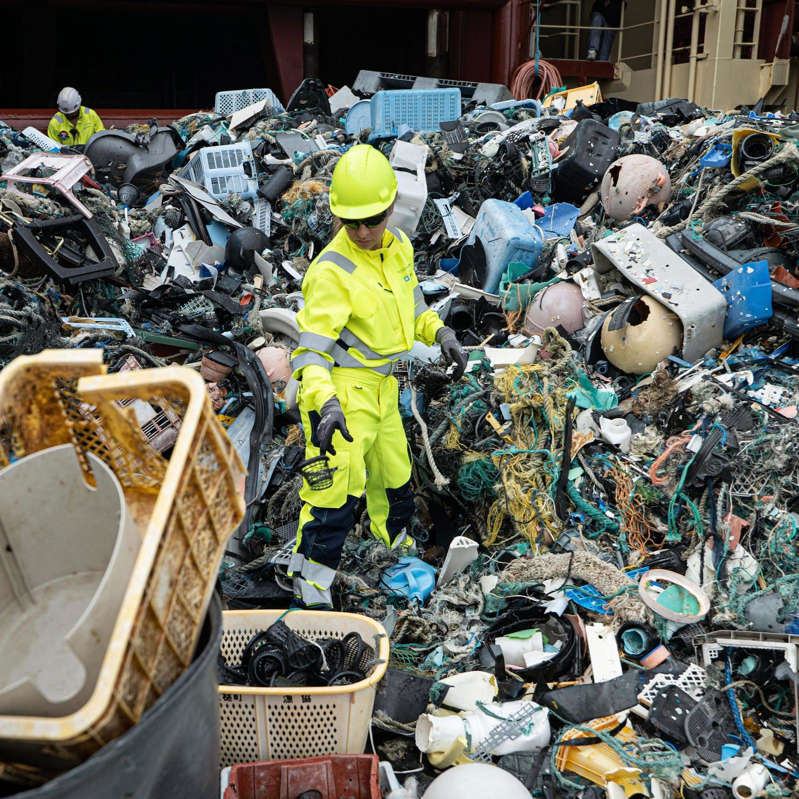
Now the good news! In July, The Ocean Cleanup non-profit, which has been developing a system to help clean up the Great Pacific Garbage Patch, took its first large-scale cleanup system, called System 002, to the Pacific. They conducted a series of tests consisting of System 002 being taken offshore to safely gather plastic from the ocean. Just last week, according to CBS News (Oct. 16, 2021), The Ocean Cleanup tweeted it had gathered about 20,000 pounds of debris. (See the photo).
System 002 works by two boats slowly guiding a U-shaped barrier through the polluted area. The circulating currents in the garbage patch move the plastic around, which helps guide that plastic into a retention zone. Workers then empty the plastic onto the marine vessel. They take the plastic to shore to recycle, and The Ocean Cleanup reuses some of the materials gathered to make products. The group predicts it could remove 90% of all floating ocean plastic by 2040.
Critics stress that “priorities should be set on preventing plastic from entering the ocean.”
Classroom discussion questions:
- How is this an OM issue? (Hint: see Supp. 5 in your Heizer/Render/Munson text).
- Are the critics right?