OM in the News: Seaweed’s Rise in a Sustainable Supply Chain
For centuries, coastal communities have tapped marine environments for food, trade, and early industrial materials. Ancient East Asian cultures harvested kelp as elite food, tax payment and even currency. In 1658, a Japanese innkeeper accidentally discovered agar by leaving seaweed jelly out in the freezing night air, revolutionizing food and medicine production.
Today, that same resourcefulness is powering a new wave of innovation as seaweed transitions from a traditional commodity into a high‑value industrial input. For OM, this shift represents both an emerging opportunity and a complex execution challenge.
Seaweed’s natural advantages make it uniquely suited for sustainable supply chains, reports ASCM Insights (Sept. 10, 2026). It requires no freshwater, no arable land, and grows rapidly—an appealing profile as organizations face tightening resource constraints and rising sustainability mandates. Researchers and manufacturers are now converting marine algae into bioplastics, fertilizers, renewable fuels, livestock feed, and even biochar, which can lock in up to 80% of the plant’s carbon. These applications don’t just support environmental goals; they create new pathways for operational resilience and carbon‑credit strategies.
Innovation is accelerating across sectors. UK researchers have developed biodegradable alginate‑based plastic films that can reduce single‑use packaging waste. In the U.S., aquaculture projects are transforming native sugar kelp into natural oils for personal care products, bio lubricants, and plastics—supported by federal investment aimed at strengthening domestic supply chains and reducing reliance on imported palm and coconut oils. These breakthroughs demonstrate how seaweed can serve as both a sustainable raw material and a strategic lever for reshoring critical inputs.
But scaling seaweed‑based materials is far from simple. High processing costs, fragmented midstream capacity, and regulatory tensions between multinational processors and local harvesters create operational friction.
Mastering this transition requires rigorous planning and inventory control. Operations managers must navigate evolving material flows, optimize production networks, and turn early‑stage innovations—like seaweed‑derived inputs—into long‑term competitive advantage.
Seaweed’s industrial future is taking shape and organizations that build the operational expertise will lead as marine‑based materials scale.
- Seaweed-based materials promise sustainability benefits, but there are steep processing costs. How should operations managers evaluate whether an emerging raw material is truly scalable?
- How can supply chain leaders balance efficiency, regulatory compliance, and community impact when integrating new natural resources into global production networks?
Guest Post: AI and the Automation of Transportation
Prof. Howard Weiss shares his insights with our readers monthly.
Automation is increasingly transforming the transportation industry. As one recent report noted, “Automation is turning transportation networks into continuously optimizing systems that consume less energy per unit moved, operate for longer hours, reduce labor bottlenecks and reshape demand for fuels and electricity.” The importance of this transformation is significant because transportation accounts for approximately 30% of U.S. energy consumption, second only to electric power generation. As discussed in the Chapter 11 of your Heizer/Render/Munson textbook, air, rail, highway, and waterway transportation systems are essential components of an effective supply chain system. Automation and AI are changing how each of these modes operates.
Trucking accounts for the majority of transportation miles and approximately 60% of transportation fuel consumption. Driverless trucks are already being tested and used in Texas. However, widespread deployment remains challenging because automated systems can have difficulty handling conditions such as curves, hills, and other unpredictable roadway situations.
While automation could eventually reduce the demand for truck drivers, the industry currently faces a shortage of drivers. So the immediate objective is often to have automation assist drivers rather than replace them. In Ohio, for example, automated trucks operate with a human driver present. These trucks can operate for much longer periods, increasing capacity by avoiding the limitations imposed by driver-hours regulations.
Rail is also becoming increasingly automated. AI and automated systems continuously inspect tracks, evaluate track conditions, and monitor wheel integrity. Rather than relying solely on periodic inspections by employees, railroads can collect information continuously. AI can also analyze train performance at different speeds and use the resulting data to identify more efficient operating practices.
Barges are particularly energy efficient because they can move large quantities of goods using less fuel than either trucks or trains. On the Mississippi River, AI-assisted pilot systems have been tested to help identify changing river conditions. Machine-learning systems are also being developed for navigation, hazard monitoring, vessel tracking, and calculating stopping distances.
Safety is perhaps the most important potential benefit of automation. However, AI can also reduce fuel consumption, minimize delays and bottlenecks, improve asset utilization, and allow transportation systems to operate more efficiently.
Classroom Discussion Questions:
- To what extent should humans remain involved in operating and supervising automated transportation systems?
- How might advances in AI influence decisions about which transportation mode companies use to move goods in the future?
OM in the News: Reshoring is Up, But Problems Persist
Manufacturing companies increased their interest in reshoring operations this year, writes Material Handling & Logistics (Sept. 3, 2026). The 2026 USA Reshoring Survey Report found that 36% of manufacturers had reshored or were actively engaged in additional reshoring– an increase from 29% in 2025. Projects are still in the works as well, with 32% of manufacturers saying they were currently quoting reshoring projects–double the 16% reported in 2025.
Why Reshore? The top reason might not be a surprise — tariffs. Here is a breakdown of survey results.
- Tariffs — 65%
- Geopolitical Risk — 60%
- Delivery time/proximity to customers — 50%
- Image/Brand of Made-in-USA — 40%
- Quality/Rework/Warranty — 25%
- Having manufacturing near engineering –15%
- Tax Reduction (from One Big Beautiful Bill) — 10%
Benefits of reshoring. Respondents saw these benefits as a result of their reshoring efforts.
- Improved speed to market — 70%
- Better fulfillment/on-time delivery — 65%
- Logistics savings (freight/transit) — 60%
- Inventory optimization/lower carrying costs — 40%
- Enhanced pricing power/brand value –20%
Challenges to Reshoring
However, there are challenges to reshoring, and those have changed over time. Currently, the top challenge, at 35%, is the availability of labor and overhead costs. Other issues include:
- Domestic component gaps — 35%
- Supply chain transition friction –20%
- Labor availability challenges — 15%
- Regulatory /compliance burdens –15%
While the Reshoring report is optimistic about reshoring as a way to reduce imports, a recent survey, The Kearney 2026 Reshoring Index, found a less positive view. They said that despite changes in US trade and tariff policies and significant changes in geopolitical realities, as of the end of 2025, America remains even more reliant on imports while its manufacturing capacity remains years away from projected goals.
The report found that despite US manufacturing investments tripling over the past four years, there’s only been 1.5% growth in capacity so far. Resolving the labor issues and other barriers to reshoring, at the end of the day, requires further supply chain adjustment.
Classroom discussion questions:
- Why might companies be motivated to reshore even when the outcomes are less positive than expected? What does this tension reveal about strategic decision‑making in operations management?
- How do capacity limitations, labor shortages, and domestic component gaps shape the feasibility of large‑scale reshoring? What operational strategies could help firms overcome these constraints?
OM Podcast # 53: AI at Verizon and the Future of Work
Welcome back to school! We hope the start of fall classes is going smoothly for everyone, and we hope you enjoy our first podcast of the semester.
AI is transforming the way organizations operate and Bryan Hartling, Senior Program and Project Manager at Verizon, is helping lead that change.


In this episode, Bryan joins Barry and Misty to discuss Verizon’s AI initiatives, machine learning applications, procurement automation, business intelligence modernization, and the future impact of AI on jobs and software services. The conversation provides an insider look into how large organizations are using AI to simplify processes, improve decision-making, and drive innovation.
Guest Post: Enabling the Supply Chain– What Clorox’s ERP Journey Teaches

Dr. Misty Blessley frequently cohosts our monthly OM podcasts from her office at West Virginia University, where she is Associate Professor of Supply Chain management.
In Chapter 11 of your Heizer/Render/Munson textbook, students learn about the Supply Chain Operations Reference (SCOR) model. SCOR entails 6 core steps – Plan, Source, Make, Deliver, Return, and Enable. While the first 5 steps focus on the flow of products and information, the Enable step focuses on the technology, data and infrastructure that support all other supply chain activities. In many ways, when firms enable, they lay the foundation that allows the rest of the supply chain to function effectively.
A recent article in Supply Chain Dive provides an excellent example of the enable process in action. Clorox, the consumer products company known for brands such as Clorox bleach, Pine-Sol, Glad trash bags, and Kingsford charcoal, expects to realize significant supply chain improvements as it completes its transition to a new enterprise resource planning (ERP) system. The benefits include better planning, lower inventory levels, greater automation, and a more responsive supply chain that can react more quickly to changes in customer demand.
But implementing a new ERP system (the topic of Chapter 14) can cause significant disruption before improvements can be realized. The company’s ERP transition began in 2021 as part of a 5-year, $500 million digitization effort designed to replace decades-old technology. During implementation, Clorox experienced fulfillment challenges and incurred additional costs as the rollout progressed more slowly than expected.
Clorox believes those challenges are largely behind it. the firm has integrated business planning into the new system and moved many activities away from spreadsheet-based manual processes toward automated workflows. The payout is expected to be improved demand fulfillment, streamlined order-to-cash activities, and reduced inventory throughout the supply chain.
Enabling capabilities often determine how effectively the entire supply chain performs. Investments in technology, data, and infrastructure may not produce immediate results, but they can create the foundation for long-term operational excellence. ERP systems improve visibility, coordination, and decision-making across organizations. Firms have learned that not implementing ERP can be costly. But just as The Clorox Company experienced, implementation woes are not unusual.
Classroom Discussion Questions:
- Why do you think so many organizations struggle with ERP implementations?
- What should firms do in advance to ease the implementation process?
Guest Post: Robots as a Service– Is Warehouse Automation Going Subscription?

Dr. Jon Jackson, Associate Professor of Operations Management at Providence College, raises an interesting issue regarding warehouse robotics. Jon has created AI classroom exercises for each chapter of our text. They are found on-line in the Instructor’s Resource Manual.
Warehouse automation typically requires a significant upfront investment. But what if companies could rent the robots instead?
A recent Wall Street Journal article (August 17, 2026) highlights the growing use of subscription-based robotics in warehouses. Instead of purchasing robots outright, companies can pay a monthly fee to use them, potentially changing the economics of automation.
North American companies ordered nearly 18,000 warehouse robots worth $1.2 billion in the first half of 2026; both figures are up from 2025. Simultaneously, the average U.S. warehouse wage reached $26.85 per hour, up 41% over the past decade. Even with the higher wages, nearly 392,000 jobs remain open in the transportation, warehousing, and utilities industries. Together, these trends create strong incentives for companies to consider greater investment in warehouse automation.
Traditionally, investing in robots means committing substantial capital to equipment that may become obsolete or may not provide enough value to justify the investment. A subscription model changes that calculation by shifting some of the financial risk from a capital investment to an ongoing operating expense. Companies can avoid much of the upfront capital expense, scale automation up or down as demand changes, and potentially gain access to newer technology as it becomes available.
This flexibility could be particularly valuable in warehouses with seasonal or uncertain demand. Rather than purchasing enough robots to handle peak demand (and leaving them underutilized during slower periods), companies could potentially add robotic capacity when they need it.
There are trade-offs, however. Subscription fees may ultimately cost more than purchasing equipment outright, and companies become dependent on the robotics provider for technology, maintenance, and service.
From an operations perspective, “Robots as a Service” raises an interesting question: Should automation be treated as a capital investment or as a variable operating expense? As robotics technology improves, the answer may increasingly depend on how much flexibility a company values.
Classroom Discussion Questions
- When might renting robots be preferable to purchasing them?
- How does a subscription model change the risk associated with investing in automation?
OM in the News: How Digital Twins Are Transforming Production Planning at Brose
Manufacturing has always required a delicate balance: maximizing throughput, minimizing inventory, adapting to demand shifts, and maintaining quality—all while avoiding costly disruptions. As factories become more automated and interconnected, that balance has grown harder to maintain. A single change in one department can ripple across an entire value stream, creating bottlenecks that traditional planning tools often fail to anticipate.
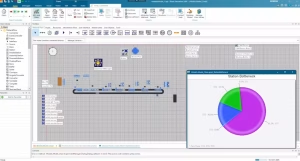
Brose, a global automotive supplier known for seat structures, door systems, and electric drives, is confronting this challenge head‑on by expanding its use of digital twin technology, reports Industry Week (Aug. 17, 2026). Brose models complete production systems—not just isolated workstations—to understand how materials, resources, and constraints interact under real operating conditions.

This shift marks a departure from calculations that struggle to capture real‑world variability. Equipment breaks unexpectedly. Operators work at different speeds. Material arrives early, late, or out of sequence. Brose’s digital twin allows engineers to observe these dynamics virtually before making physical changes on the shop floor.
One example involves a palletized manufacturing line where an automated station gradually slowed below its planned cycle time. While the issue was visible on the floor, its broader impact was not. By incorporating process times, operator activities, and material flow relationships into the simulation, Brose identified how the slowdown constrained downstream operations and tested multiple improvement strategies virtually. The result: more confident decision‑making and significantly lower implementation risk.
Brose has also extended simulation into optimization problems, such as determining efficient material drop‑off routes. Instead of manually comparing a handful of options, engineers use algorithms to evaluate thousands of routing combinations against performance objectives—surfacing solutions that would be impractical to discover manually.
Brose’s experience reflects a broader trend: digital twins (the topic of Module F in your Heizer/Render/Munson text) are becoming essential tools for continuous improvement and production planning. As product lifecycles shorten, the ability to experiment virtually before committing resources may become one of the most valuable capabilities on the factory floor.
Classroom Discussion Questions
- How does modeling entire value streams—rather than individual processes—change the way engineers identify and solve production problems?
- What types of operational decisions benefit most from virtual experimentation before physical implementation?
Guest Post: Artificial Intelligence and Public Transportation
Prof. Howard Weiss shares his insights with opur readers monthly.
AI is becoming an increasingly important tool in public transportation and traffic management. Traffic cameras have been used since 1956, when they were introduced in London. Modern AI-enabled cameras, however, do more than record images. They can interpret what they see and identify traffic violations and other events in real time.
Cities and transportation agencies worldwide are experimenting with this technology. In Greece, AI cameras identify drivers who fail to wear seat belts, who use cell phones, or who exceed speed limits. In Goa, India, 26 locations have installed cameras to identify similar violations. Mississippi uses AI cameras to alert officers to traffic violations. Houston is purchasing AI cameras to improve traffic flow. In the Dallas–Fort Worth area, AI cameras assist criminal investigations
AI cameras are also being used on buses. In Philadelphia, SEPTA uses AI-powered cameras to identify vehicles illegally parked and blocking buses. Broward and Miami-Dade Counties in Florida use cameras mounted on school buses to identify motorists who fail to stop when buses are loading or unloading students.
Benefits and Costs The primary benefit of AI cameras is improved public safety. Several communities have reported reductions in traffic violations after cameras were installed. AI can also reduce the number of police officers required for traffic enforcement and can speed citation processing.
Citywide systems can require millions of dollars in capital investment, as well as expenses for software development and preventive and breakdown maintenance, as discussed in Chapter 17 of your Heizer/Render/Munson textbook. Fines may offset some costs.
Privacy is another concern. Although systems identify vehicles rather than drivers, they can collect information about where vehicles travel and when. This raises important questions about data retention, access, and appropriate use.
Implementation and Quality Control The experience of several communities demonstrates the importance of quality control. Miami-Dade and Philadelphia both used warning periods before imposing fines. Miami-Dade later suspended its program because of inaccurate citations and subsequently modified the system to improve consistency and transparency. In Greece, reports found significant discrepancies between AI-generated citations and violations ultimately determined to be valid. Some drivers were cited even though they had stopped because of an ambulance or police vehicle.
Classroom Discussion questions:
- What rules should governments establish regarding data collection, storage, and access?
- What quality-control procedures should be required before a driver is fined based on an AI-generated violation?
Guest Post: Ancillary Service as a New Business Strategy–Turning EV Charging Time into Happier Customers and More Profitable Companies
Dr. Misty Blessley is Associate Professor of Supply Chain Management at West Virginia University. She can be reached at misty.blessley@mail.wvu.edu
In Module D of your Heizer/Render/Munson textbook, the psychology of customer wait times is discussed. Most would agree that waiting can be a painful experience. To make waiting less unpleasant, organizations often use distraction as a strategy. Some companies have mastered this approach by leveraging a strategic asset that transforms customer wait time into sales revenue. The rapid expansion of electric vehicle (EV) charging infrastructure provides a compelling example of how firms are creating a competitive advantage built around customer waiting.
According to a recent study, EV charging stations located near grocery stores experience usage rates nearly 5 times higher than stations in many other locations. This finding suggests that EV drivers prefer to combine charging with activities they already need to complete, such as grocery shopping. Rather than viewing charging as wasted time, customers can use that time productively while businesses benefit from additional sales that might otherwise have been lost.
Retailers have been quick to recognize this opportunity. Despite slowing EV sales, Walmart, along with other major retailers, is emerging as a significant player in the EV charging market. Industry experts estimate that charging stations located near retail stores can increase sales by approximately 5%. By 2030, it is projected that 1 in 5 fast-charging stations in the U.S. will be located in the parking lots of big-box retailers.
Restaurants are also capitalizing on this trend. Bojangles, for example, is expanding EV charging capabilities at select locations, recognizing that drivers waiting for their vehicles to charge are potential customers looking for a meal, snack, or comfortable place to relax.
This trend underscores the importance of service operations design. Companies are not simply deciding where to place charging stations, they are strategically integrating an ancillary service into locations where customer dwell time can be leveraged to create additional value. The charging station becomes part of a broader service system that ends with happier customers and more profitable companies.
Classroom Discussion Questions:
- Other than the firms mentioned here, what other types of businesses may/may not benefit from installing EV charging stations?
- Think of a time when you experienced the pain of waiting in line. What could the business have done to make the experience less unpleasant?
Guest Post: OM and SAP S/4HANA Production Planning and Execution
Dr. Prince Vijai is Assistant Professor of Operations at IBS Hyderabad, India.
In today’s fast‑moving manufacturing environment, production planning is no longer just about scheduling work orders or managing material availability. Modern operations require real‑time visibility, tighter integration across functions, and systems that support rapid decision‑making. SAP S/4HANA’s Production Planning and Execution (PP&E) offers exactly that—an advanced digital backbone for world‑class OM.
At its core, SAP S/4HANA PP&E connects demand, capacity, materials, and shop‑floor activity in one unified environment. This eliminates the traditional disconnect between planning and execution that many firms still struggle with. Instead of relying on batch MRP runs or siloed spreadsheets, planners gain real‑time insights into constraints, bottlenecks, and the ripple effects of schedule changes.
A few capabilities stand out:
- Real‑time MRP: S/4HANA’s in‑memory engine dramatically accelerates planning cycles, allowing planners to simulate scenarios and adjust instantly.
- Advanced Scheduling: It provides finite capacity scheduling, enabling more accurate sequencing and resource allocation.
- Integrated Execution: Shop‑floor data flows directly into the planning system, improving accuracy and reducing reaction time.
- Exception‑based management: Alerts and analytics help planners focus on issues that matter most—late orders, shortages, or overloaded work centers.
For operations managers, this integration means better alignment between what the system plans and what actually happens on the shop floor. For students, it offers a real-world example of how digital transformation reshapes classical OM concepts like bottleneck analysis, capacity planning, and inventory control.
SAP S/4HANA doesn’t replace foundational OM principles—it amplifies them. The system’s power lies in applying proven concepts with modern speed, accuracy, and connectivity. Whether you’re teaching OM, studying it, or practicing it, understanding tools like S/4HANA is increasingly essential.
As companies continue to adopt advanced planning systems, OM professionals who can bridge theory and technology will be in high demand. SAP’s PP&E environment is a great place to see that bridge in action.
- How does SAP PP transform OM concepts into practical production decisions?
- How does cost settlement help operations managers evaluate the financial performance of production?
OM in the News: GM’s $4.5B Supply Chain Deal to Secure Critical Parts

General Motors has entered a $4.5 billion purchasing facility with Procura Auto Parts to safeguard its supply chain against disruptions such as natural disasters, cyberattacks, or sudden demand surges. The automaker is aiming to secure supplies of high-risk components through a financing arrangement of prefunding the purchase of essential parts, reports The Wall Street Journal (Aug. 12, 2026).
- Procura’s Role: The London–Frankfurt–New York-based inventory management firm will buy and store critical parts from GM’s suppliers, acting as an intermediary to secure inventory.
- Funding: A bank syndicate led by JPMorgan Chase and Banco Santander will finance Procura’s purchases.
- GM’s Commitment: GM will issue irrevocable payment undertakings (IPUs) to repay Procura once the parts are used in production
GM has not disclosed the exact components, but past disruptions have involved semiconductor chips, rare earth metals, and wire harnesses.
The move follows years of global automotive supply chain shocks, including the COVID-19 pandemic and semiconductor shortages that halted production at multiple plants. By prepaying suppliers, GM aims to:
- Preserve working capital by avoiding short-term cash outflows.
- Maintain production continuity during unexpected shortages.
- Reduce vulnerability to just-in-time delivery risks.
This complements earlier GM initiatives, such as a long-term chip supply agreement with Micron Technology for memory and storage components. It reflects a broader industry shift toward strategic inventory management and supplier diversification after repeated disruptions.
In summary: GM’s $4.5B deal with Procura is a proactive, multi-year supply chain hedge designed to ensure access to critical parts, protect cash flow, and maintain manufacturing resilience in a volatile global market.
Classroom discussion questions:
1. How does GM’s decision to invest heavily in securing critical components—such as semiconductors—illustrate the growing importance of supply chain resilience in modern operations management, and what risks is the company trying to mitigate?
2. GM’s partnership with suppliers like Procura reflects a shift toward deeper, long‑term collaboration. In what ways can strategic supplier relationships improve operational performance, and what challenges might arise when firms commit to such large, multi‑year agreements?
OM Podcast #52: Renewable Natural Gas & Heavy-Duty Transportation
We hope you’re having a nice summer!
In our latest podcast, Barry and Misty interview Charles Love, renewable natural gas (RNG) expert for Love’s Alternative Energy. Together they discuss renewable natural gas, how it is produced, distributed, and used as a transportation fuel, as well as its growing role in the future of heavy-duty transportation.
During the conversation, Charles explains the difference between fossil methane and renewable natural gas, describing how RNG is created from organic sources such as food waste, animal manure, and wastewater.
Charles also discusses Love’s extensive operations, the company’s vertically integrated business model, and the important role farmers play in renewable natural gas production. Listeners will learn how renewable fuels create value throughout the supply chain while helping address environmental concerns.


Charles shares his perspective on where the industry is headed and why RNG is currently an attractive solution for heavy-duty trucking fleets seeking a combination of cost effectiveness and environmental benefits.
A Word document of this podcast will download by clicking the word Transcript above.
Have you subscribed to this podcast on Apple Podcasts? Just go to your Apple Podcasts app, search “Heizer Render Munson OM Podcast,” and subscribe to get all our podcasts on your mobile device as soon as they come out!
OM in the News: AI and the Perfect Pringle Potato Chip
For decades, the Pringle has been one of the most recognizable snacks in the world—uniform, crunchy, and engineered for consistency. But behind that iconic saddle‑shaped chip lies a surprisingly complex manufacturing challenge, writes The Wall Street Journal (Aug. 11, 2026). At Pringle’s factory in Poland, engineers have spent the last four years pursuing a bold goal: use AI to make every single Pringle a perfect one.

This ambition led to a deep partnership with Siemens and a $4–5 million investment to build an AI‑powered digital twin (our topic in Module F of the text) of the Pringles production line. Unlike traditional 3‑D models, this digital twin operates in real time, ingesting more than 200 data points every millisecond—from flour particle size to dough humidity to subtle variations in potato batches. These micro‑changes matter. Even potatoes from the same supplier can behave differently depending on the season, affecting texture, shape, and fry behavior.
Historically, dough makers relied on intuition: stretching dough by hand, weighing chips fresh from the fryer, and adjusting machines after spotting issues. Today, AI models simulate outcomes continuously, predicting how each batch will behave and recommending precise tweaks—more oil here, less water there—to keep quality stable. Human operators still make the final call, but the system’s guidance has already delivered measurable results: 10% improvement in chip quality, 13% reduction in waste, and a 40%+ return on investment on the Poland line alone.
The success is prompting expansion. Belgium is next, followed by U.S. production lines in 2027. Siemens sees this as part of a broader shift—digital twins are maturing across industries, from rockets to batteries to microchips. What began as static models are now intelligent optimization engines.
For Pringle, the future is even more ambitious. The company hopes its AI will eventually handle multiple varieties of potatoes, corn, and rice, adapting automatically while still producing the same signature chip. In other words, the perfect Pringle may soon be less a product of uniform ingredients and more a triumph of adaptive, intelligent manufacturing.
Classroom discussion questions:
- How might AI‑driven digital twins change the future of food manufacturing, and what new skills will workers need as these systems become more common?
- Should companies rely on AI to make real‑time production decisions, or is it important that humans remain the final decision‑makers? Explain your reasoning.
OM in the News: How Ford Blended Veteran Engineering Wisdom with AI to Climb the Quality Rankings
After years of slipping in JD Power’s Initial Quality Study, Ford surged to the top of the mass‑market rankings in 2026. The secret wasn’t a flashy new platform or a radical manufacturing overhaul. Instead, Ford made a deliberate investment in something the industry has quietly undervalued—deep, hard‑earned engineering experience.

The company deployed more than 350 senior engineers, known internally as “gray beards,” to tackle persistent quality issues. Many were coaxed out of retirement, bringing decades of pattern recognition, intuition, and problem‑solving discipline back into the fold. Their mission: diagnose chronic issues, mentor younger teams, and challenge design decisions before they reached production.
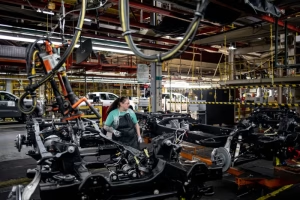
But Ford didn’t stop at human expertise. The automaker layered in targeted AI tools designed to amplify—not replace—engineers’ capabilities. Assembly teams now use iPhone‑based inspection systems to detect misaligned connectors or missing fasteners. Machine‑learning models sift through hundreds of thousands of transmission test traces daily, flagging anomalies that would be invisible to the human eye. Generative AI supports design reviews, helping engineers explore optimized geometries and identify potential failure points earlier in development.
This hybrid approach—experienced engineers empowered by precise AI—has reshaped Ford’s culture. Instead of hiding flaws, teams now celebrate finding them early. Quality issues aren’t embarrassments; they’re opportunities to strengthen the product before customers ever touch it.
Ford’s rise in the rankings isn’t just a win for the brand. It’s a case study for the entire manufacturing world: the future isn’t human versus AI. It’s human with AI, working side by side to build better products than either could alone.
Classroom discussion questions:
- How does Ford’s use of “gray beard” engineers challenge common assumptions about innovation and workforce development in high‑tech industries?
- Ford now “celebrates finding failures” as part of its quality culture. What are the advantages and potential risks of adopting this mindset in engineering organizations?
Using this definition, 9% of all U.S. jobs are in the skilled trades, with 60% of those consisting of jobs in construction and manufacturing. For each person completing a training program, the skilled trades have 3 job openings, creating a talent gap of 1.3 million workers. Around 25% of workers in the skilled trades are 55 or older, meaning demand is expected to rise as workers begin to retire.