

Hospitals are some of the most complex operations environments in the world, writes The Wall Street Journal (Sept. 29, 2026). Thousands of interdependent processes—clinical workflows, monitoring systems, documentation, staffing, and technology—must function with precision. When any part of that system becomes noisy, inefficient, or overloaded, the consequences can be serious. A striking example comes from an unlikely OM case study: hospital alarm fatigue.
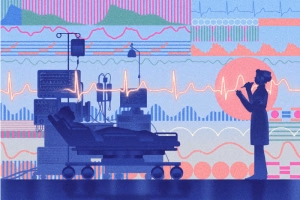

Researchers are now applying OM thinking to redesign the alarm ecosystem.
Reducing Non‑Actionable Variation Stanford Medicine introduced time delays and conditional triggers to filter out brief, self‑correcting changes in vital signs. This is classic process‑control logic: eliminate noise so workers can focus on meaningful signals. The results were dramatic—alarm volume dropped by up to 82% without compromising safety. Nurses reported better responsiveness, demonstrating how reducing process clutter improves human performance.
Human‑Centered Design for Quality Another team is redesigning alarms using principles from music cognition. Instead of harsh electronic tones, alarms use recognizable “auditory icons” and musical cues to convey urgency and type of problem. This is OM’s human‑factors engineering at work: improving quality by making information more intuitive, reducing worker stress, and speeding decision‑making.
Predictive Systems to Prevent Failure The most powerful OM innovation may be the machine‑learning tool Concern, which analyzes patterns in nursing documentation to detect deterioration before vital signs trigger alarms. It provides a quiet, color‑coded risk indicator rather than another disruptive alert. In a 60,000‑patient trial, units using Concern saw lower mortality and shorter stays. This is proactive capacity and risk management, shifting from reaction to prevention.
The OM Lesson Alarm fatigue isn’t just a clinical issue—it’s an operations problem. Smarter triggers, better signal design, and predictive analytics show how OM principles can transform safety, reduce waste, and improve outcomes in high‑stakes environments.
Classroom Discussion Questions
- How should hospitals balance the need for constant patient monitoring with the risks of alarm fatigue?
- What lessons from hospital alarm redesign—such as smarter triggers, better sound design, or early‑warning systems—could be applied to other industries that rely heavily on alerts?