

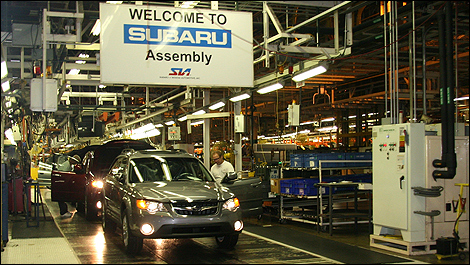
But whereas Toyota made kaizen famous, Subaru has created green kaizen. Going back almost a decade, Subaru decided to become the nation’s 1st zero-landfill car factory. It recycles 98% of the plant’s waste and incinerates the other 2% in an operation that sells power back to the grid. The plant abounds with well-reused parts containers. In 2010, Subaru saved $5.3 million by obsessively reducing, recycling, composting , and incinerating–and saved multiples of that using employee-sponsored ideas to reduce injuries and fatigue. The workers can get bonuses (up to a new car) for pointing out excess packaging and processes that can be cut from the assembly line.
To score a cherished “associate” position at the factory, would-be employees are expected to put in long hours mastering Subaru’s low-impact manufacturing. They learn to scrutinize every byproduct for savings and to look for ways to slice seconds off the assembly process. The jobs pay $14 (starting) up to $25 (peak)/ hour, yielding a salary of $50-60,000 including mandatory overtime.
Discussion questions:
1. What happens when the plant needs to slow down (say from parts shortages)?
2. How does Subaru get such worker commitment that the UAW has failed 3 times to unionize the plant?