OM in the News: AI, Lean Cultures and Toyota

“Artificial intelligence is going to replace literally half of all white-collar workers in the U.S.,” said Ford’s CEO Jim Farley, in the latest in a succession of executives warning of large-scale job cuts from AI.

Such claims can be pretty convincing—and unsettling.  Large-scale AI-related workforce reductions to date, however, are almost exclusively limited to AI-aligned companies like Meta and Google, writes Industry Week (Aug. 7, 2025).

That said, it’s undeniable that tools like ChatGPT are already having a profound influence on the future of OM work. And the bar keeps raising as AI platform providers release more powerful versions. (ChatGPT currently has around 700 million weekly users).

AI-first companies may be willing to shell out big money for AI “agents” that take the place of human workers. A popular target is workflows that are standard across many companies, such as handling employee queries to accounting or HR. Such work, however, is not as straightforward as it may seem.

Nobel Laureate Daron Acemoglu  predicts that over the next 10 years, only 5% of all tasks currently undertaken by humans will be profitably automated. He calls for a more human-centric approach. “That best possible way is a much more pro-human approach to AI that’s much more targeted at working with human decision-makers”.

Acemoglu’s findings are consistent with what lean leaders have been saying for decades. Uniquely human capabilities are essential to continuous improvement and central to lean’s most important pillar—respect for people.

Toyota’s approach to technology has been to articulate the need to improve the process and then, before evaluating automation solutions, investigate ways of meeting that need by simplifying the process (e.g., removing unnecessary steps). Taking this step avoids the common mistake of automating waste and leads to more effective and durable technology solutions.
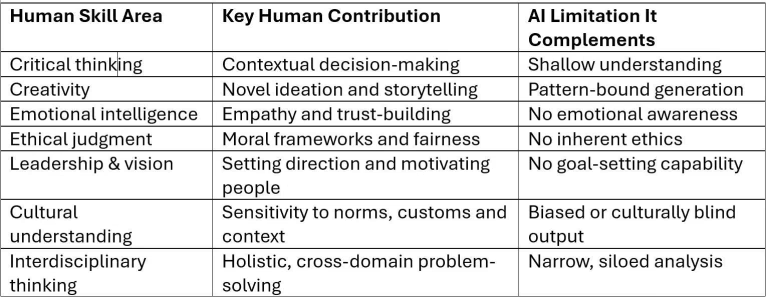
A key point here is that continuous improvement is a holistic undertaking that seeks to reduce costs and increase value. This is starkly opposed to the common preoccupation with cost cutting, and the use of AI as primarily a vehicle for reducing headcount. The human skill areas in the left column of the above table, however, are not widely recognized or developed in most organizations, and a culture that supports them takes years to build. Lean organizations, accordingly, place considerable emphasis on developing and nurturing skills such as listening, collaborating, problem solving, following a vision and mentoring.

Classroom discussion questions:

  1. How does Toyota’s approach tie with AI use?
  2. How can Chat GPT impact manufacturing work?

OM in the News: Reducing Manufacturing Waste

With inflation keeping the cost of raw materials high, it has become more important than ever for manufacturing companies to reduce waste as much as possible. Not only is this strategy good for the environment, and the company’s bottom line, but it can also boost employee well-being and morale, writes Industry Week (Nov. 12, 2024). Here are five approaches:

  1. Use Less Material. One obvious solution is to cut down on the amount of materials used. To help identify where waste is coming from – whether it is using more energy or thread than needed to produce a shirt, or printing reports that could easily be shared digitally – a thorough examination of a company’s practices is the first step. Recycling should be prioritized, including printer cartridges, old computers, monitors and batteries from small devices. Recycle containers should be near every workstation.
  2. Save Time. Time management can help cut down on waste substantially by reallocating unnecessary work to more important tasks that will help boost profit. Real-time tracking using radio-frequency identification (RFID) uses radio waves to follow a product from the beginning of manufacturing all the way through to shipping. This helps identify how to potentially streamline and speed up the production process.
  3. Embrace Artificial Intelligence. AI has the potential to discover new areas for improvement that humans may not be able to identify on their own. For example, it could be used to analyze the motion of workers and products throughout the manufacturing process. Cameras can be placed throughout a factory to capture the necessary information for the AI system to review and analyze.
  4. Optimize Workflow. Another type of waste that is important to a manufacturing company’s success is excess movement. When an employee is able to produce more without having to work as hard physically, there is less wear and tear on their bodies. This results in less injuries and sick time needing to be taken, happier employees and ultimately an increase in worker productivity.
  5. Utilize Talent. Initiating training programs to educate employees on best practices can also reduce waste. When employees perform work that unnecessarily squanders both materials and time, they need to be taught there is a better and often easier way to complete those jobs.

Classroom discussion questions:

  1. In addition to these 5 ideas in Industry Week, provide several others to reduce waste.
  2. How else can AI be used in a manufacturing process?

OM Podcast #22: Continuous Process Improvement and Lean at Pearson Education

We are gearing back up for the fall semester with some new podcasts!  In this most recent podcast Barry Render interviews John Beakes, Senior Director of Continuous Process Improvement at Pearson, the publisher of our Heizer/Render/Munson textbook.  Barry and John discuss the importance of Lean and continuous process improvement at Pearson and in other industries John has worked in.


Did you know our podcast is now available on Apple podcasts? Just go to your Apple podcasts app, search “Heizer Render OM Podcast,” and subscribe to get all our podcasts on your mobile device as soon as they come out!

Transcript

A Word document of this podcast will download by clicking the word Transcript above.

Instructors, assignable auto-graded exercises using this podcast are available in MyLab OM. See our earlier blog post with a recording of author and user Chuck Munson to learn how to find these, or contact your Pearson rep to learn more! https://www.pearson.com/en-us/help-and-support/contact-us/find-a-rep.html

OM in the News: CVS Aims to Make Inventories Leaner

CVS Health is restructuring its distribution network, reports The Wall Street Journal (Aug. 7, 2024), as the pharmacy chain seeks to speed up the flow of goods to its stores and online customers. It has closed 3 of 33 warehouses, automated one of its largest distribution centers and is opening a building dedicated to bulky items this fall, part of a multimillion-dollar plan to upgrade its supply chain to cut costs and improve profit margins.

The chain’s efforts in distribution operations that handle goods from general merchandise to pharmaceuticals are meant to” (1) help restock its stores faster and (2) free workers to help customers in stores and fill online orders for pickup and delivery.

CVS operates more than 9,000 retail locations nationwide, and 85% of the U.S. population lives within 10 miles of a store. The company wants to use that proximity to shoppers to its advantage. CVS has been squeezed by rising drug costs and lower foot traffic while sales of Covid vaccines and test kits have waned.

CVS joins other retailers, including Target, Walmart and Walgreens, that have focused on fulfilling more online orders from stores to speed up shipments, streamline inventory and make more use of bricks-and-mortar sites. It recently spent millions of dollars to automate a 1.2 million-square-foot warehouse in N.J. serving stores in the Northeast.

The automated storage and retrieval system there brings items bound for stores directly to workers, who no longer must walk warehouse aisles to retrieve merchandise. Workers then hand the products to an automated system that sorts items into bins based on destination.

CVS previously would send half-empty bins to stores throughout the day, taking up space in stores as well as workers’ time as they unpacked multiple shipments. The company now waits until bins are full and then groups them by store. The change has reduced bins it ships containing beauty products by 42%.

The tactic has also trimmed the time it takes to replenish a store down to a single day rather than several days. Moving merchandise faster allowed CVS to cut $2.5 billion worth of inventory since 2022. CVS plans to double the size and volume of the new warehouse system next year and roll the technology out across other warehouses.

Classroom discussion questions:

  1. Why is CVS trying to become “leaner”?
  2. What is the goal of the new automated warehouse in N.J.?

OM in the News: JIT Makes a Retail Comeback

Retailers are reviving an old playbook to manage their inventory levels after four years of struggling to find the sweet spot of holding enough merchandise but not too much, reports The Wall Street Journal (Jan. 24, 2024). They have worked through the excess inventory that piled up on store shelves and in warehouses over the past 18 months, and are now focusing on replenishing items rather than stocking up on goods to have on hand in case of supply-chain disruptions.

The shift marks a return to the “just-in-time” inventory management strategy (our topic in Chapter 16) that many companies had employed before pandemic-driven product shortages and volatile shifts in consumer demand prompted a switch to a “just-in-case” stockpiling approach. Companies are now better able to predict shopper demand and feel they can hold leaner inventories amid moderating spending growth and fewer supply-chain disruptions. They prefer not to hold large inventories because the excess stock ties up capital, requires more space and people to manage it, and runs the risk of becoming outdated as trends change.

“Retailers have more confidence in the overall supply chain and the logistics network and the environment, and as a result, they’re saying we’re at a point now where we’re safe to go back to JIT,” says Ohio State U. Prof Terry Esper. The SCM head at Tailored Brands adds: “The ability to react to changes in demand means the company has no need for ‘safety stock’ inventory.”

Retailers such as Walmart have rolled out technology aimed at fixing forecasting tools that were broken during the pandemic as they seek to better understand what consumers are buying and more accurately predict demand. The technology is allowing merchants to have smaller, more accurate shipments than they have in the past. “We’re able to better predict lead times, we’re able to better execute review cycles, and as we do that better, we’re able to hit target inventory levels,” says Walmart’s VP for SCM.

Still, new supply-chain disruptions could prompt a different approach and bring in more excess stock. Recent attacks by Houthi rebels in Yemen on containerships have pushed companies to reroute shipments over longer distances to avoid the Suez Canal, and low water levels at the Panama Canal have slowed some deliveries.

Classroom discussion questions:
1. Why the return to JIT?
2. Will there be less volatility in supply chains from this point on?

OM Podcast #9: Lessons From Toyota

Our latest podcast is an exciting change of pace.  Today, Jay Heizer hosts leadership coach, consultant, speaker, and author, Katie Anderson.  In this podcast they discuss her book Learning to Lead, Leading to Learn: Lessons from Toyota Leader Isao Yoshino on a Lifetime of Continuous Learning and the stories from her experience with Isao Yoshino and the Toyota Way that has made Toyota world-renown for the company’s style of management and culture of learning.

To learn more about Katie and her work, or to get the book, visit her website: https://kbjanderson.com/


Transcript

A transcript in Word of this podcast will download by clicking on the word Transcript above.

Instructors, assignable auto-graded exercises using this podcast are available in MyLab OM.  See our August 21st blog post with a recording of author and user Chuck Munson to learn how to find these, or contact your Pearson rep to learn more!  https://www.pearson.com/us/contact-us/find-your-rep.html

OM in the News: Did the Pandemic Kill JIT?

Retailers struggle with an inventory glut and overstocked warehouses

Just-in-time supply chains took a lot of heat during the pandemic after empty shelves laid bare the pitfalls of ordering as little inventory as possible in the name of efficiency. But, with retailers now struggling with too much inventory, can the lean model, our topic in Chapter 16,  be making a comeback?

Experts are mixed: While some believe that JIT has no place in the supply chains of the future, others say a modified version of the strategy will still be necessary to maintain resilience while keeping costs down. Here are the responses of three SCM experts as reported in Supply Chain Dive (Nov. 29, 2022):

CEO of LMA Consulting. JIT is not dead; however, the days of taking the concept literally and ordering inventory to arrive ‘JIT’ is dead. If ordering strategic inventory from China, you should account for likely demand and supply volatility and stockpile inventory appropriately. But most businesses took JIT literally, assuming the supply chain would continue to support their needs. They did not adjust their inventory profiles and were left empty handed during the pandemic. They are now assessing supply chain risk, reevaluating their supply chain footprint, dual sourcing key products and determining where to locate strategic capacity and inventory.

CEO of Assoc. for SCM. The pandemic blew a fuse, revealing flaws to JIT. JIT promotes efficiency and product quality, but sometimes at the expense of resilience, and therefore isn’t equipped to manage the turbulence of global events, like COVID-19, weather disasters and the Russia-Ukraine conflict. Now, around 64% of companies are pivoting from JIT to just-in-case to circumvent liability. This system depends on extra stock and buffers for high-demand products. A modified version of JIT can help where companies only stockpile certain vulnerable items to avoid fallout from potential disruptions. Consumers still have an expectation of high variety, rapid delivery and reasonable cost that defined JIT supply chains.

SCM Professor at Michigan State U. What we are seeing is the decision to reevaluate safety inventory levels. Safety inventories are a function of uncertainty of demand as well as uncertainty of supply. COVID-19 has exacerbated both forms of uncertainty, which results in companies holding more safety inventories to achieve the same target service levels. As we see supply chains normalize through 2023, we would expect companies to reduce their levels of safety inventory to correspond to the “new normal” levels of demand and supply uncertainty.

Classroom discussion questions:

  1. Explain the difference between JIT and “just-in-case” inventory.
  2. What was the impact of the pandemic on JIT?


OM in the News: Misplacing the Blame for the Baby Formula Shortage

Due to global supply chain disruptions over the past 2 years, Americans are getting used to product shortages, but they were still surprised by the recent shortage of baby formula, putting babies at risk.

As an immediate relief measure, military planes were recently used to transport baby formula from Europe and Australia to the U.S. Also, Abbott Laboratories, closed by the FDA in February, 2022, just resumed production at its Michigan plant. Despite this, Americans learned that this crisis will not end yet.

There is plenty of blame to go around, write Professors Babich (Georgetown U.) and Tang (UCLA) in Industry Week (June 17, 2022). There are many culprits they say, except for one that has been widely blamed: industry concentration, which is an innocent bystander.

The leading suspect is Abbott’s Michigan baby formula plant, which had poor quality control issues for years, but was not shut down by the FDA until Feb., 2022. The crisis would have been less severe had Abbott adopted the Toyota Production System, our topic in Chapter 16, by fixing its own quality issues sooner.

The runner-up suspect is the FDA. Its inaction and lack of urgency dates to 2019 when it was warned about Abbott’s quality issues. The FDA’s bureaucratic inflexibility means that milk formulas sold in Europe are banned in the U.S. because they exceed the FDA’s nutritional standards due to technicalities, like labeling. Its failure to do its own job is one root cause of the shortage.

Then there is the federal Women, Infants, and Children (WIC) program that funds over half of the baby formula purchased nationwide. The WIC contracting process has an unintended outcome of enabling the “approved” state provider to become a near-monopoly of the formula market for that state.

The press blamed the milk formula crisis on industry concentration–too few U.S. manufacturers. Politicians also tagged this as the culprit, as 90% of all production of baby formula is controlled by 4 companies. But industry concentration is a result of economic forces. Milk formula is a staple with stable demand, so there is no incentive for producers to invest in “just-in-case” capacity.

The crisis may continue beyond Abbott’s plant reopening. Once panic buying mentality sets in, it is difficult for consumers to switch back to normal purchasing habits.

Classroom discussion questions:
1. How is this an OM issue?

2. Explain why the WIC program has impacted the shortages.

OM in the News: Winners and Losers in the Supply Chain Crisis

“Some companies have spent their way out of logjams while others face another year of disruption,” writes Financial Times (Feb. 1, 2022). Splits are emerging in corporate America’s response to a supply chain crisis that is expected to last all year, heralding a wave of spending on new capacity, better data and support for weaker vendors.

Cadbury warned that supply ‘headwinds’ would grow stronger in 2022

Firms are complaining of shortages, delays and surging costs and are scrambling to procure semiconductors, waiting for components and suffering the effects of suppliers’ staffing gaps. GE said shortages of semiconductors, resin, parts and labor had affected its sales, while Caterpillar admitted that the challenges had been more significant than expected. The supply chain will be “the fundamental limiter of output” this year, said Tesla CEO Elon Musk, adding that the chip shortages it faces might not ease until 2023.

Companies including VF Corp (The North Face) said they had moved some production to suppliers closer to their biggest markets. Intel, Tesla and Texas Instruments just invested in new semiconductor facilities, saying these would give them more control of key components.
Companies with more domestic suppliers and those that had moved before the pandemic to broaden their supply chains were faring better than others with more complex, global logistics. Overall, it’s still the biggest companies that are able to buy their way out of the tough spots. Diverse strategies range from Sherwin Williams (the paint company) buying a resin supplier to VF Corp chartering “full-sized jetliners” to secure supplies. Some firms, like Lockheed Martin, are offering their suppliers financial help with cash infusions to keep them from going under and disrupting their supply chains.
The extended impact of Covid is forcing companies to question long-held beliefs about JIT production, including how few suppliers they depend on, how far critical components must travel and how little inventory they can hold.  Prologis, a property company, said that clients were saying that they would need 20-25% more warehouse space so they could carry more safety stock. “The engineers have designed supply chains around predictability and when that predictability goes away everything goes to hell in a handbasket,” stated the CEO.
Classroom discussion questions:
1. Why is JIT under fire?
2. Summarize the various strategies companies are using during this period.

OM in the News: Putting the Brakes on JIT

Toyota is stockpiling 4 months of some parts. Volkswagen is building 6 factories so it can get its own batteries. And Tesla is trying to lock up access to raw materials.

The hyperefficient auto supply chain symbolized by “just in time” is undergoing its biggest transformation in half a century, accelerated by the troubles car makers have suffered during the pandemic, reports The Wall Street Journal (May 4, 2021). After sudden swings in demand, freak weather and a series of accidents, they are reassessing their basic assumption that they could always get the parts they needed when they needed them.

“The JIT model is designed for supply-chain efficiencies and economies of scale,” says Nissan’s CEO. “The repercussions of an unprecedented crisis like Covid highlight the fragility of our supply-chain model.”

Ford F150
New Ford F-150 pickup trucks–unable to be sold because of the global shortage of semiconductor chips

The basic idea of JIT, as we explain in Chapter 16, is avoiding waste. By having suppliers deliver parts to the assembly line shortly before they go into a vehicle, auto makers don’t pay for what they don’t use. They save on warehouses and the people to manage them. But as supply chains get more global the system has grown brittle. The crises are more frequent.

Auto makers don’t want to replace JIT entirely, because the savings are too great. But they are moving to undo it to some degree, focusing on areas of greatest vulnerability such as irreplaceable semiconductors. Ironically, Toyota now asks its suppliers to stockpile parts, the antithesis of JIT. After the 2011 earthquake in Japan hit many Toyota suppliers, the company pushed them to disclose who sells them their components. Over time, Toyota built a database that covers 400,000 items and reaches as far as 10 tiers down.

A sister idea to JIT was the use of single suppliers for many parts. These suppliers could master the daily dance of deliveries, cut costs through volume and service the global factory networks that the top car makers operate. Chrysler buys about 400,000 parts for the 100 models in its lineup of brands– and 95% of those parts come from a single source.

Classroom discussion questions:

  1. What are the advantages and disadvantages of JIT in the auto industry?
  2. Why did Toyota develop such a deep-tiered database of suppliers?

OM in the News: Whirlpool’s Component Shortages and Production Lines

Michigan-based Whirlpool, which manufactures washing machines, KitchenAid mixers and other home appliances, has seen a surge in demand for its products since the beginning of the pandemic, reports The Wall Street Journal (April 22, 2021). At the same time, the company is facing a strained supply of key components, including microchips from China and Taiwan. It is also running low on plastic as a result of a winter storm in Texas.

While other industries have responded to the shortages by slowing down production— car makers, for example, have cut output or idled factory lines amid the lack of chips—Whirlpool is changing over its production lines more often, depending on which parts are available.

whirlpool

“We look at what is coming in a shipment and what we have on the production schedule,” the CFO said, adding that the company usually has visibility into its production plan 4 weeks in advance. At the moment, the schedule for some items is about 4 days out. “You don’t want to flex them as often as we are,” he said, referring to the company’s factories. “This isn’t ideal.”

Constantly changing which products are being made brings inefficiencies and added costs. Reduced visibility into a company’s production schedule also causes problems. Whirlpool expects its supply chain issues to continue for most of the year. It sources its materials from several thousand suppliers around the world, but holds lower inventories because of high consumer demand and restricted access to components. The average order backlog is 5-6 weeks at the moment, higher than the 2 weeks backlog with which Whirlpool usually operates.

The company in recent weeks raised sale prices for its products by 5-12% to compensate for increased raw material costs, particularly for steel and plastics. Raw materials usually make up 60-65% of cost of products sold at the firm.

Classroom discussion questions:

  1. The Japanese have made scheduling enhancements by using level schedules (see discussion on page 653, Figure 16.7, and OM in Action box on page 657). Does this seem a feasible alternative for Whirlpool?
  2. Should Whirlpool consider reducing its variety of product choices, at least during this time of strained supplies?

Good OM Reading: “The Toyota Way,” by Jeff Liker

In the 1990s Toyota’s principles of production equipment became “simple, slim, and flexible,” which some people might interpret as “go slow and be cautious in adopting new technology.”  In today’s age of lightning speed in the digital world, Jeff Liker’s new book, The Toyota Way (Oct., 2020) says that would be a mistake. His message is: “adapt technology that supports your people and processes.” Where are real needs that technology can address to help achieve corporate goals? This is a question of pulling technology based on the opportunity, instead of pushing the technology because it is the latest fad. The key issue, writes Liker, is to avoid the temptation to buy and implement the latest gee-whiz digital tools, and instead to thoughtfully integrate technology with highly developed people and processes.

Toyota’s largest supplier, Denso, in Japan, has made remarkable progress in adapting real time data collection, the Internet of Things (IOT), and data analytics to support lean systems and amplify kaizen. At the center of Denso’s approach is people, and their ability to sense reality and think creatively.  Denso demonstrates that technology has the greatest potential when there is a culture of continuous improvement and the people are highly developed. Denso operates on the belief that IOT does not cut people out of the loop, but rather provides superior information to people about the process. The power of big data and AI is to give the operator information just-in-time that they previously could only guess at. But Denso expects the operator to use that information creatively to find the root cause and solve the problem through kaizen. Denso calls this “collaborative creation and growth of human, things, and equipment.”

Toyota’s system, says Liker, is about forcing people to think deeply to solve problems. Will computer systems make us lazy thinkers?  How can we marry the powerful information coming out of the computers with the creativity of people in developing and testing ideas for improvement? This is a book worth sharing with your students when you cover Chapter 16, Lean Operations.

Guest Post: Coronavirus and the Basic Rules of Lean

Today’s Guest Post comes from Dr. Jeff Heyl, at Lincoln University in Christchurch, NZ. He is currently Associate Academic Dean and Director of the Centre for Lean Education and Research.

As the coronavirus crisis has developed, one key element of the response planning is accurate measurement of any infection. Unreliable measures meant that public health labs could not perform the disease surveillance required to predict and minimize harm before the virus became widely established. The impact has been magnified by the inability to rapidly expand the availability of testing. Yet developing tests for viral infections is a well-understood process. Within one week of the release of the genetic sequence of the virus, tests were successfully being administered in many countries. But the early test released in the US were flawed. What happened?

It seems the problem was a very basic manufacturing error. The CDC was charged with creating the initial test kits. They had considerable experience in this and placed well-qualified people in charge of the project. They also chose to manufacture the kits, and this is where the real problem arose. 

The CDC failed to follow common laboratory protocols and procedures, which resulted in contamination of the components in the test kits. The test reported false positives at 24 of the 26 labs that received the early shipments. There should have been no confusion. The CDC had the protocols and procedures with complete documentation, but they were not followed.

The problem, however, started earlier during the design phase. A decision was made to include a 3rd component to the test, and this added complexity while not providing any useful information for the testing labs. It was intended to differentiate COVID-19 from other related viruses, but the genetic sequence of COIVD-19 is unique and the test was unnecessary. The CDC designed a product no customer needed or wanted.

So in a sense, it’s not surprising the test was fatally flawed. Two basic rules of lean were violated – customer focus and follow the rules. The failures may have resulted in higher rates of illnesses and fatalities. Most commercial failures don’t have such visible or tragic consequences, but their implications for firms implementing lean systems can be just as profound.

OM in the News: Solving the Health-Care Equipment Supply Shortage

“As we struggle to come to terms with the scale of the Covid-19 pandemic, one of the most frustrating sights is witnessing front-line health-care workers begging for more masks, protective gowns, testing kits, ventilators and intensive-care beds,” writes MIT Prof. Yossi Sheffi in The Wall Street Journal (April 10, 2020).

The crisis has focused attention on just-in-time inventory principles. The discipline and mantra that “inventory is waste” was built out of the Toyota Production System (see Chapter 16 in your Heizer/Render/Munson text) that has become iconic in supply chain around the world.

The JIT philosophy calls for lean inventories and tight connections between companies and their suppliers. It reduces manufacturing and supply chain costs, as well as response times along the supply chain. All sorts of industries have applied its principles, including health care. When hospital JIT supply chains run as advertised, the savings in those costly and high-stakes systems can be substantial.

However, supply chains built on precise and timely deliveries are vulnerable to unexpected and large-scale disruptions. The fallout can become acute when supplies aren’t available when demand spikes. This is one of the main reasons the coronavirus pandemic has crippled health-care supply chains. Clearly, JIT systems haven’t been up to the challenge, and there have been suggestions that medical supply chains should build more “just-in-case” inventory to ensure they are prepared for such outbreaks. Yet the benefits of JIT are just too significant to forgo. Organizations that rely on large inventories won’t be able to compete with facilities that remain lean, and that is true for hospitals.

Instead, says Sheffi, the U.S. must keep a very large, centrally-managed inventory of health-care supplies in several locations around the country to supplement the inventory maintained at each hospital. The parallel here is the strategic oil reserves. We prepare for shortages of oil and weapons in times of crisis. Medical supplies are just as critical.

Classroom discussion questions:

  1. What are the three main principles of Lean/Toyota Production Systems discussed in Ch. 16?
  2. Sheffi’s plan is future-based. What can be done today to help the shortages?

OM in the News: The End of Just-in-Time?

After a brief recession in the early 1990s, the grocery industry came under pressure to improve profit margins. Companies settled on just in time that aimed to produce, ship and stock as few goods as possible to meet demand. By decreasing the capacity of their distribution centers, retailers saved on rent, utilities and labor. Distributors saved on fuel and wages. Manufacturers cut down on unsold inventory. In the past 2 decades, producers and grocery stores such as Kroger have gone from keeping months of inventory on hand to holding only a few weeks’ supply.

Other industries did the same, from auto making to health care. This finely balanced system works well while goods are flowing steadily. But the coronovirus black swan event blew it to pieces. For many items, supplies sold out in days, exposing the downside of the push to hold less stock in warehouses and operate fewer, fuller trucks.

Now abruptly, manufacturers, distributors and retailers have thrown that strategy into reverse, writes The Wall Street Journal (March 24, 2020). They are making as much food as they can, delivering it as fast as possible and adding staff, all to restock denuded shelves.

General Mills is trying to skip steps in a carefully calibrated process. It is delivering truckloads of Cheerios, flour and pasta straight to stores’ warehouses, instead of first sending products to its own warehouses, to eliminate a link in the supply chain. Retailers, meanwhile, are overriding the sophisticated algorithms that say how much of what products they should buy, after seeing how those models failed to account for the demand surge. Instead, retailers are talking directly to manufacturers and making decisions in real time. “JIT purchasing has been thrown out the window,” said one CEO.

Yet manufacturers run the risk of throttling up production too high if the crush in demand for some products proves to be temporary.

Classroom discussion questions;

  1. Relate this article to the discussion of supplier partnerships in Ch. 16 of your Heizer/Render/Munson OM text.
  2. How does this “black swan” event impact the bullwhip effect discussed in Supplement 11?