OM in the News: Lean Also Works in the Mining Industry

Mines are borrowing cost saving ideas from other industries

Global mining companies have scoured deserts, mountains and jungles for resources to rev up their profits, writes The Wall Street Journal (July 28, 2014). More recently, the search has taken them to a different environment: the factory floor. “We’re certainly looking outside of our own industry, and shamelessly stealing and implementing ideas where it is possible,” said Lucas Dow, head of a coal alliance in Australia. He said he’s taking on many ideas from Toyota, the company that rewrote the book on lean manufacturing with techniques like JIT inventory, designed to wring out efficiencies. He wants to run mines using simple, repeatable processes that can flow without hitting bottlenecks, like a car assembly line.

At one large coal mine, an employee recently suggested setting up several Formula One-style pit stops around the more than 12-mile-long mine site to improve refueling of dump trucks, which haul some 300 tons of raw material at a time. That change came after Mr. Dow, praising the open communication between workers and management at Toyota, asked staff to provide feedback at the end of every shift.

Mines are also using “big data” to fine-tune maintenance schedules so that the engines in their $5 million trucks can be replaced just in time, rather than as prescribed by the manufacturers. And they increased output by as much as 13% through improving productivity—managers say a modular building style traditionally used in the oil-and-gas sector saved time and money in the construction of the company’s latest processing plant.

Food-processing technology, such as machines that sort rice, are also a big help. Equipment that uses color sensors to sort rice into white and nonwhite grains, before pressurized air is fired at unwanted grains to get rid of them is being adapted to sort rocks containing iron or copper from barren material.

Classroom discussion questions:

1. Why are mines looking to lean factories for ideas?

2. Is lean only useful in manufacturing and mining?

OM in the News: Honeywell and the Seven Deadly Wastes

honeywellManagers at the 1,000 worker Honeywell factory in St. Charles, Illinois wear credit-card-size badges warning colleagues of the “seven deadly wastes,” reports The Wall Street Journal (June 30, 2013). The list of costly problems to avoid is a reminder of past problems at the plant, which makes smoke and carbon-monoxide detectors. The plant pumps out 4 million devices a year, and its efficiency gains in recent years have been achieved with a workforce that has been cut in half—illustrating the shop-floor improvements that academics have dubbed a U.S. manufacturing renaissance.

The St. Charles facility had often produced too much, anticipating demand that didn’t materialize. Overproduction and excess inventory are 2 of the 7 deadly wastes. “You couldn’t see the plant floor because there was so much inventory stacked up,” says the director of manufacturing.

Honeywell bet that St. Charles and its other US plants could be transformed into more efficient operations when other U.S. companies were fleeing for low-cost locations overseas. St. Charles assembly lines were replaced with 7 production cells where teams could build different detectors simultaneously. More of the production systems were automated to detect worker errors. The overhaul also solicited ideas for improvement from employees, a reason for maintaining the U.S. workforce. “We’re paying for people’s brains and their hands. If I just wanted hands, I could find them cheaper elsewhere,” says one exec.

St. Charles’ defect rate has fallen 80% under the improvement plan. Automation allowed one worker from each of the work cells to be reassigned. The plant now can start production of any product in the catalog within 3 minutes. Orders typically are filled within 4 days, down from 10 days. Meanwhile, the time needed to develop new detectors has shrunk to about 18 months from 3 years, as the company uses its newfound efficiency to match products from rivals.

Discussion questions:

1. Describe the “seven deadly wastes”. (See the first page of chapter 16 in the text).

2. What changes did Honeywell make to improve productivity?

OM in the News: Building the “Lean” High-Rise

constructionThat new apartment tower going up in downtown Orlando is growing so quickly, it’s as if Jack buried a bean there and a concrete stalk sprouted, writes the Orlando Sentinel (March 10, 2013). The 320 unit SkyHouse high-rise, topping out at 23 floors,  will open to renters only 13 months after the first dirt was shoveled aside. It takes that long just to build some custom homes. The job has gone quickly because of “Lean”, which is dedicated to ridding the construction process of waste, especially wasted time. Work schedules have been drawn so that nobody is left waiting on someone else.  Contractor Batson-Cook, owned  by a Japanese company, is adhering to concepts drawn from Toyota’s obsession with eliminating “muda” — or waste of motion, material and time — using Lean.

The tower’s rapid rise  is the result of a well-oiled pattern of repetition made possible by dividing the job into smaller  bites. The typical way to construct such a tower would have been to complete each 15,000 sq.ft. floor before starting on the next one. Workers would erect floor forms, lay out reinforcement steel, and set up the initial wiring and plumbing fittings, which would take 4 days to complete. The floor’s concrete would be poured and finished on the 5th day. The waste in that is that the concrete finishers are idle for the first 4 days, while the forms, steel and utilities crews are idle on the 5th day. At SkyHouse, each floor is divided into 3 sections of 5,000 square feet each. Starting early each day, the forms, steel and utilities workers prepare one of the sections for a concrete pour that occurs late in the afternoon, when 17 concrete trucks arrive.

With this approach, workers do the same thing every day at the same time. By taking smaller bites of work, crews are in constant motion. The Lean approach, by cutting construction time, reduces costs and allows a building to begin generating income sooner. Batson-Cook said it expects SkyHouse to be finished months sooner and millions of dollars cheaper than a conventionally built tower.

Discussion questions:

1. Why is Lean such a powerful construction tool? Why isn’t it used more frequently?

2. How does muda differ from Lean?

OM in the News: The “Leaning” of Anheuser-Busch

“There has never been a beer company like AB InBev,” writes Businessweek (Oct. 29-Nov.3, 2012). It was created in 2008 when InBev, the Belgium-based owner of Beck’s and Stella Artois, swallowed Anheuser-Busch(AB), the maker of Budweiser, in a $52 billion hostile takeover. Today, AB InBev is the dominant beer company in the U.S., with 48% of the market. It also controls 69% in Brazil, is the 2nd-largest brewer in Russia and the 3rd-largest in China. The company owns more than 200 different beers around the world.

In a case study in lean management (Ch.16), after taking over Anheuser, AB InBev slashed costs at the combined company by $1.1 billion in a single year. A former AB InBev executive was quoted as saying: “the company saved about $55 million a year substituting cheaper hops in Budweiser and other U.S. beers.”   AB InBev also saved money on other materials. It used smaller labels and thinner glass for its bottles. It tried weaker cardboard for its 12-packs and cases. The old Anheuser-Busch insisted on using whole grains of rice in its beer. AB InBev was fine with the broken kind.

AB InBev CEO Carlos Brito was likewise tough when it came to the perks to which Anheuser employees had grown accustomed. He cut the number of BlackBerrys in half. Execs who once traveled in corporate jets now flew commercial. He removed the interior walls at 1 Busch Place in St. Louis and turned the office into an open-plan space. “We always say the leaner the business, the more money we will have at the end of the year to share,” said Brito. “I don’t have a company car. I don’t care. I don’t need the company to give me beer. I can buy my own beer.” He also laid off 1,400 people, about 6% of the U.S. workforce.

Profits are up, but AB InBev is having trouble selling beer. The company’s shipments in the U.S. have declined 8%  from 2008 to 2011,  and last year Coors Light surpassed Budweiser to become America’s No. 2 beer.

Discussion questions:

1. What are the OM implications of AB InBev’s cuts?

2. What are the main attributes of lean companies discussed in Chapter 16?

3. How do beer drinkers feel about the changes?

OM in the News: Harley Goes Flexible

Our Global Company Profile that opens Chapter 7 describes the manufacturing process at Harley-Davidson’s plant in York, PA. The Wall Street Journal (Sept. 22-23, 2012) writes that “until recently, the company’s sprawling factory here had a lack of automation that made it an industrial museum. Now, production that once was scattered among 41 buildings is consolidated into one brightly lighted facility (see photo) where robots do more heavy lifting. The number of hourly workers, about 1,000, is half the level of three years ago and more than 100 of those workers are “casual” employees who come and go as needed.”

This revamping has allowed Harley to quickly increase or cut production in response to shifting demand. Harley got serious about cutting costs when Keith Wandell became CEO in 2009. On his first visit to the York plant, he declared the layout and working methods unsustainable and began scouting sites for a new plant to replace York. When the company notified its union that the plant would move unless it approved a new contract giving Harley more control over costs, union members voted overwhelmingly to make concessions, and Harley stayed in York.

Instead of 62 job classifications, the plant now has 5, meaning workers have a wider variety of skills and can go where needed. A 136-page labor contract has been replaced by a 58-page document. The pace of work is faster now, but managers and workers work together more smoothly, according to the Journal. In the paint department, for example, people used to do the same chore all day but now rotate through several tasks to avoid body strain and boredom.

Some items formerly made in York, such as brackets and screws, come from outside suppliers. Production fluctuates depending on day-to-day sales, so the company doesn’t have to stock up well ahead of the spring peak-selling period and guess which models and colors will be popular.

Discussion questions:

1. What major OM changes did Waddell make to turn Harley around?

2. What is the impact of job classification changes (a topic of Ch.10)?

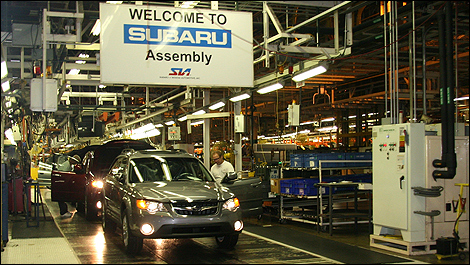
OM in the News: Subaru–America’s Leanest and Greenest Auto Plant

Our OM in Action box in Ch.6 (Managing Quality) highlights the  Lafayette, Indiana Subaru plant’s environmental leadership as it relates to ISO 14001. A good article about the same plant to reference when lecturing about lean (Ch.16) and green appears in the latest Businessweek (June 6-12, 2011). Here are a few facts about Subaru, which is perhaps the leanest car plant in the US: (1) in its 22 year history, Subaru-Indiana has rolled out 3 million cars and has never resorted to layoffs (this during a period that spanned 3 recessions  and the loss of 46,000 auto jobs in that state); (2) it has given workers a wage increase every year of operation; (3) it provides premium-free health care, lots of overtime (averaging $15,000 last year), financial counseling, and the ability to earn a Purdue U. degree on-site.

But whereas Toyota made kaizen famous, Subaru has created green kaizen. Going back almost a decade, Subaru decided to become the nation’s 1st zero-landfill car factory. It recycles  98% of the plant’s waste and incinerates the other 2% in an operation that sells power back to the grid. The plant abounds with well-reused parts containers. In 2010, Subaru saved $5.3 million by obsessively reducing, recycling, composting , and incinerating–and saved multiples of that using employee-sponsored ideas to reduce injuries and fatigue. The workers can get bonuses (up to a new car) for pointing out excess packaging and processes that can be cut from the assembly line.

To score a cherished “associate” position  at the factory, would-be employees are expected to put in long hours mastering Subaru’s low-impact manufacturing. They learn to scrutinize every byproduct for savings and to look for ways to slice seconds off the assembly process. The jobs pay $14 (starting) up to $25 (peak)/ hour, yielding a salary of $50-60,000 including mandatory overtime.

Discussion questions:

1. What happens when the plant needs to slow down (say from parts shortages)?

2. How does Subaru get such worker commitment that the UAW has failed 3 times to unionize the plant?