OM in the News: Japan’s Manufacturing Crisis

Hiroya Kawasaki, CEO of Kobe Steel, bowed as he left a news conference in Tokyo

Japan’s reputation for flawless manufacturing quality and efficiency transformed the country’s postwar economy, changed business practices world-wide and spawned a library’s worth of management manuals and business advice books. “Now, the model is cracking,” writes The Wall Street Journal (Feb. 5, 2018).

Kobe Steel, Mitsubishi Materials, and Subaru have all just admitted to manipulating quality inspections. Takata declared bankruptcy last year after supplying 50 million defective vehicle air bags in the U.S. Mitsubishi Motors has admitted covering up vehicle faults and falsifying fuel-economy data. Nissan says its Japanese factories let unqualified employees perform final quality inspections. Indeed, Japanese brands have been bested by U.S. car makers in the past 2 years.

The scandals call into question one of the world’s most influential theories of management and manufacturing. Japan’s model, celebrated in publications such as HBR, hinges largely on the concept of kaizen, or “continuous improvement.” Kaizen means eliminating unnecessary activity, reducing excess inventory and using teamwork to fix problems when they arise. It also places enormous responsibility on the line workers (called genba) at the factory-floor level to manage daily operations and generate innovation. The genba have traditionally been guaranteed jobs for life in return for dedication. But many Japanese companies can no longer afford the luxury of  lifetime employment for factory craftsmen.

At Kobe Steel, quality-checking staffers became the first targets of layoffs because they didn’t appear as busy as production-line workers. Line workers were told to make quality checks themselves, and some checks were outsourced after the company suspended hiring. Workers involved in data falsification felt they had no choice because they needed to keep production moving.

(Japan, nonetheless, remains a manufacturing powerhouse, ranking 3rd in manufacturing output, behind China and the U.S. and just ahead of Germany).

Classroom discussion questions:

  1. Explain the concept of kaizen.
  2. Why is the Japanese system facing a crisis?


OM in the News: Dr Pepper’s Move to Kaizen

dr pepperAt its Plano, Texas, HQ and in manufacturing plants in the U.S. and Mexico, Dr Pepper’s mantra is RCI, or rapid continuous improvement (although some executives there use the Japanese word for improvement, kaizen). At “kaizen events,” teams of Dr Pepper employees spend several days dissecting every step of their work flow in search of waste.

Here are some details, based on a Wall Street Journal (Feb. 22, 2016) interview with Dr. Pepper’s CFO: “We’ve done 575 kaizen events. RCI is about taking the existing baseline and improving it by finding the waste. It starts with walking the entire process. We call it “going to gemba.” The goal is always to shorten cycle times. You would be surprised. You put a bunch of people in a room to describe how a process works, and they don’t all agree with each other—and they all work on the same process.

We have 32 people in the RCI group. They aren’t there to make improvements themselves but to facilitate teams. We’ve issued 6,500 certificates for participating in kaizen events. Through a number of projects, we improved inventory turnover by 35%, or 1.5 million square feet. We’ve also learned how to create flexibility, including setup reduction in our fountain-syrup line. Sanitizing lines to take the next flavor used to take an average of 32 minutes. We figured out we could do it in 13. Some of the changes are as simple as: He walked from the machine to get a tool. Why is the tool not at the machine?

We walk by waste every day. A team watched the process of fountain-syrup bags being assembled and packed into the cardboard boxes used to ship the bags. Somebody asked, “Why does that box have the maroon Dr Pepper logo on it when the box isn’t a consumer package?” You call on the box supplier and ask, if we took that off, how much could we save a year? They said $60,000, and we said great.”

Classroom discussion questions:

  1. What is RCI and why is it important?
  2. Explain the concept of inventory turnover (see Ch.11).

OM in the News: Kaizen at San Francisco General Hospital

Kaizen team leader at SF General Hospital

At San Francisco General Hospital, clinicians, executives and staff are peppering their conversations with Japanese words like kaizen and muda.  This “Toyota Way”, writes the San Francisco Chronicle (Oct. 14, 2013),  is an effort to infuse the Japanese automaker’s management philosophy and practices into the way the hospital delivers medicine to its patients.

To make the system work, a team of employees is assigned to analyze a particular area targeted for improvement. The group immerses itself in a weeklong, hands-on session, and emerges with a plan to make specific changes designed to have a big impact on costs or the patient’s experience. One recent kaizen focused on the number of minutes it takes from the moment a patient is wheeled into the operating room to when the first incision is made. A team spent a week trying to come up with ways to whittle 10 minutes off the hospital’s average “wheels in” to incision time of 40 minutes. Another targeted the Urgent Care Center and dropped the average wait from 5 hours down to 2.5 by adding an on-site X-ray machine–instead of forcing patients to endure a 15 min. walk to the main radiology department.

Toyota’s production system has been increasingly adopted by hospitals trying to improve medical quality and increase patient satisfaction. Here are some of its Japanese terms, many of which do not have a direct English translation: Gemba: the place where work is performed. Hansei: a period of critical self reflection. Heijunka: a level production schedule that provides balance and smooths day-to-day variation. Jidoka: using both human intelligence and technology to stop a process at the first sign of a potential problem. Kaizen: continuous improvement. Kanban: a visual card or signal used to trigger the fulfillment of need, such as restocking supplies. Muda: anything that consumes resources but provides no value. Poke-yoke: a mistake-proofing device that prevents errors.

(Ironically, the day before this flattering article about quality appeared, NBC News reported that SF General  lost a 57-year old female patient for 2 weeks–she was just found dead in a hospital stairway.)

Classroom discussion questions:

1. Why are hospitals adopting the “Toyota Way”?

2. Which of the many Japanese terms above could have prevented the lost patient?

OM in the News: Eiji Toyoda’s Death at Age 100

Eiji  Toyoda at NUMMI California plant in 1985
Eiji Toyoda at NUMMI California plant in 1985

Eiji Toyoda, a member of Toyota Motor’s founding family and architect of its “lean manufacturing” method that helped turn the automaker into a global powerhouse, died this week in Toyota City, at age 100. “Toyoda,” writes The New York Times (Sept. 18, 2013), “changed the face of modern manufacturing.”

Toyoda is said to have developed an uncanny ability to spot waste. “Problems are rolling all around in front of your eyes,” Mr. Toyoda once said. “Whether you pick them up and treat them as problems is a matter of habit. If you have the habit, then you can do whatever you have a mind to.”

In 1950, he set out on a 3-month tour to survey Ford’s plant in Detroit, then the largest and most efficient factory in the world. That year, Toyota had produced just 2,685 automobiles, compared with the 7,000 vehicles the Ford plant was rolling out in a single day. Mr. Toyoda was unfazed, bringing back a thick booklet that outlined some of Ford’s quality-control methods; the company translated it into Japanese, changing “Ford” to “Toyota” in all references.

Even as he aggressively expanded production at Toyota, Mr. Toyoda applied a manufacturing culture based on concepts like “kaizen,” a commitment to continuous improvements suggested by the workers themselves, and JIT production, a tireless effort to eliminate waste. Those ideas became a core part of what came to be called the Toyota Production System. “One of the features of the Japanese workers is that they use their brains as well as their hands,” he said in 1986. “Our workers provide 1.5 million suggestions a year, and 95% of them are put to practical use. There is an almost tangible concern for improvement in the air at Toyota.”

The methods Mr. Toyoda nurtured have had global influence, and Toyoda pushed expansion overseas, establishing the company’s joint factory with GM, called NUMMI. There he introduced his lean-production methods as part of a migration of Japanese auto manufacturing the US.

Classroom discussion questions:

1. Summarize the principles of TPS (see Ch.16).

2. What was Eiji Toyoda’s major contribution to manufacturing?

Good OM Reading: Health Care Kaizen

Paula’s husband had just come out of open-heart surgery. Laying in the recovery room with a breathing tube in his throat, he was clearly agitated. He motioned at his arms to try sign language, but the limbs would not move. Paula (a nurse at the hospital) began to panic along with him. When the anesthesia wore off, he said his hands and arms were numb–they remained so for weeks. It turns out that when surgeons performed the procedure, they had leaned over the  man and put pressure on his arms. With a single, small improvement, a nurse found that arm sled “positioners” could be used to tuck a patient’s limbs in place while removing the pressure.

This story is just one of 100’s in a new book called Health Care Kaizen, by Graban and Swartz, that describes small improvements made by those who do the work.  Kaizens are low-cost, low-risk process changes that can be easily implemented. The idea, say the authors, is to challenge and empower everyone in the organization to use their creative ideas to improve their daily work. And what better a place to see improvements than in our health care systems!

It is often said that “people hate change.” But in this readable book, we see that people actually love change when:  (1) they are fully engaged in the process, (2) they get to make improvements that help patients, and (3)  they don’t fear losing their jobs as a result of the changes. At one hospital, the CEO offered to shave his head if employees generated ideas that saved $3.5 million that year. The staff responded with $7 million in savings (such as $22,000 by switching from paper gowns to cloth ones) and the boss shaved in public.

At another, the neonatal ICU had automated paper towel dispensers. A nurse noticed babies flinching from the ongoing noise and decided to study the impact of what turned out to be a 50 decibel sound. The kaizen result was manual dispensers which allowed babies to get more rest, thereby gaining weight and getting home sooner–saving $2,000/day ICU fees.

Whether you teach health care OM or are looking for great examples of kaizen for class, this is a book worth reading.

OM in the News: Health Care Kaizens

Now, more than ever, hospitals are being expected to do more with less.  That’s where lean methodologies come in, says Healthcare Technologies Online (May 2, 2012).   Lean methodologies, as we discuss in Chapter 16, are geared toward continuous process improvement, and there are two predominant lean schools of thought — Six Sigma and Kaizen.   Each takes a slightly different approach to achieving this outcome. Six Sigma incorporates more statistical analysis than Kaizen, focusing on eliminating defects so that a final product is as close to perfection as possible. Kaizen looks to improve all aspects of a business by standardizing processes and eliminating waste.

The Kaizen philosophy also strives to include every employee into the process improvement initiative.  Kaizen stresses that the real experts in any organization are the people who actually do the work each day, and these employees should be intimately involved in improving their own workflows. In healthcare, this could be a nurse in the emergency department, someone working in finance, a surgeon in the operating room, or an IT executive.

Each person has their own ideas for how their specific workflows could be more efficient. The idea of Kaizen is that a lot of little ideas evaluated and implemented at a local level can have a huge impact on an organization and can generally be implemented much more quickly and easily than a single million-dollar idea handed down from corporate. However, many employees don’t feel empowered to implement changes in their organizations, even if they are common sense solutions. Kaizen puts a structure in place that provides employees with this power.

Kaizen changes are often small, but when instituted in masse they can make a huge difference. For example,  Franciscan St. Francis Health of Indianapolis  estimates that its facility implemented nearly 4,000 Kaizen ideas last year that resulted in a multi-million dollar impact to the hospital’s bottom line.

Discussion questions:

1. Find and describe how another hospital has successfully implemented lean techniques.

2. Why don’t all hospitals embrace kaizen and six sigma tools?

OM in the News: Subaru–America’s Leanest and Greenest Auto Plant

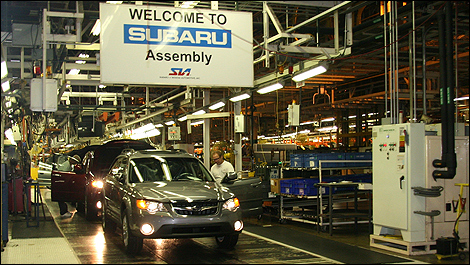
Our OM in Action box in Ch.6 (Managing Quality) highlights the  Lafayette, Indiana Subaru plant’s environmental leadership as it relates to ISO 14001. A good article about the same plant to reference when lecturing about lean (Ch.16) and green appears in the latest Businessweek (June 6-12, 2011). Here are a few facts about Subaru, which is perhaps the leanest car plant in the US: (1) in its 22 year history, Subaru-Indiana has rolled out 3 million cars and has never resorted to layoffs (this during a period that spanned 3 recessions  and the loss of 46,000 auto jobs in that state); (2) it has given workers a wage increase every year of operation; (3) it provides premium-free health care, lots of overtime (averaging $15,000 last year), financial counseling, and the ability to earn a Purdue U. degree on-site.

But whereas Toyota made kaizen famous, Subaru has created green kaizen. Going back almost a decade, Subaru decided to become the nation’s 1st zero-landfill car factory. It recycles  98% of the plant’s waste and incinerates the other 2% in an operation that sells power back to the grid. The plant abounds with well-reused parts containers. In 2010, Subaru saved $5.3 million by obsessively reducing, recycling, composting , and incinerating–and saved multiples of that using employee-sponsored ideas to reduce injuries and fatigue. The workers can get bonuses (up to a new car) for pointing out excess packaging and processes that can be cut from the assembly line.

To score a cherished “associate” position  at the factory, would-be employees are expected to put in long hours mastering Subaru’s low-impact manufacturing. They learn to scrutinize every byproduct for savings and to look for ways to slice seconds off the assembly process. The jobs pay $14 (starting) up to $25 (peak)/ hour, yielding a salary of $50-60,000 including mandatory overtime.

Discussion questions:

1. What happens when the plant needs to slow down (say from parts shortages)?

2. How does Subaru get such worker commitment that the UAW has failed 3 times to unionize the plant?