

“Artificial intelligence is going to replace literally half of all white-collar workers in the U.S.,” said Ford’s CEO Jim Farley, in the latest in a succession of executives warning of large-scale job cuts from AI.
Such claims can be pretty convincing—and unsettling. Large-scale AI-related workforce reductions to date, however, are almost exclusively limited to AI-aligned companies like Meta and Google, writes Industry Week (Aug. 7, 2025).


AI-first companies may be willing to shell out big money for AI “agents” that take the place of human workers. A popular target is workflows that are standard across many companies, such as handling employee queries to accounting or HR. Such work, however, is not as straightforward as it may seem.
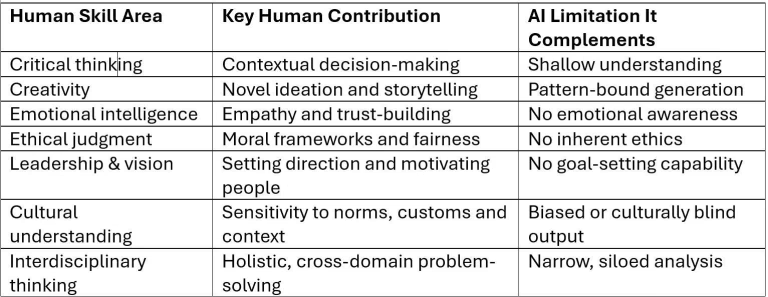
Nobel Laureate Daron Acemoglu predicts that over the next 10 years, only 5% of all tasks currently undertaken by humans will be profitably automated. He calls for a more human-centric approach. “That best possible way is a much more pro-human approach to AI that’s much more targeted at working with human decision-makers”.
Acemoglu’s findings are consistent with what lean leaders have been saying for decades. Uniquely human capabilities are essential to continuous improvement and central to lean’s most important pillar—respect for people.
Toyota’s approach to technology has been to articulate the need to improve the process and then, before evaluating automation solutions, investigate ways of meeting that need by simplifying the process (e.g., removing unnecessary steps). Taking this step avoids the common mistake of automating waste and leads to more effective and durable technology solutions.

Classroom discussion questions:
- How does Toyota’s approach tie with AI use?
- How can Chat GPT impact manufacturing work?