OM in the News: AI, Lean Cultures and Toyota

“Artificial intelligence is going to replace literally half of all white-collar workers in the U.S.,” said Ford’s CEO Jim Farley, in the latest in a succession of executives warning of large-scale job cuts from AI.

Such claims can be pretty convincing—and unsettling.  Large-scale AI-related workforce reductions to date, however, are almost exclusively limited to AI-aligned companies like Meta and Google, writes Industry Week (Aug. 7, 2025).

That said, it’s undeniable that tools like ChatGPT are already having a profound influence on the future of OM work. And the bar keeps raising as AI platform providers release more powerful versions. (ChatGPT currently has around 700 million weekly users).

AI-first companies may be willing to shell out big money for AI “agents” that take the place of human workers. A popular target is workflows that are standard across many companies, such as handling employee queries to accounting or HR. Such work, however, is not as straightforward as it may seem.

Nobel Laureate Daron Acemoglu  predicts that over the next 10 years, only 5% of all tasks currently undertaken by humans will be profitably automated. He calls for a more human-centric approach. “That best possible way is a much more pro-human approach to AI that’s much more targeted at working with human decision-makers”.

Acemoglu’s findings are consistent with what lean leaders have been saying for decades. Uniquely human capabilities are essential to continuous improvement and central to lean’s most important pillar—respect for people.

Toyota’s approach to technology has been to articulate the need to improve the process and then, before evaluating automation solutions, investigate ways of meeting that need by simplifying the process (e.g., removing unnecessary steps). Taking this step avoids the common mistake of automating waste and leads to more effective and durable technology solutions.
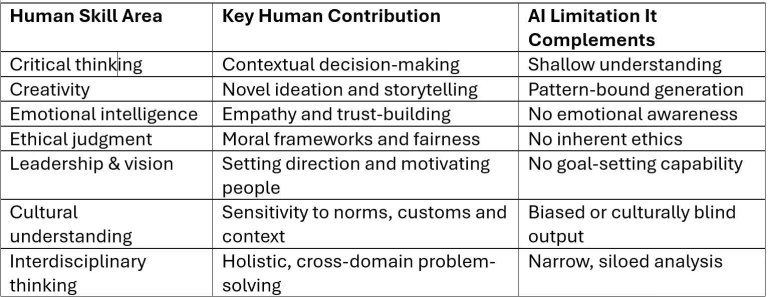
A key point here is that continuous improvement is a holistic undertaking that seeks to reduce costs and increase value. This is starkly opposed to the common preoccupation with cost cutting, and the use of AI as primarily a vehicle for reducing headcount. The human skill areas in the left column of the above table, however, are not widely recognized or developed in most organizations, and a culture that supports them takes years to build. Lean organizations, accordingly, place considerable emphasis on developing and nurturing skills such as listening, collaborating, problem solving, following a vision and mentoring.

Classroom discussion questions:

  1. How does Toyota’s approach tie with AI use?
  2. How can Chat GPT impact manufacturing work?

OM Podcast #22: Continuous Process Improvement and Lean at Pearson Education

We are gearing back up for the fall semester with some new podcasts!  In this most recent podcast Barry Render interviews John Beakes, Senior Director of Continuous Process Improvement at Pearson, the publisher of our Heizer/Render/Munson textbook.  Barry and John discuss the importance of Lean and continuous process improvement at Pearson and in other industries John has worked in.


Did you know our podcast is now available on Apple podcasts? Just go to your Apple podcasts app, search “Heizer Render OM Podcast,” and subscribe to get all our podcasts on your mobile device as soon as they come out!

Transcript

A Word document of this podcast will download by clicking the word Transcript above.

Instructors, assignable auto-graded exercises using this podcast are available in MyLab OM. See our earlier blog post with a recording of author and user Chuck Munson to learn how to find these, or contact your Pearson rep to learn more! https://www.pearson.com/en-us/help-and-support/contact-us/find-a-rep.html

OM in the News: CVS Aims to Make Inventories Leaner

CVS Health is restructuring its distribution network, reports The Wall Street Journal (Aug. 7, 2024), as the pharmacy chain seeks to speed up the flow of goods to its stores and online customers. It has closed 3 of 33 warehouses, automated one of its largest distribution centers and is opening a building dedicated to bulky items this fall, part of a multimillion-dollar plan to upgrade its supply chain to cut costs and improve profit margins.

The chain’s efforts in distribution operations that handle goods from general merchandise to pharmaceuticals are meant to” (1) help restock its stores faster and (2) free workers to help customers in stores and fill online orders for pickup and delivery.

CVS operates more than 9,000 retail locations nationwide, and 85% of the U.S. population lives within 10 miles of a store. The company wants to use that proximity to shoppers to its advantage. CVS has been squeezed by rising drug costs and lower foot traffic while sales of Covid vaccines and test kits have waned.

CVS joins other retailers, including Target, Walmart and Walgreens, that have focused on fulfilling more online orders from stores to speed up shipments, streamline inventory and make more use of bricks-and-mortar sites. It recently spent millions of dollars to automate a 1.2 million-square-foot warehouse in N.J. serving stores in the Northeast.

The automated storage and retrieval system there brings items bound for stores directly to workers, who no longer must walk warehouse aisles to retrieve merchandise. Workers then hand the products to an automated system that sorts items into bins based on destination.

CVS previously would send half-empty bins to stores throughout the day, taking up space in stores as well as workers’ time as they unpacked multiple shipments. The company now waits until bins are full and then groups them by store. The change has reduced bins it ships containing beauty products by 42%.

The tactic has also trimmed the time it takes to replenish a store down to a single day rather than several days. Moving merchandise faster allowed CVS to cut $2.5 billion worth of inventory since 2022. CVS plans to double the size and volume of the new warehouse system next year and roll the technology out across other warehouses.

Classroom discussion questions:

  1. Why is CVS trying to become “leaner”?
  2. What is the goal of the new automated warehouse in N.J.?

Guest Post: Coronavirus and the Basic Rules of Lean

Today’s Guest Post comes from Dr. Jeff Heyl, at Lincoln University in Christchurch, NZ. He is currently Associate Academic Dean and Director of the Centre for Lean Education and Research.

As the coronavirus crisis has developed, one key element of the response planning is accurate measurement of any infection. Unreliable measures meant that public health labs could not perform the disease surveillance required to predict and minimize harm before the virus became widely established. The impact has been magnified by the inability to rapidly expand the availability of testing. Yet developing tests for viral infections is a well-understood process. Within one week of the release of the genetic sequence of the virus, tests were successfully being administered in many countries. But the early test released in the US were flawed. What happened?

It seems the problem was a very basic manufacturing error. The CDC was charged with creating the initial test kits. They had considerable experience in this and placed well-qualified people in charge of the project. They also chose to manufacture the kits, and this is where the real problem arose. 

The CDC failed to follow common laboratory protocols and procedures, which resulted in contamination of the components in the test kits. The test reported false positives at 24 of the 26 labs that received the early shipments. There should have been no confusion. The CDC had the protocols and procedures with complete documentation, but they were not followed.

The problem, however, started earlier during the design phase. A decision was made to include a 3rd component to the test, and this added complexity while not providing any useful information for the testing labs. It was intended to differentiate COVID-19 from other related viruses, but the genetic sequence of COIVD-19 is unique and the test was unnecessary. The CDC designed a product no customer needed or wanted.

So in a sense, it’s not surprising the test was fatally flawed. Two basic rules of lean were violated – customer focus and follow the rules. The failures may have resulted in higher rates of illnesses and fatalities. Most commercial failures don’t have such visible or tragic consequences, but their implications for firms implementing lean systems can be just as profound.

OM in the News: Lean Production and the New York Times


Many of the instructors following our OM blog are looking for interesting articles in the press that they can share with their students. I like this particular piece in the New York Times (Oct. 11, 2018) that provides several interesting examples of lean operations (the topic of Chapter 16). The article traces back to the roots of lean in the vaunted Toyota Production System developed in Japan in the late 1940s, which was aimed at streamlining processes to eliminate waste, improve productivity and, ultimately, grow profits.

Roughly 40 years later the term lean production was coined by John Krafcik, CEO of Waymo, the autonomous driving car company. Krafcik was part of a team led by the research scientist James Womack, who became founder of the Lean Enterprise Institute. The Institute’s approach, which differs in some ways, focuses on eliminating waste, rethinking work flow and improving productivity, from entry-level employees to high-level executives. “When we came up with the name lean production, what we meant was the complete system,” Dr. Womack said. “What the world heard was factories. But the frontier has been outside of the factory world for the last 20 years.”

Sometimes, seemingly tiny changes exemplify the lean approach. The president of Cambridge Engineering, a manufacturer of industrial heating and ventilation technologies said a new entry-level line employee, Justin Meade, realized he was wasting time each hour just to discard trash. Meade, who had little technical training, came up with the idea of attaching a trash can to a chair to cut 15 steps. Over the next 6 months he continued to make more revisions to devise an even better version. The result: shaving an estimated 70 minutes from a 90-minute job.

About 20 years ago, Toyota set up the T.P.S Support Center, a nonprofit that aims to help businesses and nonprofits, like the New York Food Bank. The beneficiaries need not be in Toyota’s supply chain. Instead, the company hopes to help smaller North American companies streamline their operations.

Classroom discussion questions:

  1. Provide examples of lean from the NYT article.
  2. What is the history of lean?


OM in the News: Tesla’s Lean Problems

A recent report in Industry Week (Sept. 12, 2018) suggests that Tesla, like a lot of facilities, has trouble being lean.  Here are a few observations from industry experts who visited the Fremont manufacturing plant.

From a Lean Enterprise Institute advisor: “High, leaning stacks of cardboard boxes and other items make it difficult to see. There was stuff piled up on the floor, and the stuff was dirty. There were fork lifts—I haven’t seen these in an assembly floor in a long time. Most of the AGVs  were empty. The aisles were narrow and crowded, and some of the stuff, piled up, was leaning into the aisle. Rear doors are on the Model 3 body going down the main assembly line, while the front doors aren’t.  In most of the plants I’ve been in, all four doors are off while it’s going through the main interior assembly so the workers can get better access, and the doors don’t get damaged.”

From the CEO of the Center for Automotive Research: “The low production numbers, with the number of workers and the size of the facility, indicates inefficiencies where the manufacturing team is doing a lot of manual work instead of optimizing the production process. The fact that the entire outdoor area—a collection of tents—is set up for rework says they’re having fundamental issues with quality.”

From a manufacturing technology consultant: “They first focused very much on high levels of robotics and automation, only to realize how difficult it was, and now they’re scaling back. So they wasted time ramping up and going back so they could get to the levels of automation that they thought they could. It’s very likely that someone with real, deep manufacturing experience could have realized it early enough.”

Classroom discussion questions:

  1. Why do you think Tesla is facing such production problems?
  2. There have also been reports of multiple paint room fires and a higher than average number of safety incidents. How can OM help resolve such issues?


OM in the News: Business Students Find Real World Applications for OM Topics

dnaCrime-scene DNA is processed three weeks faster at a state forensic laboratory thanks to internship work by recent Washington State University graduate Kristina Hoffman, writes WSU News (Feb. 3, 2016). A forensic scientist with the Washington State Patrol, she applied “lean” business management practices that resulted in a 26% increase in productivity, $5,200 savings on overtime pay, and reduction in the average turnaround time for processing DNA samples from 93 days to 71.

“The importance and impact are immediately translatable to the public at large,” said the director of the WSU degree program. A DNA sample could help identify a serial criminal who would be arrested 3 weeks sooner, thus making communities safer. Alternately, if you were a suspect in jail awaiting DNA analysis, you time in jail would be shortened by 3 weeks,” she said.


For her internship, Hoffman sought to reduce the delay in DNA sample processing by applying the principles of lean management, the topic of Chapter 16, which systematically seeks to achieve small, incremental changes in processes in order to improve efficiency and quality. She enrolled in Lean Agility, one of the WSU professional science master’s courses. At the State Patrol, she incorporated lean principles into various aspects of the workflow, from DNA case assignment to sample analysis to sample result reporting.

In the Lean Agility class, adds our new coauthor, Chuck Munson at WSU, students learn how to minimize problems and maximize productivity. They use statistical and logical techniques to identify and deliver improvements in production and operations management.

Classroom discussion questions:

  1. Ask students for ideas as to how lean could be used in companies they know.
  2. What are some areas in which lean could be applied at your college?

OM in the News: Lean Experiences at the University of Dayton

daytonOM tactics to improve efficiency and work quality with roots on shop floors and assembly lines are paying dividends on the business side of serving students, writes the University of Dayton News (Dec.16, 2013). For example, using Lean Six Sigma activities, the bookstore reduced the number of new textbook returns by 5%, freeing staff to focus more on customers. Dining services consolidated salad prep and now is able to serve more locations. Other areas around campus have saved on printing costs by using reusable printer cartridges and consolidating printers and copiers. “Our students are at the heart of what we do. We want to relentlessly focus on improving their experiences,” says UD’s Finance VP.

“Lean Six Sigma is a never-ending process of improvement activities within an organization,” adds the director of UD’s School of Engineering’s Center for Competitive Change. “Through Lean Six Sigma activities, organizations adopt a philosophy of engaging employees and using data to solve problems. The entire focus is on customers. This can be used in our business operations.” There are more areas for improvement, he points out. “For example, how can we make better use of our time? Can we cut down on the number of forms we can use for hiring? Do we need 18 local access networks for computers systems? If we can use 2 people for a job, instead of 4, how do we better use the other 2 to be more productive in another area?”

The University rolled out the initiative in the bookstore, dining services and facilities management in July. It hopes to expand into 40 areas this semester and to reach a total of 200, with UD students working with each area. Through the projects and completion of the UD’s Six Sigma green belt class, they will earn their industry Six Sigma certification. The overall goal is a 10% improvement in the quality of delivering products and services to students.

Examples of lean in academic settings are not common, and this is one worth sharing with your students.

Classroom discussion questions:

1. What ideas do you have for improving processes on your campus?

2. Why aren’t lean concepts more widely applied on campus?

Video Tip: Lean Operations at a NYC Food Bank

metro world childThis summer, my older son, a senior majoring in OM at the University of Florida,  interned at a wonderful non-profit called Feeding Children Everywhere. This organization manufactures and provides free prepackaged soup meals to millions and millions of needy families in the US and abroad. One packet, when added to 2 quarts of boiling water, delivers a healthy (and tasty) meal to a family of 4. Using efficient operations and a legion of volunteers, the cost is only 75 cents per package.

So when I came across this wonderful 6 minute video (click below) of how lean production helped improve a food bank in NYC, I thought it would make a perfect introduction to the role of OM in a non-profit–one that might really interest your students when you are covering Chapter 16.

http://www.youtube.com/watch?v=EedMmMedj3M

To aid families more quickly, we see in the video that Toyota partnered with Metro World Child to help them serve meals to more New Yorkers who were impacted, and still suffering, from Superstorm Sandy. Using the principles of the Toyota Production System, we see how the number of meals delivered hourly has increased 18-fold, meal-assembly time has significantly decreased, and the number of volunteers needed is nearly half of what it used to be. Toyota has also pledged to donate another meal for each viewing of the video up till July 19, 2013. Thanks to an explosion of online views, there have been more than 1 million meals given out on the company’s tab to date.

OM in the News: Pink Slime and Lean Hospitals

The public is continually subjected to health-related scares, from food packaging to water bottles that contain BPA, a chemical that has been linked to cancer. The media also highlights food additives that are not really harmful, but just sound unappetizing, such as “pink slime” in ground beef and the use of dried insects to color beverages at Starbucks. Yet, according to The Reporter (May 10, 2012), our nation’s hospitals are the one place where people actually have the most reasons to be scared and to demand change.

Studies estimate that 100,000 Americans die each year from preventable medical errors and another 100,000 die as the result of hospital-acquired infections. This health-care safety problem can be tackled with the OM tools of lean and TQM. We see this in one of our text’s most popular video case studies, “The Culture of Quality at Arnold Palmer Hospital”– worth showing when teaching Chapter 6.

The good news is that a growing number of hospitals are dramatically reducing different types of preventable errors, including patient falls, bedsores, wrong-site surgeries and medication mistakes, using the principles of lean (Chapter 16).  Dr. Richard Shannon helped his Pittsburgh hospital achieve, in just 90 days, a 95 percent reduction in deaths caused by central-line-associated blood-stream infections–through improved teamwork and making sure the correct supplies are always readily available.  Because these improvements do not rely on expensive technology or years of specialized training, they can be replicated in any hospital.

A 2010 survey, however, shows the bad news–that most hospitals are not devoting time or resources to prevent central-line infections, which claim 30,000 lives annually. And these hospital-acquired infections cost the U.S. about $30 billion a year in unnecessary medical expenses.

Discussion questions:

1. What  OM tools in Chapter 6 can be applied to help prevent infections in hospitals?

2. After watching the video, what does Arnold Palmer Hospital do to maintain quality?

OM in the News: Hospitals Turn to Lean

 Hospitals, under increased pressure to cut costs and become more efficient as Medicare reduces reimbursement rates, are turning increasingly to lean healthcare, writes MedCity News (March 23, 2012). Quoting Mark Graban, author of Lean Hospitals: Improving Quality, Patient Safety and Employee Engagement, “the lean model is about empowering people to improve and making lots of little savings.”

One of the biggest expenses for hospitals that can be controlled are complications resulting from hospital acquired infections. Graban referenced one hospital that saved $8 million by reducing hospital acquired pressure ulcers. “The goal is to have every employee be a problem solver every day.” Graban added that it’s critical for upper management to create an atmosphere where staff at all levels feel that they can contribute and that their contribution is valued.

Small changes can make a significant difference. Just because something needs to be changed doesn’t necessarily mean it has to be a major undertaking. In many cases improvements that can make a difference are subtle differences. Graban recounts one instance in which a hospital had installed an electronic paper towel dispenser right down the hall from a neonatal intensive care unit and its noise caused some disruption. Some staff spoke with the maintenance team and explained why it was a problem and replaced it with a manual dispenser. “That becomes empowering where a hospital allows changes to be made without treating it as a bureaucratic process,” Graban said.

Ask patients. By taking the time to involve patients in the lean process, hospital staff could get insights that may not have occurred to them or get a better sense of their priorities.

Discussion questions:

1. Suggest some areas in which lean can be applied in a hospital setting?

2. What is the origin of lean production?

OM in the News: Iowa Hospitals Saving Millions With Lean Techniques

Though lean has been around for the past 3 decades in manufacturing,  its use in driving health-care performance improvement has been much more recent.  In fact, many of the lean specialists working at hospitals  have been hired from manufacturing companies in the past 6 years. They’re now applying skills once devoted to making factory floors more efficient to health-care challenges such as decreasing patients’ waiting time in ERs.

The Business Record (Feb. 24, 2012)  just  reported that in my home  State of Iowa (I was born in Dubuque), more than 70% of the 118 hospitals say they are now using lean techniques. This is up from 50% just 3 years ago. The Iowa Medical Society provides 73 separate detailed, and on-line, monthly quality measures based on reports from all of the state’s hospitals.

Iowa’s 2 major quality goals are to reduce hospital-acquired infections by 40% and reduce preventable readmissions by 20%. If these two goals were achieved nationwide, health care costs in the US would be reduced by $35 billion. Since the Congressional Budget Office (CBO) expects health-care spending to increase at a rate of 8%  per year between now and 2022, Medicare/Medicaid programs will double in the next decade to $1.8 trillion, or 7.3% of our nation’s total economic output.

Under the Patient Protection Act, hospitals’  medical reimbursement payments will be linked to their performance on such procedures as cardiac, surgical, and pneumonia care. “Health care is turning to lean to continue to stay in business,” says the CEO of  the Iowa Healthcare Collaborative. Currently, one of its biggest projects is an initiative to ensure operating room supplies are delivered to the right place at the right time, to minimize unnecessary movements of supplies.

You might want to show the Arnold Palmer Hospital video on JIT (see Ch.16) if you discuss this article with your class. It illustrates the many ways OM and lean are  critical to the future of hospitals.

Discussion questions:

1. Why is lean so important in the health-care system?

2. Name several areas in which lean can be applied in a hospital.

Video Tip: Lean Six-Sigma at Franciscan St. Elizabeth Hospital

I just came across a wonderful 5-minute video about lean six-sigma that Mark Graban mentioned in his blog–one of my favorites– about Lean Hospitals (see our Links We Like on the right side). The video is narrated by Brian Hudson, a  researcher at Franciscan St. Elizabeth Hospital.  Hudson was trying to improve the time it takes to get a patient with chest pain from “door” (arrival at the hospital) to “balloon” (insertion of a tube to unblock a clogged artery) down  from 114 minutes to the national standard of 90 minutes. A faster “door to balloon ” time often is the difference between life and death for a heart attack patient.

A year after Hudson started his research in 2007, using lean 6-sigma, he had been able to get his hospital’s average to 74 minutes. In 2009, Hudson suffered a heart attack, watching the clock in the emergency room the whole time with the same mental checklist he had developed for doctors. If you don’t show this video in class, watch it yourself–it may save your life!

OM in the News: Lean Operations and Hospital MRI Productivity

When we discuss how to build a lean organization in Chapter 16 (JIT and Lean Operations), we note that one of the many ways to improve productivity is to eliminate all but value added activities.  A new research study in the Journal of the American College of Radiology (Sept., 2011) reports on a German hospital that was able to almost double the percentage of patients receiving an MRI scan in 24 hours, increase scanner productivity by 1/3, and save $338,000 in its first year of implementing lean management techniques.

Long the lifeblood of corporate bosses, lean is only now beginning to filter down to health care. The authors, at the 1,200 bed University Hospital Giessen write: “Many health care organizations do not measure key parameters such as demand, capacity, patient access, process efficiency, and productivity. They are run like cottage industries of dedicated artisans. Among the consequences are underutilization of very expensive resources and long patient delays”.

They identified 33 “failure modes”, or process snags leading to waste,  and fixed the 14 most critical ones. Fixes included increasing staffing levels to keep personnel from being overloaded, eliminating redundant exams, and getting rid of superfluous documentation. This dropped radiology information systems time from 3 minutes/exam to under 1 minute. After launching the program, 1,000 additional exams  can be run per year. The mean cycle time also dropped (from 52 to 39 minutes), while throughput increased by 38%, and scanner productivity jumped 32%.

“Quality and cost are reconciled by process improvement”, they conclude. We would also note that lean is not just about laying off people  to save money. Here is a good class example about using lean to set the best staffing level and finding new ways to use and develop workers.

Discussion questions:

1. Identify other ways to improve hospital productivity with lean tools.

2. How was the hospital able to justify higher staffing costs?

OM in the News: Hospital ERs Turn to Lean Management

The Wall Street Journal (Aug.2, 2011) writes: “To speed patients through the system, emergency rooms are adopting lean-management principles pioneered by Toyota to increase efficiency, cut costs, and provide better service”. It’s certainly about time. Waiting times in ERs that can run into several hours have become a fact of life in the US. And while the number of ER  departments has dropped by 1/3 over the past 2 decades, the number of patients seeking care has gone up by 40%. To boot, there are fewer doctors doing primary-care even as more uninsured patients show up (who must, by law, be treated).

The lean production changes (see Ch.16) include: (1) streamlining the traditional methods of triaging, which means no longer providing a bed for non-critical patients,(2) staffing with less-costly nurse practitioners and PAs so ER doctors can avoid paperwork and focus on care, and (3) posting ER waiting times on-line , in waiting rooms, and even on highway billboards.

The 2 metrics ERs use to judge their efficiency are: LWBS (“leave without being seen”) and AWT (“average wait time”). The latest national LWBS number is 2.7%, up from 1.7% in the prior decade. (California is closer to 20%).  “We don’t want them to walk out the door for their own health, but it’s also not a good business model”, says one ER director. Revenue drops about $450,000 if even 1% of patients walk in a typical ER.

With lean changes, one Phoenix hospital chain (Banner Health) saw its LWBS drop from 8% in 2007 to 0.5%  this year, while volume increased 4%. At Ochsner Medical Center (New Orleans), AWT went from several hours down to 33 minutes, while the LWBS rate dropped from 15% to 1%. The process analysis tools we discuss in OM can indeed make a major difference in the quality of health care.

Discussion questions:

1. What tools in Ch.7 (Process Strategy) can be useful in reengineering in the ER?

2. What other JIT/Lean/TPS approaches discussed in Ch.16 can be employed in the ER?