
 Walk into almost any operations and supply chain meeting today and you’ll hear it:
“We should use AI for this.”
“Can we plug in an LLM?”
“Let’s add a copilot.”
Machine Learning Machine learning uses historical data to detect patterns, improve predictions and support decisions. In real-world operations, that includes:
- Demand forecasting
- Inventory optimization
- Predictive maintenance
- Quality and anomaly detection
LLM (Large Language Model) LLM refers to systems that can read and generate human-like text. It processes and generates language based on patterns learned from large datasets. It shows up:
- Summarizing supplier emails or RFQs
- Drafting customer responses
- Translating ERP data into plain language
LLMs don’t “know” a business unless connected to the firm’s data. Without that context, they can sound confident—but be wrong.
Copilots “Copilot” is one of the most overused—and misunderstood—terms. They are a layer that sits on top of a business system (ERP, CRM, email) to assist users in real time. It is useful for:
- Suggesting responses inside email
- Helping navigate ERP workflows
- Recommending next steps
A copilot doesn’t replace a system—it improves how people interact with it.
Agents Agents move from assisting to acting. They are systems that can take a goal and execute steps to achieve it.
Examples:
- Monitoring inventory
- Detecting shortages
- Reaching out to suppliers
- Proposing or initiating reorders
Most agent-based systems are still early. They require strong guardrails and tight integration to work reliably in production environments.
Embeddings (The Quiet Connectors) Embeddings convert a company’s data into a format AI systems can understand and search. That’s what allows AI to:
- Reference ERP data
- Search internal documents
- Provide context-aware responses
For operations students and faculty, the goal is not to become AI experts. It’s to understand the language well enough to ask better questions and identify where these tools can create real advantage.
 The shipping giant, which already deploys artificial intelligence in software development and other areas, is now looking to drive AI agents further into operations, including network planning and business processes. By 2028, FedEx expects to have AI integrated into more than half of its core operational workflows. FedEx is currently focused on setting up the underlying data and management foundation to oversee its AI bots.
 That said, it’s undeniable that tools like ChatGPT are already having a profound influence on the future of OM work. And the bar keeps raising as AI platform providers release more powerful versions. (ChatGPT currently has around 700 million weekly users).
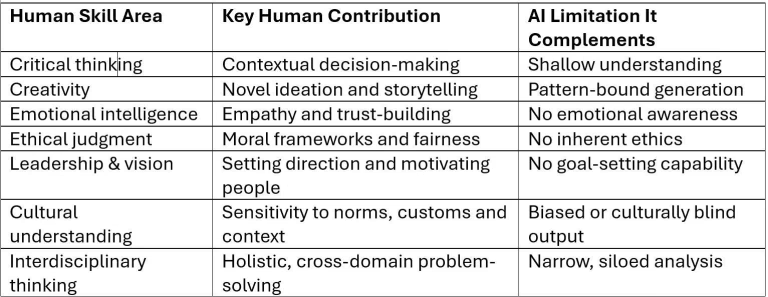 A key point here is that continuous improvement is a holistic undertaking that seeks to reduce costs and increase value. This is starkly opposed to the common preoccupation with cost cutting, and the use of AI as primarily a vehicle for reducing headcount. The human skill areas in the left column of the above table, however, are not widely recognized or developed in most organizations, and a culture that supports them takes years to build. Lean organizations, accordingly, place considerable emphasis on developing and nurturing skills such as listening, collaborating, problem solving, following a vision and mentoring.