Guest Post: Merging OM Tradition with Digital Innovation

Dr J. Prince Vijai is Assistant Professor of Operations Management at IBS Hyderabad, in India.

The transition from traditional OM to digital operations is not a replacement but an evolution. Digital tools enhance the classical OM framework by adding intelligence, speed and adaptability.

1. Process Optimization and Automation In classical OM, process optimization involved detailed mapping and iterative improvements. With digital operations, AI can now identify inefficiencies, simulate improvements and automate decision-making without human intervention. Siemens has integrated sensors, cloud platforms and AI to create a digital thread across product design, manufacturing and logistics resulting in a 20% reduction in production time and a 30% reduction in energy consumption.

2. Inventory and Supply Chain Management Traditional inventory models rely on forecasts and safety stock assumptions. Digital operations use real-time data from IoT sensors and machine learning to predict demand, monitor inventory levels and automate replenishment. For instance, Walmart uses AI and IoT to streamline its vast supply chain, reducing stockouts and improving shelf availability.

3. Forecasting and Scheduling Operations managers have long used statistical tools for forecasting. Digital operations use advanced analytics and machine learning to provide more accurate, dynamic forecasts. Real-time analytics enables organizations to quickly adapt to market changes, weather disruptions or supply chain breakdowns.

4. Quality Management Traditional quality management emphasizes inspection and control charts. Digital quality management integrates data from machines, sensors and customer feedback for continuous, real-time quality assurance. Predictive maintenance, enabled by digital twins and IoT, reduces downtime and improves asset reliability. For example, GE developed digital twins to monitor the performance of jet engines in real time, enabling predictive maintenance and reducing unexpected failures.

The shift to digital operations is not without challenges. Employees accustomed to traditional processes may resist adopting new technologies. Data from different departments or legacy systems can be siloed, limiting visibility and coordination. Implementing AI, IoT and automation involves significant expenses. And digital operations increase exposure to cyber risks.  

Future trends include:

  • Hyperautomation that combines  AI and machine learning to automate increasingly complex tasks.
  • Cognitive operations that use AI not just to automate but to learn and adapt continuously.
  • Edge computing that enables data processing closer to the source (e.g., in factories or stores) for faster insights.
  • Green operations that leverage digital tools to track carbon footprints and support sustainable practices.

Embracing the synergy between OM and digital operations is a strategic imperative for long-term success.
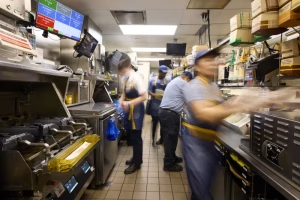
OM in the News: McDonald’s Gives Its Restaurants an AI Makeover

McDonald’s is giving its 43,000 restaurants a technology makeover, starting with internet-connected kitchen equipment, artificial intelligence-enabled drive-throughs and AI-powered tools for managers, reports The Wall Street Journal (March 5, 2025).

McDonald’s is introducing new technology in part to drive better experiences for its crews. “Our restaurants, frankly, can be very stressful,” said the CIO.

The goal? To drive better experiences for its customers and workers who today contend with issues ranging from broken machines to wrong orders. To accomplish that, McDonald’s tapped Google Cloud to bring more computing power to each of its restaurants—giving them the ability to process and analyze data on-site. The setup, known as edge computing, can be a faster, cheaper option than sending data to the cloud, especially in more far-flung locations with less reliable cloud connections.

McDonald’s is also exploring the use of computer vision (see Chapter 7), the form of AI behind facial recognition, in store-mounted cameras to determine whether orders are accurate before they’re handed to customers.

Additionally, the ability to tap edge computing will power voice AI at the drive-through. Edge computing will also help its restaurant managers oversee their in-store operations by creating a “generative AI virtual manager,” which handles administrative tasks such as shift scheduling on managers’ behalf.

AI will be able to help McDonald’s tailor its promotions and offers by using customer data such as prior purchasing history, and even linking it with weather data. “A customer who we know loves our sweet treats could get an offer through the app for a McFlurry on a hot summer day,” said the firm’s CIO.

Despite its first-mover advantage, McDonald’s will still face challenges including cost and the difficulty of rolling out the same technology across franchises and corporate-owned locations. But, compared with some of its quick-service restaurant peers, McDonald’s has been relatively aggressive at investing in new digital technologies. That, combined with the vast amount of data it has collected on its customers, gives the fast-food giant a leg up on figuring out how to improve customer loyalty.

Classroom discussion questions:

  1. What is “edge computing” and why is it a powerful tool for OM?
  2. Summarize the technology makeover being undertaken. Why is the firm going down this expensive path?

OM in the News: Using Machine Learning to Keep the Beer Flowing

Anheuser-Busch uses this sensor to pick up ultrasonic sounds coming off conveyor belt and motors.

The world’s largest beer maker is using low-cost sensors and machine learning to predict when motors at a Colorado brewery might malfunction, reports The Wall Street Journal (Jan. 24, 2019).  The Anheuser-Busch plant was the first among the company’s 350 beer facilities to test whether wireless sensors that can detect ultrasonic sounds—beyond the grasp of the human ear—can be analyzed to predict when machines need maintenance. “You can start hearing days in advance that something will go wrong, and you’ll know within hours when it’ll fail. It’s really, for us, very practical,” said the VP.

The installation at the brewery cost just $20,000. Since the system was deployed, it has predicted pending equipment failures and prevented unscheduled production-line halts, and more than $200,000 in product loss. (The Colorado plant employs 580 people and ships 225 truckloads of Budweiser, Bud Light and other beer brands each day).

Sensors have been used for predictive maintenance in the past, but they were unable to transmit information in real time. Advances in processing data at the edge of the network, referred to as edge computing, enable companies to collect and analyze real-time sensor data from machines. Machine learning refers to the subset of AI that allows computers to act “intelligently” without being explicitly programmed. Algorithms can increase the accuracy of predictions based on large amounts of historical and real-time sensor data.

Organizations that own wind turbines or jet engines are expected to save about $1 trillion a year as a result of predictive maintenance techniques. Sound-based predictive maintenance is becoming more important for companies, as there has been a wave of retirements among workers who were tasked with listening to machines to identify potential breakdowns. The price of internet-of-things sensors is expected to fall to 26 cents on average by 2024, from 46 cents in 2018.

Classroom discussion questions:

  1. What is predictive maintenance?
  2. How does this differ from “breakdown maintenance?”