Guest Post: From No Frills to Trendy Food, Fashion and Home, Walmart’s New Product Assortment 

Professor Misty Blessley, at Temple U., cohosts many of our podcasts, as well as sharing her insights with our readers monthly.

 Value retailer, Walmart, known for focusing on price-sensitive shoppers, has moved into premium products and broader brand assortments, with the goal of winning over customers with more buying power. Appealing to higher-income customers (those earning over $100,000), requires the firm to shift from a no-frills mindset. 

The firm remains committed to everyday-low-pricing (EDLP), thus it must continue managing this highly effective strategy while integrating broader lines. This requires a supply chain flexible enough to support both high-turn grocery and slower fashion and lifestyle products, for example. 

On the inbound supply chain side, Walmart diversifies its supply base to procure new products. As is outlined in Chapter 11 of your Heizer/Render/Munson book, this requires identifying, vetting and selecting new suppliers as well as a host of supply-side tasks like vendor and contract management. 

Managing inventory requires additional adaptations. Walmart refreshed the look of its website and stores while avoiding alienating its historical customers. It did so by keeping flagship items in stores and premium lines at distribution centers. Chapter 12 outlines inventory concerns Walmart faces, from the importance of inventory record accuracy to strategies for managing inventory. 

On the outbound side, the firm’s e-commerce and fulfillment operations must be capable of satisfying wealthier customers, who often expect faster, higher-service delivery options, such as same-day delivery or premium curbside pickup. Meeting these expectations puts pressure on Walmart’s fulfillment network for more micro-fulfillment centers and localized inventory pools to reduce delivery times. Facility, inventory, and transportation cost trade-offs are also covered in Chapter 11.

Walmart is an exemplar in omnichannel retailing because it seamlessly integrates its physical stores, online platforms, supply chain, and last-mile services into a unified customer experience. Its customers purchase and receive products when, where and how desired. Walmart is offering frills next to its no-frills strategy.

Classroom Discussion Questions:

  1. How would you call upon Ch. 11 and 12 as a Walmart supply chain manager? 
  2. Some firms target different customer segments under different brand names. For example, Gap Inc. owns Gap, Old Navy, Banana Republic and Athleta. Walmart has chosen a different strategy. How is Walmart capable of serving its price-sensitive and wealthier customers under one brand?
OM in the News: Walmart’s AI “Super Agents”

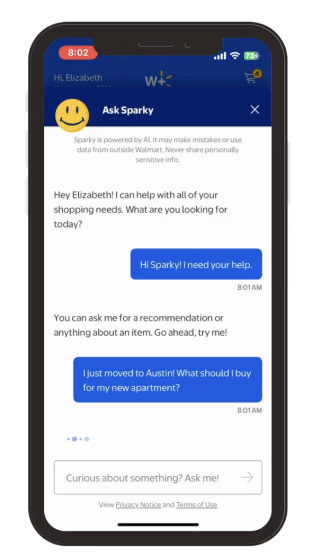
Walmart has developed an AI strategy in the creation of four “super agents” reports The Wall Street Journal (July 24, 2025). Agents refer to artificial intelligence tools that can independently take some action on behalf of a user. One is for customers, one is for employees, one is for engineers, and one is for sellers and suppliers. The super agent for each group will tap the capabilities of a number of behind-the-scenes agents, all in a single unified experience.

“Artificial intelligence is already changing how we work,” said Walmart’s CEO. “Learning and applying what we learn, as we build new tools, is the responsibility and an opportunity for all of us to improve experiences for our customers, members and fellow associates.”

The firm believes it is critical to stay ahead of the technology curve in an area like retail, where the top 10 retailers can change dramatically decade to decade. Its hope is that AI agents will help deliver top-line growth, as they give customers more personalized and enticing shopping experiences, as well as bottom-line savings, where they can help manage supply chains and inventory more efficiently.

Walmart’s situation is unique, with most companies still figuring out how to deploy even one AI-powered agent that can perform a task autonomously or in coordination with humans.

The four super agents are at different stages of development. The customer-facing super agent, Sparky, is already live. Marty, the supplier-facing super agent, launches in Fall and will include functions like checking the analytics on purchases and suggesting and putting into motion advertising campaigns. The employee and engineering super agents are expected in the next year.

Classroom discussion questions:

  1. Explain what an AI “agent” does.
  2. Why does the firm want to be a leader in AI technology and how is it implementing this goal?

OM in the News: Delivery Wars!

A decade ago, Walmart’s thousands of stores across the country made it look like a dinosaur in the online-shopping era, writes The Wall Street Journal (March 8-9, 2025). Now the retail giant is mounting one of the few serious challenges to Amazon’s dominance in e-commerce, and those very stores are central to its strategy.

Samantha Atkinson became a Spark driver last year to supplement her income. When Walmart workers load the car of a delivery driver, one order generally goes in the trunk, the second in the back seat and the third in the front passenger seat to prevent delivery errors.

Walmart delivered 5 billion items on the same day they were ordered last year, double the number delivered in 2023It can now deliver most of the 120,000 products in its supercenters, including meat, eggs and milk, to 93% of U.S. households the same day, sometimes in hours. “I am very, very grateful that we have 4,700 stores,” which now double as fast-delivery hubs, says Walmart’s CEO. To make most of those speedy deliveries, the retailer relies on thousands of freelance drivers using a system called Spark, created by Walmart, which uses an app to coordinate online orders. Tens of thousands of Spark drivers, who aren’t Walmart employees, make the majority of same-day deliveries.

About 41% of U.S. e-commerce sales go through Amazon, a much bigger share than Walmart’s 9%. But Walmart had $681 billion revenue in 2024 versus Amazon’s $638 billion. Over years of attempts, tests and failures, Walmart has carved out a niche that has Amazon working to catch up—fast delivery of online orders that often include inexpensive groceries, and increasingly other items it sells in its stores, such as clothing, batteries and prescription medicines.  Walmart gets more than 50% of its revenue from meat, eggs, lettuce and other groceries. It has used its scale to drive down prices for those items, which draw shoppers for regular trips.

Walmart’s same-day delivery coverage has stretched from 76% of U.S. households 2 years ago to 93% today.

Amazon also continues to expand rapidly. It has over 1,000 shipping facilities around the U.S., and more than 200 million people globally subscribe to its Prime membership. The similar Walmart+ offers free delivery for orders over $35.

But Amazon has struggled to dominate the fresh-food delivery business. It’s tried several models for delivery through Whole Foods and Amazon Fresh.

Classroom discussion questions:

  1. How does Walmart’s delivery service compare to Amazon’s?
  2. What is Walmart’s strategic advantage? Amazon’s?

OM in the News: The U.S. Made T-Shirt

The U.S. is awash in a sea of cheap imports that has destroyed much of the domestic apparel industry. In 2023, less than 4% of the apparel purchased in America was made here, reports The Wall Street Journal (Dec. 31, 2024).  Then, there is Walmart, whose aisles are piled high with goods this holiday season. But one item sticks out: cotton T-shirts that were made in America and cost $12.98.

The Walmart T-Shirt

It wasn’t tariffs that made the $12.98 shirt economically feasible, says the CEO of American Giant, the U.S. apparel company producing them. It was Walmart’s heft—and guaranteed orders. The country’s biggest retailer—and importer of consumer goods—pledged in 2013 to buy more items that were made, grown or assembled in the U.S. In 2021, Walmart increased its goal and promised to spend billions more each year through 2030.

American Giant said that without Walmart acting as a backstop by committing to buy a predetermined number of shirts over time, American Giant’s suppliers wouldn’t have had the confidence to make the investments in automation and other upgrades that drove down production costs. The company buys yarn that is grown, spun, dyed and sewn in the U.S., contracting with suppliers mainly in the Southeast. It also owns cutting and sewing facilities in N. Carolina and Los Angeles.

How did American Giant get the price down from the $40-$60 it usually charges for a T-Shirt? By automating parts of the process to keep labor costs low, it was able to compete with countries such as Vietnam and China where workers are paid a fraction of the U.S. minimum wage.

“You can make almost anything here, as long as it doesn’t require lots of labor,” says the CEO. To fulfill Walmart’s order for hundreds of thousands of shirts, the company tweaked the design and then spent $1 million on machinery designed to make production faster and more efficient.

The T-shirts arrived in 1,700 Walmart stores and were up against other 100% cotton T-shirts selling for half as much. But those shirts didn’t have any American emblems. Walmart bars suppliers from using the term “American Made” or the American flag on products that aren’t made in the U.S. Despite the success of American Giant and a handful of other apparel companies that have figured out how to produce domestically, it is unclear how much Americans care about buying products made in the U.S.

Classroom discussion questions:

  1. Could American Giant have reshored without Walmart?
  2. What are the key OM decisions that were made?

OM in the News: Ditching Self-Checkouts?

“Retailers Scale Back Self-Checkouts to Curb Irritation—and Theft” is The Wall Street Journal  (May 5, 2024) headline.  Self-checkout was introduced to reduce the cost needed to staff registers adequately, with companies such as CVS Health deploying them 20 years ago. With self-checkout, one worker can monitor and help shoppers at several registers.

Shoppers using self-checkout machines at a Kroger store in Louisville, Ky.

It seems that problems with technology are prompting companies including Target and Walmart to change operations or ditch the stations. Dollar General, Five Below, and grocery chain Schnucks, have limited how many items customers can bring to self-checkouts to avoid bottlenecks and alleviate headaches for staff. Walmart pulled self-checkout lanes from a handful of stores in recent months based on feedback from associates and customers.

While the primary intention is to improve customer service and checkout efficiency, companies expect some reduction of theft as well. Self-checkout accelerated during the pandemic, when human-to-human contact lessened. But self-checkouts have contributed to increased “shrink”—a Chapter 12 term used to describe losses from theft, lost inventory or damaged goods—because shoppers make mistakes or steal. Retailers, hesitant to spend more on staffing, are deciding if they prefer to reduce labor costs or combat shrink.

About a fifth of people who used self-checkouts said they accidentally took an item without paying for it, according to a survey of 2,000 shoppers last year. Some 15% of self-checkout users admitted to stealing an item on purpose. On social media, some users have posted videos of shoppers scanning a lower-price item instead of the higher-price item that should have been scanned.

“Shoplifting used to be mostly invisible,” said a trade group exec. “What we are seeing today are methods that are open and brazen.” Some Walmart stores are designating self-checkout lanes for Walmart+ customers, who pay a membership fee of $98 a year. Walmart added more self-checkouts to stores years ago but quickly found that they came with challenges including higher levels of theft and consumers’ fumbling with the technology. In response, it quietly disabled the weight sensors at self-checkout scanners because they triggered too many “wait for assistance” messages that annoyed shoppers and staff.

Classroom discussion questions:

  1. If theft is an issue, what can retailers do to minimize it?
  2. Do students prefer self-checkout? Why?

OM in the News: Walmart and “On-time, In-full” Shipments

This is the latest shift in a logistics effort that has historically left companies scrambling to meet the retail giant’s demands.

Walmart wants suppliers to deliver shipments on time 90% of the time and in full 95% of the time, down from a 98% benchmark for both measures set in 2020 amid a surge in consumer demand. The change marks a significant lowering of Walmart’s “on-time, in-full” (or OTIF) thresholds that are meant to increase the efficiency of Walmart’s sprawling U.S. logistics network of distribution centers serving the company’s thousands of stores.

Walmart has been working to get tighter control over its inventory as it fulfills more online orders from its stores and competes on home-delivery speed with e-commerce giant Amazon.com. Vendors that fall short of Walmart’s on-time, in-full targets face fines worth 3% of the cost of the goods that didn’t arrive on time or in full.

Walmart last shifted its thresholds in September 2020, when it tightened the requirements as supply-chain disruptions left many store shelves empty of high-demand products during the Covid-19 pandemic. The latest change comes as the retailer returns to more normal ordering patterns after years of struggling with sharp fluctuations in stocking levels during the pandemic. The greater equilibrium in supply chains has helped relieve pressure on suppliers.

Consumer packaged-goods vendors delivered an average of 84% of orders on time in 2023. Walmart’s lowered thresholds should be welcome news to vendors that have struggled to meet the 98% benchmarks. “Very, very rarely do things go perfectly as planned with deliveries. Trucks break down or get caught in traffic, and orders are sometimes packed with the wrong quantity and mix of items, such as orange-flavored soda instead of grapefruit,”  said one industry expert.

Classroom discussion questions:

  1. Why is Walmart changing its OTIF policy?
  2. How does impact suppliers?

OM in the News: JIT Makes a Retail Comeback

Retailers are reviving an old playbook to manage their inventory levels after four years of struggling to find the sweet spot of holding enough merchandise but not too much, reports The Wall Street Journal (Jan. 24, 2024). They have worked through the excess inventory that piled up on store shelves and in warehouses over the past 18 months, and are now focusing on replenishing items rather than stocking up on goods to have on hand in case of supply-chain disruptions.

The shift marks a return to the “just-in-time” inventory management strategy (our topic in Chapter 16) that many companies had employed before pandemic-driven product shortages and volatile shifts in consumer demand prompted a switch to a “just-in-case” stockpiling approach. Companies are now better able to predict shopper demand and feel they can hold leaner inventories amid moderating spending growth and fewer supply-chain disruptions. They prefer not to hold large inventories because the excess stock ties up capital, requires more space and people to manage it, and runs the risk of becoming outdated as trends change.

“Retailers have more confidence in the overall supply chain and the logistics network and the environment, and as a result, they’re saying we’re at a point now where we’re safe to go back to JIT,” says Ohio State U. Prof Terry Esper. The SCM head at Tailored Brands adds: “The ability to react to changes in demand means the company has no need for ‘safety stock’ inventory.”

Retailers such as Walmart have rolled out technology aimed at fixing forecasting tools that were broken during the pandemic as they seek to better understand what consumers are buying and more accurately predict demand. The technology is allowing merchants to have smaller, more accurate shipments than they have in the past. “We’re able to better predict lead times, we’re able to better execute review cycles, and as we do that better, we’re able to hit target inventory levels,” says Walmart’s VP for SCM.

Still, new supply-chain disruptions could prompt a different approach and bring in more excess stock. Recent attacks by Houthi rebels in Yemen on containerships have pushed companies to reroute shipments over longer distances to avoid the Suez Canal, and low water levels at the Panama Canal have slowed some deliveries.

Classroom discussion questions:
1. Why the return to JIT?
2. Will there be less volatility in supply chains from this point on?

OM in the News: Walmart’s Warehouse of the Future

Leland Geiger transitioned from unloading trucks manually to using an autonomous forklift

Walmart is in the process of automating or partially automating many of its hundred-plus U.S. warehouses in the coming years. The shift means Walmart can use fewer people to process more goods and make stocking shelves at stores more efficient. To keep their jobs, many of the company’s tens of thousands of warehouse workers need to retrain for new roles. Some will leave. Warehouses will also need to hire people with new skills, such as technicians.

Large companies such as Walmart and Amazon that rely on massive warehousing networks have worked for years to automate more of their supply chains to increase the volume of packages they can process and reduce labor costs, writes The Wall Street Journal (July 29, 2023). Because of Walmart’s scale, its plan to make automation standard in more of its supply chain is likely to affect how smaller competitors invest in their own facilities and what a U.S. warehouse job becomes.

“What this technology does for us is increases capacity, increases the accuracy of our loads, increases the speed of the supply chain and lowers cost,” said the VP of supply chain for Walmart. It is “also completely reshaping the way that our associates work within the distribution center.”

In Walmart’s Central Florida warehouse, as sections of robotic arms and screens are gradually installed across the more than 1millionsquare-foot facility, some of its 900 workers say they are skeptical about transitioning to new roles that require different skills. Transferring from unloading trucks manually to what Walmart calls an “automated cell operator” is easier physically but harder mentally.

Skepticism and fear of layoffs among workers are common when a warehouse first transitions to automation. Many workers are excited about a new challenge, but others leave. Employers automate, in part, to cut labor costs, so losing some workers during the process helps avoid the need for layoffs. At warehouses, managers are emphasizing that the new roles require less manual labor and offer more mental stimulation and potential longevity. Some of the jobs offer a pathway to higher-paying automation roles such as systems operators.

Classroom discussion questions:

  1. What are the advantages of an automated warehouse such as the one in Florida?
  2. Disadvantages?

OM Podcast #2: How Does Blockchain Work?

Welcome to our second Operations management podcast! Today, Jay Heizer and Barry Render delve into the topic of blockchain, which is a topic in Chapter 11, Supply Chain Management. We will talk about its cryptocurrency origins and the work of Gerber, Nestle, Unilever, Walmart, and IBM to create a blockchain system called Food Trust. We also discuss blockchain’s shortcomings and how both shipping giant Maersk and retail giant Walmart have had to cut back on their original goals dramatically.


Instructors, assignable auto-graded exercises using this podcast are available in MyLab OM.  Contact your Pearson rep to learn more!  https://www.pearson.com/us/contact-us/find-your-rep.html

See you every two weeks in our new podcast series. Next up, on April 24th, is a discussion about the formidable task of managing large projects, which ties into Chapter 3 of our OM text.

OM in the News: Retailers Tackle Cardboard Overload

The days of tiny online orders shipping to customers in oversized boxes are a step closer to becoming a thing of the past, writes The Wall Street Journal (April 4, 2023).

Big retailers are rolling out machines in their e-commerce distribution operations that make packages sized specifically to fit the items being shipped, potentially reining in some of the big volumes of cardboard generated as online shopping has grown.

Walmart is using machines from packaging-technology company Packsize that take dimensions needed to ship an item, then cut, crease and glue corrugated cardboard to make custom boxes. The machines then label and seal the packages.

Walmart said it has installed machines that churn out custom boxes at 12 of its fulfillment centers, and plans to add the technology to more. It has been able to cut down the amount of cardboard and filler material it uses per order by making individual boxes.

Amazon has also been increasing its use of made-to-fit packaging to ship items from books to shoes. It started using custom packaging in 2016 and is expanding its use of the technology.

Retailers traditionally have used boxes of set sizes to fill online orders, many of them not suited to the enormous array of products now available online. The push to deliver goods faster has also put a premium on speed in fulfillment centers, leading workers to stuff goods in the closest available boxes. But the speed and functionality of machines that make custom boxes has improved in recent years.

The accumulation of cardboard in households, trash heaps and recycling centers has been one visible result of the surge in online shopping in recent years. Each order has added to the boxes reaching Americans’ doorsteps, including containers that can be far bigger than the items inside.

Besides being better for the environment, the made-to-fit boxes can help companies cut shipping costs because the shipments take up less space in trucks and delivery vans.

Classroom discussion questions:

  1. How do companies benefit from better packaging?
  2. Are there other ways to improve packaging beside machines such as the one shown above?

OM in the News: Blockchain Fails to Gain Traction

Blockchain, the technology underpinning bitcoin and other cryptocurrencies, for years has been viewed by some companies as a way to drive industry-transforming projects, among them the tracking of assets through complex supply chains. So far, that hasn’t happened, writes The Wall Street Journal (Dec. 16, 2022).

We have followed the topic (Chapter 11, pages 451-2 in your Heizer/Render/Munson text) relentlessly, with 22 blogs over the past few years. To review them, enter “blockchain” in the search box on the right.

Maersk and IBM discontinued a blockchain-based program to track shipments

The latest effort to run aground was that of Maersk and IBM, which hoped to follow shipments via the blockchain. Another big effort, Walmart’s attempt to track groceries on the blockchain, continues, but very slowly.

“There’s not one company that has really shown, let’s say, a material change,” said Moody’s VP, of blockchain efforts in supply chains. It has been slow going or worse for big bets on blockchain for a number of reasons: the complexity of the technology, the time required to get a blockchain into operation and the difficulties in enlisting participants.

TradeLens, the Maersk- IBM blockchain platform, was launched in 2018 to help digitize container shipping on a secure global tracking platform. Had it worked, it would have been a game-changer, cutting down on paperwork to clear customs and offering cargo owners more visibility of their boxes during transit.

In 2018, Walmart partnered with IBM to start tracking its produce items through blockchain. The effort began with leafy greens, and in the four years since has added just one more item: green bell peppers. Walmart said it took time to get buy-in from suppliers who found the onboarding process daunting. Many didn’t have digital record-keeping systems and had to make large upfront investments before they could start using blockchain.

“There used to be a time, 4 years ago, every interview that I would get into, the question was about blockchain and how’s UPS going to use blockchain. Are you guys going to solve all the problems in the world with blockchain?” says a former UPS exec. “It’s been a long time since anyone has asked me about blockchain,” he added. “It never really took off in my world.”

Classroom discussion questions:

  1. Describe exactly how blockchain works.
  2. Why has blockchain faltered?


Video Tip: The Bullwhip Effect Hits Stores This Season

This could be the year of clearances and deals. Retailers have seen a surge of inventory as they found themselves carrying too much stuff that consumers no longer want so much of, including basic apparel, home appliances and furniture. says The Wall Street Journal (Oct. 5. 2022) in this 4 minute video (click here).

Ahead of last holiday season, retailers ordered with plenty of cushion in mind to prevent empty shelves. Now a bullwhip effect, which we discuss in Supplement 11, could be in store. The latest indication was from Kohl’s which reported that inventory rose 40% compared with a year earlier.  Walmart and Target saw inventory swell by 32% and 43%. Off-price retailers Burlington and Ross Stores indicated that they also saw closeout inventory start to skyrocket.

There are broadly two shifts going on that threw a wrench to retailers’ inventory planning. One is a shift from discretionary to essentials, which both Walmart and Target saw. And within discretionary spending, consumers are still spending, but getting pickier with their dollars. Kohl’s, Target and TJX Cos. all said sales in the home category have declined.

Spending instead is shifting to what shoppers need as they go back to the office, attend concerts and travel again such as dressier apparel, makeup and luggage. This isn’t an entirely surprising or alarming picture of consumer health, but low-income consumers clearly are feeling the pinch from inflation, which outpaced wage growth for 5 consecutive months. Walmart, for example, said some consumers are switching from gallons of milk to half gallons. They also are switching away from name brands to private label on categories such as deli and lunch meat.

Retailers with slower inventory turns—such as department stores and apparel sellers—might find current conditions especially difficult to navigate. On average, Macy’s  and Kohl’s sold and replaced inventory 3.88 times and 4.34 times, respectively, last year. By contrast, Walmart, Target and off-price retailer TJX all turn over inventory more than 6 times a year.

Retailers were on a high last year when everything—supply chain delays, low inventory, homebound customers and stimulus checks— conspired to feed their bottom lines. A comedown was inevitable.

Classroom discussion questions:

  1. Explain how and why the bullwhip effect takes place.
  2. Inventory turns are illustrated in Example 3 in Chapter 11 (see page 460). What do they mean and why are they an important measure of supply chain performance?

OM in the News: McDonald’s Un-Location Decision

Fewer people want to eat their meals at Walmart, writes The Wall Street Journal (April 10-11, 2021).  For years Walmart and large restaurant chains like McDonald’s enjoyed a mutually beneficial relationship. The retailer delivered a steady stream of diners, and the eateries provided rental profits and a reason for shoppers to stick around stores. Walmart and McDonald’s first started working together around 1994. At one time, Walmart allowed McDonald’s to be the exclusive restaurant when it was present in a store. 

But those bonds have frayed as more shopping goes online and fast-food restaurants depend more on drive-through windows for sales, a feature Walmart locations don’t have. The pandemic has made indoor dining unappealing—or prohibited—for many shoppers, accelerating the split.

mcdonald's

So McDonald’s is closing hundreds of restaurants located in the huge retailer’s stores, the last vestiges of a 30-year-old experiment between the companies. (At its peak, there were 1,000 McDonald’s restaurants inside Walmarts). The closures could pose a challenge for Walmart, which has long counted on revenue from restaurants leasing space inside its stores. That is different from some competitors such as Costco, which runs its own restaurant space selling inexpensive pizza and hotdogs. Retailers hope food service inside store walls draws shoppers to linger longer or give workers a place to eat while taking a break.

McDonald’s locations inside Walmart stores are generally less profitable than stand-alone restaurants, in part because they lack a drive-through, the main source of McDonald’s sales. And customers at times loaded up on refills and condiments, diluting margins. Even before the pandemic, Walmart shoppers increasingly preferred to shop and leave or buy online. Around a third of restaurant sales inside stores come from Walmart employees.

To compensate, Walmart plans to open more Domino’s, Taco Bell, Ben’s Soft Pretzels, and Ghost Kitchens Brands locations to fill the space.

Classroom discussion questions:

  1. Why is McDonald’s un-locating?
  2. Are there any downsides to replacing McDonald’s with chains like Domino’s or Pizza Hut?

OM in the News: Score One for Humans over Supply Chain Robots

Walmart has ended its effort to use roving robots in store aisles to keep track of its inventory, reversing a 5 year push to automate the task with the hulking machines after finding during the coronavirus pandemic that humans can help get similar results.

The retail giant has ended its contract with robotics company Bossa Nova Robotics, with which it joined to add 500 six-foot-tall inventory-scanning machines to stores. Walmart had hoped the technology could help reduce labor costs and increase sales by making sure products are kept in stock, reports The Wall Street Journal (Nov. 3, 2020).

A robot rolled through aisles at a Natrona Heights, Pa., Walmart

Walmart ended the partnership because it found different, sometimes simpler solutions that proved just as useful. As more shoppers flock to online delivery and pickup because of Covid-19 concerns, Walmart has more workers walking the aisles frequently to collect online orders, gleaning new data on inventory problems. It is pursuing ways to use those workers to monitor product amounts and locations, as well as other automation technology.

In addition, Walmart has concerns about how shoppers react to seeing a robot working in a store. It said earlier this year that the Bossa Nova robots would be in 1,000 of its 4,700 U.S. stores, bringing more automation to stores, characterizing the machines as robot “sidekicks” for store workers. (Bossa Nova laid off 50% of its staff after the contract with Walmart ended). Walmart does continue to use other robots in stores, such as floor scrubbers that move through aisles alone.

Classroom discussion questions:

  1. In Ch. 7, we discuss “Technology in Services.” Walmart discontinued the Bossa Nova model, but what technologies does it still depend on in its stores?
  2. What were the strengths and weaknesses of the Bossa Nova robots?

OM in the News: Walmart’s Grocery Robots

Walmart’s Alphabot machines are designed to up efficiency and cut labor costs.

In the backroom of a Walmart store in Salem, N.H., is a floor-to-ceiling robotic system that the retailer hopes will help it sell more groceries online. Workers stand on platforms in front of screens assembling online orders of milk, cereal and toilet paper from the hulking automated system. Wheeled robots carrying small baskets move along metal tracks to collect those items. They are bagged for pickup later by shoppers or delivery to homes.

Walmart is using automation to improve efficiency in a fast-growing but costly business that comes with a range of logistical challenges, reports The Wall Street Journal (Jan.9, 2020). The backroom robots help cut labor costs and fill orders faster and more accurately. They also unclog aisles that these days can get crowded with clerks picking products for online orders. Walmart can’t “disadvantage our most-profitable customer, which is the one who drives to the store and does all the work themselves,” said a company exec.

A store worker can collect around 80 products from store shelves an hour. The robotic system, called Alphabot, is designed to collect 800 products an hour per workstation, operated by a single individual. Workers stock the 24-foot-high machine each day with the products most often ordered online, including refrigerated and frozen foods.

Walmart has become an online grocery heavyweight by offering a service from thousands of stores that lets shoppers pick up online orders from store parking lots without leaving their cars. It also offers home grocery delivery from more than 1,000 stores. Online grocery sales are growing fast, but the logistical and profit challenges of filling shoppers’ orders and delivering fresh food to homes have retailers battling to find a model that pays off.

Using store workers to fill orders with products already on shelves isn’t only costly, it makes it hard to tell online shoppers exactly what’s available at any given moment. “The whole problem with picking inventory from the shelf is inventory is never where it’s supposed to be,” said an industry analyst.

Classroom discussion questions:

  1. What are the advantages and disadvantages of the Alphabot system?
  2.  Chapter 2 of your Heizer/Render/Munson text lists 3 approaches to achieving competitive advantage. Which one(s) does Walmart employ?