OM in the News: Aggregate Planning Using Seasonal Workers

Every year, hundreds of thousands of U.S. workers take on seasonal jobs during the holidays. This is one of the most popular aggregate planning strategies that firms use to deal with capacity, as is noted in Chapter 13 of your Heizer/Render/Munson text.

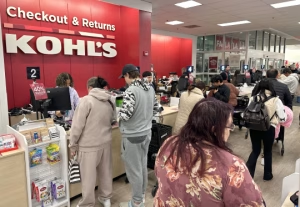
Holiday shoppers crowded a Kohl’s store in Wisconsin last year.

The retail and transportation-and-warehousing sectors typically rush to hire as they staff up for the holidays and let those workers go once the season is over. In the final three months of last year, the two sectors added 912,000 jobs. They then shed 858,000 jobs over January and February.

While the jobs are temporary, they provide an important source of income for low-wage workers, many of whom move from job to job over the rest of the year, writes The Wall Street Journal (Nov. 12, 2025).

This year, some of the companies that do the most holiday hiring have broken from their usual practice of advertising how many holiday workers they plan to hire. United Parcel Service, for example, said last year that it would hire 125,000 workers in its “holiday hiring spree.” This year, it hasn’t made an announcement. Also holding off: Macy’s, which said in 2024 that it would hire more than 31,500 seasonal workers, and Target, which said last year that it would add 100,000 seasonal jobs. (Both UPS and Target have laid off regular employees this year.)

Through October this year large companies have announced plans to hire 372,520 seasonal workers. That compares with 660,150 at the same point last year.

 But Portugalia Marketplace in Fall River, Mass., which nets about 30% of its annual business in November and December, calls for “all hands on deck”—as it wrote in a recent seasonal hiring posting for its warehouse that fills online orders. The grocer’s staff typically grows from 50 people to 60 near year-end as families shop for holiday groceries and the store hosts more events to attract visitors.

Classroom discussion questions:

  1. What other capacity options do firms have?
  2. Why is seasonal hiring slowing this year? Is it an AI issue?

Guest Post: Electronic Shelf Labels, Dynamic Pricing and OM

Prof. Howard Weiss shares his insights with us monthly.

Disney, sports arenas, hotels and airlines have been using dynamic pricing (see Chapter 13) to increase revenue for years. Now it has come to supermarkets and is being implemented using Electronic Shelf Labels (ESLs).

ESLs allow retailers to use a computer or other electronic device to change the displayed price of an item rather than having to go to the shelf, remove the old price display and put up the new display. They have been widely used in Europe and now are being installed and experimented with in U.S stores including Kroger, Schnucks, Walmart and Whole Foods. But supermarkets are not the only stores that could benefit from digital pricing. Each Best Buy store devotes an estimated 40 labor hours per week to change price tags. With over 1,000 Best Buys, this could save 2 million labor hours per year.

While for Disney and airlines the major advantage is to increase revenue, for supermarkets the major advantage is operational. Rather than having employees go up and down aisles to manually change prices, the prices can be changed much more quickly from a console. In theory, the price of an item could change while you are shopping, although most changes are more prone to be weekly.

Some stores stock over 100,000 items (called stock keeping units, or SKUs), so having to change prices on even 10% of the items would take a great deal of time if done manually. The reduction in time with ESLs obviously leads to more efficiency and productivity. Another savings is on the cost of the printed price tags themselves. Digital price tags can include information in addition to the price itself. For example, it can show the current inventory level of the item or shoppers could use an app to easily find products in a store.

There are downsides to ESLs. They cost money and a store would need to purchase one ESL for each SKU. Also, an error in the listed price this could have repercussions at checkout lines. Another concern is how long the battery in an ESL will last. Still, within the next few years, millions of customers will be seeing digital pricing.

Classroom discussion questions:
1. List the items you would want for a financial analysis of implementing ESLs. Would breakeven be appropriate?
2. Have you been in any stores with digital pricing?

Guest Post: The New Labor Landscape and the Gig Worker

Dr. Misty Blessley is Associate Professor of Statistics, Operations, and Data Science at Temple University.

Operations and supply chain managers are frequently faced with the need to vary the size of their workforce, a topic in the Aggregate Planning chapter (Ch. 13) in your Heizer/Render/Munson text. The need to do so can be for many reasons, but during the peak holiday season when companies typically add staff, managers needed to do the opposite in 2022. A challenging economic outlook meant layoffs for many light industrial workers holding jobs in product assembly, warehouse operations and order fulfillment.

According to the U.S. Bureau of Labor Statistics, about 13,000 warehouse jobs were cut last November. This might lead one to conclude that supply chain managers could have their pick from an abundance of qualified candidates. However, operations and supply chain workers are flexing their newfound ability to make choices about when, where, and how they work.

A recent article in Supply & Demand Chain Executive states: “We anticipate increased adoption of a more gig-like model as employers in manufacturing, logistics, fulfillment and supply chain seek to offer the types of things employees really want.” A more gig-like model means that employers use hourly workers based on current business needs, which is known as workforce-as-a-service. A person who accepts this type of work, as opposed to working as a company employee, is known as a gig worker. The shift from traditional employment models to a new labor landscape is occurring. This is because the COVID pandemic brought job flexibility that is here to stay, and it does not exclude work in light industrials.

If firms are going to attract the best gig workers, they need to understand what gig workers want. While some gig workers accept gigs, in addition to traditional employment, to combat the increasing cost of living, others rely exclusively on gigs. But both groups report that money isn’t everything. Workers want flexibility, to enjoy the work they perform and to advance their careers. As mentioned, last season many managers were faced with how to correct being overstaffed. Workforce-as-a-service as a means to varying workforce size, presents a new way of thinking for management.

Classroom discussion questions:
1. How can gig workers be incorporated into aggregate planning?
2. To which components of job design can gig work most likely appeal?

Guest Post: Aggregate Planning with Excel OM

Today’s Guest Post comes from Dr. Albena Ivanova, who is Professor of OM at Robert Morris University in Pennsylvania.

Excel OM software, which comes free with your Heizer/Render/Munson text, is an excellent tool for students to learn the various concepts of Operations Management. I have been using this software in conjunction with MyOMLab ever since I started teaching. I have found that using this software has not only made the homework completion process smoother but also helped students gain a better understanding of the course concepts.


The first thing that I do is show students how to arrange their tabs so they can have the two screens open at the same time next to each other. I usually pick algorithmic problems for class practice, where we are all working on the same problem, but with different numbers. I use the Study Plan for class practice and then give similar questions (but with different numbers) for homework and for the exam. My homework is not time limited, however, the students have only one (1) attempt. If they need to practice, they can do that in the Study Plan before completing the homework.


In the attached video I explain the process of using the Excel OM software to complete an Aggregate Problem homework in MyOMLab. The software has been slightly modified, and I have explained these modifications in detail in the video. I think that these small edits provide additional learning experience for the students, as they can see how to create or edit their own templates.


Overall, using Excel OM software has been a game-changer in my classroom. It has helped students better understand the course concepts. I hope my experience and the attached video will be helpful to fellow operations management professors in their efforts to enhance the learning of their students.

Guest Post: Seasonal Employees

Professor Howard Weiss shares his insights with our readers monthly. This topic is especially timely.

Chapter 13 in your Heizer/Render/Munson text, Aggregate Planning, discusses temporary workers as one strategy to use to adjust for changes in demand. This is a useful strategy when the size of the labor force is large. Thus, using seasonal workers is the appropriate strategy for UPS to follow– and it does. This year, beginning now in October and ending in January, UPS plans to hire over 100,000 employees to meet the December holiday demand when the volume of packages doubles. One benefit to the seasonal workers who are hired is that 35% of them will later be hired into full time positions as package handlers, delivery drivers, tractor-trailer drivers, and driver helpers.

Many other organizations also require seasonal workers. Retail stores clearly have the same seasonality as UPS. Spirit Halloween is a company that sells Halloween costumes, decorations, props, and animatronics and has over 1,400 stores open in September and October in all 50 states and in 9 provinces in Canada. Summer is a season rife with seasonal jobs. Philadelphia and many other cities hire seasonal workers for the summer for parks and recreation. Summer camps do the same, as do zoos. Barnes & Noble hires seasonal workers for the beginnings of semesters at universities. H&R Block hires seasonal workers in the winter for tax preparation. Seasonal fruit pickers are hired during harvest times. Landscapers hire workers seasonally.

Your textbook notes the downside of hiring seasonal employees is that “new employees need to be trained, and productivity drops temporarily.” In addition, the training may not be as complete as training for full time employees. The book further states that “layoffs or terminations lower the morale of all workers and also lead to lower productivity.” In addition, seasonal workers may be less committed and less loyal than full time employees.

Of course, there are several advantages to using seasonal workers, the most obvious of which is the flexibility it affords to handle increased seasonal demands and keep wages and benefits costs as low as possible since the seasonal employees are not full-time employees. In addition, if there is an issue with a seasonal employee, it is easier to dismiss the employee. Or on the optimistic side, if a seasonal worker is excellent he or she can be hired full time, as is the case with UPS.

Classroom discussion questions:
1. How else can seasonality of demand be approached?
2. What products/services not mentioned above require seasonal employees?

Good OM Reading: Enhancing Sales & Operations Planning with Integrated Business Planning (IBP)

As we note in Chapter 13, Sales & Operations Planning (S&OP) is a critical element in making aggregate planning work.  A recent report by McKinsey & Company advises that the unprecedented challenges created by Covid, the war in Ukraine, and what have become chronic supply chain issues, suggest that S&OP be replaced by a more encompassing approach. They call their approach Integrated Business Planning (IBP).

McKinsey’s more encompassing IBP approach consists of five essentials:
1. A business – focused design that covers the midterm time horizon (3 – 24 months) and enables strategy implementation and target achievement.
2. High-quality process management with cross-functional decision makers empowered to resolve issues immediately.
3. Accountability and performance management with shared metrics to encourage collaboration across stakeholders with set targets and clear direction to resolve the trade-offs among conflicting Key Performance Indicators.
4. Effective use of data, analytics, and technology so timely integrated information is available to optimize real-time decision making.
5. Specialized organizational roles and capabilities with specific process owners to promote functional excellence and cross-functional collaboration.

McKinsey’s research indicates that this more encompassing well-functioning IBP process, can yield one or two additional percentage points in EBIT and increased service levels, while lowering freight costs and capital intensity. Additionally, customer delivery penalties and missed sales are reduced, as well as making planners more productive.

Classroom discussion questions:
1. How does McKinsey’s IBP differ from the standard S&OP discussed in Chapter 13?

2. What are the organizational changes appropriate to move from a S&OP process to an IBP process?

Guest Post: Southwest’s Airplane Disruptions

Today’s guest Post comes from Prof. Howard Weiss, who upon returning from Europe, observed an aggregate planning problem.

From October 10 through October 12, 2021 Southwest canceled more than 2400 of its flights due to bad weather and air traffic control problems in Florida, reported The Wall Street Journal (Oct 21, 2021). Your Heizer/Render/Munson Aggregate Planning chapter (Ch. 13) discusses planning for the airline industry and more specifically about airlines that use hubs. But Southwest does not use hubs. Rather it operates a very complex spider web-like point-to-point route network, and thus a flight between two cities in California can be impacted by bad weather in Florida, for example. According to Southwest’s COO, “40% to 50% of the airlines’ planes flow through Florida nearly every day, and many crews change there. So when we have a disruption, a significant disruption, in Florida, it tends to spread to our entire network.” By Friday night, he said, the airline had “well over” 100 planes and crews “that weren’t where they were supposed to be.” 

Your textbook suggests that for successful Aggregate Planning there should be:

  1. Accurate scheduling of labor hours. 
  2. An on-call labor resource
  3. Flexibility of individual worker skills.
  4. Flexibility in output rate

These suggestions are difficult for any airline to follow but even more difficult for Southwest. Of course, the cancellations led to a large increase in the number of customers trying to reach Southwest and because telephone staffing did not increase this led to waits of several hours to reach customer service.

Classroom Discussion Questions

  1. What could Southwest do to appease customers whose flights were cancelled?
  2. How does Southwest’s on-time performance and cancellation rate compare to other airlines’ performance in general? 


Guest Post: Meeting the School Bus Driver Shortage During COVID

Prof. Howard Weiss shares his OM insights with us monthly.

Massachusetts has just announced that the Massachusetts National Guard has been activated to help with the state’s shortage of school bus drivers. Up to 250 members will be available to cities and towns.

The COVID crisis has left many school districts short of employees, including bus drivers. Obviously, getting students to their schools is critical. Chapter 13, the Aggregate Planning chapter in your Heizer/Render/Munson textbook, suggests 5 ways that capacity issues might be addressed.

  1. Use inventory.
  2. Vary the size of the workforce
  3. Use part-timers or overtime
  4. Use subcontractors
  5. Change prices to influence demand.

Massachusetts has come up with an ingenious combination of increasing the size of the work force and using subcontractors by using the National Guard. The major stumbling block is that the national guard members must be trained and licensed to drive school busses. Currently, 90 members have the proper license and the rest will be trained. For Massachusetts, the best part of this implementation is that the cost will be reimbursed by the federal government since it is a COVID-related issue.

Philadelphia has taken a different approach of reducing demand by using parents as part-timers. The school district will now pay families $300 a month ($3,000 for the school year) if they opt-out of transportation services.

Classroom discussion questions:

  1. What school districts or states currently have school bus driver shortages? Does your home school district have a shortage? 
  2. What other option does a school have if it is short of drivers? 


OM in the News: Scramble to Produce Covid Vaccine Derails Supply of other Drugs

The unprecedented effort to manufacture Covid-19 vaccines is disrupting supplies of other critical medicines in the U.S., including treatments for infectious diseases and injectable drugs that prevent blindness. Pfizer has told U.S. hospitals to expect interruptions to supplies of four of its products — an antibiotic, a steroid and two types of testosterone — according to The Financial Times (March 19, 2021). The drugs require some of the same ingredients and manufacturing capacity as the Covid-19 vaccine that Pfizer has co-developed.

covid

Pfizer warned of “short-term supply interruptions to medicines due to increased vaccine production” and stated that hospitals should “anticipate some disruptions” in the second half of the year. The company said that it aimed to deliver approximately 2 billion doses of its Covid vaccine globally by the end of 2021.

This comes as the U.S. tries to boost vaccine supplies in order to fully reopen its economy. The government has invoked the Defense Production Act to ensure that vaccine makers get the drugs and production capacity they need. But the use of that Korean war-era powers has left a third of pharmaceutical firms scrambling for ingredients, equipment or space on production lines.

Other groups involved in medicine production and distribution are also struggling. Schott, one of the world’s largest glassmakers, warned that there was a wait of 12- 18 months for new orders of glass vials. That shortage is affecting almost every type of injectable drug in the U.S., including chemotherapy, insulin and other medicines that are found in crash carts in ERs, ICUs, and surgical suites in hospitals.

Catalent, a contract manufacturer working for the vaccine makers Moderna and Johnson & Johnson, is also prioritizing large orders of injections over other treatments, meaning thousands of patients have had to do without Tepezza, a treatment for thyroid eye disease.

Classroom discussion questions:

  1. Chapter 13 of your Heizer/Render/Munson text lists 5 capacity options used as aggregate planning strategies. Which could Pfizer and others employ today?
  2. What are the advantages and disadvantages of each option you named?

Guest Post: Hiring Workers to Meet Demand

Our Guest Post today comes from Howard Weiss, Professor of Operations Management Emeritus at Temple University.

The city of Philadelphia is one of many cities that due to COVID-19 are experiencing increasing volumes of residential trash that needs to be collected, reports The Philadelphia Inquirer (Aug. 26, 2020). Because people have been spending more time at home there has been a dramatic increase of household trash. The problem is compounded by the fact that some of the trash collectors are not showing up for work because they have the virus, fear getting the virus or are self-quarantining because they have been exposed to someone who has the virus.

In Aggregate Planning, Chapter 13 in your Heizer/Render/Munson OM text, one option suggested is to hire workers as needed to meet the demand. This may be easier said than done. In July, the mayor of Philadelphia announced that between 120 and 150 workers would be hired into the Streets Department. The city maintains a list of 3,455 labor candidates but at the moment there are only 45 of these candidates employed for trash collection. Fifty-five have been hired but 10 have quit.

The Inquirer notes that “The city has faced challenges at every step of the hiring process. Issues include finding workers from the city’s existing list of laborer civil service candidates who are interested in taking the job, getting them to show up for and pass medical assessments, and then keeping them at work once they begin.”

Baltimore is using a different option of collecting trash but not recyclables. For recyclables, Baltimore is using a self-service option as discussed in Chapter 7 in which citizens are expected to take their recyclables to a drop-off center. Dallas is considering ending collections in alleyways because collecting on streets is more efficient in terms of labor.

Classroom discussion questions:
1. What other options do cities have to increase their trash collection?
2. What other resources are required if more trash collectors are hired?


OM in the News: Disneyland’s Dynamic Pricing Model

Disney’s theme parks in the U.S. can fill to capacity during certain times of year.

After raising some ticket prices for its theme parks by more than 20% over the past 5 years, Walt Disney will set a new benchmark when it offers die-hard fans the chance to attend a 6-hour preview of a new attraction at Disneyland — for $299. Even for fans used to high prices, the sneak peek at Pixar Pier breaks new ground.

The steep price stems in part from a perennial tension Disney faces at its theme parks, where public demand is so strong, reports The Wall Street Journal (June 19, 2018). Raising prices — currently around $100 on average days and more than $120 during “peak” times around holidays — could mitigate tourist appetite and increase profits. The company, however, is wary of appearing to gouge customers. Disney is working on adopting a dynamic pricing model similar to airlines, in which prices fluctuate depending on when a ticket is purchased. Disney already has introduced a limited version of dynamic pricing to its parks, charging a range of prices based on 3 categories of dates: “value,” “regular” and “peak.” Prices range from $97 to $135 for Disneyland.

Under the new changes, a ticket to Disneyland for Christmas Day, for example, may cost less if purchased on July 1 than on Dec. 24. This would encourage visitors to commit to a day to visit the park farther in advance, which allows parks to plan better. Disney parks often reach their limit during the summer tourism season and over Christmas break, when the parks sometimes have to turn away would-be customers for several hours.

New attractions at the parks help Disney to handle crowds, but they also draw more visitors. Disney’s “Avatar”-themed experience has drawn crowds that can cause waiting times for some rides to average 1-2 hours—and in some cases, stretch to 4 hours.

Classroom discussion questions:
1. How does Disney’s use of yield management differ from that of airlines?

2. How does Disney deal with capacity issues (see the 6 points on page 313)?


OM in the News: Revenue Management and “Hello, Dolly!”

Thanks to what’s known as revenue management or dynamic pricing, in which costs shift constantly to match demand, top ticket prices for hit shows on Broadway have hit previously unheard-of levels. (Annual Broadway ticket sales reached a record $1.45 billion this season).

Last month the top box-office price for “Hello, Dolly!” was $748. For the phenomenon “Hamilton,” it was $849. Online this week the top price for a performance of “Hello, Dolly!” at several ticket resellers was $1,450. “People have been whipped into a frenzy by the top prices,” said the president of the Disney, producer of the current, dynamically priced hit musicals “The Lion King” and “Aladdin.”

As more transactions shift to the internet, consumers are getting used to a world in which dynamic pricing is increasingly the norm, writes The New York Times (June 9, 2017). We have pretty much accepted it for airline fares; airlines pioneered the concept of revenue management years ago. It has since spread to hotel rooms, sporting events, concerts and designer clothing — and is likely to be used for just about any highly differentiated product where demand may at times far exceed supply. The dynamic pricing algorithm, a software tool that draws on data for millions of past audience members, recommends prices for several different types of performances — peak dates like Christmas, off-peak dates like a weeknight in February, and periods in between.

“At the most basic level, all pricing is about allocating scarce resources,” said the head of optimization sciences at Uber. Surge pricing is another form of dynamic pricing. “I’ve worked in theater, concerts and sports,” he said, “and they all have a similar problem: For extreme hits, demand at what people would consider a reasonable price far exceeds supply.”

Classroom discussion questions:

  1. Why is revenue management a critical OM tool at airlines and hotels?
  2.  How does the Orlando Magic use dynamic pricing? (Review the video case in Chapter 13).

OM in the News: Yield Management Enters the Magic Kingdom

Fireworks blasted from the top of Cinderella Castle as Walt Disney World in Florida celebrated the Disney Global 50th Anniversary.
Fireworks blasted from the top of Cinderella Castle as Walt Disney World in Florida celebrated its 50th Anniversary.

For the first time,” writes the Boston Globe (Feb. 29, 2016), “tickets to Walt Disney World in Florida and Disneyland in California will cost more during holidays and some weekends — up to 20% more — than during slower periods, as the bursting-at-the-seams parks seek to spread out demand.”  Here at Disney World in Orlando, Florida, which includes four major theme parks, the price changes are complex, and vary by park. At the most popular Disney World park, the Magic Kingdom, which handles 20 million visitors annually, single-day prices will remain at the current level, $105, for value periods. Prices will rise to $110 for regular periods, and to $124 for peak.

Overcrowding during holidays has become enough of a problem — endless lines for rides do not make for “the Happiest Place on Earth” — that Disney had little choice in moving to a demand-based ticket-pricing structure, analysts say. Demand-based pricing (which we call revenue or yield management in Chapter 13) is commonly used in the lodging and airline industries. It has also been adopted by other theme park operators in the U.S., including Universal Studios, which will unveil a major Harry Potter-themed expansion of its Los Angeles park next month. Movie theaters and sports teams are also experimenting with similar pricing efforts.

For Disney, the change will likely shift people visiting during mid-tier times into the quietest ones. During high-demand periods such as Christmas, it will generate more money but likely create no noticeable attendance drop-off.

Classroom discussion questions:

  1. Why is Disney introducing demand-based pricing?
  2. What professional sports teams are using yield management?

OM in the News: Yield Management Hits the Zoo

A ski resort in Michigan is among the businesses embracing dynamic pricing: Charging based on demand.

Adult passes to the Indianapolis Zoo used to cost $16.95. Now they set customers back $8 or $30—or almost anywhere in between. The zoo prices tickets like airfares, changing prices daily based on advance sales and expected demand. Since introducing such dynamic pricing last year, the zoo’s admission revenue has grown 12%.

Backed by vast amounts of data and powerful software, more businesses are varying prices by the day, the hour, or even the minute, writes The Wall Street Journal (Dec. 14, 2015). Frequent price changes are increasingly common in the physical world, amplifying the effects of supply and demand on everything from parking spots to golf course fees. A Dallas highway shifts toll prices every 5 minutes depending on traffic. Kohl’s uses electronic price tags in 1,200 stores to change prices for busy and slow times. More than 250 ski resorts in North America adjust the price of tickets daily.

Airlines pioneered more sophisticated dynamic pricing (called yield management) in the 1980s. Hotels and rental car firms followed in the 1990s. Coca-Cola tested raising its vending-machine prices on hot days in 1999 but retreated after customer backlash.

More recently, sports teams, bands and SeaWorld have begun adjusting prices based on demand. Uber and Lyft charge multiples higher from one moment to the next, based on the number of users looking for a ride and drivers on the road. Consumers typically resist dynamic pricing when it is introduced, but then quickly acclimate. Five years ago, Major League Baseball teams caught flak when they began changing ticket prices based on factors such as date, opponent, weather forecasts and seats remaining. Now pretty much every one of them is doing it routinely. Our video case study, Using Revenue Management to Set Orlando Magic Ticket Prices, provides a great in-class example.

Classroom discussion questions:

  1. What are the advantages and disadvantages of this approach?
  2. What is the impact of yield management to the Orlando Magic (see the Chapter 13 video)?

OM in the News: Revenue Management Puts Lion King at the Top of Broadway

Since 2011, the show’s producers have been relying on a previously undisclosed computer algorithm to recommend the highest ticket prices that audiences would be likely to pay for each of the 1,700 seats at every performance. While other shows also employ this dynamic pricing system to raise seat prices during tourist-heavy holiday weeks, only Disney has reached the level of sophistication achieved in the airline and hotel industries by continually using its algorithm to calibrate prices based on demand and ticket purchasing patterns.

By charging $10 more here, $20 more there, “The Lion King” stunned Broadway at year’s end as the No. 1 earner for the first time since 2003, bumping off the champ, “Wicked.” And Disney even managed to do it by charging half as much for top tickets as some rivals. “Credit the management science experts at Disney’s corporate offices — a data army that no Broadway producer could ever match — for helping develop the winning formula,” writes The Times. The algorithm, a software tool that draws on “Lion King” data for 11.5 million audience members so far, recommends prices for five different types of performances — peak dates like Christmas, off-peak dates like a weeknight in February, and periods in between. “The Lion King” is widely believed to be selling far more seats for $227 than most Broadway shows sell at their top rates, a situation that bolsters its grosses.

Our newest video case study, “Using Revenue Management to Set Orlando Magic Ticket Prices,” in Chapter 13, makes a similar point for the sports industry, which has also traditionally lagged behind airlines, hotels, and rental car companies in profiting from yield management.

Classroom discussion questions:
1. Why is revenue (or yield) management a critical OM tool at airlines and hotels?

2. Why don’t more sports and entertainment organizations use this tool?