
For years, automation has been promoted as the future of warehouse operations. Walmart’s ongoing multibillion-dollar effort to automate its supply chain demonstrates both the promise and the reality of large-scale operational transformation. Walmart relies on over 140,000 warehouse workers to keep goods moving. It isn’t an easy job. A worker might walk 20,000 steps a shift.
The retailer is modernizing a network that supports more than 5,000 U.S. stores while attempting to keep nearly 200 supply chain facilities operating, reports The Wall Street Journal (Oct. 9, 2026). What sounds like a straightforward technology upgrade has turned into a decade-long lesson in OM.
 Warehouse processes that seem simple to humans are often extraordinarily difficult to automate. Tasks such as removing products from cartons, sorting individual items, building store-ready pallets, and handling irregularly sized products require flexibility that robots still struggle to replicate consistently.
Walmart has invested heavily in automated storage systems, robotic arms, autonomous mobile robots, and advanced software. These technologies promise faster inventory movement, improved accuracy, lower stockout rates, and more efficient store replenishment. Yet implementation has revealed many operational hurdles. Robots require maintenance, packaging must be redesigned, legacy facilities need retrofitting, and suppliers must sometimes modify products so automated systems can handle them properly.
An interesting operations challenge is that Walmart is redesigning warehouses while they remain in service. Unlike a greenfield facility built specifically for automation, most of Walmart’s distribution centers were constructed decades ago. Integrating new technologies into existing operations adds substantial complexity and risk.
The case also illustrates a broader lesson about process improvement. Automation does not simply replace labor with machines. Instead, it changes the nature of work. While some manual tasks may decline, demand grows for technicians, engineers, and operators who can monitor, troubleshoot, and optimize increasingly sophisticated systems.
Walmart’s experience highlights that automation is a strategic capability, not a quick fix. Competitors such as Amazon have raised industry expectations for speed and efficiency, creating an automation arms race. Companies that pursue automation should be prepared for experimentation, setbacks, and continuous learning.
Walmart’s journey is a reminder that successful automation is not primarily a technology challenge. It is an operations, process design, workforce, and change management challenge.
Classroom Discussion Questions
- Walmart chose to automate existing warehouses while keeping them operational rather than building entirely new facilities. What are the advantages and disadvantages of this strategy from an OM perspective?
- Automation can improve productivity and accuracy, but it also introduces new costs such as maintenance, energy consumption, and specialized labor. How should managers evaluate whether an automation investment is truly successful?

 North American companies ordered nearly 18,000 warehouse robots worth $1.2 billion in the first half of 2026; both figures are up from 2025. Simultaneously, the average U.S. warehouse wage reached $26.85 per hour, up 41% over the past decade. Even with the higher wages, nearly 392,000 jobs remain open in the transportation, warehousing, and utilities industries. Together, these trends create strong incentives for companies to consider greater investment in warehouse automation.
 Prof. Howard Weiss shares his insights with opur readers monthly.
 Cities and transportation agencies worldwide are experimenting with this technology. In Greece, AI cameras identify drivers who fail to wear seat belts, who use cell phones, or who exceed speed limits. In Goa, India, 26 locations have installed cameras to identify similar violations. Mississippi uses AI cameras to alert officers to traffic violations. Houston is purchasing AI cameras to improve traffic flow. In the Dallas–Fort Worth area, AI cameras assist criminal investigations
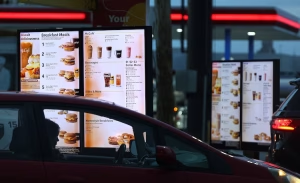 Unfortunately, the system, which was meant to make ordering easier, did anything but, with customers reporting that the automated ordering system added extra items to their tab. McDonald’s ended its partnership with IBM in 2024, but announced that it was exploring “voice ordering solutions more broadly.” Now, the fast food chain has found a new partner in Google to bring its Arch IQ and drive-thru assistant, Archy, back to life.
 This is one of the 35 driverless trucks PepsiCo is running on Arizona roads, marking it as the first major U.S. consumer-goods company with real-life, large-scale use of autonomous trucks on public roads.
 Now Siemens has just revealed Eigen, an AI agent that can replace manual coding or programming for programmable logic controllers, distributed control systems, and robotics applications, updating code or instructions to reflect new priorities and goals.
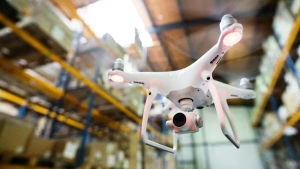 The business impact is measurable: reduced downtime, lower mobilization costs, reduced safety risk and faster response to problem detection. In the energy and utilities sector, drone-based inspection has been estimated to reduce inspection costs by 70% and downtime by 90%.
 Elon Musk calls it “the algorithm,” a distillation of lessons learned while relentlessly increasing production capacity at Tesla’s Nevada and Fremont factories.
 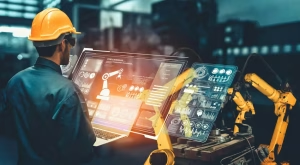 Similar to the PC revolution decades ago, all signs point to AI following suit with enhanced productivity and profitability. Productivity soared when PCs became interconnected across organizations. Manufacturing will see the same breakthrough with “embedded AI”—to help ease workforce bottlenecks with specific solutions. On the shop floor, for example, predictive-maintenance AI (see Chapter 17) can analyze sensor data to forecast equipment failures and avoid labor-sapping downtime.
 The shipping giant, which already deploys artificial intelligence in software development and other areas, is now looking to drive AI agents further into operations, including network planning and business processes. By 2028, FedEx expects to have AI integrated into more than half of its core operational workflows. FedEx is currently focused on setting up the underlying data and management foundation to oversee its AI bots.
 The global map of robotics is specialized. There is a multi-polar supply chain that is difficult to disrupt:
 Manufacturing faces a dual disruption. AI, robotics and automation are reshaping production at unprecedented speed, while skilled labor shortages intensify when experienced workers retire, taking decades of knowledge with them.