OM Podcast #48: Cold Storage, AI, and the Future of Industrial Facilities

In this episode of the Podcast, Professors Barry Render and Misty Blessley sit down with David Aschenbrand, Executive Managing Director at Newmark, to explore how cold storage and temperature‑controlled facilities are evolving in today’s operations and supply chain environment. Drawing on his background across logistics, transportation, warehousing, and industrial real estate, David explains how cold storage facilities support food, pharmaceutical, and other temperature‑sensitive supply chains, and what clients look for when developing or operating these specialized buildings.

The conversation highlights how facility design decisions—such as location, building footprint, dock configuration, and proximity to ports—can directly affect labor availability, transportation efficiency, and long‑term operational performance. David shares insights on the growing role of automation and AI in industrial facilities, while emphasizing the continued importance of skilled trades and hands‑on roles that support these operations.
The episode concludes with a discussion of what rising labor costs mean for cold storage operators. Together, the hosts and guest offer a practical look at how operations management, facility design, workforce trends, and technology intersect in modern cold chain and warehouse environments.


TRANSCRIPT LINK
A Word document of this podcast will download by clicking the word Transcript above.

Prof. Barry Render
Prof. Misty Blessley
Dave Aschenbrand

Have you subscribed to this podcast on Apple Podcasts?
Just open your Apple Podcasts app, search “Heizer Render Munson OM Podcast,” and subscribe to get our newest episodes as soon as they’re released!


Instructors: assignable auto‑graded exercises using this podcast are available in MyLab OM. To learn more, view our earlier blog post featuring Chuck Munson or contact your Pearson representative: Find your rep

Guest Post: Martin Guitars and Operations

Prof. Howard Weiss, retired from Temple U., illustrates his wide range of interests.

Martin is a guitar manufacturer that began operations in 1833. Martin specializes in acoustic guitars which account for about half as many guitars as electric guitars in the global guitar market. It is one of the most popular brands along with Fender, Gibson, Yamaha, Ibanez and Taylor.  

Location: Martin began its operation in Manhattan. In 1839 Martin opened a plant in Nazareth PA, 90 miles due west of its NYC plant. In 1989 Martin opened a plant in Sonora, Mexico in order to make guitars that were more affordable. It is worth noting that two of Martin’s competitors, Fender and Taylor guitars also have plants in Mexico. These guitars are commonly referred to as MIM (Made in Mexico). See Ch.8.

Capacity: Martin has made over 3 million guitars since its inception, including one million since 2016. It currently produces a total of 500 guitars per day, 6 days per week, at the two plants. (See Supp. 7)

Forecasting: Clearly demand has been increasing. Martin’s forecasting needs to consider historical and causal analysis (see Ch. 4) since certain events can spike or drop the sales. For example, sales increased more than usual during the folk music craze and also when MTV was running its Unplugged series (featuring acoustic guitars). At first, COVID caused a decline in sales due to cancelled concerts and closed stores. But then there was an increase in demand, especially for beginner guitars since people were looking for activities while at home and could order guitars online.

Supply Chain: The supply chain (Ch. 11) begins in the forest and at the lumber facilities both in the U.S. and India.

Layout: Martin uses process layout–see Ch.7. Most of the work is done by hand but there are robots in the factory.

Safety: With all of the woodwork that is being performed the major safety concern is that of sawdust.

Quality Control: The incoming wood is inspected by humans because machines cannot pick up defects in the wood. Each guitar is checked for tone. The guitar gets put in a case, but then sits for 4 days and then undergoes rigorous testing to make certain the guitar parts, e.g. neck, bridge, tuning pegs, still work. (See Ch. 6).

Classroom Discussion Questions

  1. How could Martin use the Quality Control techniques discussed in Ch. 6 of your text book?
  2. What are some possible reasons Martin relocated from Manhattan to Nazareth, PA?

Guest Post: Using Solver’s Nonlinear Programming Procedure for Operations Models

Prof. Howard Weiss shares his insights on the power of Excel’s Solver.

I previously have posted for The OM Blog that in the operations course it is important to help students develop their Excel skills. Today I will introduce students to nonlinear programming in Excel’s Solver for Trend Analysis models, a topic in Chapter 4 of your Heizer/Render/Munson text. It highlights to the students exactly what is being optimized – sum of squared errors.

Trend Analysis
Example 8 from Chapter 4 illustrates the Solver process. The initial intercept of 10 and slope of 10 yield the forecasts in column D. Errors and squared errors follow from the forecasts and demands with the sum of squared errors shown in cell F12. This is Solver’s objective. The changing cells are the intercept and slope, there are no constraints, and the method in Solver is GRG Nonlinear. In addition, for least squares the “Make Unconstrained Variables Non-Negative” needs to be unchecked since slopes/trends can be negative in forecasting– although not in this example.

After solving, the solution, not displayed here, appears as Intercept 56.71, slope=10.54 (as shown in the text) and the minimum sum of squares, not shown in the text or figure above, is 773.

Guest Post: Location Analysis and Community Attitudes

Prof. Howard Weiss, developer of the Excel OM and POM software that we provide free with our text, explains NIMBY.

In considering location strategy, as discussed in the Location chapter (Ch. 8) of Heizer/ Render/ Munson, it is critical to recognize that site selection is influenced not only by operational and cost factors but also by the social and political climate of the host community. One powerful expression of community resistance is encapsulated in the acronym NIMBY—“Not In My Back Yard.” The 1970’s term describes a paradoxical stance: residents often acknowledge the necessity of a facility or infrastructure project but strongly oppose its placement within their immediate vicinity.

A recent example can be found in Middletown, PA, where residents protested the conversion of a decommissioned coin mint into a warehouse. While the project promised potential economic benefits, community members expressed concerns over increased traffic congestion, heightened noise levels, possible pollution, and the erosion of local character. Such reactions are emblematic of broader NIMBY dynamics, where objections are rooted in both tangible and intangible perceived costs.
In addition to the Middleton commonly cited reasons for opposition, others include include health risks, pollution, crime, diminished aesthetic beauty, property values, security, parking, scenic views, access to natural resources, and environmental concerns (such as  habitat disruption and air and water contamination).

NIMBY disputes span a wide range of industries and public projects. In the U.S., notable examples include the halted completion of the Shoreham Nuclear Power Plant on Long Island; resistance to homeless shelters/housing in San Francisco; opposition to offshore wind farms near Cape Cod; battles over California’s high-speed rail; community pushback against cell tower installations in suburban neighborhoods; and municipal bans on hydraulic fracturing in cities such as Denton, Texas. Other contentious proposals have involved the expansion of hazardous waste landfills (East Liverpool, Ohio), medical marijuana dispensaries, and psychiatric treatment centers.

NIMBY is not confined to the U.S. In the U.K., plans to build a prison near the town of Thornton faced intense local opposition. In Australia, residents of Eastern Creek fought against the development of a waste-to-energy incinerator.

For operations managers, the implication is clear: location strategy cannot be determined by quantitative factors alone. Understanding and addressing community attitudes is essential to minimizing conflict, avoiding costly delays, and ensuring long-term project viability.

Classroom discussion questions:

  1. Why is this an OM issue?
  2. Have any students faced a NIMBY development in their communities? The results?

OM in the News: Locating an AI Data Center Means Huge Power Needs

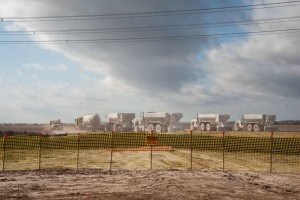
Meta Platforms just scooped up 2,700 acres of Louisiana farmland for what would be its largest-ever data center, built over flat rice fields in one of the poorest corners of the state.  At 4 million square feet, or 70 football fields, Meta’s data center will cost $10 billion and sit on more acreage than L.S.U. in Baton Rouge, which has more than 34,000 students. CEO Zuckerberg says the site will be used to train future versions of Meta’s open source AI models and be “so large it would cover a significant part of Manhattan.”

Building advanced artificial-intelligence systems will take city-sized amounts of power, which has turbocharged electricity demand projections for the first time this century, reports The Wall Street Journal (March 31, 2025). 

operations management and artificial intelligence and AI and location
Construction at the site of Meta’s new data center in Holly Ridge, La

Tech companies are pressing into unexpected parts of the country, far from traditional data-center markets such as Northern Virginia. They are hunting for huge swaths of flat land with access to natural gas and transmission lines, landing them on the doorstep of oil-and-gas country. To meet the voracious power needs of the project and other growth, Entergy Power intends to spend $3.2 billion to build three natural gas-fired power plants, tapping the state’s vast gas reserves.

In tiny Holly Ridge, La., hundreds of pieces of construction equipment are rolling past, with 5,000 construction workers on the way. Meta will bring money, jobs and local tax revenue. But the project also threatens to burden electricity customers across much of Louisiana with higher costs if demand from the tech giant eventually dries up.

L.S.U. estimates Meta could use 15% of Louisiana’s current electricity generation. That is worrisome to other utility customers largely because of the mismatch between the 40- 50 year lifespan of gas-fired power plants and Entergy’s 15-year deal with Meta.

Meta’s permanent jobs—around 500—are fewer than the thousands that might have accompanied an auto factory. For a region with a median household income of $53,000, the impact will be meaningful, though. Average salaries at Meta are projected at $82,000.

As we discuss in Chapter 8, Location Strategies, states often must offer financial incentives to draw major new employers. To woo Meta, Louisiana approved a sales-tax exemption for data-center equipment and helped procure more land from local farmers.

Classroom discussion questions:

  1. Are the incentives offered Meta unusual or risky?
  2. Why are data centers and their current technologies controversial?

Guest Post: The Natural Gas Supply Chain

Prof. Howard Weiss shares his insights with our readers monthly.

Natural Gas is a resource with several uses and, in fact, almost 50% of U.S. homes use it for heating. This figure shows the supply chain for natural gas.

Resource location Natural gas is extracted from rock formations, wells and coalbeds.

Pareto Principle Natural gas is produced in varying amounts in 95 countries. The U.S., Russia, Iran, and Qatar produce half of the natural gas worldwide. Five states, Texas, Pennsylvania, Louisiana, W. Virginia and New Mexico, produce over 60% of the total natural gas in the US. Thus, both U.S. and worldwide production follow the Pareto principle as explained in the quality chapter (Ch. 6).

Transportation The supply chain chapter (Ch.11) lists six major means of distribution – trucking, railroads, airfreight, waterways, multimodal and pipelines. Unlike oil, before natural gas is processed it can only be transported through pipelines.

Project Management. Building the pipeline is a project with two major parts. The pipeline company does not own the land where the pipeline is, but rather needs to get legal access to the properties. The second part is the construction of the pipeline itself. This involves digging and bending pipes to fit the planned route of the pipeline. Companies install about one mile of pipe per day. The U.S. has more than 300,000 miles of main pipelines, while Russia has more than 100,000.

Quality control After construction the pipeline is testing using water piped at a higher pressure than the gas will be transported.

Processing The gas goes to a compressor station (where impurities are removed) and then is pressurized to move it post-processing.

Post Processing Transportation The gas is then moved at 25 miles per hour through pipelines. Some gas is liquefied by chilling it to -263 degrees Fahrenheit so it can be shipped by special tanker ships and rail cars. Natural Gas is 600 times more in volume than liquefied natural gas. LNG can also be shipped to places that do not have pipelines.

Storage Currently there are 400 storage sites for natural gas in the U.S.

Classroom Discussion Questions:
1. Does your residence use natural gas? If so, what are its uses?
2. Some natural gas that is discovered is not sold but rather is burnt off at the site where it is found. Why do you think the gas is wasted rather than being sold?


Guest Post: Vertical Farming

Prof. Howard Weiss, who developed the Excel OM and POM software that accompanies our text for free, shares an interesting thought.

One of the location factors displayed in Figure 8.1 of your Heizer/Render/Munson textbook is the size of the potential location. One way to increase the size available for operations is to build vertically. This is why there are skyscrapers in so many cities. As the populations in cities grew there was a need for more room for both housing and business and skyscrapers create more room on the same building footprint.

The concept of expanding operations vertically has now reached the farming industry. Vertical farming is a technique where crops are grown on top of each other, typically indoors inside a facility that may be a skyscraper, warehouse or shipping container.

There are several advantages to vertical farming. First, of course, is that more crops can be raised on a smaller facility footprint. These farms operate in a highly controlled environment. Weather has minimal or no effect on these farms because the temperature, humidity, light and water are completely controlled. Also, different crops can be developed simultaneously whereas on a traditional farm different crops are planted and harvested in succession. Because the farms are indoors there is year- round crop production. Water can be recycled and reused. The farms can be located closer to urban centers reducing transportation costs. Less labor is required.

However, there are several downsides to vertical farming. While fewer employees are required than on a typical farm, these employees need to learn new skills. The startup costs for a vertical farm are higher than the startup costs for a traditional farm. While the environment is controlled, the energy costs to do so are higher than energy costs on a typical farm. In addition, energy costs have been rising both in the U.S. (8.4% higher) and Great Britain (58% higher) over the past few years and the carbon footprint of a vertical farm is larger than that of a typical farm. The cost to the consumer of the food that is grown is higher than food from typical farms. The types of crops that can be grown is not as large as that of a typical farm.

Classroom Discussion Questions
1. How could an individual take advantage of vertical farming when growing vegetables?
2. Are there any vertical farms located near your university location?


Guest Post: Girl Scout Cookies and Operations Management


Prof. Howard Weiss always has an interesting view of OM to share with our readers

We are currently in the middle of the Girl Scout cookie season. Several operations issues discussed in your Heizer/Render/Munson textbook face the Girl Scouts.

Location Only two manufacturers bake Girl Scout cookies. ABC Bakers is in South Dakota and supplies 25% of the cookies while Little Brownie Bakers is in Kentucky and supplies 75%. Six of the nine types of cookies are baked at both bakeries but each bakery also bakes three flavors that the other does not bake. (See the map).

Transportation If the types of cookies baked at the two bakeries were identical then this would lead to a transportation model as explained in Module C of your textbook. The model would include 2 sources (bakeries) and over 100 destinations (Girl Scout Councils). However, each Council can select whichever bakery they want to use which means that there is no attempt to minimize shipping costs.

Forecasting Recently, the Girls Scouts put out a new cookie, Adventurefuls. Forecasting demand for Adventurefuls was difficult because there were no past sales available to help create the forecast, so the quantitative methods in the forecasting chapter (Ch. 4) could not be used. The forecast for the new cookies was considerably lower than the actual demand and meeting demand was compounded by a labor shortage due to COVID. The Aggregate Planning chapter (Ch. 13) lists five methods for handling differences between supply and demand. There was no inventory that could be used; increasing the workforce, using part-timers or subcontractors was not feasible– so the only method left was to influence the demand. The Scouts placed a cap on the amount of these cookies that each troop could order.

Supply Chain In 2023, another new cookie, Raspberry Rally, was introduced and, again, demand was underforecast. This time a major reason for the poor forecasting was that customers could order the cookies exclusively online rather than through a girl scout. The production could not be increased because the manufacturer needed a long lead-time to produce the cookies and there were power outages at the Kentucky plant. A new distribution channel opened as some people were offering up their Raspberry Rally cookies on eBay for $20, $50 or even $200 a box instead of the usual $6 per box.

Classroom Discussion Questions:
1. Suggest a method for forecasting the sale of new Girl Scout cookies.
2. If the Girl Scouts wanted to minimize costs would each council receive their cookies from the nearer of the two bakeries? Why or why not?

Guest Post: Repurposing Military Bases

Prof. Howard Weiss developed the Excel OM and POM software that we provide free with our text.

In previous blogs for your Heizer/Render/Munson text, I have written about both failures and successes in repurposing facilities. The US has been successful in repurposing many of the more than 350 bases that the military has closed since 1988, saving over $500 million dollars due to these closures. But it is not a simple matter.

Safety Concerns While no two bases are alike, several are contaminated with toxic solvents, lead, radioactive materials, asbestos, and explosives residue. The US has spent over $1 billion dollars to address these issues and has been successful with remediation of the problems at some, but not all, of the installations. Remediating is not always a quick and easy process. For example, the groundwater at Lowry Air Force Base in Denver is not expected to be cleaned up until 2084. Another safety issue is that of unexploded ammunition.

Remediation It is challenging to remediate any facility. Environmental standards are stricter today, such as the use of asbestos in buildings, than when these bases were built. And there has been an increase over time in the number of local, state and the federal government environmental regulations. Some of the current laws apply specifically to base remediation while others refer to any organization. Another challenge is that remediation plans may need to be approved by several different government offices.

Uses There have been many different uses of closed installations. Several are still used for some military purpose such as training for the National Guard or veteran services. Other uses include office space, homes, apartments, schools, businesses, parks, golf courses, arts and fitness centers, movie sets, production studios, training centers, a university, an international airport, corporate headquarters and a prison. Military Shipyards are different from normal installations, so private companies have taken them over in Charleston and Philadelphia. Shipyards can also be used as a container port.

Leasing Companies do not need to wait for a base to close in order to repurpose a facility because they may be able to lease space. For example, a manufacturer leased space at Chanute Air Force Base in Illinois, in 1992, even though the base was not yet closed.

Classroom Discussion Questions:

  1. Has a military installation closed near you and how has it been repurposed?
  2. What good and bad effects does base closing have on the community?

Guest Post: Health Care and Location

Prof. Howard Weiss, who developed the Excel OM and POM software that comes free with our text, shares his insights monthly.

Figure 8.1 in the Location Chapter in your Heizer/Render/Munson textbook explains that two of the factors that affect site location decisions are proximity of services and customer density. Consider doctor visits.

House Calls
At the turn of the 20th century, family doctors would come to a patient’s house to give medical attention. For the patient, visits could not be more proximate than at home. House calls peaked in the 1930s but the life cycle of house calls is essentially at the end today. One reason is that there are fewer family doctors now. Another reason has to do with insurance company reimbursement requirements. There are, however, more visiting nurses, physical therapists and other medical care personnel making house calls.

Urgent Care
In the 1970s, doctors began to open urgent care centers to serve patients who do not have emergency needs. There are over 10,000 urgent care centers in the U.S. The advantages of urgent care centers are
 Centers typically do not require an appointment
 Centers are open for more hours than doctors’ offices.
 In most cases, patients are within a 10-minute drive of a center.
 Centers generally post fees and these fees are typically less than the fee at a doctor’s office or emergency room.

Mobile Health Clinics
Also, in the 1970s, health care organizations began using mobile health clinics to serve rural and underrepresented areas that have less patient density. There are over 2,000 mobile clinics in the U.S. each providing an average of 3,500 visits annually.

Medical clinics in retail outlets
Around the turn of the 21 st century, pharmacies, supermarkets and other retail outlets began to place medical clinics in their facilities. These clinics are more plentiful than mobile clinics and create a win-win situation for the patient and the retail outlet. Advantages to the patient are the same as those for urgent care centers. The advantage to the retail outlet is that the clinic increases foot traffic to the store and yields a new revenue stream.

Telehealth visits
The most recent location change has been telehealth. This brings us back full-circle to care in the home as the patient is home and communicates with a doctor via internet or telephone. Telehealth also includes using devices, such as heart monitors, that send information to the doctor’s office. There are. however, still some legal issues surrounding telehealth.

Classroom Discussion Questions:
1. Where was your last visit to a physician?
2. What might some of the legal issues of telehealth be?

Guest Post: Curbside–The New Greyhound Location

Prof. Howard Weiss has developed the Excel OM, POM, and Active Model software that comes free with our text.

The Location chapter (Ch. 8) of your Heizer/Render/Munson textbook discusses the location of a new facility but a related question is the closing of a current facility. Figure 8.1 lists as its first factor for determining the site as : “size and cost”.

Recently, Greyhound has decided that one way to reduce costs is to close its bus terminals. It has closed terminals in Philadelphia, Knoxville, Louisville and Houston, where riders are dropped off and picked up at the curb; in Tampa where riders are dropped off in a parking lot; and in Columbus which now uses a public bus terminal.

Of course, curbside or parking lot usage leads to a number of difficulties for passengers. In many cases there is no shade, no heat or air conditioning, no food, no place to sit, nor any restrooms. In addition, buses idling at the curb takes away a lane for cars or bikes. There are several reasons that bus terminals are being closed.

Relocation Often times a facility will be closed because it is being relocated to another location. This is true in some cases for Greyhound which recently moved its downtown Cincinnati station to the suburbs. This relocation did hurt riders who needed a more central location.

Condition of Terminal In midtown Houston the Greyhound bus station is an old, dilapidated station and for sale. However, the area around the station is improving, as new apartment buildings, restaurants, bars and grocers open.

Property value One main reason for leaving the bus terminals is to sell the properties which have become very valuable. In addition to Houston, the Louisville site will be turned into a 256 unit apartment complex. In Chicago, which serves 500,000 passengers each year and 55 busses per day, the station is for sale, with no replacement in the plans.

One stated reason for closure of terminals is because there will be a new bus terminal. But in Louisville construction has not started on the new terminal, even though the old terminal is closed. Greyhound is not alone. In Minneapolis, the Uptown Transit Station closed months ago and a facility will not reopen until Spring 2024. The station has been beset with vandalism, drug use and other activities which make it unsafe.

Classroom Discussion Questions:
1. How can bus terminals be made safer?
2. What other facilities have been sold due to the value of the land?

Guest Post: Why Does the U.S. Keep Stockpiles?

Prof. Howard Weiss shares his insights with us monthly.

Your Heizer/Render/Munson text inventory chapter (Ch. 12) discusses the use of safety stock. While companies use safety stock, so too does the U.S. maintain safety stock, termed stockpiles, for several different types of products. The most well-known stockpile is that of the Federal Emergency Management Agency (FEMA) which was most recently used due to the damage caused by Hurricane Ian. FEMA stockpiles commodities such as food and water and equipment such as generators across eight distribution centers.

The Strategic National Stockpile (SNS) was created in 1999 for the storage of medical supplies. It has recently been in the news because at the end of 2022, the SNS released flu medication due to the high number of patients with flu across the country. In addition to medication, the SNS contains masks, gloves, gowns, respirators, face shields and other emergency supplies. These supplies are stored at secret locations. Your textbook discusses preventive maintenance in the Maintenance and Reliability chapter, and one other aspect of storing the ventilators is that they each must undergo annual preventive maintenance.

Since 1975, the U.S. has maintained a Strategic Petroleum Reserve (SPR) to be used in the event of a disruption in the flow of oil. The oil is stored in underground tanks in Texas and Louisiana. In November of 2021, oil was released due to the rising cost of gasoline and in March of 2022, oil was released due to the invasion of Ukraine. The reserve is currently at its lowest level since 1983. In addition to the SPR there is a separate stockpile of home heating oil maintained in Boston, New York and Groton, Connecticut for the Northeast section of the country because the Northeast has the majority of homes that use heating oil.

In 1925, the U.S. authorized the creation of the National Helium Reserve in Texas. Helium was used for blimps by the military and has other uses, including medical ones. In 1996, plans were created to move control to the private sector by 2023. In 1977, the government began to purchase the milk that dairy farmers could not sell. It converted the milk into cheese and other products and ultimately stockpiled over 500 million pounds located in 35 states.

Not surprisingly, the U.S. stockpiles weapons and ammo and rare earth materials used for weapons. Currently these stockpiles are low due to release of the stockpiles to the Ukraine.

Classroom discussion questions:
1. What are some of the items that individuals stockpiled at the beginning of COVID?
2. What is another downside to stockpiling equipment in addition to having to maintain the equipment?

Guest Post: Location– Facility Repurposing Failures

Prof. Howard Weiss is providing Guest Posts while I am travelling.

Figure 8.1 of your Heizer/Render/Munson textbook lists 6 factors affecting the decision about what site to select at a local level. Another factor at the site level is whether or not it is possible to take over an already existing site. In two previous blogs I have discussed successful repurposing of facilities in general and repurposing of closed Kmart buildings. Unfortunately, not all repurposing decisions turn out well. One case below shows the problems to the organization taking over the facility while the second demonstrates the problems to the township in which the facility is repurposed.

Philadelphia Parking Authority The Philadelphia Parking Authority (PPA) decided that it could repurpose a decaying 16-acre Exelon steam regeneration plant into an administration building and an impound lot. In 2019 PPA signed a lease for this property which had been vacant since it was closed in 1985. The owner agreed to improve both the 500,000 square foot administration building and the parking lots. In 2021 workers were moved into the building. There were sewage and bathroom problems and in a few weeks PPA pulled its workers out of the facility. The parking authority has ended its lease and is currently in the course of creating a new headquarters at another location in Philadelphia. The PPA will be reimbursed over $2,000,000 for the project but even with the reimbursement the estimated loss to PPA, not including wasted time, for this failed location is over $1,000,000. 

Lockheed Martin Site In 1995, Pennsylvania offered Lockheed Martin, a defense contractor, an incentive package of grants and loans worth $25 million to relocate employees to Newtown, Bucks County, PA. Your textbook notes, in the OM in Action box on “Iowa – Home of Corn and Facebook” in Chapter 8, that studies show that “incentives did not substantially contribute to economic performance”. Indeed, this was the case with Lockheed as it decided to close the facility by 2015. Closing cost the township roughly $560,000 in income tax from Lockheed’s 1,200 employees.

The drug company KVK Tech purchased the site for $12.5 million in 2015. Currently the site is barely used and the parking lots are nearly empty. In addition, local, state and federal officials have had difficulty with KVK using trailers instead of expanding, being in non-compliance on waste water and having flawed manufacturing processes.

 Classroom Discussion Questions: 

  1. Name a facility that generally is not repurposed. 
  2. What incentives does your city or county or state give to companies for locating in your area?

Guest Post: Lumber, Sawmills, and Location Decisions

Prof. Howard Weiss is providing blog posts while I am travelling.

The Location Chapter of your textbook (Ch. 8) notes that “goods for which there is a reduction in bulk during production (such as a sawmill cutting trees to lumber) typically need facilities near the raw material.” While sawmills need to locate near the trees for economic reasons, the lumber industry itself has made location decisions since colonial times for other reasons.

The lumber industry in the U.S. began with New England colonies providing much of the lumber. The lumber was used in the colonies but also exported to Great Britain. By 1830, more lumber was being shipped out of Maine than any place in the world. Lumber is still exported from Canada and the U.S., which account for 12% and 8% of world lumber exports, respectively. China is the number one exporter and accounts for 13% of world exports.

As lumber supplies, i.e. trees, dwindled in New England, logging moved to New York and Pennsylvania and then to the Great Lakes region. By the beginning of the twentieth century, Midwest supplies were not sufficient and logging moved to the Pacific Northwest.

Recently though, the warmer weather in the Pacific Northwest and Canada has led to insect infestations and wildfires forcing lumber producers to move elsewhere, namely, into the South. Since 2021, 4.54 million board feet of capacity have been added to Southern States whereas Eastern Canada, British Columbia and the US West have all lost capacity.

In addition, the replenishment time for forests in the south is 20-30 years, which is less than for other areas. Major lumber companies have also moved south to Alabama, Georgia, Florida, Texas and the Carolinas because wood there is plentiful and inexpensive.

The figure below displays the number of lumber mills closed in the Northwest and the number of lumber mills in the South.

The move from the Northwest to the South means that different trees will be providing lumber. The Northwest forests were mainly Douglas firs whereas the Southern forests are Southern Pine trees. Southern Pine is not as straight as Douglas fir and is more prone to warping. This affects the choices of wood and design by the major users of lumber – the construction industry.

Classroom discussion questions:
1. What are the by-products from a sawmill?
2. Draw a figure of the supply chain for lumber, similar to the supply chain figure for soft drinks given in Figure 1.2 of your Heizer/Render/Munson text.

Guest Post: Shoe Capital of the World

Our Guest Post comes from Prof. Howard Weiss, who created the ExcelOM and POM software that we provide free to our readers.

Lynn Massachusetts In colonial days shoemakers had a capacity of roughly 5 shoes–not pairs–per day. The industrial revolution moved shoe manufacturing to factories, increasing capacity to 50 pairs per day. In 1883, Jan Matzeliger of Lynn, Massachusetts patented a machine that would use a wooden mold to form the leather top of the shoe and then attach it to the bottom. The new machine replaced this step (called lasting) which was performed by hand by skilled shoemakers. And it increased the capacity to 750 pairs per day while reducing the price of shoes by 50%.

 Figure 8.1 of your Heizer/Render/Munson textbook mentions several factors for a successful location which we examine now with respect to shoe manufacturing.

Labor talent Due to the continuous flow of skilled shoemakers into the state, 234 shoe manufacturers chose Lynn as their location and manufactured over 1,000,000 pairs per day. This made Lynn the Shoe Manufacturing Capital of the World. The state of Massachusetts produced more shoes than anywhere else in the U.S. through World War I. 

Matzeliger’s lasting machine

Leon, Mexico Today, however, over 90% of shoes bought in the U.S. are not manufactured here. One of the major manufacturing locations is Leon, in the state of Guanajuato, Mexico which currently has over 3,000 shoe manufacturers including Nike, Converse, Crocs, Skechers and New Balance. This makes Leon the current Shoe Manufacturing Capital of the World. There are several reasons for this:

Location of markets Leon is located roughly 250 miles northwest of Mexico City and has easy highway access to other cities in Mexico and to the U.S. through the 45 U.S.-Mexico border crossings. Mexico’s infrastructure is in excellent shape as are its highways. Shipments by truck to the U.S. take no more than 3 days, and to Latin America no more than 7 days. Guanajuato has an international airport with flights to cities in Mexico and L.A., Houston, Chicago and Dallas. Shipments to Europe take less than 2 weeks.

Labor talent again Mexico has had large influx of skilled leatherworkers from Europe.

Proximity to raw materials/supply chain One of the key materials needed to manufacture shoes is leather and there are nearly 700 leather tanneries in Guanajuato providing this raw material.

Classroom discussion questions: 

  1. What major manufacturer or service organization is located near your home or school and what were the factors for selecting that location?
  2. What is the effect of NAFTA in selling shoes manufactured in Mexico in the United States?