OM in the News: AI Is Mining Our Trash for Treasure

Here’s a job the computers can take without much complaint: sorting recyclables. For humans, it is a foul, laborious job that entails standing over a conveyor belt, plucking beer cans and detergent bottles from a stream of refuse. The job pays little and is hard to fill.

At one recycling facility near Hartford, machines are taking over the dirtiest jobs, reports The Wall Street Journal (Jan. 8, 2026). A few workers remain on the line, mostly to watch for hazardous items. Otherwise, the system of conveyors, magnets, optical sorters and pneumatic blocks runs largely unmanned. The technology allows them to sort up to 60 tons an hour of curbside recycling into precisely sorted bales of paper, plastic, aluminum cans and other materials. The material is sold to mills, manufacturers and remelt facilities, which pay more for cleaner bales.

AI is used to instantly spot recyclables and send instructions to machinery down the line at to remove them.

Watching over it all are computers that analyze material as it passes by at 7 mph. The devices use AI to identify recyclables, flag food-grade material, gauge items’ mass, assess market value and calculate points at which a robotic claw might best clasp each piece.

 The U.S. 50% aluminum tariff has lifted demand for scrap metal, while pulp mill closures have left box makers more reliant than ever on old corrugated containers. And consumer goods companies want to reclaim their bottles as states adopt extended producer responsibility laws aimed at reducing plastic pollution.

Part of the problem: Americans’ poor recycling habits are an obstacle to profit. A lot of beer cans and delivery boxes never even make it to sorting centers. A study in Virginia’s waste stream showed that 28% was recyclable, yet the system was stuck at a recycling rate of about 7% no matter how much it spent trying to teach people how and what to recycle.

The big breakthrough in recycling technology has been combining vision recognition systems with pneumatic blocks. Using puffs of air to separate items has proved much faster and more accurate than robotic pickers, which are limited to about 40 items a minute, compared with thousands for pneumatic system.

Classroom discussion questions:

  1.  Why has recycling been so inefficient?
  2. Should job loss through automation be a concern?

Guest Post: Drinking Graywater Beer?

Prof. Misty Blessley, at Temple U., raises an interesting sustainability issue.

Every drop of water on Earth is part of a continuous cycle. The same water brewed into beer eventually  travels through wastewater systems before being treated and returned to the environment, ready to be consumed again. Gray water is defined as: wastewater from showers, baths, bathroom sinks, and washing machines, excluding toilet water (blackwater) and water from kitchen sinks/dishwashers.

A San Francisco firm, Epic Cleantec, makes this cycle explicit by brewing beer with recycled graywater from showers and laundry. Buildings globally use 15% of all potable water, yet almost none reuse it. Partnering with nearby Devil’s Canyon Brewing Company, it created two beers—Shower Hour IPA and Laundry Club Kölsch, using water purified through a multi-stage system until it meets or exceeds potable water standards. Their approach demonstrates how scarce resources can be sourced in new and innovative ways.

Reusing waste water can help counteract climate change

The supply chain implications are significant. Brewing is water-intensive, requiring several gallons of water for every gallon of beer produced. As climate volatility and drought increasingly pressure municipal water supplies, integrating recycled water helps mitigate supply risk. Pairing this with drought-tolerant barley and hops further enhances supply chain resilience by mitigating upstream agricultural vulnerabilities.

Epic Cleantec’s model represents circular economy principles in action: closing loops, recapturing resources, and turning waste streams into valuable inputs. Many other food and beverage companies are embracing similar strategies. Rubies in the Rubble (UK) creates condiments from surplus produce that would otherwise be discarded. Upcycled Foods, Inc. (U.S.) produces SuperGrain flour to make bread from spent brewing grain. Planetarians (U.S.) transforms spent yeast and soybeans into a vegan meat product that is competitively priced compared to chicken and below beef.

Epic Cleantec emphasizes the circularity of its inputs to build consumer acceptance, hoping customers celebrate the closed loop. For details on the “circular economy” see Supp. 5 of your Heizer/Render/Munson text.

Classroom Discussion Questions:
1.  Forecasting is covered in Ch 4 of the Heizer/Render/Munson textbook. How would you forecast demand for beers made with recycled graywater, given potential consumer hesitation?
2.  TQM Tools are covered in Ch 6. Which tools should the two firms use to ensure water quality and process reliability throughout treatment and brewing?

OM in the News: Salvaging Critical Minerals From Old Laptops and Phones Isn’t So Easy

While electronic waste (e-waste) seems almost infinite, from fried computers to dormant BlackBerry phones, securing discarded tech for metals recycling can be quite tricky.

Electronic waste is dropped on to a conveyor belt during a process to harvest rare earth and other metals in France.

Recycled lithium, copper and other critical minerals can find new life in everything from electric vehicles to battery storage. The push to recycle metals in the U.S. comes amid intensifying efforts to compete with China, which dominates the critical minerals market, reports The Wall Street Journal (Dec. 1, 2025).

“It’s like urban mining,”  said one industry CEO, explaining the benefits of reusing metals from old electronics and scrap waste instead of procuring it directly from the earth. “Rather than going into the mines, we go into our communities,” he said.

Collecting e-waste can be tricky because there isn’t a strong infrastructure to retrieve devices directly from homes, scrapyards, manufacturers or collection sites, and some consumers have privacy concerns when handing over old hardware that could hold personal information.

Meanwhile, large quantities of e-waste are being shipped abroad. About 2,000 shipping containers of electronic waste are sent each month from the U.S. to countries in Asia, particularly Malaysia. But the need to increase the domestic supply of critical minerals has become more urgent, as is evident in the U.S.’s near-total reliance on Chinese imports for lithium-ion batteries.

Shipping e-waste abroad rather than recycling it in the U.S. is “a tragic lose, lose, lose proposition,” said a second industry expert. “The country misses out on the value from the critical metals going to waste, as well as recycling jobs for local workers.”

Most lithium-ion batteries on the market are likely to be hazardous when they are disposed of because they could catch fire or explode if not handled carefully. The environmental footprint of lithium-ion battery recycling emits less than half the greenhouse gases of conventional mining and refinement of metals, and uses about one-fourth of the water and energy of mining.

The global consumption of lithium was estimated to be 220,000 metric tons in 2024—a 29% jump from 2023. But tech recycling in the U.S. has a long way to go. E-waste recycling collection, from relying on municipal return sites to retailer take-back programs, is irregular and fragmented, so recyclers often cannot rely on steady, predictable volumes.

Classroom discussion questions:

  1. Why doesn’t the U.S. recycle all its e-waste?
  2. Could AI help in recycling? (See Supp. 5 of your Heizer/Render/Munson text).

OM in the News: Methane Emissions and the Fashion Industry

Savvy shoppers looking for luxury often hunt for high-quality materials such as 100% wool or genuine leather. But these two materials are responsible for an outsize share of the fashion industry’s methane footprint, reports The Wall Street Journal (Sept. 15, 2025). 

Fashion needs to be more sustainable

Methane traps far more heat than carbon dioxide; it’s 86 times more potent in contributing to global warming in a 20 year time frame than carbon emissions are. These carbon emissions come mainly from animals such as cows, sheep and goats belching out the gas.

Leather and wool are particularly harmful to the environment. The materials make up only 3.8% of the apparel industry, but producing them accounts for 75% of fashion’s methane footprint.

Buying a high-quality piece of clothing made of a natural fiber such as wool will last longer than a cheaper, less durable version made of fossil-fuel derived polyester. But the fashion industry doesn’t do enough to address the environmental impact of animal-derived materials.

Man-made polyester also has a major impact on the planet, particularly as fast fashion companies pump out cheap pieces to satisfy ever-evolving trends—many of which end up in landfills. Greenhouse gas emissions from clothing are ballooning. The global fashion industry is responsible for emitting about 8.3 million metric tons of methane every year, which means its footprint will amount to nearly 4 times the methane emissions released by France annually. Ultimately, shoppers are better off buying fewer pieces of clothing and shopping secondhand when they can to lower methane and carbon emissions.

Sourcing new materials is especially harmful. Producing textiles, from extracting raw materials to manufacturing, accounts for 92% of the fashion industry’s greenhouse gas emissions overall. There is increasing anxiety about where mountains of clothing end up when they’re discarded. The European Parliament is going to adopt a new law requiring producers to oversee textile waste from clothing to blankets and curtains.

One challenge lies in fabric complexity. Most modern textiles are blends of natural and synthetic fibers—like cotton, polyester, and elastane. Yet most recycling technologies today, which are still primarily mechanical, can only process single-material fabrics.

Classroom discussion questions:

  1. Are your students aware of the emissions from different types of fabrics?
  2. Which is worse for the planet–polyester clothes or wool?  Why?

OM in the News: Europe Tells Textile Producers to Manage Their Own Waste

Producers that sell textiles in the European Union will have to cover the cost of collecting, sorting and recycling those materials, under a new directive to reduce waste in the fashion industry. The EU is adopting a new law whereby producers will have to oversee the management of waste from clothing to blankets to curtains, reports The Wall Street Journal (Sept. 11, 2025). The directive covers the full life cycle of a product and aims to motivate producers to “reduce waste and increase the circularity of textile products,” since they will be bearing the cost of managing that waste.

EU Pushes Rules for Circular Economy

The EU is looking to reduce the environmental impact of the fast-fashion industry. Some 12.6 million tons of textile waste are generated in the EU each year. It estimates that just 1% of textiles are recycled worldwide.

 The law will apply to all producers, including those using e-commerce tools and irrespective of whether they are established in an EU country or outside the bloc. Smaller companies will have an additional year to comply with the requirements.

“This legislation will accelerate the move towards circular business models and more sustainable consumption,” said a recycling consultant. “The requirements will bring added costs and operational pressures for producers at a time when many are already under strain.”

Elsewhere, the EU is to set new targets on food waste. From 2031, member states will be required to reduce food waste generated during processing and manufacturing by 10%, while the target for shops, restaurants and households will be 30%. Every year, almost 60 million tons of food waste, amounting to about 291 pounds per person, is created within the EU.

Classroom discussion questions:

  1. Supplement 5 in your Heizer/Render/Munson text introduces the term “circular economy.” What does that mean and how does it apply in this EU case?
  2. Discuss the OM implications of this new directive? Does it impact U.S. firms?

OM in the News: The Future of Trash Pickup and AI

Americans are among the top producers of trash per capita. Each person in the U.S. disposes of nearly a ton of refuse annually. Simplifying trash day, and diverting the 80% of reusable material that still ends up in landfills, is one key to solving our problems.

Urban planners, the refuse industry and cities across the country are reimagining how we manage and dispose of our waste, reports The Wall Street Journal (Aug. 28, 2025). The New York City and MIT are among those leveraging AI, robotics and electric power to tackle a growing garbage crisis fueled by cheap products and throwaway culture.

Most of Americans don’t recycle regularly, citing the inconvenience and confusion involved in sorting their trash. To help people up their sustainability game, sanitation engineers are promoting a new system: the single-stream model. The operation is simple—residents throw everything into one trash bin. Then, that waste is transported to a remote facility, where AI-powered cameras and robots sort it, diverting items that can be recycled. The goal is to have a system that’s more circular, that can reuse and recycle things more.

AI can also identify items such as electronics that contain hazardous or valuable materials—including copper, silver, gold and rare-earth minerals—and send them on for disassembly and harvesting before they enter the waste stream.

Individual garbage bins or piles of plastic bags aren’t only an all-you-can-eat buffet for rodents—but also malodorous, leaky and inefficient, requiring endless noisy stops from garbage trucks on collection day.

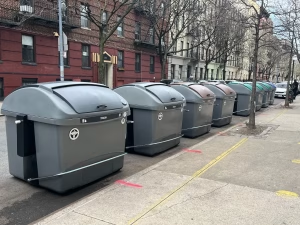
The new NYC shared Empire Garbage Bins.

To solve these problems, cities are moving toward containerization: large, centralized bins shared by a street or neighborhood. One NYC neighborhood  is already piloting a program of such containers, with plans for citywide expansion in the future.

Smart bins could even ping dispatch offices when they are ready for pickup. Large collection vehicles could be used more sparingly, and with fewer stops—thus decreasing noise, pickup time and pollution. In the future, the parameters that we use could be, ‘Is it full? Or is it smelly?’ Then collection on that bin can take place only if the contents meet those conditions.

AI-optimized routing and trash-loading technologies could also help make pickups shorter, less frequent and less disruptive.

Classroom discussion questions:

  1. How could AI be used to help recycle?
  2. What are the major inefficiencies of most garbage collection and recycling systems?

OM in the News: Polyester Is Driving Up Fashion’s Emissions

Greenhouse gas emissions from clothing companies are mounting, reports The Wall Street Journal (July 24, 2025).  The spike is fueled by supercharged apparel production, as well as a mounting reliance on virgin polyester. Virgin polyester, a material made from fossil fuel-created plastic, is the latest industry trend.

Polyester now makes up 57% of total global fiber production. The market share of recycled polyester used in clothing has recently dropped, pointing out that the material costs more than its virgin counterpart.

Environmental concerns about apparel have proliferated since the arrival of ultrafast fashion companies, which churn out low-cost clothes direct-to-consumer to satiate lightning-quick trend cycles.

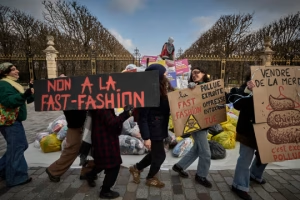
Activists hold banners as they gather in front of bags of textile waste delivered in Paris

Recycling clothing can be especially tricky when fibers are woven together, for example cotton and polyester, which are often blended to lower costs and provide stretch in fabric.

But consumers are growing worried about clothing shedding microplastics that could harm human health and the environment. There’s also been concern about “forever chemicals” in textiles used to make workout gear.

New technologies including artificial intelligence are helping brands to get a better handle on their clothing stock, piloting made-to-order methods that significantly reduce waste by producing only what is needed.

Some countries are taking swift action to try and blunt the harms of fast fashion. France recently adopted a bill to tax each fast fashion item €5 ($5.87 ) which will increase to €10 by 2030.

Classroom discussion questions:

  1. Why is fast fashion an OM issue?
  2. How else might AI be used to improve sustainability in the fashion industry?

OM in the News: Junk Is Needed for the New Electric Era

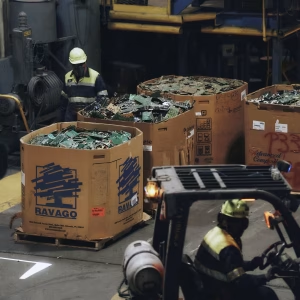
Circuit boards from thousands of different products arrive at Glencore’s Rhode Island facility, where the company determines the copper content and the value of the waste.

One of the world’s largest miners is digging into America’s junk drawers, old phones and landfills. The quarry: bits of copper to meet the needs of the energy transition and data boom.  Shredded cellphones, obsolete computer cables and chewed-up cars are heaped 30 feet high outside Glencore’s 97-year-old copper smelter deep in Canada’s boreal forest. There, the scrap is melted with copper concentrate from mines to produce fresh slabs of metal.

Shifting from fossil fuels to more renewable electricity promises to remake commodity markets, writes The Wall Street Journal (Nov. 21, 2024). If America requires less crude oil and coal, it will in turn need copper for everything electric. “In the next 25 years we will consume more copper than humanity has consumed until now,” says Glencore’s  recycling head.

Data centers being built to facilitate AI and store smartphone videos are full of copper. So are the phones. Even if rich mine deposits are found, it takes decades to bring them online. That prevents miners from responding quickly to new demand, which leaves scrap to balance the market. Copper never goes away and is infinitely recyclable.

Miles worth are strung through homes and cars and along rights of way, carrying electricity and drinking water. But a lot sits in junk yards and landfills. When prices rise, there is more incentive to get it. Copper prices are currently among the highest ever. Nearly half of demand will be met with recycled copper by 2050, up from about a third today.

Germany’s Wieland began construction in 2022 on a $100 million recycling facility in Shelbyville, Ky. Another German firm, Aurubis, is building an $800 million recycling facility in Augusta, Ga. Glencore recently bought a failed electronics recycling facility in Arkansas and will use it, too, to gather scrap. Glencore found that the concentration of copper in landfilled auto fluff can be more than twice that found in geologic mines.

Classroom discussion questions:

  1. Why the demand for copper?
  2. What makes copper recycling attractive?

OM in the News: Plastic Recycling’s Wasted Opportunity

Here at the Render household, we take our recycling very seriously. Each Tuesday, a garbage truck collects the contents of our bin. It contains lots of plastics—shampoo bottles, yogurt cups, milk jugs and more. But how much actually gets recycled?

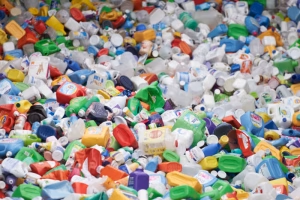
Just 14% of waste plastic containers and packaging are sent to a recycling facility, according to the most recent EPA report. Another 17% gets incinerated. Nearly 70% goes to landfills. Waste paper and cardboard do better: 81% gets recycled. The rate for glass containers is about 31%. For aluminum, including cans and foil, 35%.

Recycling plastic is a challenge because of chemistry…and business, writes The Wall Street Journal (Oct. 22, 2024). The U.S. used to export recycling to China, but the country stopped taking most foreign waste in 2018. If American companies aren’t interested in making new products from recycled plastic, there’s no incentive to develop the infrastructure to collect, sort and reprocess old packaging.

Over five decades after soda makers first turned to plastic bottles, America’s PET bottle recycling rate stands at under 30%

There are seven categories of plastic resins. Most types aren’t even considered for curbside recycling. Meanwhile, businesses have touted their containers as recyclable as they look to keep consumers and regulators happy. Yet for recycling to work, there has to be demand for all the used plastic that we toss. Today virgin plastic is both cheaper and better.

The numbers on plastic items range from 1 through 7. But having a number doesn’t make it recyclable. PET—polyethylene terephthalate, used for soda and other drink bottles—goes by number 1 and is the most highly recycled plastic in the U.S.  at 29%. HDPE—high-density polyethylene, found in milk jugs and detergent containers—is number 2 at 27%. PP—polypropylene, which bears the number 5 and is commonly used in yogurt and butter containers—hasn’t been widely recycled in the U.S.

Most flexible supermarket bags are not accepted in curbside recycling bins. Rigid containers made from polyvinyl chloride (No. 3), polystyrene (No. 6) or multilayer plastics (No. 7) shouldn’t go in blue bins either. Sorting and cleaning a wide assortment of plastic containers is expensive, in part due to the many different pigments and other additives used. Throwing bags, six-pack rings and other flexible plastics into blue bins can mess up a recycling facility’s sorting machinery. And pieces smaller than a credit card won’t be sorted.

Classroom discussion questions:

  1. What is the recycling policy on your campus and is it effective?
  2. What is the solution to this problem?

OM in the News: The Ziploc Bag Dilemma

Billionaire Fisk Johnson has been on a crusade to contain the plastic waste crisis.  He has gone scuba diving among plumes of plastic sludge. He has funded research on how microplastics are damaging for human health. And he has made trips to Congress to ask for regulations placing responsibility on consumer-goods companies to recycle the plastic waste their products generate.

Companies like his! For 20 years, Johnson has been at the helm of one of the biggest consumer companies in the world—and a major manufacturer of products packaged in plastics. He is CEO of family-owned SC Johnson, which makes Ziploc bags, Mrs. Meyer’s Clean Day soaps and Windex cleaners.

“On one hand, I see plastic as one of the most useful, versatile and cost-effective materials developed in the last century,” Johnson testified in Congress. “On the other hand, as a lifelong conservationist, I also have seen how plastic has become one of the more profound emerging global pollutants that is affecting planetary, animal, and human health.”

That paradox is one of the most challenging questions confronting businesses—how to balance the tide of consumerism with escalating environmental concerns? Are consumers prepared to pay more and change the way they get their soap, cleaners and food to drastically reduce plastic waste?

SC Johnson still relies on plastic for packaging many of its products, and single-use plastic films like Ziplocs aren’t commonly recycled. Close to 40% of the world’s millions of tons of plastics produced are used in packaging and 85% of that plastic ends up in landfills, writes The Wall Street Journal (Oct. 13, 2024). Johnson says he has introduced sustainable packaging, including Windex bottles made from recovered plastic, but that regulations and fees on companies using plastics are needed so companies like his can remain competitive. Alternatives like glass can be costly, fragile and leave a bigger carbon footprint, he adds.

“You could say, alright, well, single-use plastics is a terrible business, and we should just get out of it,” says Johnson. “But somebody else who’s less well-intended is going to just take that up. It’s a free market. My argument is that it’s better off in our hands.”

Classroom discussion questions:

  1. Is there a solution to this dilemma?
  2. What would be your strategy as head of OM at SC Johnson?

OM in the News and Video Tip: A Circular Economy Hub for Automaker Stellantis

Stellantis opens its first circular economy hub.

Stellantis–the global automaker with brands including Chrysler, Fiat, Jeep, Maserati and Peugeot– has inaugurated a Circular Economy Hub at its manufacturing complex in Turin, Italy, demonstrating its commitment to a “360-degree approach” to automotive production, involving a strategy of remanufacturing, repair, reuse, and recycling (4R‘s.) Stellantis says it is adopting capabilities and facilities “to change its consumption model to reduce the environmental impact and better manage the company’s aggressive decarbonization target of reaching carbon net zero by 2038.”

“Circular economy,” a topic in Supplement 5 of your Heizer/Render/Munson text, describes an economic concept for production and consumption that preserves the value of energy, materials, and labor as products move from design through to end-of-use handling and recycling. The Hub represents a $40 million investment, covering 785,000 sq. ft.  The site will employ 550 workers by 2025.

“The Circular Economy Hub brings together a powerhouse of skills and activities aimed at creating a high-performing center of excellence in Europe,” stated Stellantis in American Machinist (Nov. 28, 2023). “We are industrializing the recovery and sustainable reuse of materials, building new technologies and advanced capabilities as we grow in this area.”

The primary objectives for the Hub are to extend the life of parts and vehicles, ensuring that they last for as long as possible; or, failing that, to recycle those materials and others from end-of-life vehicle dismantling for remanufacturing as new parts and/or vehicles. The goal for the first operation, “Reman,” is to manage over 50,000 remanufactured parts annually by 2025, rising to 150,000 by 2030. For the Hub’s Sorting Center, the target is to process an estimated 2.5 million worn parts annually by 2025, increasing to 8 million by 2030.

The Vehicle Reconditioning activity will undertake aesthetic and/or mechanical repair of remanufactured or used parts and then reintroduce those to the supply chain through Stellantis’ manufacturer-certified used-vehicle program and services network. Last, the Vehicle Dismantling activity will convert end-of-life vehicles into resources for parts to be remanufactured, reused, or recycled.

Stellantis intends for the Hub to generate “efficiencies and synergies” among these activities, and through vertical integration of materials and processes. Here is a 3.5-minute video showing the 4R process in action.

Classroom discussion questions:

  1. What is meant by “circular economy?” Give an example with an iPhone as the product.
  2. What auto parts will be hard to repurpose?

OM in the News: Can AI Rescue Recycling?

Recyclers across the U.S. are struggling, hurt by a shortage of workers and rising costs that too often make recycling uneconomic. They are hoping, writes The Wall Street Journal (Nov. 9, 2023), that artificial intelligence can help turn things around and boost recycling rates.

The Boulder County Recycling Center

How can AI help? By doing the sorting work  that a dwindling number of people want to do—and doing it better. AI-driven robots pick up recyclable trash at around 80 pieces a minute; people can sort 50-80 pieces a minute. Optical sorters, a more established technology that’s growing more efficient thanks to improved AI, are much faster, sorting up to 1,000 pieces a minute.

Staffing shortages mean sorting sites can’t operate at full capacity. (Sites are often only 80% staffed and sometimes as little as 20%).  In the long run, sorting machines are cheaper than human labor. Recyclers typically recoup their investment in robotic systems in two years.  Around 32% of the sorting centers in the U.S. are now using robotics, up from less than 5% in 2019.

Optical sorting machines are in most of the large facilities. They use sensors and lights to rapidly find what is recyclable on a conveyor belt of mixed materials. When recyclable materials are identified, the machines fire a burst of compressed air at them to sort them into bins.

Waste Management, the biggest recycler in the U.S., is betting on AI as part of its goal to boost its recovery of recyclable materials 60% by 2030. It is investing $1 billion in recycling infrastructure including 40 recycling centers through 2026, with a big portion going to automation and AI. An automated WM plant has 4-6 people sorting along with the machines, compared with 50 employees at a nonautomated facility.

Republic Services, the second-biggest waste-and-recycling company, is investing in robots as part of its goal to recycle 40% more key materials by 2030, including cardboard, metal, paper and plastics. The company plans to have robotics at 20% of its 74 sorting centers in 2024, up from 10% today.

Still, AI brings its own challenges. Robots require upfront spending and equipment that needs frequent maintenance and upgrades. The cost for a single robot ranges from $150,000 to $300,000. Building or upgrading a recycling center around optical sorters is even more expensive than robots. Optical sorting systems cost $1-2 million each.

Classroom discussion questions:

  1. Recycling of municipal solid wastes has actually dropped in recent years. Why?
  2. What are the advantages and disadvantages of AI in this field?

OM Podcast #6: The EV Battery Supply Chain

Welcome to our latest Operations Management podcast! Today, Barry Render and his guest, Providence College Professor Jon Jackson, discuss an important issue facing the auto industry: the supply chain for electric vehicle batteries. Their talk includes battery end-of-life issues, recycling in the U.S., and a look ahead to 2035 when the E.U. and several U.S. states will ban gas-powered vehicles.


Transcript

A transcript in Word of this podcast is available by clicking on the word Transcript above.

Instructors, assignable auto-graded exercises using this podcast are available in MyLab OM.  Contact your Pearson rep to learn more!  https://www.pearson.com/us/contact-us/find-your-rep.html

OM in the News: Cutting the Environmental Footprint of Fast-Fashion

“Fast fashion is a problem,” said a European Union official in The Financial Times (July 5, 2023).  Lawmakers in the European parliament have called for an “end to fast fashion” and the setting of specific targets for textile waste collection, prevention and recycling. Fast-fashion brands such as the online retailers Shein and Boohoo and clothing giants H&M and Inditex (which owns Zara), have come under increasing pressure to move away from low-cost business models that have resulted in millions of tons of clothes being trashed.

Clothing companies are being pushed to improve the recyclability of their products

The EU wants the textile industry to pay for the processing of discarded clothing and footwear under new rules aimed at cutting the environmental footprint of fast-fashion brands. It proposes to push clothing companies to improve the recyclability of their products and catalyze a growing second market. The equivalent of over 26 pounds of clothes and footwear per EU citizen is discarded each year of which more than three-quarters is incinerated or goes to landfill.

Companies that sell to consumers in the EU would be responsible for paying for the treatment of any waste textiles with the amount charged dependent on the amount of processing required. The cost of making companies pay for clothing waste would amount to 12 cents per T-shirt but it would vary according to the product and what treatment was needed.

Companies say they want to sell more sustainable products, but are hampered by the lack of recycling infrastructure. H&M said it backed the measures and aimed for 30% of its clothes to be made from recycled fibers by 2025. Euratex, the EU textile industry body, said that it was working on pilot projects with small fabric manufacturers in 11 textile producing regions to create a closed loop system with clothes better designed for recycling.

Fast fashion was invented by companies such as Zara, in the late 1990s, when they took the latest styles seen on the catwalk and brought similar products to market. Zara took only 3-4 weeks to bring a simple T-shirt from design to the stores and 6-8 weeks for a jacket or a dress.

Classroom discussion questions:

  1. How do your students feel about fast-fashion its environmental impact?
  2. What is the role of OM in this issue?

OM in the News: The EV Battery Dilemma

Traffic backs up at the Bay Bridge. California is set to implement a plan to prohibit the sale of new gasoline-powered cars by 2035.

Recent U.S. regulations are pumping billions into battery manufacturing and incentives for EV purchases. The E.U., and several U.S. states, have passed bans on gas-powered vehicles starting in 2035. This transition will require lots and lots of batteries, reports Grand View Research (June, 2023).

When a lithium-ion battery, which consists of thousands of cells filled with cobalt, nickel and manganese, comes to the end of its life, its green benefits fade. If it ends up in a landfill, its cells can set afire or leach dangerous chemicals that can contaminate water supplies and ecosystems. The thin metal exterior of a battery will decompose within 100 years, exposing the toxic heavy metals inside, which will never decompose.

But recycling these batteries can be hazardous. If they are not opened carefully, they can explode, short-circuit, and let off toxic fumes.  In the coming decades, tens of millions of EV batteries will reach their end-of-life. (Some predict there will be 150 million EVs on the road by 2030. Last year there were fewer than 12 million). Current EV batteries “are really not designed to be recycled,” says one industry expert.

The E.U. and China are setting new rules for some level of battery reuse. But it will not be easy to meet the new regulations. Most recycling processes produce heavy waste and emit greenhouse gases, and very little recycling goes on today.  (Recycling rates in the E.U. and the U.S. are less than 5%). Most of the batteries that do get recycled undergo a high-temperature melting-and-extraction process. Those operations, which are carried out in large commercial facilities are energy intensive. The plants are also costly to build and operate, and require sophisticated equipment to treat harmful emissions generated by the process. And despite the high costs, these plants don’t recover all valuable battery materials.

Battery-swapping is one innovative business strategy proposed in OR/MS Today (June 20, 2023).  A battery swapping infrastructure station  network could provide a service for EV owners to “refuel” their vehicles. Replaced batteries would subsequently be recharged and exchanged for other arriving EVs needing a battery swap. One significant challenge impeding this concept was the need for a universal battery standard that multiple automakers could share. The battery packs needed to have identical dimensions and shapes to be compatible. Tesla tried the concept in 2013, but gave up on it a few years later.

Classroom discussion questions:

  1. Why is battery swapping so difficult?
  2. Why is recycling EV batteries so complex?