OM in the News: The Turning of the Screw

Harley's York PA plant
Harley’s York PA plant

Companies’ pursuit of “big data”—collecting and crunching ever larger amounts of information—is often thought of as another way to figure out exactly what customers want. But big data is also a means of measuring millions of little things in factories, such as how many times each screw is turned. That is what Raytheon is doing at its Alabama missile plant, writes The Wall Street Journal (May 16, 2013). If a screw is supposed to be turned 13 times after it is inserted but is instead turned only 12 times, an error message flashes and production of the missile or component halts. Improvising with a defective screw or the wrong size screw isn’t an option.

Similarly, At Harley-Davidson’s plant in York, Pa., software keeps a constant record of the tiniest details of production, such as the speed of fans in the painting booth. When the software detects that fan speed, temperature, humidity or some other variable is drifting away from the prescribed setting, it automatically adjusts the machinery. In the past, says Harley’s VP, operators had leeway on paint jobs and each could do the work in a slightly different way. Harley has also used the software to find bottlenecks that could keep it from its goal of completing a motorcycle every 86 seconds. Harley managers recently determined that installation of the rear fender was taking too long. They changed a factory configuration so those fenders would flow directly to the assembly line rather than having to be put on carts and moved across an aisle.

Harley and Raytheon are just two of many manufacturers installing sophisticated, automated software systems, known as manufacturing execution systems, or MES, to gather and analyze factory-floor data. Semiconductor and other high-tech companies were early adopters of MES, but now others are catching up. Suppliers include Apriso, GE, SAP, Siemens, and Rockwell Automation.

Discussion questions:

1. Why is MES a valuable operations tool?

2.  By what other names is MES known in manufacturing?

OM in the News: How Technology Helps Kroger Reduce Queues

QueVision monitors tell how many lanes need to be open now and in 30 min.

Supermarket giant Kroger, reports The Wall Street Journal (May 2, 2013), is winning the war against lengthy checkout lines with a powerful weapon: infrared cameras long used by the military and law-enforcement to track people. These cameras, which detect body heat, sit at the entrances and above cash registers at most of Kroger’s roughly 2,400 stores. Paired with in-house software that determines the number of lanes that need to be open, the technology has reduced the customer’s average wait time to 26 seconds. That compares with an average of four minutes before Kroger began installing the cameras in 2010.

Reducing wait times is becoming a top priority for retailers, from high-end department stores to hardware chains to fast-food outlets. Battling both online rivals that offer at-home convenience and intensifying competition among fellow brick-and-mortar outlets, many companies see enhancing the shopping experience as a way to build loyalty. Kroger’s system, dubbed QueVision, is now in about 95% of its stores. The system includes software developed by Kroger’s IT department that predicts for each store how long those customers spend shopping based on the day and time. The system determines the number of lanes that need to be open in 30-minute increments, and displays the information on monitors above the lanes so supervisors can deploy cashiers accordingly.

The company says surveys show customer perception of its checkout speed has improved markedly since 2010. “The bottom line is we want our checkout experience to be the best, and it’s our goal that our customers will enjoy the experience so much that they’ll want to return,” says Kroger’s senior VP.

Discussion questions:

1. What other new technologies are being used in service industries to speed up checkout lines (see the WSJ article and Chapter 7)?

2. How can QueVision help boost orders?

OM in the News: Uncaged, Robots Become Gentler

The Baxter robot
The Baxter robot

FACTORY robots are usually caged off from humans on the assembly line lest the machines’ powerful steel arms deliver an accidental, bone-crunching right hook. But now, reports The New York Times (March 31, 2013), gentler industrial robots are coming out from behind their protective fences to work shoulder-to-shoulder with people. It’s an advance made possible by sophisticated algorithms and improvements in sensing technologies like computer vision.

The key to these new robots is the ability to respond more flexibly, anticipating and adjusting to what humans want. That is in contrast to earlier generations of robots that often required extensive programming to change the smallest details of their routine. A Georgia Tech prof states: “Robots of the future won’t just be in manufacturing. Almost any area could have a robot that would help make our life easier, whether lifting patients in hospital beds or helping at home.”

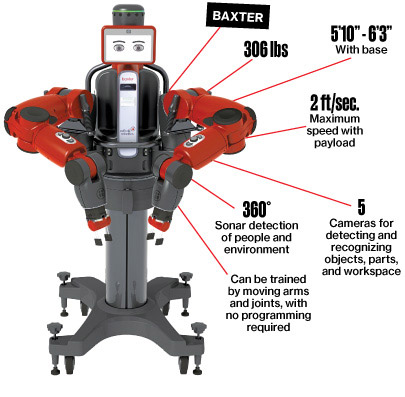
Gentle, helpful robots aren’t just being created in labs; they are also arriving in the marketplace. Since January, Rethink Robotics of Boston has been sending customers its two-armed robot called Baxter, which can work uncaged, moving among people. Baxter’s cameras inspect what is to be lifted, recognizing an object from many angles. In the coming year, Baxter will be able to grab objects not only from above, but also from the side, putting them into a milling machine, for example, and pressing the “go” button. It will also be able to connect with other machines to synchronize tasks.

“Baxter is a great starting point for this new generation of robots,” adds the Georgia Tech prof, “making the technology accessible to companies that before would have had to pay hundreds of thousands of dollars.”

Discussion questions:

1. How have robots evolved in the past 20 years?

2. What are some operations functions that a robot like Baxter can help improve?

OM in the News: Mass Customization vs. Simplicity

Dozens of options for jam and mustard

In 1980, the typical credit card contract was about 400 words long. Today, many are 20,000 words. In a typical day, we encounter dozens of moments when we are delayed, frustrated or confused by complexity, writes The Wall Street Journal (March 30-31, 2013). Our lives are filled with gadgets we can’t use (GPS devices, fancy blenders), instructions we can’t follow (labels on medicine bottles, directions for assembling toys) and forms we can’t decipher (tax returns, gym membership contracts, wireless phone bills).

Every facet of our lives, even entertainment and recreation, is complicated by an ever-widening array of choices delivered at a frantic pace. Consider:

• More than 800,000 apps in the Apple App Store

• 240-plus selections on the Cheesecake Factory menu, not including lunch or brunch specials

• 135 mascaras, 437 lotions and 1,992 fragrances at Sephora.com

. 45 Medicare Part D prescription plans to choose from

The supermarket chain Trader Joe’s, reports the Journal,  tries to simplify rational choice. The company’s long-standing goal is to reduce the grocery-shopping experience to a few manageable decisions. It believes that giving people everything overwhelms customers, clutters stores and undermines the shopping experience. And, says Trader Joe’s, it is inefficient for handling inventory. So the 350 store chain offers many fewer products than other supermarkets (about 4,000 items instead of 40,000). But it sells $1,750 in merchandise per sq. ft., more than double the sales generated per sq. ft. by Whole Foods.

This WSJ article makes for a nice discussion when you are covering mass customizations benefits and downsides in Chapter 7. (Table 7.1 lists 10 other items for which choices have exploded in the past few decades.)

Discussion questions:

1. Why has mass customization become a part of our culture?

2. What are the issues operations managers face in making mass customization successful?

OM in the News: RFID Tags Ensure Hospital Hygiene Practices

Wristband contains RFID reader and motion sensors to measure hygiene

My wife was so disturbed with yesterday’s post about hospital quality problems, that I decided to provide a positive hospital story today. RFID Journal (April 1, 2013) reports  that IntelligentM has developed a hospital solution that employs RFID readers built into wristbands to identify tags on soap dispensers, intravenous (IV) solution packaging, surgical drains and ID badges–thereby alerting users if they fail to wash their hands, or need to do so more thoroughly.

Users’ wristbands incorporate very small readers that interrogate RFID tags installed on sinks, disinfectant dispensers and other objects. IntelligentM also sends weekly hand-hygiene “report cards” to employees. In developing the system, the firm wanted to be able to provide alerts that would lead to corrective action being taken before a patient was exposed to potentially infectious materials. The wristband is small enough so as not to be cumbersome to users who may also be wearing and removing rubber gloves.

When the nurse places her hand under a sanitizer or soap dispenser, the wristband reader interrogates the tag mounted there. The reader vibrates once, reminding the wristband bearer to indeed wash her hands, and indicating that it has read the dispenser’s tag. If the band detects that she has stopped washing before the proper amount of predetermined scrubbing time has elapsed, it vibrates three pulses, thereby prompting her to wash her hands a second time using the proper procedure.

When the nurse meets with a patient and begins a procedure, such as opening an IV package, a tag on that package is read and the system again identifies the action based on the tag’s ID number. The wristband’s software checks its database to determine the last time this worker had washed her hands. If it was not recent enough, the tag vibrates three times to indicate she must wash her hands before continuing the procedure.

Discussion questions:

1. What other uses for RFID can you envision in hospitals?

2. What prevents this system from being universally applied?

OM in the News: Replacing the Postal Service With Digitized Mail

outboxJust because the USPS isn’t making mail a profitable business doesn’t mean it can’t be done, reports CNN Tech (Feb.26, 2013), as it describes the driver of a white Prius with a giant, red plastic flag affixed to its side, undelivering mail from mailboxes. The driver and the car are part of  Outbox, a company that is  picking up where the embattled  Postal Service leaves off — by digitizing physical mail. The driver visits Outbox subscribers’ homes three times a week,  collecting the letters, bills, magazines and advertisements that were deposited there by official postal workers and delivers them to a warehouse. There they are opened and photographed, and the resulting digital files are sent electronically to the recipient.

For $5 a month, this makes physical mail disappear. Using a mobile device or computer, Outbox customers can ask to be unsubscribed from junk mail, have unwanted items destroyed or request that important mail be re-delivered to their home. Not surprisingly, Outbox has met resistance from the USPS, which has refused to collaborate. “The Postal Service is focused on providing an essential service in our mission to serve the American public and does not view Outbox as supporting that mission,” says the USPS.

The USPS has been slow to innovate and adapt to new technology on its own. It also faces serious financial issues, with $15.9 billion in losses last year –and it just announced plans to cease Saturday mail delivery in an attempt to save $2 billion. Technology has steadily eaten away at its core business for years. The volume of mail handled by the USPS dropped from 203 billion pieces a year in 2002 to 160 billion in 2012, as bill payments, statements and marketers migrate online.

After its first two cities, Austin and San Francisco are fully staffed, Outbox plans to bring its service to New York, Boston, Chicago, Los Angeles and Washington. This is a great example of service technology (Chapter 7) that your class will enjoy.

Discussion questions:

1. What can the USPS do to compete in an increasingly digital world?

2. What are some major operations issues Outbox faces in its business?

OM in the News: RFID for Tracking Surgical Implants

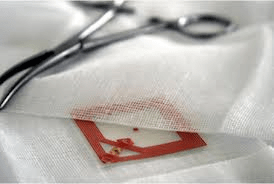
rfidWe note the increasing role of RFID (Radio Frequency ID) tags in our Process Strategy and Inventory chapters (Ch. 7, 12). Now, RFID Journal (Feb. 5, 2013) describes an exciting medical advance that will soon track surgical implants by placing the tags on implants and tools. The system, by Texas startup Innovapaedics, also includes a cloud-based server to store data and provide reporting to customers regarding the location, use and status of each instrument used during surgery, as well as devices implanted  into patients.

Innovapaedics’ 3-5-year goal is to offer a “Smart Implant” solution that would include RFID tags and sensors permanently attached to implants. After an item is implanted into a patient, its RFID sensors would detect pressure and temperature changes, among other events, in order to track a patient’s healing process, as well as the device’s condition, and transmit that information to a reader. In the short-term, meanwhile, the company has developed MedEx, an RFID solution for tracking implants prior to their use within a patient, to track which items were used on that individual. The resulting data is incorporated into medical and billing records.

MedEx also enables hospitals to track surgical tools. A tag can be permanently attached to each surgical tool, and the tag’s ID number is linked to specific data about that tool in the MedEx. As a new tray of tools is created for use during a surgery, each tag is interrogated as the tool is placed into the tray and linked to that tray’s RFID number. Post-surgery, the tools are cleaned and sterilized, and are then placed in a tray once more. MedEx  stores a record of which tools belong in that tray, and displays an alert if the wrong tool is placed there, or if a tool is missing. The software cannot only track the tray in which a specific tool is stored, or to which patient a particular implant has been administered, but also enable the reordering of inventory based on which implants were used.

Discussion questions:

1. Why is this an important OM advancement?

2. Describe other medical applications of RFID tags already in use–(see Chapter 5).

OM in the News: Shell Oil’s Use of Operations Technology in Drilling

Noble crew and imaging equipment

A new generation of digital technologies in offshore oil drilling ships is helping Shell Oil drill wells faster, more safely and at a lower cost than ever before. It is part of the technological revolution fueling North America’s oil-and-gas boom, writes The Wall Street Journal (Jan. 3, 2013), increasing the continent’s energy independence. The Noble Bully—a 30,270-gross-ton behemoth as long as two football fields—can guide a 21.5-inch-wide drill bit thousands of feet below the water’s surface to the center of a target 4 sq. ft. in size.

Innovations in information technology, the topic of Chapter 7, including powerful new data-imaging tools and predictive analytics, are making it possible for companies like Shell and Chevron to map and exploit previously uncharted oil-and-gas fields locked in shale and “tight” rock formations, or buried far below the ocean floor and obscured by thick layers of salt. Seven to eight feet narrower and 160 to 260 feet shorter than conventional offshore drilling vessels, the Noble Bully can operate as deep as 12,000 feet. Shell says it can drill as much as 40,000 feet below the seafloor.

The Noble Bully’s  sensors pick up more data than their predecessors from sonic blasts sent out by an exploration ship. Shell operates the highly automated drill ship with 160 workers—40% fewer than required on a typical vessel. Shell scientists working on shore analyze the data with artificial intelligence the company developed, and produce 3- and 4-dimensional maps of the oil reservoirs.

Safety is an almost constant topic of conversation aboard the Bully, where anyone—even visitors—have the authority to stop work if they think something isn’t right.

Discussion questions:

1. How is Shell enhancing oil drilling productivity?

2. What is the role of the operations manager in offshore drilling?

OM in the News: The March of Robots into China

Welding robots at Great Wall's Tianjin plant
Welding robots at Great Wall’s Tianjin plant

Step into the factory of Chinese SUV and truck maker Great Wall Motors, writes Businessweek (Nov.30-Dec.6,2102), and it’s easy to forget you’re in China. Swiss-made robots pivot and plunge, stamping metal door frames and soldering them to the skeletal vehicle bodies of a mini-SUV. Workers in hard hats are few and far between. “With automation, we can reduce our head count and save money,” says Great Wall’s manager, who has invested $161 million (about $50,000/robot) into mechanizing 4 plants with 1,200 robots. “Within three years, this cost will be completely paid for in savings from reduced worker wages.” After the robots were added, the number of welders dropped from 1,300 to around 400.

Last year sales of industrial robots in China reached 22,577 units, up 51% over 2011. That puts China just behind Japan and S. Korea, but ahead of Germany and the U.S., in the purchase of new robots. China is on track to become the world’s largest robot market by 2014. One factor driving the switch to robots is demographics. Next year China’s labor force will peak at 1 billion before starting to shrink. Labor shortages are already common and are driving wage inflation– up around 20% annually recently.

For the textile industry, facing ever-narrower margins, automation may be the only alternative to shutting down or moving. While some factories relocated to lower-wage Cambodia and Vietnam, sweater maker Milo’s Knitwear upgraded. After spending $1.9 million for 29 Japanese stitching machines, its factory has reduced staff from 140 workers to 6. Worker protests have also sped up the automation trend. Labor unrest at Foxconn has forced shutdowns at several of its facilities. Last year the company announced the ambitious goal of adding a million robots within three years. Foxconn will have at least 30,000 robots in China by year-end.

Discussion questions:

1. Why is automation such an important OM decision in China?

2. How has automation impacted manufacturing jobs in the U.S?

Teaching Tip: Pigs and Operations Management Ethics

 The Ethical Dilemmas at the end of each of our 17 chapters are a popular feature that many OM instructors assign as homework or use for lively class discussions. Some colleges, such as Benedictine University,  view ethics as an important part of their OM curriculum (as noted in their linked syllabus).  If you look over the Ethical Dilemma in Chapter 7, which deals with the trade-off between increased productivity/ lower costs of pork vs. the comfort of the pigs, you will appreciate the article in the New York Times (Oct.6, 2012) on this very sensitive subject.

The article opens: “Sow 44733 had broken the shoulder of one of her pen mates, rousted another who was huddled in the corner and was chewing on the ear of a third. Other sows in the pen sported abrasions, torn ears and bloody tail stumps. It was that kind of behavior that led hog farmers like Tom Dittmer to isolate sows in individual stalls called gestation crates that are barely bigger than the pigs themselves.”

“The reason the industry switched to crates wasn’t because we wanted to harm our animals,” Mr. Dittmer said. “We did it because we thought it was what was best for the animals.” The move also kept the price of pork reasonably low for consumers, he said.

Now, hog farmers are under increasing pressure from corporate pork buyers and animal rights groups to return to the old way of doing things: putting sows in group housing. In September alone, three companies — Dunkin’ Donuts, ConAgra Foods and Brinker (Chili’s) — announced that they would no longer buy pork derived from pigs housed in gestation crates. Farmers resent the tactics, saying they worry that the move will be unsustainably costly for them and result in soaring pork prices for consumers.

Research is mixed about which type of housing is best for the animals’ welfare, according to the American Veterinary Medical Association.

Want to ask your students what they think?

OM in the News: Baxter–The Smarter Robot

Robots are always an interesting technology topic in Chapter 7, and the latest Businessweek (Sept. 23-30, 2012) describes Baxter, a super smart robot that Rethink, Inc. believes will spark a manufacturing revolution. The firm hopes the robot, adept at the mindless repetitive tasks common on most assembly lines, can increase the productivity of U.S. manufacturers and help them retain business that would otherwise migrate overseas.

With 5 cameras, a sonar sensor that detects motion 360 degrees around it, and enough intelligence to learn tasks within an hour, Baxter is designed to work safely alongside humans and do simple jobs such as picking items off a conveyor belt. It’s also cheap enough, at $22,000 a unit, so that the investment math works: If Baxter performs 3 years of 8-hour shifts, it’s the equivalent of labor at $4 an hour. “We are spending hundreds of billions of dollars doing this kind of work in China,” says Rethink’s chief technical officer. “We want companies to spend that here, in a way that lets American workers be way more productive.”

Traditional assembly line robots made by companies like ABB in Switzerland and Yaskawa Electric in Japan, which can cost more than $200,000 apiece, do a few things extremely well, such as painting and welding, but require carefully organized and controlled environments. Most wouldn’t know if a human wanders close by, so they are often isolated in cages away from employees. Baxter, though, sits on a gurney and can be set down safely just about anywhere on a factory floor. Its eyes are on a swiveling computer screen and greet any worker who approaches. To teach Baxter a job, a human simply grabs its arms, simulates the desired task, and presses a button to set the pattern.

Discussion questions:

1. How can Baxter change manufacturing?

2. What is Rethink’s plan for the next generation robot?

OM in the News: Harley Goes Flexible

Our Global Company Profile that opens Chapter 7 describes the manufacturing process at Harley-Davidson’s plant in York, PA. The Wall Street Journal (Sept. 22-23, 2012) writes that “until recently, the company’s sprawling factory here had a lack of automation that made it an industrial museum. Now, production that once was scattered among 41 buildings is consolidated into one brightly lighted facility (see photo) where robots do more heavy lifting. The number of hourly workers, about 1,000, is half the level of three years ago and more than 100 of those workers are “casual” employees who come and go as needed.”

This revamping has allowed Harley to quickly increase or cut production in response to shifting demand. Harley got serious about cutting costs when Keith Wandell became CEO in 2009. On his first visit to the York plant, he declared the layout and working methods unsustainable and began scouting sites for a new plant to replace York. When the company notified its union that the plant would move unless it approved a new contract giving Harley more control over costs, union members voted overwhelmingly to make concessions, and Harley stayed in York.

Instead of 62 job classifications, the plant now has 5, meaning workers have a wider variety of skills and can go where needed. A 136-page labor contract has been replaced by a 58-page document. The pace of work is faster now, but managers and workers work together more smoothly, according to the Journal. In the paint department, for example, people used to do the same chore all day but now rotate through several tasks to avoid body strain and boredom.

Some items formerly made in York, such as brackets and screws, come from outside suppliers. Production fluctuates depending on day-to-day sales, so the company doesn’t have to stock up well ahead of the spring peak-selling period and guess which models and colors will be popular.

Discussion questions:

1. What major OM changes did Waddell make to turn Harley around?

2. What is the impact of job classification changes (a topic of Ch.10)?

OM in the News: Wal-Mart Checks Out Mobile Checkout

How can operations management play a role in cost savings at Wal-Mart? Check out this quote from The Wall Street Journal (Sept.1-2, 2012): “The company says it spends $12 million per second on cashiers’ wages in the U.S.”  At $12 million per second, it is no wonder that Wal-Mart is testing a checkout system that allows shoppers to use their mobile phones to scan items as they walk through stores and pay at self-service kiosks, skipping the cashiers’ lines.

Called “Scan and Go,” the mobile-payment app is the latest attempt by the Wal-Mart OM group to reduce long checkout lines.  The system does not yet allow customers to pay with their mobile device, but is meant to make scanning easier for them. Wal-Mart also just announced plans to add more self-checkout lanes, as only 1,600 of the 4,500 Wal-Mart and Sam’s Club stores in the U.S. include this option.

Retailers have been using self-checkout for more than a decade to try to reduce labor costs and speed up transactions, but not all chains have been happy with their experiences. Companies like grocery chain Albertsons and housewares giant IKEA  are actually eliminating self-checkout, citing lost revenue, theft, and lack of interaction with customers. Many shoppers also complain the self-service systems are balky.

The scanning idea could serve as a loyalty program for Wal-Mart, which does not issue discount cards to customers in exchange for the ability to collect data on their shopping habits. Scanning will allow the firm to collect data on what customers buy and how long they spend in stores–and to send shoppers coupons for competitive products in real-time as they scan items. “If you scan peanut butter and immediately a $2-off coupon pops up to buy a competing brand, Wal-Mart can change customer’s behaviors right there in the aisle,” says an industry consultant.

Discussion questions:

1. What are the advantages of mobile scanning/checkout?

2. Why are self-checkouts not universal?

OM in the News: Starbucks Process Improvement with Apps

Businessweek (Aug.23-30, 2012) provides a great example of business process improvement (Chapter 7) through Starbucks’ mobile payment plan program. Even before its recent $25 million investment in startup company Square, Starbucks had been processing a million mobile-phone transactions per week. “What mobile payments allows is an unprecedented relationship between us and our customer,” says Starbucks’ chief digital officer.

Starbucks released its first mobile app in 2009; it helped customers find stores, learn about coffee, and get nutrition information. In 2011, the chain released a more powerful Starbucks Card Mobile App, which also lets consumers pay at the register by waving a bar code on a phone’s screen in front of a scanner. Customers can load Starbucks’ digital prepaid card with an existing credit card.

Starting this fall, coffee lovers will be able to use smartphones to pay via an account linked directly to their credit cards. The mobile payment options also promise a profit boost for Starbucks. By letting its customers make purchases with their smartphones, Starbucks pays fewer fees—which sometimes top 2%—on credit-card transactions. Square says it can now process Starbucks payments at a lower rate than other payment networks.

From an OM perspective, the apps can also help sales by making store lines move 10 -20% faster during peak hours. Each 1% increase in a store’s capacity during rush hour translates into a revenue boost of up to 1%. “Current payment solutions don’t meet the expectations of customers or merchants,” says Wal-Mart’s VP. Since selling through a mobile app can cut transaction fees in half, the cost savings can make a big difference in retail, where operating margins are in the single digits (about 6% for Wal-Mart). The bottom line: Starbucks has created a successful mobile payments model that other retailers are following in an effort to reduce transaction fees.

Discussion questions:

1. What other mobile phone apps can increase OM efficiency?

2. How else has Starbucks increased productivity, as discussed in OM in Action boxes in the text?

OM in the News: Penney’s Turns to the iPad For a Cash Register

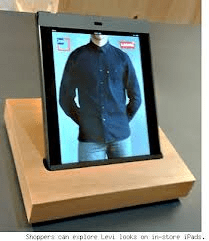
In Chapter 7, Process Strategy, we discuss the impact of new technology and equipment on the customer service experience. USA Today (July 25, 2012) provides a great example to use in class with a front page story that starting this weekend, salespeople in Penney’s new Levi’s shops will use only iPads to check out customers. All of Penney’s 1,100 stores will offer mobile checkout by the end of the year.

More than 6,000 Nordstrom salespeople are already using mobile devices to check people out, just like at Apple stores. “By the end of this year, Nordstrom salespeople will be able to do everything on their handheld devices that they can at a register,” says Jamie Nordstrom, grandson of the chain’s founder. “I believe the future of our point-of-sale systems is completely mobile,” he adds. “It’s hard to know whether it’s in one year or five years because the technology is evolving so rapidly.”

Several grocery stores — Costco and Sam’s Club are two — already use employees armed with mobile devices for “line busting.” The workers scan products for customers standing in lines and print a bar code that they can take to cashiers to pay. Nordstrom salespeople will still be able to make change, but not with the “cash registers of yesterday”. “As long as there is cash, we’ll always be happy to accept cash”, Nordstrom says.

Other stores where customers interact often with salespeople will likely start adopting mobile checkout. “If you go through the whole process of shopping with help along the way, why should you have to stop and be funneled to a line?” says an industry consultant.

Discussion questions:

1. What other technology changes are impacting OM in the retail scene?

2. How does the iPad build flexibility into the store’s operations?