
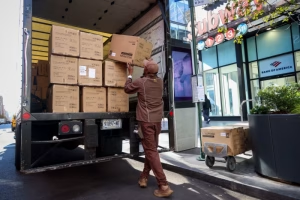
The company said the change will increase visibility throughout its small-package delivery network, while increasing delivery accuracy and reducing the manual labor needed to scan individual parcels.
“What this does is it offers our customers real-time, near real-time, visibility of where their packages are at within our network,” said a UPS exec.
The capability is a step beyond the shipment-tracking information widely used today, which relies on workers scanning bar codes as packages enter and leave warehouses or vehicles. That tracking point typically lags behind a package’s current location, leaving gaps in visibility where packages may be misplaced or lost.
UPS is now embedding RFID tags into shipping labels and has installed RFID sensors on all its U.S. delivery trucks, at its more than 5,500 retail stores and in its final-mile delivery centers.
The technology allows UPS to automatically sense and track when a package crosses a threshold into or out of a building or vehicle. That will give customers a more up-to-date, accurate picture of where packages are, though it does not include real-time location tracking.
The company in part uses the technology to identify what it calls misloads, where packages are loaded onto the incorrect delivery truck. The RFID tag on a given package sets off a sensor as it’s loaded into a delivery truck and makes a noise indicating if the package is on the wrong vehicle.
UPS said misloads have dropped near 70% since it started using the technology in 2024, and that the RFID technology will eliminate about 20 million manual scans per day.
The high cost of individual tracking devices and the complexity of small-package delivery networks have limited tracking technology to more industrial applications as well as shipping high-value goods such as healthcare products, electronics and luxury items. UPS said the cost of RFID tags has come down to a few cents each, allowing the company to deploy the technology at scale.
Classroom discussion questions:
- What are the advantages and disadvantages of RFID?
- Why are misloads to be avoided?

 Prof. Howard Weiss shares his insights with our readers monthly.
 During the last decade an average of 1,300 containers were lost at sea. In 2022, 661 containers were lost. In 2024, 576 containers that were lost. A notable cause of container loss is severe weather. In the 2024, three incidents off the Cape of Good Hope resulted in losses of 99, 44, and 46 containers, respectively. The region is known for its rough seas. However, due to Houti terrorists in Yemen, more ships are rerouting around Africa instead of passing through the Red Sea, increasing exposure to such risks. (About 1/3 of lost containers are eventually recovered).
 Nearly a third of global shipping could run on biofuel in 2030– up from less than 1% today. But the price advantage of biofuels would result in unsustainable demand. Carriers have invested in the use of biofuels derived from used cooking oil and animal fats. With the supplies limited, just 2.5 – 3% of shipping could run out of used cooking oil and animal fat biofuels by 2030. Two interesting facts:
 Dr. Misty Blessley, Associate Professor of SCM at Temple U., shares here thoughts with our readers on a regular basis.
 Temple U. Professor Misty Blessley describes a new technology that will uplift sustainability in the shipping industry.
 In the Red Sea, Houthi rebels have stormed onto cargo ships, causing freight rates to quadruple and setting a precedent that American vessels aren’t welcome across one of the world’s most vital transport lanes.
 In the fiercely competitive retail segment, three factors drive consumer choices: product availability, price and delivery speed. Minor variances in delivery time can considerably sway customer decisions.
 Prof. Howard Weiss shares his OM insights with us monthly.

 IKEA is today the world’s biggest seller of furniture, with 460 mostly franchise-operated stores spread across 62 countries that carry some 9,500 products. Its price-conscious shoppers wonder: How does a nice chair cost only $35?


