OM in the News: Amazon Is on the Cusp of Using More Robots Than Humans

The automation of Amazon facilities is approaching a new milestone: There will soon be as many robots as humans. The e-commerce giant, which has spent years automating tasks previously done by humans in its facilities, has deployed more than one million robots in those workplaces, reports The Wall Street Journal (July 1, 2025). That is the most it has ever had and near the count of human workers at the facilities.

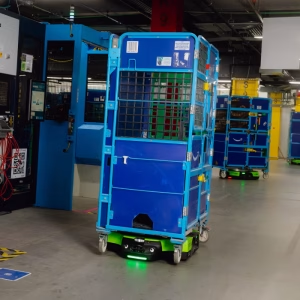
Mobile robots reposition package carts

Company warehouses buzz with metallic arms plucking items from shelves and wheeled droids that motor around the floors ferrying the goods for packaging. In other corners, automated systems help sort the items, which other robots assist in packaging for shipment.

One of Amazon’s newer robots, called Vulcan, has a sense of touch that enables it to pick items from numerous shelves. Amazon has taken recent steps to connect its robots to its order-fulfillment processes, so the machines can work in tandem with each other and with humans. Now some 75% of Amazon’s global deliveries are assisted in some way by robotics. The growing automation has helped Amazon improve productivity, while easing pressure on the company to solve problems such as heavy staff turnover at its fulfillment centers.

For some Amazon workers, the increasing automation has meant replacing menial, repetitive work lifting, pulling and sorting with more skilled assignments managing the machines. Amazon has trained more than 700,000 workers across the world for higher-paying jobs in mechatronics and robotics apprenticeships.

The number of packages that Amazon ships itself per employee each year has also steadily increased in the past decade to 3,870 from 175, an indication of the company’s productivity gains.

Amazon is also rolling out artificial intelligence in its warehouses to improve inventory placement, demand forecasting, and the efficiency of its robots. Amazon said it will cut the size of its total workforce in the next several years.

Classroom discussion questions:

  1. Research Amazon’s history of using robotics.
  2. What are the advantages of introducing more robots?

OM in the News: The Holy Grail of Automation–Now a Robot Can Unload a Truck


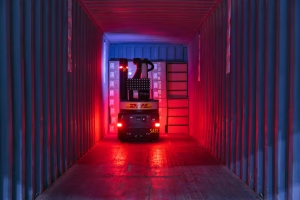
The robots are coming for the last human warehouse jobs.  Loading and unloading a truck is backbreaking, mind-numbing work that retailers and parcel carriers have tried to solve for years. Workers may not stay long in these jobs. Summers and winters are particularly grueling for anyone stuck in a metal trailer, slinging heavy boxes. Injuries are common.

Automating this process has long been the holy grail of warehouse logistics, writes The Wall Street Journal (June 24, 2025). When loaded, packages must be fitted together to fill the available space and be sorted by weight—with the heaviest items on the bottom—so they don’t topple or break. Unloading them is challenging, too, because the unloader must move in and out of a trailer, ferrying packages of different sizes and weights.

On a typical warehouse floor today, every task might be heavily automated—except for workers loading and unloading the trucks. People who have worked these jobs say they have to stand for extended periods, hefting boxes as heavy as 70 pounds. New advances in robotics are changing that.

Improved sensors and algorithms, advancements in AI and faster image-processing technology are making these robots proficient players in tasks that are like a game of 3-D Tetris. This shifts the burden of physical lifting from humans to robots. Proponents of the technology say it will mean more efficiently packed pallets, fewer damaged items and a lot of time saved. The machine-learning algorithm isn’t aware of what’s inside each package, but does know the item’s weight, approximate center of gravity and how fragile it is.

DHL’s Stretch robot can unload 580 cases an hour, twice the rate of a human unloader.

The robot will use the information it has on an item to choose the optimal pallet and determine where the it should be placed to minimize damage, but still allow the highest possible number of boxes to be packed in the given space.

DHL just signed an agreement with Boston Dynamics for 1,000 of these robots. United Parcel Service is also increasing automation at its facilities, including for loading and unloading trailers—a move that will help the company cut costs. FedEx has been testing and refining the truck-loading process in one of its facilities since 2023. Walmart also has introduced robots that can unload a truck.

Classroom discussion questions:

  1. Why is this an important OM advancement?
  2. How else are robots now being used in warehouses?

OM in the News: AI and Warehouse Supply Chain Disruptions

The ability to react quickly to supply chain disruptions is critical, and companies are under increasing pressure to predict and prevent them before they occur. Instead of managing reactively, firms are turning to artificial intelligence (AI) and predictive analytics to revolutionize operations, writes Material Handling & Logistics (Feb. 13, 2025). AI provides the tools and insights to anticipate disruptions and optimize processes in real-time.
By analyzing vast amounts of operational data, AI can identify patterns and trends that may indicate potential bottlenecks. This allows companies to foresee bottleneck issues such as labor shortages, equipment breakdowns, or delayed shipments before they occur, giving them time to adjust and implement preventive strategies.

At the heart of this proactive approach is predictive analytics, our topic in Module G. Predictive analytics uses historical data, machine learning algorithms and statistical models to forecast future events and behaviors. For example, if a shortage is predicted, the system can recommend adjusting staffing levels or reallocating resources to avoid delays. Similarly, predictive analytics can predict when certain equipment may require maintenance or inventory levels are likely to drop below critical thresholds, allowing a business to take preventive actions and avoid disruptions.

Bottlenecks are among the most significant threats to warehouse efficiency. These disruptions can lead to delays, increased costs and missed deadlines, impacting customer satisfaction and profitability. Predictive analytics allows businesses to foresee bottlenecks before they become critical. For example, suppose analytics indicate that a certain shipping lane will be delayed due to increased demand or reduced capacity. In that case, a warehouse can reroute goods to avoid congestion.

To summarize, there are four  key advantages of using AI in warehouse operations: (1) Improved Resource Allocation, (2) Increased Labor Efficiency, (3) Reduced Downtime and Delays, and  (4) Enhanced Decision-Making.

With real-time data and forward-looking forecasts, operations managers can make better, more informed decisions about handling day-to-day operations and long-term strategies. This leads to better outcomes and improved performance across the entire supply chain.

Classroom discussion questions:

  1. How can AI be used to improve warehouse operations?
  2. What is the difference between descriptive analytics and predictive analytics? (See Module G of your Heizer/Render/Munson text)

OM in the News: The End of the Forklift?

Some of America’s biggest manufacturers are backing away from forklifts, reports The Wall Street Journal (Jan. 5, 2024).  The vehicles have been integral to factories and warehouses for more than a century, but now companies are aspiring to go “forklift-free” to improve productivity and safety. Each year around 7,500 workers are injured in forklift-related collisions, tip-overs and other mishaps, while nearly 100 are killed. Orders for forklifts dropped 28% in 2023.

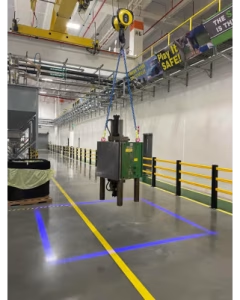
Ipex designed its new factory to rely on overhead cranes and hand-pushed electric pallet jacks

Plastic-pipe manufacturer Ipex designed its new factory in North Carolina to minimize the use of forklifts. That made the plant, which opened in 2023, a safer, quieter and less stressful workplace. “Employees feel like they can walk anywhere within the interior shop floor and not have to look out for forklifts,” said Ipex.

Mercedes is also reducing forklifts in its U.S. plants, replacing some with autonomous vehicles. Tesla is making a similar effort, using push carts and trailer-hauling “tuggers” inside its factories to cut down on traffic and injuries. Whirlpool’s washing-machine factories have been eliminating forklifts from production areas, and use robotic tuggers to deliver parts to assembly-line workers.

Forklift makers say they have added numerous safety features to their vehicles. These include high-visibility seat belts that make it easy to see whether an operator is wearing it, lighting that warns pedestrians a forklift is coming and sensors that slow the vehicle before a collision takes place. Forklift manufacturers say there is high turnover among drivers and lament what they call the glorification of unsafe operation. Dozens of TikTok and YouTube accounts feature videos showing drivers skidding, crashing and dropping oversize loads that smash across warehouse floors.

Classroom discussion questions:

  1. Why will it be difficult to totally replace forklifts?
  2. What are the safety issues that are frequently seen in factories with many forklifts?

OM in the News: Amazon’s New Robotic Warehouse and Humans

Amazon just opened its most-automated warehouse yet. But underneath the robotics and artificial-intelligence technology at the site, the facility will still rely on thousands of employees, writes The Wall Street Journal (Dec. 7, 2024). The 3 million-square-foot building in Shreveport, La., is Amazon’s first warehouse to use automation and AI at every step of the fulfillment process and be able to handle one million orders a day.

Amazon’s Sparrow device uses suction cups to lift items and artificial intelligence software to identify objects by color, shape and size

The facility shows how companies are spreading automation through their distribution centers to get online orders to consumers at an ever faster pace. The sprawling site also demonstrates the challenges Amazon and other companies face as they seek to turn over some of the most physically demanding and repetitive warehouse tasks to robots.

Amazon hired more than 1,400 people at the Shreveport distribution center and plans to eventually employ 2,500 workers picking orders, loading and unloading trucks and managing the robotics systems. The idea is to speed up operations, save on labor costs and make warehouses safer for the workers that remain. Amazon has been the subject of government scrutiny over the treatment of the workers at its facilities. The warehousing sector had one of the highest rates of injuries and illnesses in the U.S., with 4.7 cases recorded per 100 workers compared with the national average of 2.4 cases per 100 workers.

Some traditional warehouse roles have proved too difficult for Amazon to fully automate, however, partly because the company sells more than 400 million widely varied products that range in size, weight and fragility, from dog toys to toaster ovens. Humans can easily look into a storage container packed full of goods, identify a particular item and know how to pick it up and handle it, whether it is a bottle of shampoo or a sweater.

 “The tactile grasp that the human hand has, and the situational awareness and the perception of the human brain, is unmatched,” said Amazon’s chief technologist. Instead, robots at the facility carry storage containers full of merchandise to human employees who look inside and pick out the item a customer ordered, then place that item into a tote box that goes onto a conveyor belt and is taken to be packaged.

Classroom discussion questions:

  1. What are the advantages and disadvantages of automating warehouses?
  2. Why do warehouses have high injury rates?

OM in the News: Why Cold Food Storage is Hot

Fresh lobster from Maine. Bags of frozen peas. Racks of ribs, shrink-wrapped in plastic. Americans have come to expect that with a click of a button, almost any item, perishable or not, can be delivered to their homes the next day. The companies that makes this all possible are logistics operators, such as Linage and Americold, that most of us have never heard of but all of us depend on daily.

The cold-storage industry dates back to the 1800s, when a booming business selling blocks of ice enabled developers to build warehouses that could preserve food and extend its shelf life, writes The Wall Street Journal (July 27-28, 2024).

Technological breakthroughs in the early 1900s led to mechanical cooling systems that created more reliable, long-lasting cold storage. The invention of refrigerated shipping containers, trucks and railcars lengthened the food supply chain, enabling goods to travel around the world under safe conditions.

Frozen, concentrated orange juice hit U.S. grocery shelves after World War II and pushed more Americans to buy home refrigerators and freezers. What came swiftly after it was the fish stick and the TV dinner. And because then everyone had a freezer, the food companies start making stuff to put in it.

Sprawling cold-storage warehouses were built farther outside cities as Americans moved to the suburbs and began shopping at supermarkets weekly, rather than picking up fresh food daily. “The way our modern food system works is based on refrigeration,” said an industry expert. Cold storage is “the reason you can have tomatoes in the winter.”

The specialty warehouses also enabled the growth of the pharmaceutical industry in the U.S. The importance of cold storage was highlighted during the effort to distribute Covid-19 vaccines as drugmakers rushed to get shots that required storage at ultracold temperatures into the world.

The pandemic also changed the way Americans eat. Consumers over the past four years have switched to eating more meals at home as they cope with rising food costs. Shoppers are ordering ready-made meal kits and eating more frozen food. Frozen-food sales rose to $74 billion in 2023, up 33% above 2019. More than 18 million square feet of new temperature-controlled space has been built across the U.S. since 2019.

Our Podcast #14 “Feeding the World Through Complex Supply Chains” also deals with this topic.

Classroom discussion questions:

  1. How does this industry differ from traditional supply chains?
  2. What other reasons exist for the growth in demand for frozen foods?

Video Tip: Inside Amazon’s Strategy to Redefine Fast Shipping

In the fiercely competitive retail segment, three factors drive consumer choices: product availability, price and delivery speed. Minor variances in delivery time can considerably sway customer decisions.

Consumers often pay a premium for quicker delivery. This trend is particularly stark in the U.S. Here, e-commerce companies grapple with Amazon’s evolving delivery benchmarks, shifting from 3-day to 2-day, to 1-day and now same-day delivery in many areas. Amazon’s speedy delivery consistently outpaces other retailers, being powered by advanced robotics automation.

But to stay ahead of Target and Walmart, Amazon is overhauling its distribution network. The Wall Street Journal just visited a same-day facility to explore the company’s fast-shipping strategy and produced this excellent 8-minute video  that your students will enjoy.

Amazon launched Prime in 2005, with a revolutionary free Two-Day Shipping  on 1 million items. Today, Prime has more than 300 million items available with free shipping and tens of millions of the most popular items available with free Same-Day or One-Day Delivery. Across the top 60 largest U.S. metro areas, more than half of Prime member orders arrived the same or next day.

Here is how Amazon did it:

“Regionalizing” U.S. operations network They divided the country into 8 smaller, easier-to-reach regions with a broad selection of inventory in each region, making it faster and less expensive to get those products to customers. Previously, the firm fulfilled orders from operational sites across the country.  Over 76% of customer demand is now fulfilled within their region.

Selecting the Right Items Amazon uses increasingly advanced machine learning algorithms to better predict which items customers in various parts of the country will want and when they will want them, and then works with vendors to store those products closer to customers. This helps to ensure that we have the right inventory, in the right places, at the right time. Each same-day facility stores the top 100,000 items sold in the region.

Growing the Same-Day Delivery network Same-Day facilities are smaller buildings situated close to the large metro areas they serve, which decreases the distance to customers. These buildings are designed for speed with smaller footprints, streamlined conveyors, and picking directly to pack stations. As a result, the average time from picking a customer’s items to positioning the customer’s package on the outbound dock is 11 minutes in Same-Day facilities, more than an hour faster than traditional fulfillment centers.

Note that we highlight Amazon’s inventory practices in Chapter 12’s Global Company Profile on pages 490-491.


OM in the News: Robots Bringing a Human Touch to Warehouses

“Humanoid robots are on their way to warehouses as companies start to move beyond the disembodied arms, moving trays and other machines aimed at speeding up logistics operations,” writes The Wall Street Journal (June 13, 2023).

Agility’s Digit robot has ‘eyes’ that show people where it’s going

Agility Robotics, Figure AI and Boston Dynamics are among companies designing robots more closely modeled on human beings for use in distribution centers. The new machines are being engineered with the ability to walk around warehouses, reach items high on shelves, crouch to put things down and pick up and move boxes, defying some of the prior physical limits on automation. The devices are intended to help warehouse operators mitigate labor shortfalls and eliminate the need to redesign warehouses to match the capabilities of machines.

Logistics operators have been adding automation to their warehouses for years to speed up the stacking and retrieving of goods and to take some of the most burdensome, repetitive tasks off workers. Many of the devices are designed to work in concert with employees by taking on tasks such as hauling heavy goods or bringing totes of items directly to workers. Humanoid robots take that automation a step further, seeking to stand in place of a human employee.

Agility Robotics, which has received funding from Amazon, has made a human-shaped robot called Digit that is teal, silver and black with white animated eyes. (Click here for an 11 second video).The device stands 5 feet 9 inches tall, weighs 141 pounds and can carry up to 35 pounds. Its humanlike shape gives Digit the ability to just walk into existing infrastructure and existing workflows and start to do tasks. The robot is designed to take on jobs warehouse operators have trouble hiring people to do, including repetitive roles like loading and unloading storage containers.

Some companies, seeking to address labor shortages and rising labor costs, have moved toward building warehouses that are entirely automated, known as dark warehouses. That level of automation can cost tens of millions of dollars.

The humanoid robots do need breaks, even if not for the same reasons as humans.  Digit can operate for 2 hours with a 1-hour charge. That is well short of an 8-hour shift, but the machine is meant to work as part of a fleet, where two robots work while one charges.

Classroom discussion questions:

  1. What are the advantages and disadvantages of these “humanoid robots”?
  2. Can these robots replace warehouse workers totally?

Video Tip: Where New Warehouses are Booming–Loop 303

The growing logistics activity comes as many retailers and manufacturers are looking to reconfigure their supply chains, both to get closer to the big U.S. consumer markets and to get around the bottlenecks at traditional freight hubs.

The drive along the 36-mile length of the Loop 303 freeway around Phoenix takes under an hour. The trip goes fast, but not quite as fast as the land along the 303 is being gobbled up by developers and filled with massive manufacturing and logistics facilities. “Developers from all parts of the country have been planting flags in that area. For the most part, that corridor is spoken for,” says one developer.

The rush of activity along the 303 was triggered by a number of factors, chief among them being the rising costs of development in California. Slowly, companies were starting to realize they could build a distribution center or manufacturing plant in the Phoenix area for much less than a facility would cost in the major cities in California. And, the ports of Long Beach and the border with Mexico were within a few hours’ drive by truck.

“The Southwest Valley of Phoenix has always been the industrial and manufacturing corridor,” said an industry VP. “You can get to the ports in six hours, drop your shipment and get back home, all within allowable times.”

This 5-minute Wall Street Journal video (Oct. 12, 2022) takes a close look at one 17-mile stretch of Arizona’s Loop 303 highway where dozens of warehouses are springing up. Importers say regions like this one in Arizona are a good alternative to expensive and heavily-congested hubs like California’s Inland Empire, where space is scarce and comes at premium prices. Click here to watch it.

Classroom discussion questions:

  1. What are the advantages and disadvantages of opening warehouses on Loop 303?
  2. Of the 7 factors that impact location decisions discussed on pages 338-340 (see Chapter 8) in your Heizer/Render/Munson text, which applies here?

OM in the News: Amazon’s Forecasting System Misfires

Amazon expanded operations and staff during the pandemic, but demand hasn’t kept pace.

As Covid-19 spread in 2020, homebound customers turned to Amazon at an unprecedented clip. Orders neared that of the holiday season and the company was short-staffed and often out of stock on key items, pushing delivery windows from 2 days to weeks on some items. Founder Jeff Bezos greenlighted a strategy, guided by a revered internal forecasting tool, that overshot the long-term projections for demand. Instead of a permanent shift in consumer behavior, the pandemic-fueled growth in online shopping has slowed as in-person shopping has bounced back.

Early in the pandemic, Amazon opened hundreds of new warehouses, sorting centers and other logistics facilities, and doubled its workforce from 2020 to 2022, to more than 1.6 million people. But demand hasn’t kept pace with that planned capacity. Now new CEO Andy Jassy is cutting back the excesses. He is subleasing at least 10 million square feet of warehouse space, deferring construction of new facilities, and finding ways to end leases with outside warehouse owners. Jassy has also abruptly closed down the company’s bricks-and-mortar retail operation—68 stores—and is paring back its bloated head count.

Part of Amazon’s e-commerce challenges today, writes The Wall Street Journal (June 17, 2022), stem from a piece of technology long prized as a secret weapon, an internal forecasting system called Supply Chain Optimization Technologies, or SCOT. It was designed to incorporate a multitude of factors and spit out projections for product demand and the growth in logistics needed to fulfill it.

SCOT forecasts produced low, medium and high estimates. Because of unprecedented volume in the early days of the pandemic, Amazon repeatedly chose the higher end of SCOT’s estimates. Those estimates meant that the company needed many more fulfillment centers and other infrastructure to keep up. So Amazon aggressively built out new warehouses and transportation hubs, and went on a hiring spree to get customers their packages. But the forecasting technology wasn’t equipped to process an unforeseeable event like the pandemic and caused the company to commit to building infrastructure early in the pandemic that take 18 months to 2 years to come online. When the virus receded, Amazon was left with more planned capacity than orders.  After being understaffed for 2 years, the company was suddenly overstaffed.

Classroom discussion questions:

  1. Using Chapter 4 terminology, what type of forecasting system did Amazon employ?
  2. What could the company have done differently, in hindsight?

OM in the News: Amazon’s Capacity Issues

Amazon’s growth has skyrocketed throughout the pandemic, doubling the size of its operations and nearly doubling its workforce over a two-year period. While some of Amazon’s fulfillment network hires during the quarter covered employee absences amid the omicron variant surge, the company quickly transitioned from being understaffed to being overstaffed, resulting in lower productivity, reports Supply Chain Dive (April 29, 2022).

“Capacity decisions are made years in advance, and we made conscious decisions in 2020 and early 2021 to not let space be a constraint on our business,” said Amazon’s CFO. “During the pandemic, we were facing not only unprecedented demand, but also extended lead times on new capacity, and we built towards the high end of a very volatile demand outlook. ”

The tide has turned, however, as consumers have slowed their e-commerce spending activity in recent months. Net sales at Amazon’s online stores dropped 3% last quarter, while Amazon’s fulfillment expenses jumped nearly 23%. UPS, which counts Amazon as its largest customer, reported an unexpected drop in home delivery volume as March e-commerce sales saw their weakest gain in more than three years.

Amazon aims to rightsize its massive fulfillment network in response to demand now falling back to pre-pandemic levels. But this process won’t happen overnight. It will take several quarters for Amazon to grow into the current capacity it has built out. In July, the company was focused squarely on adding capacity to meet the current high customer demand. Three months later, labor was the company’s primary capacity constraint, creating $4 billion in added costs. In early February, omicron added to Amazon’s staffing challenges.

“We hired more people and then found ourselves overstaffed when the omicron variant subsided rather quickly, at least from our standpoint in warehouses,” said the CFO. “So, the issue has switched from disruption to productivity losses to overcapacity on labor.”

One issue that has been present throughout the past year is inflation, specifically for transportation costs and wages. The war in Ukraine has amplified inflationary pressures as fuel costs have climbed, and Amazon is looking for ways to offset the higher prices. This year, it hiked the price of its U.S. Prime membership and introduced its first fuel and inflation surcharge for sellers using its fulfillment services.

Classroom discussion questions:

  1. Summarize Amazon’s capacity issues and their genesis.
  2. Which of the 6 tactics for matching capacity to demand listed in Supplement 7 of your Heizer/Render/Munson text might Amazon apply?

OM in the News: Winners and Losers in the Supply Chain Crisis

“Some companies have spent their way out of logjams while others face another year of disruption,” writes Financial Times (Feb. 1, 2022). Splits are emerging in corporate America’s response to a supply chain crisis that is expected to last all year, heralding a wave of spending on new capacity, better data and support for weaker vendors.

Cadbury warned that supply ‘headwinds’ would grow stronger in 2022

Firms are complaining of shortages, delays and surging costs and are scrambling to procure semiconductors, waiting for components and suffering the effects of suppliers’ staffing gaps. GE said shortages of semiconductors, resin, parts and labor had affected its sales, while Caterpillar admitted that the challenges had been more significant than expected. The supply chain will be “the fundamental limiter of output” this year, said Tesla CEO Elon Musk, adding that the chip shortages it faces might not ease until 2023.

Companies including VF Corp (The North Face) said they had moved some production to suppliers closer to their biggest markets. Intel, Tesla and Texas Instruments just invested in new semiconductor facilities, saying these would give them more control of key components.
Companies with more domestic suppliers and those that had moved before the pandemic to broaden their supply chains were faring better than others with more complex, global logistics. Overall, it’s still the biggest companies that are able to buy their way out of the tough spots. Diverse strategies range from Sherwin Williams (the paint company) buying a resin supplier to VF Corp chartering “full-sized jetliners” to secure supplies. Some firms, like Lockheed Martin, are offering their suppliers financial help with cash infusions to keep them from going under and disrupting their supply chains.
The extended impact of Covid is forcing companies to question long-held beliefs about JIT production, including how few suppliers they depend on, how far critical components must travel and how little inventory they can hold.  Prologis, a property company, said that clients were saying that they would need 20-25% more warehouse space so they could carry more safety stock. “The engineers have designed supply chains around predictability and when that predictability goes away everything goes to hell in a handbasket,” stated the CEO.
Classroom discussion questions:
1. Why is JIT under fire?
2. Summarize the various strategies companies are using during this period.

OM in the News: Inside the Amazon Warehouse

“In his drive to create the world’s most efficient company, Jeff Bezos discovered what he thought was another inefficiency worth eliminating: hourly employees who spent years working for the same company,” reports The New York Times (June 15, 2021) in a very critical analysis of Amazon operations. Longtime employees expected to receive raises. They also became less enthusiastic about the work. Bezos came to believe that an entrenched blue-collar work force represented “a march to mediocrity.”

amazon1

In response, Amazon encouraged employee turnover. After 3 years on the job, hourly workers no longer received automatic raises, and the company offered bonuses to people who quit. It also offered limited upward mobility for hourly workers, preferring to hire managers from the outside. It worked. Turnover at Amazon is much higher than at many other companies — with an annual rate of 150% for warehouse workers, which means that the number who leave the company over a full year is larger than the level of total warehouse employment. The churn is so high that it’s visible in the government’s statistics on turnover in the entire warehouse industry: When Amazon opens a new fulfillment center, local turnover surges.

At Amazon, workers sometimes find out about a new shift only the day before, scrambling their family routine. When workers want to get in touch with human resources by phone, they must navigate an automated process that can resemble an airline customer-service department during a storm. Employees are constantly tracked and evaluated based on their amount of T.O.T., or time off task. One employee who had earned consistent praise was fired for a single bad shift.

As Bezos prepares to step down as CEO, he says he wants to change Amazon’s workplace culture, stating “We are going to be Earth’s best employer.” Still, it is not at all clear that Amazon will change its basic approach to blue-collar work. The constant churning of workers has helped keep efficiency high and wages fairly low. Profits have soared, and the company is on pace to overtake Walmart as the nation’s largest private employer. Bezos has become one of the world’s richest people. People want to believe that being a generous employer is crucial to being a successful company. But that isn’t always true.

Classroom discussion questions:
1. Evaluate Amazon’s warehouse employee strategy.
2, In Chapter 2, we we provide 3 strategies for competitive advantage. Which does Amazon employ?

OM in the News: Amazon and the Choke on NYC

When the pandemic gripped New York City, it propelled an enormous surge in online shopping that has not waned, writes The New York Times (March 4, 2021). But it also highlighted the need for an unglamorous yet critical piece of the e-commerce infrastructure: warehouse space to store and sort packages and satisfy customer expectations for faster and faster delivery. Amazon today has 12 warehouses in NYC and more than two dozen in the suburbs, totaling over 7 million sq. ft. Having warehouses in the city is more cost effective and can trim roughly 20% off delivery expenses compared with deliveries that originate in New Jersey. No other large competitor has a single warehouse in the city.

The onslaught of e-commerce has meant a flood of delivery trucks crowding streets and vying for limited parking, resulting in 500,000 parking violations

While New York’s narrow streets, chronic traffic jams and brutal lack of parking are all formidable challenges, the city also has a severe shortage of warehouses just when they are most needed to properly grease an efficient delivery system. Roughly 2.4 million packages are delivered in the city every day, nearly half a million more than before the pandemic, And 80% of deliveries are to residential customers, compared with 40% before the outbreak.

The online shopping boom will only worsen problems like congestion and pollution that were already bad before the pandemic, sending flotillas of delivery trucks across the city and flooding sidewalks and lobbies with packages. The e-commerce demands also place added pressure on warehouse workers and drivers to fulfill and deliver orders on time, as customers now expect. Just-in-time delivery and last-mile delivery means you need to be very close to customer to provide the level of service that people now expect.

Classroom discussion questions:

  1. Why is Amazon investing in so many warehouses in the area?
  2. Will online demand drop after the pandemic is under control?

OM in the News: How COVID-19 Changed Warehouses

In the first flush of the COVID-19 pandemic, warehouses rushed to do what they could to keep their workers safe. Now that warehouse managers have had time to see what’s worked, what hasn’t, and what they could’ve done better, they’ve adjusted their workflows, making changes that keep workers safe. Changes for worker safety dovetailed with a surge in demand for e-commerce, which has pushed warehouses to adjust at the same time, reports Supply Chain Dive (Oct. 27, 2020).

Warehouse managers are making investments in finding the right PPE and shifting workplace design to accommodate social distancing. “How do I incorporate temperature monitoring so I can screen potentially sick workers? How do I look at sick leave policies? How do I leverage technology to trace and track movement and contacts, if someone reports that they’ve tested positive?” are some of the questions managers are asking.

Most warehouse design changes are today less about the spaces and more about how workers move through them. Technology has played an important role, from applications that have employees do check-ins about potential symptoms, to algorithms that create routes for workers that ensure social distancing. An algorithm can recognize within an aisle if employees are following the 6 feet rule separation. AI and machine learning can use data from cameras that are networked into a central hub. Such a system knows how many people should be within that aisle within a specific time and if too many tasks are going to that aisle. Technology can also sense when an employee is not working at usual capacity, which could be a sign of illness. 

With hiring at full force this holiday season, companies are trying to “pre-skill” those coming into their workforce with a basic understanding of inventory management, transportation, logistics and manufacturing. And they are also working to “upskill” leaders to be able to assimilate technology with the workforce.

Classroom discussion questions:

  1. Prior to COVID-19, what were the main issues facing warehouse managers? (Hint: see Chapter 9’s section on Warehouse and Storage Layouts on p.375-77 of your OM text).
  2. What are the new OM warehouse issues?