
 AI is rapidly shifting from digital decision‑support to hands‑on operational control. As AI systems move into the physical world, they are reshaping core OM functions—especially inventory management, quality assurance, and maintenance. For operations managers, this marks a transition from AI as an analytical tool to AI as an active operational partner, writes The Orlando Sentinel (Sept. 20, 2026).
AI and Inventory Management Inventory systems (see Chapter 12 in your Heizer/Render/Munson text) are becoming increasingly autonomous. Instead of relying on periodic counts or manual updates, AI‑enabled sensors and vision systems now track materials in real time—monitoring stock levels, identifying misplacements, and even predicting shortages before they occur. Machine‑learning models can dynamically adjust reorder points, safety stock, and lot sizes based on demand variability, supplier reliability, and production schedules. The result is tighter control, lower carrying costs, and fewer stockouts.
AI‑Driven Quality Assurance Quality management (see Chapter 6) is undergoing a similar transformation. High‑resolution cameras, acoustic sensors, and thermal imaging feed continuous data streams into AI models capable of detecting defects far earlier—and more accurately—than human inspectors. Instead of sampling, AI enables 100% inspection at full production speed. These systems not only flag defects but also trace root causes by linking anomalies to machine settings, operator actions, or upstream materials. Quality becomes proactive rather than reactive.
Predictive and Autonomous Maintenance Maintenance (the topic of chapter 17) is perhaps the area where AI’s physical presence is most visible. Predictive maintenance models analyze vibration, temperature, and performance data to forecast failures before they occur. More advanced systems automatically adjust machine parameters to prevent breakdowns, optimize lubrication cycles, or balance loads across equipment. This reduces downtime, extends asset life, and stabilizes capacity planning.
The OM Challenge Ahead As AI becomes embedded in physical operations, managers must rethink process design, workforce skills, and risk management. Inventory, quality, and maintenance systems will increasingly operate autonomously—but they still require human oversight, ethical safeguards, and strategic alignment. The future OM leader must be fluent in both operational fundamentals and AI‑driven decision‑making.
Classroom Discussion Questions:
- How will AI‑enabled real‑time inventory, quality, and maintenance systems change traditional OM decision frameworks?
- What new risks arise when AI autonomously adjusts physical processes, and how should managers design controls to mitigate them?
 That’s the new reality for many manufacturers facing a stubborn obstacle: the ever-widening gap between data and decisive action. Now, a new class of digital entities is changing that equation. AI agents powered by decision intelligence are beginning to sense, reason and act across the manufacturing ecosystem, cutting decision latency from minutes to milliseconds.
 At that time, Starbucks’ CTO wrote: “The tech is currently live across thousands of coffeehouses, and will be in use across the chain’s entire North American system by the end of September. At cafes using the AI systems inventory is now counted 8 times more frequently, giving us real-time visibility and enabling faster, more precise replenishment.”
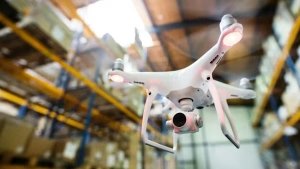 The business impact is measurable: reduced downtime, lower mobilization costs, reduced safety risk and faster response to problem detection. In the energy and utilities sector, drone-based inspection has been estimated to reduce inspection costs by 70% and downtime by 90%.
 Shoppers last year returned 17.6% of items they purchased online, valued at more than $247 billion and more than double the percentage of goods returned in 2019. Returns have become such an entrenched part of online commerce that companies have sprung up to handle the growing business. UPS acquired one of those specialized operators, Happy Returns, for $465 million.
 Professor Misty Blessley, at Temple U., cohosts many of our podcasts, as well as sharing her insights with our readers monthly.
 Dr. Prince Vijai is Assistant Professor of Operations at IBS Hyderabad, India. This post is based on his recent presentation at the DSI meeting in Orlando.
 Professor Misty Blessley at Temple U. looks at the “No- Buy” movement.
 At its core the movement is a consumer mindset focused on refraining from non-essential purchases for a set period, for some an entire year. Trending on online communities are people sharing their No-Buy challenges and success stories. Some are motivated to cut debt or save for long-term goals, while others are concerned with sustainability, minimalism, or anti- consumption values. Participation is surging, especially among millennials and Gen Zs, who are juggling inflation, student debt, and climate anxiety.
 For over a decade, self-checkout was the retail future, speed, convenience, and cost savings.
  Temple U. Professor Misty Blessley raises an interesting inventory issue–returns.
 This is the latest shift in a logistics effort that has historically left companies scrambling to meet the retail giant’s demands.
 Shrink is now one of the most frequently discussed topics among management at Home Depot, said the firm’s CFO, having moved onto its list of top priorities two years ago. That focus hasn’t changed even though some mitigation efforts, such as locking up certain items and using live-view parking lot cameras, are in place.