OM in the News: A Devastating Fire at a Major Ford Supplier

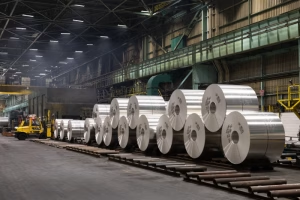
A late-night fire leveled a key part of a New York aluminum plant in hours. Its absence is going to disrupt business at Ford Motor  and other automakers for months to come.

The plant’s operator, Novelis, supplies about 40% of the aluminum sheet used by the auto industry in the U.S. Novelis said a major portion of its Oswego, N.Y., plant has been knocked offline until early next year.

Novelis produces more than 350,000 metric tons of sheet aluminum annually for the automotive industry

Ford is the biggest user of the plant. Its F-150 pickup, the top-selling vehicle in the U.S. and the automaker’s main profit driver, is one of the industry’s biggest users of aluminum, writes The Wall Street Journal (Oct. 7, 2025). The setback is severe.

“This represents a serious question for the production of F-150 because that’s the aluminum that comes out of Oswego,” said an industry analyst. Ford switched the F-150’s exterior to aluminum from steel a decade ago.

“Since the fire nearly three weeks ago, Ford has been working closely with Novelis, and a full team is dedicated to addressing the situation and exploring all possible alternatives to minimize any potential disruptions,” stated Ford.

It is the latest supply-chain snafu for the global auto industry, roiled in recent years by trade wars, a global semiconductor shortage and a potentially crippling reliance on China for rare-earth magnets used in vehicles.

Though automakers and other major industrial manufacturers worked to diversify their supply chains in the wake of the coronavirus pandemic, which shut off access to Chinese factories, companies often remain largely dependent on one or two makers for critical parts because of the high cost tied to employing multiple suppliers.

 Around a dozen automakers get aluminum from Novelis, including Ford, Toyota, Hyundai, Volkswagen and Jeep maker Stellantis.

Classroom discussion questions:

  1. Which tool(s) in Supplement 11 could be used by Ford in this situation?
  2. What do other major car manufacturers do ?

OM in the News: The Magnet Supply Chain and Auto Production Problems

In the auto industry, rare-earths are what allow electric-vehicle motors to function at high speed. They are also used in less exotic, though no less critical, functions performed by such parts as windshield wipers and headlights.

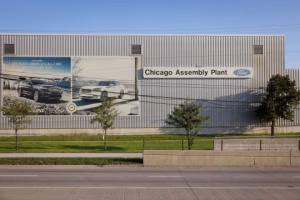
Ford shut down Explorer production at its Chicago plant in May because of a rare-earth shortage

China was supposed to have eased export controls on rare-earth magnets as part of a 90-day tariff truce agreement with the White House, but the country has slow walked license approvals for magnets. As exports of rare-earth magnets have virtually ground to a halt, carmakers face hard decisions about whether they can continue to keep some plants operating. Several production lines and plants across Europe have already closed, with more impacts expected in the coming weeks as inventories deplete, reports The Wall Street Journal (June 5, 2025). U.S., Japanese, and Indian vehicle production are also reducing or shutting down without more Chinese rare-earth components.

Car companies are looking at alternative sources for magnets in Europe and Asia, instead of purchasing them directly from Chinese factories as they do currently. But none of these sources would provide enough magnets to support the demand from the  industry. And  China controls almost all of the refining capability that transforms raw minerals into usable forms.

The lack of magnets hits EVs and hybrid vehicles harder than conventional cars and trucks. A typical EV contains far more rare-earths than a gasoline-powered model, but rare-earth magnets are found throughout any modern vehicle.

One option to conserve dwindling magnet supplies is reverting to older electric-motor technology that doesn’t make use of rare-earth magnets. Carmakers stopped using those motors because the current versions are cheaper and more efficient. They are also considering stripping out some premium features, such as adjustable seats, that make use of several tiny electric motors. High-end speaker systems that use rare-earth magnets could also be replaced with downgraded versions.

Classroom discussion questions:

  1. As Ford’s head of supply chains, what are your options?
  2. What is the long-term solution?

OM in the News: Top Five Global Supply Chain Risks

The supply chain landscape continues to evolve at an unprecedented pace. A new report in Material Handling & Logistics (Jan. 15, 2025), identifies the top five most likely supply chain events that could impact companies in 2025. 

Climate Change — 90% Risk Score Driven by shifting climate patterns and record-high temperatures, extreme weather events are a dominant risk to the supply chain. Volatile flooding has the potential for deep disruption. Indications point to the state of ocean temperatures being elevated in 2025 and beyond, with the potential for record-breaking highs.

Geopolitical Instability with Increased Tariff Risk – 80% Risk Score

The following major geopolitical events are likely to impact global trade in 2025:

• Ongoing Houthi attacks on cargo and container ships in the Red Sea continue to lead to longer transit times and equipment imbalance.

• Continued conflict in Ukraine could destabilize manufacturing and trade activities, putting European economies at further risk.

Increased Chinese military drills near Taiwan could hinder trade through major sea routes, affecting global container shipping flows.

*The automotive, semiconductor, and manufacturing industries are possibly at risk due to proposed tariffs by the U.S.

Cybercrime – 75% Risk Score. Escalating cybersecurity risks in 2025, driven by the growing reliance on AI, IoT devices and interconnected systems include:

• Growing reliance on AI and cloud computing within supply chains is creating new “back door” opportunities for bad actors.

•Cyberattacks via sub-tier supply chains where criminals can more easily exploit common programming errors and vulnerabilities, allowing them into organizations via phishing and software connection links.

Rare Metals and Minerals– 65% Risk Score

• Within a politically charged atmosphere between the West and the major commodity producers – China and Russia – companies will face new tariffs and sanctions on critical metals.

• China could impose broader export restrictions, highlighting the need to diversify sourcing strategies. Lack of supplier diversity complicates procurement, leads to supply shortages and makes the price of affected commodities particularly vulnerable to trade tensions and eventual tariffs or sanctions.

 Forced Labor – 60% Risk Score A growing crackdown on forced labor across industries will increase pressure on companies who are facing scrutiny to manage and eliminate suppliers violating human rights. Anticipated risks in 2025 include: Labor conditions in China, a cascade of legislation to address lax forced labor issues, the global concentration of commodities (like palm oil and vanilla) that originate in countries cited for modern slavery.

Classroom discussion questions:

  1. What can an OM team at a manufacturer do to mitigate these risks?
  2. Do you agree with these rankings? Would you add other risk factors?


OM Podcast #29: The Art & Science of Developing Supply Chain Strategies

Happy New Year!  After a brief end of semester break to enjoy the holidays with family, we’re back with the first podcast of 2025.  In this podcast, Barry Render interviews Alex Klein, Senior Manager of Supply Chain Solutions for APL Logistics, a third-party logistics provider.  Alex and Barry discuss the art and science of developing supply chain strategies for shippers with three fascinating, wide-ranging real world examples from Alex’s career.

Transcript

A Word document of this podcast will download by clicking the word Transcript above.


Have you subscribed to this podcast on Apple podcasts? Just go to your Apple podcasts app, search “Heizer Render OM Podcast,” and subscribe to get all our podcasts on your mobile device as soon as they come out!

Instructors, assignable auto-graded exercises using this podcast are available in MyLab OM. See our earlier blog post with a recording of author and user Chuck Munson to learn how to find these, or contact your Pearson rep to learn more! https://www.pearson.com/en-us/help-and-support/contact-us/find-a-rep.html

OM in the News: Navigating Supply Chain Disruptions

“Historically, supply chain teams react to crises only after they have already begun,” writes Material Handling & Logistics (Dec. 19, 2024). A crisis starts and the team goes into fire-fighting mode. After the situation is remedied, teams return to business as usual, only to await the next crisis. Balancing strategic imperatives with solving these short-term crises is the key to effective supply management.

For years, supply chain professionals have been forced to play defense, constantly reacting to minimize disruptions as they arise. This approach not only diminishes employee productivity by forcing them to constantly switch between projects and contexts, but it also undermines the perception of the function’s strategic importance.

The Panama Canal is no stranger to challenges and complexities brought about by natural disasters, geopolitical tensions, or technical failures

But new technology is transforming the way supply chains are managed. Instead of addressing problems as they arise, procurement professionals can identify opportunities for strategic value early and often, developing proactive response plans for dealing with predictable disruption events. While the specific timing and severity of disruption events like hurricanes, port closures, labor strikes, or country shutdowns are difficult or perhaps even impossible to predict, there are a finite number of event types each year that can disrupt supply chains, and thus a finite number of response plans that can assure resilient continuity of supply.

With the advent of new predictive procurement tools like those we discuss in Module G (Applying Analytics to Big Data), supply planners and purchasing teams now have the capacity to reduce the chaos of unexpected disruptions.  AI-driven tools are now helping to streamline and automate labor-intensive tasks, allowing procurement teams to quickly identify alternative suppliers and manage spot-market opportunities when unexpected challenges arise. By analyzing data trends, such as historical supplier performance metrics and environmental factors, these predictive procurement systems enable businesses to make more informed decisions proactively.

Identifying alternative sources of supply within a company’s existing supplier base is key, since qualifying new suppliers can be time-consuming, and expanding the total number of suppliers may introduce unnecessary complexity. Also,  securing carriers with secondary capacity is equally important, as logistical challenges often arise when transport routes are disrupted.

Classroom discussion questions:

  1. What tools do AI provide supply chain planners?
  2. What canal issues have companies faced the past two years, and how have they dealt with them?

OM in the News: Hurricanes and a Rare-Earth Supply Chain Vulnerability

Hurricane Helene left widespread destruction in N. Carolina a few weeks ago. One of the towns impacted was Spruce Pine, the location of the world’s largest deposit of high-purity quartz, an ingredient used in semiconductor manufacturing. Two mining companies that operate in Spruce Pine had to halt operations due to flooding and damage to infrastructure in the area.

The global semiconductor industry is dependent on Spruce Pine as the primary source for  virtually all high-purity quartz it consumes, as it is one of only a few places in the world where such quartz is known to exist. The quartz is used to create chips that power everything from laptops to automobiles.

The disruption in Spruce Pine is an example of a single point of failure – a situation in which a system is configured in such a way that failure in one part of the system causes the entire system to fail, a topic in Ch. 17. Avoiding single points of failure comes down to practicing good risk management, writes Industry Week (Oct. 24. 2024):

  • Are there any suppliers (or suppliers of suppliers) that are the sole manufacturers of a certain input? (See Ch. 11)
  • How likely a disruption is to occur – and if it occurs, how impactful the consequences will be. (See Supp. 11)
  • There are four categories of risk controls: avoidance, mitigation, shifting the risk to another party, and accepting the assessed level of risk.

One classic risk mitigation strategy is diversification – in the case of the supply chain, this means using multiple sources of supply. Some limited sources of quartz do exist in other nations. Another is holding an adequate cushion of inventory (see Ch. 12) that can ensure operational continuity in case of a disruption of supply.

Further, AI and machine learning can enable companies to gain critical visibility into their supply chains by aggregating data from multiple sources, such as from vendors, open source repositories, IoT sensors, and so on. Such analytics can answer supply chain questions that are descriptive (how many days of inventory are on hand), diagnostic (why isn’t there enough inventory), predictive (what will happen if supply is disrupted), and prescriptive (what is the best course of action to take to mitigate disruptions)–all topics in Module G of your Heizer/Render/Munson text.

Classroom discussion questions:

  1. What other natural disasters in the past 20 years have impacted the computer industry?
  2. What does it mean to “map out your supply chain”?


OM in the News: The Rocket Fuel Supply Chain

An ammonium perchlorate plant explosion in Nevada demonstrated the vulnerability of a key part of the supply chain for many commercial and military rockets.

In Chapter 11 and Supp. 11, we discuss the importance of having multiple suppliers for critical components/parts. Yet the Pentagon long relied on one U.S. company to make the main ingredient–ammonium perchlorate fuel– that powers its most potent missiles.

Most of that fuel still comes from a specialty-chemicals company in Utah called American Pacific. It is an example of the single-source chokepoints that Pentagon logistics experts have long flagged as a national-security risk, reports The Wall Street Journal (April 28, 2024).

Despite efforts to diversify, many weapon materials have no U.S. manufacturers. Others have only one source or a dominant provider. The supply-chain snarls caused by the pandemic heightened officials’ sense of urgency by exposing other materials only made in adversarial countries such as China.

Northrop, which is best known for making stealth jets such as the B-21 Raider, also makes missile-defense systems and solid-rocket motors that need ammonium perchlorate to fire. It tried to lower the prices it paid for the chemical by investing more than $100 million to build production lines in northern Utah. But its effort has been slow to take off. Cost overruns bedeviled the program, making expense management a priority for the company.

As one of two major U.S. solid rocket makers, Northrop has long been a big buyer of ammonium perchlorate. The company’s rocket motors are used in missile systems such as Lockheed Martin’s Guided Multiple Launch Rocket System. The U.S. has sent thousands of these missiles to Ukraine. The military’s exacting requirements for its arsenal—which include at least a year of testing materials for shelf life and performance before they can be certified for specific weapons—have limited supply of the Northrop-made ammonium perchlorate. Higher prices for materials such as ammonium perchlorate can dent contractors’ profits on so-called fixed-price contracts when they are left on the hook for cost overruns.

Classroom discussion questions:

  1. Which of the risks in Table 11.3 (page 448) of your Heizer/Render/Munson text apply here?
  2. Why can’t Northrop obtain the fuel it needs?

OM in the News: The Key Bridge Collapse and Auto, Coal and Tofu Supply Chains

A containership plowed into and destroyed a major Baltimore bridge this week, causing deaths and disrupting one of America’s busiest ports. The Singaporean ship, called the Dali, lost propulsion and struck the Francis Scott Key Bridge, sending large sections of the steel truss bridge tumbling into the river below. The collapse severed a part of Interstate 695.

The bridge collapse stands to snarl shipping along the East Coast for months, reports The Wall Street Journal (March 27, 2024). Companies that transport cars and coal, two of the key cargoes that run through Baltimore, are already looking for alternative destinations. The Maryland governor said it would take a “long-term build” to replace the bridge. “There’s no question that this will be a major and protracted impact to supply chains,” said the U.S. Transportation Secretary.

The Port of Baltimore is the 17th largest in the nation. It handled 52.3 million tons of foreign cargo worth nearly $81 billion in 2023, and creates more than 15,000 jobs. Some 800,000 vehicles passed through the port in 2023, making it the top port in the nation for auto shipments. The port ranks second in the country for exporting coal and is a niche port for tofu and soybeans.

All vessel traffic in and out of the Port of Baltimore is suspended. Ports in Norfolk, Va., and the New York and New Jersey area are expected to pick up most of the diverted ship traffic. All East Coast ports have become more important in recent years as the U.S. attempts to boost its trade with friendly nations and reduce geopolitical risks related to trade with China, which generally happens via West Coast ports.

Baltimore port’s suspension is one more disruption in an already-stressed system for the global supply chain.  Cargo will now have to be rerouted to other ports, which means figuring out where there is enough capacity to move things. The biggest problem is the effect on other ports. Many ships stuck in the port were destined to make stops at other U.S. ports to load and unload goods before heading overseas, a complicated logistical dance now scrambled.

Classroom discussion questions:

  1. How can supply chain managers deal with a situation like this (which we call a “super-event” in Supplement 11 of your Heizer/Render/Munson text)?
  2. What other events that have impacted global shipping have taken place in recent years? (Hint: think canals)

OM in the News: Two Canals–Two Problems

More than 50 ships queued to cross the Panama Canal on a recent day—from tankers hauling propane to cargo ships packed with food. A prolonged drought has led the canal’s operator to cut the number of crossings, resulting in longer waits. The tolls that ships pay are now around 8 times more expensive than normal. A single Panama Canal crossing costs around $500,000. But the canal operator has cut the number of daily ship crossings in half (from 36 to 18)  and shippers have to go through a bidding process where the highest offer (sometimes $4 million) secures a crossing.

A Houthi helicopter attacking a ship off the coast of Yemen

Over 7,000 miles away, vessels that move containers through Egypt’s Suez Canal are waiting for naval escorts or avoiding the passage altogether to take a much longer voyage around South Africa. Ship operators fear that their crews could be imperiled on the journeys through the Red Sea by missile or drone attacks from a Yemen-based rebel group. Houthis have attacked more than 50 ships since November​, including a cargo vessel loaded with fertilizer​ that sank into the Red Sea and another that resulted in three deaths.

The Suez’s problems are geopolitical and those in Panama are climate-based, but both are roiling global trade and supply chains, writes The Wall Street Journal (March 11, 2024) Cargo volumes through the Suez and Panama canals have plunged by more than a third. Hundreds of vessels have diverted to longer routes, resulting in delivery delays, higher transportation costs and economic wreckage for local communities.

Ship operators are bracing for months of uncertainty in the waterways where some 18% of global trade volumes crossed last year. It’s the first time that both are disrupted simultaneously. Daily freight rates on some routes between Asia and the U.S. surged to more than $20,000 per box, five times higher than current levels.

Businesses are starting to feel the ripples. Tesla and Volvo paused vehicle production for 2 weeks in January because of parts shortages. Some apparel companies opted for their spring fashions to be delivered by air instead of sea to ensure items arrived on time. As more businesses return to pre-Covid practices of keeping minimal inventories and rely on timely deliveries, they are more vulnerable to disruptions if bottlenecks at the two canals continue.

Classroom discussion questions:

  1. What options do shippers have?
  2. How can supply chain disruptions be avoided?

OM in the News: Shipping Dangers on the High Seas

Ships today handle more than 80% of global goods. And the modern economy rests on the rule that ships of any nation may sail the high seas. “Suddenly, that pillar of the international order shows signs of buckling,” writes The Wall Street Journal (Feb 1, 2024). 

In the Red Sea, Houthi rebels have stormed onto cargo ships, causing freight rates to quadruple and setting a precedent that American vessels aren’t welcome across one of the world’s most vital transport lanes.

Open oceans allowed a global economy to emerge from the wreckage of two world wars. The freedom for all container ships to safely ferry goods on the high seas helped lift China from poverty, turn the U.S. into a country of middle-class consumers and cement the dollar as the world’s reserve currency. Until the 20th century, trading nations competed in blood for the right to ship merchandise to foreign ports; these days they compete on price and quality.

Only eight decades separate the present from a past when most manufactured goods moved by land and a ship was only as safe as the state protecting it. Less than 500 million tons of dry cargo crossed the seas annually in the 1950s. That world was dotted with small manufacturers serving local buyers. Today, container ships carry  23 times more tonnage, integrating a global economy of mammoth conglomerates targeting whichever customer on earth offers the most profit, soonest. That integration has driven down costs, allowing IKEA to cheaply sell identical sofas in 59 countries and McDonald’s to fry Idaho’s Russet Burbank potatoes around the world.

But it has also made car factories, big-box retailers, fashion houses and electronics dealers significantly more vulnerable to even the smallest snags: Witness the tens of billions of dollars in trade held up when a single cargo ship, the Ever Given, ran aground in the Suez Canal for six days of 2021. Or the supply-chain breakdown that unfolded as the Covid-19 pandemic left container ships log-jammed outside Asian and American ports.

Governments from Europe to Asia that have grown prosperous and accustomed to safe seas want to keep maritime chokepoints open, particularly the Suez Canal, the Taiwan Strait and the Horn of Africa. Worldwide, the average cost of shipping a 40-foot container has jumped 2.7-fold in the past 3 months, to $3,964.

Classroom discussion questions:

  1. What can operations managers do to address this risk?
  2. In Supp. 11 of your Heizer/Render/Munson text (see page 477), transportation mode analysis is introduced. How can this model be used to deal with Red Sea disruptions/costs/dangers?

OM in the News: Apple’s Supply Chain and Climate Change

Torrential rains flooded Guangzhou this year, where Apple has 71 facilities.

Few global multinationals have been more vocal and forthright in their ambitions to take on climate change than Apple. Yet Apple’s vast supply chain — comprising more than 400 facilities across 180 regions in nearly 30 countries– stands in the path of some of the most damaging effects of climate change itself, .

Based on global databases of power-generation, extreme weather, flood zones, economic impact and carbon emissions, the very regions most vulnerable to climate change are those with the highest concentration of manufacturers, writes Bloomberg,com (Sept.  26. 2023). This risk isn’t exclusive to Apple. Global companies including Samsung, Sony, and Dell procure from many of the same vendors.

Put simply, the belt of the planet where natural disasters will intensify most rapidly due to global warming — from floods and heatwaves to increasingly powerful cyclones — is precisely the one where Apple has built its manufacturing footprint. It’s most visible in a swath of Asia from India to Japan.

We’ve already seen the damage weather disasters can do to multinational manufacturing operations. Floods across Thailand in 2011 shuttered more than 14,000 businesses, throwing a wrench into global automotive and electronics supply chains that were dependent on low-cost manufacturing. It was the biggest flood disaster in insurance industry history, causing about $55 billion of losses and slowing deliveries of Apple computers as component suppliers were forced to suspend work.

Much of the world has since made efforts to prevent such a disaster. Toyota, a pioneer of JIT, raised the time it held onto its inventory from 30 days to 49 now. Apple’s inventory days increased from 5 to 11 since the 2011 floods. Overall, larger inventories make supply chains more resilient to disaster — but they also cost money because of capital tied up in warehouses. Despite this, the countries in Asia where Apple’s supply chain has been built are also some of those that will be most prone to floods. Power cuts pose similar risks to manufacturers. A heat wave last year left India’s grid on perilously thin margins as coal-fired generators ran short of fuel.

Apple’s plans for greening its manufacturing network illustrate the challenge. The company has called on its suppliers to follow its own path to zero-carbon power by 2030. Yet many of the countries on which it is most dependent have unusually high shares of fossil fuels in their grids, with coal accounting for more than 60% in China and Indonesia, and nearly 75% in India.

Classroom discussion questions:

  1. What can Apple do at this point?
  2. What technique in Supp. 11 in your Heizer/Render/Munson text can be applied to analyze potential natural disasters?

OM in the News: The UAW Strike and Supply Chain Tiers

As the United Auto Workers strike continues, risks of disruption are compounding for automotive supply chain managers, reports Supply Chain Dive (Sept. 20, 2023).

The union has already idled production lines at three plants in response to failed negotiations with Ford, GM and Stellantis. As the UAW threatens further work stoppages, supplier health may be at risk.

“Depending on how deep this strike goes, it can be really challenging for the suppliers to stay afloat. Risk is particularly focused on the Tier 2 and Tier 3 suppliers,” said one industry expert. He added: “Tier 1 firms should be talking to downstream suppliers, asking: ‘How are your financials? When we do get out of this, are you going to be able to ramp back up?’”

To be proactive, supply chain managers can streamline various processes which include order intakes, raw material and labor planning.

Order cancellations from the affected assembly plants can bottleneck the entire supply chain. Suppliers can continue to build parts regardless of canceled orders, but if the customer refuses to accept deliveries, then suppliers need to pay to store those parts. Demand for the parts and materials will decrease or even cease as the automakers cancel firm orders for parts and future orders in the coming weeks and even months, depending on the duration of the strike.

As a result, the supply chain will likely feel lingering impacts even when the strike eventually ends. For instance, suppliers who may have furloughed workers might take a while to get operations up and running. If more automaker plants get impacted, downstream suppliers may need to reboot their systems.

Ripple effects will move across the entire supply chain. Tier 1 suppliers with strong balance sheets will be fine. But Tier 2 and Tier 3 suppliers may struggle with cash flow as orders are canceled. Secondary effects are already being seen. GM is temporarily laying off employees at its Fairfax plant — which is not included in the first wave of strikes — as that facility’s operations are disrupted from a lack of stamping parts from the Wentzville facility, which is on strike. While supply chain managers may be able to keep things moving, operations get tricky if the UAW goes after engine plants. Shutting down plants where engines are built will cripple other plants across the U.S., Canada and Mexico.

Classroom discussion questions:

  1. What are Tier 2 and Tier 3 suppliers? Give an example of each.
  2. What are the issues underlying the UAW strike?

OM in the News: The Bullwhip Effect Hits Tyson Foods

Two years ago, chicken breasts were coming down the processing line at Tyson Foods’  Arkansas plant so fast the machine slicing them into 15-gram nuggets for Chick-fil-A would occasionally break down.

Now, the line has stopped—for good.

After pushing its plants and staff to increase production of nuggets, breasts and wings as the Covid-19 pandemic eased, Tyson is pulling back, reports The Wall Street Journal (Sept. 6, 2023). The company announced the Arkansas plant would close, one of six planned shutdowns in an effort to cut costs. Tyson’s chicken business, which produces 1/5 of the U.S. supply, is grappling with flat demand and a drop in wholesale prices, which some industry experts say Tyson itself exacerbated by ramping up production.

As the pandemic eased, demand for chicken surged as consumers headed back to restaurants, and fast-food chains capitalized on a craze for fried-chicken sandwiches. Chicken companies such as Tyson, Pilgrim’s Pride and Wayne-Sanderson Farms were challenged to keep up, as processing-plant jobs remained hard to fill.

Pumping out more poultry at each plant and capturing more market share from competitors became a central part of Tyson’s efforts to fix its struggling chicken business, which already had problems hatching enough birds and staffing its processing lines.

The company was killing 37 million birds a week at its processing plants during 2021. By 2022, the company had boosted that to 39 million, and Tyson said it intended to process 42 million chickens a week by the end of the 2023 to boost volume and gain market share.

Nationally, about 162 million chickens on average were slaughtered weekly during in 2021. That number rose to 164 million in 2022. As it pushed to produce more chicken, in a classic bullwhip effect (see pages 473-475 in Supp. 11 of your Heizer/Render/Munson text), Tyson miscalculated demand. In late 2022, the company wrongly predicted how much chicken grocery stores would buy for their meat cases and produced too much of the wrong type.

Tyson closed down two plants in May, laying off nearly 1,700 workers. (The company ousted the president of its poultry business shortly thereafter). Last month, the company closed an additional four plants, which employ about 3,000 workers. The four account for about 10% of its slaughter capacity.

Classroom discussion questions:

  1. Explain the bullwhip effect.
  2. What mistakes did Tyson make?

Video Tip: The Bullwhip Effect Hits Stores This Season

This could be the year of clearances and deals. Retailers have seen a surge of inventory as they found themselves carrying too much stuff that consumers no longer want so much of, including basic apparel, home appliances and furniture. says The Wall Street Journal (Oct. 5. 2022) in this 4 minute video (click here).

Ahead of last holiday season, retailers ordered with plenty of cushion in mind to prevent empty shelves. Now a bullwhip effect, which we discuss in Supplement 11, could be in store. The latest indication was from Kohl’s which reported that inventory rose 40% compared with a year earlier.  Walmart and Target saw inventory swell by 32% and 43%. Off-price retailers Burlington and Ross Stores indicated that they also saw closeout inventory start to skyrocket.

There are broadly two shifts going on that threw a wrench to retailers’ inventory planning. One is a shift from discretionary to essentials, which both Walmart and Target saw. And within discretionary spending, consumers are still spending, but getting pickier with their dollars. Kohl’s, Target and TJX Cos. all said sales in the home category have declined.

Spending instead is shifting to what shoppers need as they go back to the office, attend concerts and travel again such as dressier apparel, makeup and luggage. This isn’t an entirely surprising or alarming picture of consumer health, but low-income consumers clearly are feeling the pinch from inflation, which outpaced wage growth for 5 consecutive months. Walmart, for example, said some consumers are switching from gallons of milk to half gallons. They also are switching away from name brands to private label on categories such as deli and lunch meat.

Retailers with slower inventory turns—such as department stores and apparel sellers—might find current conditions especially difficult to navigate. On average, Macy’s  and Kohl’s sold and replaced inventory 3.88 times and 4.34 times, respectively, last year. By contrast, Walmart, Target and off-price retailer TJX all turn over inventory more than 6 times a year.

Retailers were on a high last year when everything—supply chain delays, low inventory, homebound customers and stimulus checks— conspired to feed their bottom lines. A comedown was inevitable.

Classroom discussion questions:

  1. Explain how and why the bullwhip effect takes place.
  2. Inventory turns are illustrated in Example 3 in Chapter 11 (see page 460). What do they mean and why are they an important measure of supply chain performance?

OM in the News: An Auto Parts Maker Adapts to Russia’s Invasion

Leoni’s CEO addresses staff at a town hall meeting in western Ukraine.

After Russia invaded Ukraine on Feb. 24, reports The Wall Street Journal ( April 12, 2022), many Western companies in Ukraine packed up and tried to transfer production elsewhere. The sudden stoppages raised concerns among Ukrainians that some of the factories would close for good. Leoni, which makes auto wire harnesses (simple but vital contraptions that help organize electrical and data wires in a car), came close to leaving too. Within hours of the invasion, the company shut its plants. It planned to shift production to Romania and other sites outside the country, uncertain when production would resume in Ukraine.

Some 70% of Leoni’s harnesses produced in Ukraine go to VW. So when production stopped, VW had to shut down some of its biggest plants in Germany.

After sending workers home, Leoni executives set out to duplicate the harness production lines in other countries. As well as Romania, Leoni has plants in Serbia, Slovakia and North Africa where wages and other costs are low. VW said it would assist in the effort financially and logistically, providing factory space outside of Ukraine.

But a strange thing happened.  Workers began calling their supervisors asking to return to work. Initially, Leoni thought the security situation was too precarious to restart production. In the first days of the war, Russia had launched a barrage of missiles at targets across the country. (It takes only 16 minutes for a Russian missile to reach the area).

Leoni discovered it could rent an old abandoned nuclear fallout shelter. Despite being decrepit, the bunker was close enough to get the people out of the factory, into waiting buses, and to safety within 14 minutes. So on March 2, with much of the fighting concentrated in the east and Kyiv, Leoni restarted production. When the sirens blare several times a day, the workers run for the buses. They then hole up in the freezing shelters and wait for the all-clear.

By the end of March, Leoni’s plants were operating two shifts. Raw materials arrive on trucks and finished harnesses are then taken by truck to customers in the West. VW, which had shut much production in the wake of the invasion, said it could restart its idled factories in Germany sooner than expected thanks to Leoni’s efforts. “We are all deeply impressed by the courage of the employees at Leoni,” said a VW exec.

Classroom discussion questions:

  1. Evaluate VW’s harness supply decisions and how it should handle inventory now.
  2. What do you think of Leoni’s decision?