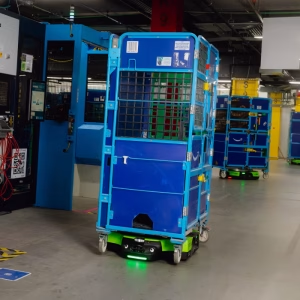
For years, automation has been promoted as the future of warehouse operations. Walmart’s ongoing multibillion-dollar effort to automate its supply chain demonstrates both the promise and the reality of large-scale operational transformation. Walmart relies on over 140,000 warehouse workers to keep goods moving. It isn’t an easy job. A worker might walk 20,000 steps a shift.
The retailer is modernizing a network that supports more than 5,000 U.S. stores while attempting to keep nearly 200 supply chain facilities operating, reports The Wall Street Journal (Oct. 9, 2026). What sounds like a straightforward technology upgrade has turned into a decade-long lesson in OM.
 Warehouse processes that seem simple to humans are often extraordinarily difficult to automate. Tasks such as removing products from cartons, sorting individual items, building store-ready pallets, and handling irregularly sized products require flexibility that robots still struggle to replicate consistently.
Walmart has invested heavily in automated storage systems, robotic arms, autonomous mobile robots, and advanced software. These technologies promise faster inventory movement, improved accuracy, lower stockout rates, and more efficient store replenishment. Yet implementation has revealed many operational hurdles. Robots require maintenance, packaging must be redesigned, legacy facilities need retrofitting, and suppliers must sometimes modify products so automated systems can handle them properly.
An interesting operations challenge is that Walmart is redesigning warehouses while they remain in service. Unlike a greenfield facility built specifically for automation, most of Walmart’s distribution centers were constructed decades ago. Integrating new technologies into existing operations adds substantial complexity and risk.
The case also illustrates a broader lesson about process improvement. Automation does not simply replace labor with machines. Instead, it changes the nature of work. While some manual tasks may decline, demand grows for technicians, engineers, and operators who can monitor, troubleshoot, and optimize increasingly sophisticated systems.
Walmart’s experience highlights that automation is a strategic capability, not a quick fix. Competitors such as Amazon have raised industry expectations for speed and efficiency, creating an automation arms race. Companies that pursue automation should be prepared for experimentation, setbacks, and continuous learning.
Walmart’s journey is a reminder that successful automation is not primarily a technology challenge. It is an operations, process design, workforce, and change management challenge.
Classroom Discussion Questions
- Walmart chose to automate existing warehouses while keeping them operational rather than building entirely new facilities. What are the advantages and disadvantages of this strategy from an OM perspective?
- Automation can improve productivity and accuracy, but it also introduces new costs such as maintenance, energy consumption, and specialized labor. How should managers evaluate whether an automation investment is truly successful?

 North American companies ordered nearly 18,000 warehouse robots worth $1.2 billion in the first half of 2026; both figures are up from 2025. Simultaneously, the average U.S. warehouse wage reached $26.85 per hour, up 41% over the past decade. Even with the higher wages, nearly 392,000 jobs remain open in the transportation, warehousing, and utilities industries. Together, these trends create strong incentives for companies to consider greater investment in warehouse automation.
 Now Siemens has just revealed Eigen, an AI agent that can replace manual coding or programming for programmable logic controllers, distributed control systems, and robotics applications, updating code or instructions to reflect new priorities and goals.


 Telephone Switchboard Operator. Before direct-dial telephone systems took over, switchboard operators were the backbone of communication, ensuring calls reached the right destination. In the 1950s, the U.S. had about 1,342,000 telephone switchboard operators. It was a demanding job that required quick reflexes. By the 1970s, automated dialing systems phased out the need for human operators.
 Milkman. Having fresh milk delivered to your doorstep was once a common part of American life. The local milkman made rounds, leaving glass bottles on doorsteps and retrieving empty ones. This service was necessary before the widespread adoption of home refrigeration. By 2005, this number had dwindled from over 50% of homes receiving delivery to just 0.4%.
 Motion Picture Projectionist. Projectionists played a vital role in the moviegoing experience in the 1950s, operating and maintaining film projectors in theaters. By 2013, 92% of movie theaters had made the switch to digital projection. In 1950, 26,000 people were employed as projectionists. By 2023, that number had fallen to 2,610.
 A common fear associated with automation is job loss. Sharpie’s story shows an alternative path. Rather than cutting staff, Newell retrained workers for higher-skill roles such as robotics support, maintenance, and technical troubleshooting. These new roles led to average wages increasing by nearly 50%.