Guest Post: The Two Stories of Tesla’s Solar Panels

Temple U. Professor Misty Blessley provides interesting blog topics monthly.

In our 2023 OM blog, New York State Built Elon Musk a $1 Billion Factory, we learned that building a solar panel facility was “a bad deal” for NY. The state built a massive plant and provided solar-panel manufacturing equipment. Tesla’s end of the deal was to churn out enough solar-panel shingles by 2020 to cover 1,000 roofs on a weekly basis.

These solar panels are finally on the verge of materializing, and with this are two stories. One connects Tesla’s long game in vertical integration and the other is New York’s long-delayed economic vision.

Tesla’s Long Game in Vertical Integration
Tesla’s new residential solar panels fill the company’s missing piece. The firm was missing the energy generator (aka solar panel). Despite the solar factory in New York, Tesla spent years relying on third-party suppliers for its solar panels. Now, it can fully optimize performance across the entire home energy stack. Tesla can vertically integrate the full chain from generation (solar panels), to conversion (inverter), to storage (Powerwall), and to consumption (EV charging).
New York’s Long-Delayed Economic Vision
This pivot finally gives New York its payout. By bringing solar panel manufacturing in-house, Tesla is delivering the kind of industry and employment the state originally hoped for. The region, once defined by its industrial decline, gains a foothold in the clean energy manufacturing economy. The move aligns with federal and state incentives that reward U.S.-made components, strengthening the economic logic behind NY’s investment. Tesla’s shift toward a unified home energy ecosystem mirrors the vision that justified the state’s $1 billion bet. The factory, once criticized as a stranded asset, now becomes the manufacturing backbone of Tesla’s residential energy strategy.

Tesla didn’t just release new solar panels. It connected the car in the driveway to the sun, and in doing so may have finally delivered the manufacturing story NY was waiting for.

Classroom Discussion Questions:
1. How is vertical integration good for Tesla? For Tesla owners? To compare this to an internal combustion engine, it is somewhat like having petroleum, a refinery and a gas pump in the garage or driveway.

2.  Knowing that Tesla’s occupation of the Buffalo facility is long overdue, what stipulations should a city or state impose on a firm when incentivizing a location decision to the tune of $1 billion?

OM in the News: Technology Supply Chains and the Shift From China

Rising costs, geopolitical tensions, and trade disruptions are causing tech giants like Apple, Samsung, Dell, and Nokia  to find suppliers at new locations across Asia, reports Material Handling & Logistics (June 19, 2025).

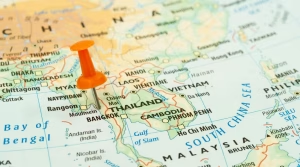
India, Malaysia, Thailand, Vietnam, and Taiwan have emerged as the most prominent alternative suppliers to China for the technology industry, despite Taiwan’s own geopolitical challenges.

The products most affected by these diversification strategies include smartphones, smart watches, computers, and laptops, representing core product lines for the world’s leading technology manufacturers.

Despite the rhetoric in support of nearshoring that was born out of the pandemic, U.S. companies like Apple have kept the largest share of their suppliers in Asia. This is because of the comparative advantage that exists in countries like India, Malaysia, Thailand, Vietnam, and Taiwan.

Here are the regional advantages of each:

India: Offers a large domestic workforce skilled in smartphone and laptop manufacturing at a fraction of the labor cost. The country has rapidly developed its technology manufacturing capabilities, particularly in smartphone assembly, where it has become a major production hub for both Samsung and Apple devices. India’s combination of technical expertise, lower wages, and massive domestic market makes it particularly attractive for technology companies.

Malaysia: Has well-established infrastructure and a low-cost workforce skilled in the back-end processes of semiconductor manufacturing. Malaysia has developed specialized expertise in semiconductor packaging and testing, making it a critical node in the global chip supply chain. The country’s established technology parks and government support for high-tech manufacturing have created a conducive environment for technology suppliers.

Vietnam & Thailand: Government incentives, including tax breaks for technology companies and funding for new facilities, have fostered an innovative environment for new suppliers. Vietnam has emerged as a particularly important alternative for smartphone and laptop manufacturing, while  Thailand has developed strengths in smartwatch and computer production. Both countries have benefited from their proximity to China’s supply ecosystem while offering lower costs and reduced geopolitical risk.

Taiwan: Taiwan is becoming increasingly prominent in the global computer parts supply chain. Taiwan’s world-leading semiconductor industry, centered around TSMC, gives it a unique and difficult-to-replicate advantage in high-end electronics manufacturing. The country’s technical expertise and established ecosystem for advanced electronics production make it an essential partner for many technology companies.

Classroom discussion questions:

  1. Does this article conflict with the the fact that reshoring continues to add jobs in the U.S.?
  2. What do these 5 countries have in common?

OM in the News: Corruption’s Impact on Operations

Transparency International, which compiles the annual Corruption Perceptions Index (which we publish as Figure 8.2), found that 47 countries out of the 180 it surveyed had their lowest score last year since it started using its current methodology for its global ranking. (See transparency.org/en/news/, Feb. 11. 2025).It said of its 2024 survey that “global corruption levels remain alarmingly high, with efforts to reduce them faltering.”

The group also pointed to worldwide risks from corruption to efforts to combat climate change. It said that a lack of transparency and accountability mechanisms increases the risk of climate funds being embezzled or misused, while “undue influence,” often from the private sector, obstructs the approval of ambitious policies. The organization measures the perception of public sector corruption according to 13 data sources, including the World Bank, the World Economic Forum and private risk and consulting companies. It ranks 180 countries and territories on a scale from a “highly corrupt” 0 to a “very clean” 100.

The global average remained unchanged from 2023 at 43, with more than two-thirds of countries scoring under 50. Denmark held on to first place with 90 points, followed by Finland with 88 and Singapore with 84. New Zealand dropped from third to fourth. The U.S. slid from 69 points to 65 and from 24th place to 28th

South Sudan slid to the bottom of the index with just 8 points, displacing Somalia although the latter country’s score dropped to 9. They were followed by Venezuela with 10 and Syria with 12. In the Middle East and North Africa, the situation of anti-corruption efforts “remains bleak” as political leaders exert near-absolute control while benefiting from wealth and clamping down on dissent. But it said that “unforeseen opportunities are also emerging,” for example in the wake of the fall of President Assad’s government in Syria. Sub-Saharan Africa had the lowest average score of any region, at 33.

In Asia and the Pacific, governments “are still failing to deliver on anti-corruption pledges,” Transparency International said.

Classroom discussion questions:

  1. Why is this annual index useful in OM?
  2. Explore the variables used in creating the ranking.

OM in the News: Shrinkage, Pilferage, and Store Closures

Target’s CEO said that theft was trending ‘in the wrong direction.’

Chapter 8 in our text discusses the key success factors that affect location decisions. But what about decisions relating to closing those locations?

The Wall Street Journal (Sep. 27, 2023) notes that Target  plans to close nine locations across four states, citing elevated levels of theft and safety concerns for its shoppers and employees.    The retailer announced that stores in the New York City, Seattle, San Francisco and Portland markets would close next month. The decision is the latest sign of actions executives are taking to protect their businesses.

Retailers have said they have faced a growing wave of theft in recent years that has led to responses such as locking up more merchandise on shelves (see the photo), hiring off-duty police officers, and closing hard-hit stores. The average inventory “shrink rate” (see Chapter 12, page 496) reported by retailers increased to 1.6% of sales.

Walmart recently closed a number of stores in urban areas, including Chicago, Washington, D.C., and Portland. Nike temporarily closed one of its Portland stores last year amid issues with theft, but just announced the location would close permanently. Three of the stores that Target said it would close are in the San Francisco, a place that has had a number of high-profile retail defections of late. Department-store chain  Nordstrom closed two stores near San Francisco’s downtown this year, including one in a shopping mall.
For the closing stores, Target said theft was “threatening the safety of our team and guests, and contributing to unsustainable business performance.” It also said investments made to prevent theft, such as adding security guards and using theft-deterrent tools, have been ineffective in curbing retail crime. Target has seen a 120% increase in theft incidents which involve violence or threats in the first five months of this year, leading to a $500 million loss from shrink.
Target’s announcement follows a string of violent incidents at other retailers. A CVS store manager in Mesa, Ariz. was fatally shot earlier this month after suspecting a man was stealing from the store. This week, mobs hit Apple, Lululemon and Foot Locker stores in Philadelphia. Retail theft in that city increased by 30%, to 13,330 this past year.
Classroom discussion questions:
1. What can store managers do in this situation?
2. How might Figure  8.1’s (page 337) site decision factors change given this dangerous urban  trend?

OM in the News: New York State Built Elon Musk a $1 Billion Factory

The new Tesla facility in Buffalo was supposed to house a huge solar-panel operation, the largest one in the Western Hemisphere, but the project hasn’t turned out as planned. “It was a bad deal.” writes The Wall Street Journal (July 7, 2023).

But we have written about government incentives many times in this blog and discuss them in detail in Chapter 8 of our text, Location Strategies. When NY’s then-Gov. Andrew Cuomo, cut the ribbon in 2015, he proudly stated: “This is too good to be true.”  It seems he was right.

New York paid to build a quarter-mile-long facility with 1.2 million square feet of industrial space, which it now owns and leases to Tesla  for $1 a year. It also bought $240 million worth of solar-panel manufacturing equipment. Tesla said that by 2020 the Buffalo plant each week would churn out enough solar-panel shingles to cover 1,000 roofs. It is, however, averaging just 21 installations a week. The suppliers that Cuomo predicted would flock to a modern manufacturing hub never showed up. Auditors have written down nearly all of New York’s investment.

The state has agreed to amend the terms of its subsidy 12 times over the years, including by reducing the number of jobs to be created in manufacturing and shifting deadlines to accommodate the company. “In terms of sheer direct cost to taxpayers, this may rank as the single biggest economic development boondoggle in American history,” says a think tank founder.

Buffalo, once an engine of manufacturing, has stagnated for generations as industrial companies headed south. Previous efforts at renewal largely fell flat. In 2012, Cuomo said he wanted to spend $1 billion in state taxpayer money to turn Buffalo around.

America’s governors are swept up in an arms race of awarding packages of taxpayer money to attract industrial megaprojects. Last year, states gave each of eight company facilities more than $1 billion in tax breaks and other aid. In Wisconsin, a factory by Taiwan’s Foxconn that was to employ 13,000 workers in exchange for some $3 billion in state subsidies sits mostly empty. Suburban Virginia offered tax breaks to win a competition for Amazon’s “second headquarters,” but much of that project is on hold.

Classroom discussion questions:

  1. What incentives do governments often offer companies to entice relocation?
  2. What are the major factors that companies consider when making location decisions? (Hint: see Chapter 8 in your Heizer/Render/Munson text).


OM in the News: China or Mexico?

“We needed to have a near-source option to complement our supply chains out of Asia,” said one U.S. manufacturer. “The supply-chain crisis taught us that it’s crucial to have critical components close to home.”

More and more companies seek to navigate a world of mounting geopolitical and business uncertainty that has exposed weaknesses in far-flung supply chains. For many manufacturers, that has meant returning production closer to home, a push toward nearshoring that is chipping away at the offshoring drive over the past few decades that moved a swath of production from Western countries to low-cost centers in Asia, and most of all to China.

Mexico appears to be ideal for some companies seeking sites outside Asia to make goods more cheaply than in the U.S., reports The Wall Street Journal (April 25, 2023). It has a relatively cheap labor force compared with other North American workers and is a member of a free-trade agreement with the U.S. and Canada, saving the cost of tariffs that are imposed on a raft of imports from Asia. Although the cost of manufacturing in Mexico may be higher than in some parts of Asia, the country also delivers cost savings from shorter shipping distances to U.S. consumers that reduce the need to carry so much inventory. This also offsets the risk of production disruptions and lost sales because of freight delays.

But Mexico also has drawbacks that make factory decisions far from certain. The electrical grid can be unreliable and the lack of locally produced parts and raw materials mean manufacturers still must source components from Asian suppliers. Building up similar ecosystems in Mexico will take years. And physical security is a concern in a country notorious for drug cartels and violent crime.

Although China is losing its share as an exporter to the U.S. of goods such as electronics and apparel to countries like Mexico and Vietnam, it remains the global manufacturing leader. “China’s losing out, but it’s not lost,“ said an industry expert. 

China’s advantages go beyond the low-cost production that initially lured manufacturers to the nation. A vast network of suppliers has sprung up since then—companies providing everything from refining commodities for factory production to makers of the inner components of manufactured goods—offering a sprawling ecosystem of businesses for a variety of sectors.

Classroom discussion questions:

  1. Summarize the Mexico vs. China tradeoffs facing American manufacturers.
  2. Figure 8.1 (page 357) lists six KSFs for country location decisions. Compare Mexico and China on each.

OM in the News: ‘War of the States’ and Lavish EV and Chip Maker Subsidies

States have long competed for big employers, writes The Business Journal (April 2, 2023). But now they are floating more billion-dollar offers and offering record-high subsidies, lavishing companies with grants and low-interest loans, municipal road improvements, and breaks on taxes, real estate, power and water.

“We’re in the second war of the states,” said one site selection consultant. “It is kind of a Wild West moment. It’s wild money and every state seems to be in on it,” added a U. of Texas professor. Georgia, Kansas, Michigan, New York, North Carolina, Ohio and Texas have made billion-dollar pledges for a microchip or EV plant, with more state-subsidized plant announcements by profitable automakers and semiconductor giants surely to come.

2022 set a record for the number of billion-dollar-plus incentive deals. At least eight were finalized, though that figure might be higher since such deals can be cloaked in secrecy and take time to come to light. More than $20 billion in public money was committed to subsidizing those known megadeals.

The subsidy offers are generally embraced by politicians from both major parties and the business elite, who point to promises of hundreds or thousands of jobs, massive investments in construction and equipment, and what they contend are immeasurable trickle-down benefits.

Still, academics who study such subsidies find them to be a waste of money and rarely decisive in a company’s choice of location. Studies conclude “they do little, if anything, to promote meaningful improvements in economic outcomes.”

The mounting cost of competing for the projects hasn’t dissuaded states from trying. On the contrary, they’re clambering to outdo each other. Michigan was stung by hometown Ford’s $11 billion commitment in 2021 to build EV and battery plants in Tennessee and Kentucky. It responded by pledging more than $2.5 billion for EV projects by Ford and GM and plants by makers of EV batteries and battery components. Pennsylvania has yet to lure a microchip or EV factory, and the state is sounding the alarm after watching neighboring Ohio land a $20 billion Intel plant. Texas promised to win passage of “economic development tools,” saying the state lost out on a massive Micron semiconductor plant because it couldn’t match the $5.5 billion in tax credits offered by New York.

Classroom discussion questions:

  1. Financial incentives are just one aspect of location decisions. What other factors (a topic in Chapter 8 in your text) do firms consider?
  2. What is driving the massive incentives states are offering?

OM in the News: The New American Battery Plants

South Korea’s LG Energy Solution just said it would invest $5.6 billion in a battery-manufacturing complex in Arizona, the latest in a string of new plants by foreign companies as the U.S. transitions toward cleaner fuels. LG Energy’s new battery complex will mainly serve electric-vehicle makers in North America. The amount is four times larger than what the firm had initially pledged when it first revealed plans last year to manufacture the batteries in Arizona. LG Energy reassessed its investment options due to unprecedented economic conditions. Inflation has been driving up the costs of raw materials and other expenses for manufacturers worldwide.

The complex will consist of two battery plants and mark the largest investment ever for a stand-alone battery-manufacturing facility in North America. Battery makers have been pushing to build up a bigger production base in the U.S., which is looking to strengthen its local supply chains and reduce reliance on China while speeding up shifts to green technologies, writes The Wall Street Journal (March 27, 2023)

13 battery gigafactories coming to the US by 2025 – ushering new era of US battery production

The U.S. has offered billions of dollars in tax credits for EVs sold in the U.S., but it only applies if they have a certain value of their battery components assembled in North America. (The Arizona plant will meet the eligibility requirements of the EV tax-credits program.) The program has stoked complaints from foreign car makers, but has opened business opportunities for non-Chinese battery players including South Korea’s LG Energy, Samsung, and SK On, as well as Japan’s Panasonic, which have all announced plans for new manufacturing plants in the U.S., including many via joint partnership with auto makers.

When excluding China’s CATL, LG Energy is the top battery maker globally, accounting for 21% of the combined EV and energy-storage-system battery market by units sold. In addition to the Arizona complex, LG Energy is working to expand its battery-manufacturing base across North America. It has three plants it has built or is building across the U.S. with General Motors as well as one planned plant with Honda in Ohio and one with Stellantis in Canada.

Classroom discussion questions:

  1. What factors discussed in Chapter 8 (Location Strategies) are chip manufacturers using in making location decisions?
  2. Why are so many plants under construction?

OM in the News: Corruption and Global Operations Management

In Chapter 8 (Location Strategies), we write: “One of the greatest challenges in a global operations decision is dealing with another country’s culture. Bribery and corruption create substantial economic inefficiency.” Table 8.2 (page 339) ranks corruption based on Transparency International’s annual survey, which has just been updated for 2022. The news is not encouraging.

The 2022 Corruption Perceptions Index (CPI)  shows that most of the world continues to fail to fight corruption: 95% of countries have made little to no progress since 2017. According to the Global Peace Index, the world continues to become a less peaceful place. There is a clear connection between this violence and corruption, with countries that score lowest in this index also scoring very low on the CPI. Governments hampered by corruption lack the capacity to protect the people, while public discontent is more likely to turn into violence. This vicious cycle is impacting countries everywhere from South Sudan (with a score of 13 (on a 0-100 scale, with 0 being highly corrupt and 100 being very clean) to Brazil (score of 38).

The head of Transparency International adds: “Corruption has made our world a more dangerous place. As governments have collectively failed to make progress against it, they fuel the current rise in violence and conflict – and endanger people everywhere. The only way out is for states to do the hard work, rooting out corruption at all levels to ensure governments work for all people.”

The CPI ranks 180 countries and territories by their perceived levels of public corruption. The CPI global average remains unchanged at 43 for the eleventh year in a row, and more than 2/3 of countries have a serious problem with corruption, scoring below 50.

  • Denmark (90) tops the index this year, with Finland and New Zealand following closely, both at 87. Strong democratic institutions and regard for human rights also make these countries some of the most peaceful in the world.
  • South Sudan (13), Syria (13) and Somalia (12), all of which are embroiled in protracted conflict, remain at the bottom of the CPI.
  • 26 countries – among them the United Kingdom (73), Qatar (58) and Guatemala (24) – are all at historic lows this year.

Corruption, conflict and security are profoundly intertwined. The misuse, embezzlement or theft of public funds can deprive the very institutions in charge of protecting citizens, enforcing the law, and guarding the peace of the resources they need.

Classroom discussion questions:

  1. Why is this a Chapter 8 topic?
  2. What world events have impacted corruption levels this past year?

OM in the News: The New Electric Vehicle Hubs

More automakers are bringing EV battery production in-house to secure a stable supply of batteries as demand for vehicles outpaces the manufacturing of them, reports Supply Chain Dive (Oct.18, 2022)

LG Energy Solution created a joint venture with Stellantis to construct a large-scale battery plant in Ontario, Canada — the country’s largest automotive cluster. The companies said they expect the plant will spur a “strong battery supply chain in the region.”

Honda will invest billions of dollars to manufacturer EV batteries in Ohio and retool the Marysville plant for EV production.

Now, Honda is following a similar script in Ohio. In addition to the joint venture with LG Energy Solution, the automaker announced it will invest $700 million to retool three Ohio plants.

“These Honda facilities, along with the new EV battery plant, will serve as a new EV hub in Ohio,” the company said. “Honda’s EV hub will leverage the company’s longstanding production, product development and purchasing operations located in Central Ohio.”

The actions come as the automaker aims to begin EV production and sales in North America by 2026, and make battery-electric and fuel cell EVs represent 100% of its vehicle sales in North America by 2040. EV batteries manufactured at the joint venture plant will be combined with battery cases produced at Honda’s Anna Engine Plant and installed in EVs built at two other Ohio plants, after they are revamped for EV production.

Ford has begun construction on an EV “mega campus,” bringing suppliers, a battery plant and assembly line to one location to exert greater control over its supply chain. General Motors has taken a similar approach, with two of its joint venture battery plants located in Ohio and Michigan near neighboring facilities. Automakers’ U.S. investments come on the heels of federal incentives encouraging domestic production of electric vehicles.

Classroom discussion questions:

  1. What are clusters and hubs and why are they important? Provide examples from other industries.
  2. What drives the battery production?

OM in the News: Manufacturers Head South

Caterpillar’s planned relocation of its global headquarters to Texas from Illinois comes as the equipment maker and other companies expand their manufacturing bases south. Manufacturing employment has been on the rise in many Southern and Southwestern U.S. states in recent years, as companies target the regions for new factories, plant expansions and corporate bases, seeking what some executives have said is a growing available workforce and cheaper real estate.

Florida, Texas and Arizona increased their manufacturing employment the most in the five years through 2021, while New York, Washington and Illinois lost the most manufacturing workers over that same period.

Ford announced its new investments in Kentucky and Tennessee outside the Kentucky State Capitol

Ford Motor said it would spend $11.4 billion along with a South Korean partner to build four factories in Tennessee and Kentucky that would support electric batteries and vehicles. Toyota said that it would invest $1.24 billion in a North Carolina battery and car plant. Leprino Foods is investing $870 million in a new mozzarella plant in Texas, and Novelis intends to build an aluminum rolling plant near Mobile, Ala.

“Companies investing in southern parts of the country have cited benefits including growing workforces, more affordable housing, availability of physical infrastructure and quality educational systems,” writes The Wall Street Journal (June 16, 2022). Southern and Southwestern state lawmakers have worked to make their states friendly to new or established manufacturers, letting companies deduct energy spending from sales-tax bills, for example, or providing exemptions from local property taxes and tax credits that can be resold to other businesses. States in the South and Southwest have typically lower unionization rates than states in historic union strongholds such as Illinois and New York. In 2021, 15% of Illinois workers were represented by a union, compared with 4.7% in Texas.

Such factors, as we discuss in Chapter 8, Location Strategies, can be meaningful in the manufacturing industry, where profit margins often are thin. “A big reason you see this migration is it has a lower cost of business to operate in this area,” said the head of the Texas Business Association.

Classroom discussion questions:

  1. List all the factors that manufacturers consider in making location decisions.
  2. What is meant by a “right-to-work” state?

OM in the News: Why Tennessee Hits the Electric Vehicle Sweet Spot

Tennessee is emerging as a leader in a national scramble to develop electric-vehicle and battery production, as states compete to woo multibillion-dollar investments from auto companies pivoting away from the combustion engine. Ford and South Korean battery maker SK Innovation recently said they plan to develop a large complex to make EVs and batteries there. That follows similar investments made by GM and VW to add EV production at their Tennessee assembly plants.

Ford’s real-estate scouts began their search early this year by looking at 85 potential locations across more than a dozen states. Ford’s checklist included a large empty property, so Ford could move quickly without having to clean up or retrofit an existing facility; cheap and reliable energy derived from renewable sources; access to rail and interstates; and reasonably close proximity to Ford’s other assembly plants– all factors we discuss in Chapter 8 of your text.

Tennessee has stepped out in front in large part because of yearslong efforts by the state and the Tennessee Valley Authority, which provides power to the region, writes The Wall Street Journal (Oct. 16-17, 2021). The state promoted its extensive workforce-training programs, a right-to-work law, and proposed $500 million in incentives. The TVA offered inexpensive,  reliable energy and at least $100 million in power upgrades and other incentives.

Energy costs are a big consideration for the battery factories because of the immense amount of electricity they use: 5 times more than in a typical auto assembly plant. TVA charges some of the lowest industrial energy rates in the country.

Tennessee made its mark on the auto world in 1983, when Nissan opened its first U.S. plant in Smyrna, Tenn. This was followed by large manufacturing operations for GM and VW. Hundreds of suppliers followed. Today, many thousands of Tennesseans are employed in vehicle manufacturing.

Auto makers are spending more than $300 billion globally by mid-decade to transition their lineups, including on massive battery factories and on new and revamped assembly plants. VW is nearing completion of an $800 million expansion of its decade-old assembly plant in Chattanooga, where next spring it is scheduled to start production of its new ID.4 electric SUV.  GM in the past year decided to double down on Tennessee as a base of EV production, spending $2 billion to overhaul its assembly plant in Spring Hill, for electrics, starting with a plug-in Cadillac SUV.

Classroom discussion questions:

  1. What is a “right-to-work state” and why was it a factor here?
  2. Discuss the incentives offered to auto makers. Are they reasonable?

Guest Post: Kmart, Location Factors, and Repurposing Buildings

Howard Weiss is Professor of Operations Management Emeritus at Temple UniversityHe is also the developer of our POM and ExcelOM software, provided free to adopters.

Since 2005, Kmart has closed all but 17 of its 2,085 stores. In Figure 8.1 in the Location chapter of your Heizer/Render/Munson textbook, location of markets is listed as a factor in deciding on a country in which to locate. For retailers, location of markets is also a major factor in site decisions. In fact, in 2012, Professor Yingru Li published a study stating that the selection of store locations partially explains why Wal-Mart, which currently has more than 5,300 stores in the U.S., has been more successful than Kmart.

Unfortunately, when Kmart was locating new stores it did not factor into its decisions that customers were moving further outside of cities and that it should locate stores beyond a city’s beltway.

In a previous blog here I discussed the repurposing of facilities. U-Haul self-storage seems to be the biggest beneficiary of the closings as it has opened storage facilities in over 20 former Kmarts. Some other uses and their locations are:

Churches, Charlotte, NC; Plainview, TX; Holland, MI

Drug Company, Desert Hot Springs, CA

COVID-19 vaccine clinic, Cudahy, WI

Storage Facility (Not U-Haul), Fremont, OH; Roanoke, Va, Danville, NC; Reno, NV;

Cannibis Location, Antioch, CA

Factory, Auburn Hills, MI

Retail Store – Big Box/Department, Clive, IA; Exeter Township, PA

School, Brevard County, FL; Waukegan, IL

Library, Lebanon, MO

Farmers Market, Herndon, WA

Classroom discussion questions:

  1. What other venues might relocate to a closed Kmart?
  2. Why have so many of the Kmart stores been converted to storage facilities?

Guest Post: Size and Natural Hazard Risk

Prof. Howard Weiss shares his insights with us monthly. Dr. Weiss recently retired from Temple U.

Scrub Daddy Inc., the maker of smiley-faced scouring pads featured on ABC’s Shark Tank reality show, is moving into a recently acquired South Jersey office-and warehouse building from its current home in Delaware County.

As mentioned in Figure 8.1 of your Heizer/Render/Munson textbook, one location factor is the size of the site. Size has become more important than it previously was because employees need to maintain a safe distance from each other due to COVID-19. In the case of Scrub Daddy, the size of their new facility is large enough to accommodate the 65 employees who currently are located in three facilities in a different suburb of Philadelphia.

Another factor that may, in general, be important is risk assessment based on natural hazards as opposed to the political risks listed in the figure.  The Federal Emergency Management Agency (FEMA) has prepared the National Risk Index (NRI) which identifies risks by county based on the following 18 natural hazards: Avalanche, Coastal Flooding, Cold Wave, Drought, Earthquake, Hail, Heat Wave, Hurricane, Ice Storm, Landslide, Lightning, Riverine Flooding, Strong Wind, Tornado, Tsunami, Volcanic Activity, Wildfire, and Winter Weather

FEMA (https://www.fema.gov/flood-maps/products-tools/national-risk-index) essentially performed a Factor Rating on these 18 factors for each county in the U.S. For each factor, the county scores were scaled from 0 to 100. FEMA assigned equal weights to each of the 18 factors and simply computed the sum of the 18 hazard scores for each county.

Classroom Discussion Questions

  1. What are the advantages and disadvantages of consolidating all of your employees in one location?
  2. Does using equal weights on the 18 factors make sense for individual organizations?

OM in the News: What Texas Wants for Christmas

The answer: More California companies to relocate to what Texas claims is the more business-friendly state. Oracle and HP are the latest big corporations to announce moves to the Lone Star State. Elon Musk, the CEO of Tesla, is also moving to Texas, and the electric car company is expanding there.

The announcements have highlighted the vastly different tax and regulatory systems in the country’s two most populous states, writes The Wall Street Journal (Dec. 17, 2020). California relies more on taxing personal income, particularly of high-income households, and operates a growing regulatory structure. Texas leans on more regressive property and sales taxes and boasts a more laissez-faire environment. The biggest difference: High-paid executives who move can see their state income-tax bills go from 13.3% to nothing.

Austin houses the powerful attraction of the U. of Texas

Moves by high-profile companies to Texas from California are not only likely to improve the personal finances of executives, but also offer employees more affordable housing and lighten regulatory burdens. For companies, much of the difference between California and Texas boils down to ease and cost of hiring—not just now but down the road. Companies have grown frustrated with the cost of attracting and keeping employees, as living expenses soar in California, and as regulatory mandates expand. “The compounding effects of California’s economic and political environment is making it more difficult to run a business effectively,” said one industry expert.

The Tax Foundation puts Texas 11th in its ranking of state business-tax climates, with California 49th. The biggest factor—outweighing any change in business taxes—is likely to be the lower cost of employing workers in the state. For most employees, that calculation is about housing costs.

Classroom discussion questions:
1. What other factors mentioned in Ch.8 (Location Strategies) affect location decisions?

2. How is “clustering” an advantage to both of these states?