

Amazon, Google, and Microsoft are among the tech companies spending an estimated $1 trillion on AI infrastructure this year and last. In some regions, they are using far more water than they report, depending on how data centers are powered. And their water consumption is projected to grow rapidly in coming years. Water demands of the biggest infrastructure buildout in U.S. history could lead to regional fights over who gets an increasingly scarce resource, writes The Wall Street Journal (July 3, 2026).
Google’s just-released 2025 sustainability report is an instructive example. The company said it consumed 10.9 billion gallons of water—a 34% increase from 2024—almost all for data-center cooling. Meta’s water use was 19 billion gallons in 2024. Meta has a plan to “become water positive in 2030,” in part through water-restoration projects. Microsoft has announced data centers that will have zero water use, as well as a commitment to “community-first AI infrastructure.” This includes a pledge to “replenish more water than we use.”
Cheap land and cheap power have put data centers in the high water-stress areas such as Arizona. About 2/3 of new data-center construction in the U.S. is in water-stressed areas. Phoenix is an example: the total water demands of data centers there amount to 3% of the city’s annual water use. By 2031, they could be in excess of 20%, a number approaching total water used by residents to maintain all of Phoenix’s lawns and landscaping.
Recently, Nvidia said it had solved the data-center water issue, showing off a closed-loop cooling system that doesn’t require additional water once filled. Unfortunately, most existing data centers use evaporative cooling systems that are energy-efficient but water-hungry, and retrofitting those could be prohibitively expensive.
In these boom times, it’s clear why AI data centers are in the spotlight. And the lack of transparency and widespread use of non-disclosure agreements by many data-center builders has only drawn more suspicion and distrust. These are among the reasons that $170 billion of AI data-center capacity has been blocked, stalled or canceled since 2024.
Classroom discussion questions:
- What solutions are being considered to deal with electricity and water demands?
- Are data centers overbuilding?
 Pods are the next step in an ongoing project management organization evolution. In recent decades, so-called scrum teams—cross-functional groups focused on deploying and iterating quickly—have replaced a slower, step-by-step project management methodology known as “waterfall,” which is noted in Chapter 3 of your Heizer/Render/Munson text.
 Dr. Jon Jackson is Associate Professor of Operations Management at the Providence College School of Business. He has created a series of AI exercises for each chapter in our text.
 ASCS opens Amazon’s vast global logistics network not just to its own marketplace sellers, but to businesses operating across competing marketplaces and in B2B channels. As Peter Larsen, vice president of Amazon Supply Chain Services, puts it, the platform is “available to any business of any shape or size.”
 Shipping costs have risen sharply in recent years. Major carriers such as FedEx and UPS have increased base rates annually while adding fuel surcharges, residential delivery fees, and dimensional pricing rules. As a result, retailers are increasingly shifting their focus from “fastest delivery” to “lowest cost delivery.”
 We’re talking about the data centers now being built and financed by some of the world’s biggest companies in the artificial-intelligence boom. Four U.S. tech giants—Microsoft, Meta, Amazon, and Google—are planning to spend $670 billion to build out AI infrastructure this year alone as they scramble to increase the computing power needed to operate and scale their AI-related endeavors.
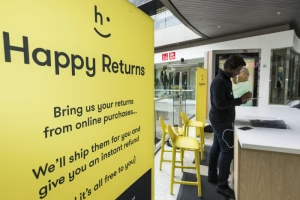 Shoppers last year returned 17.6% of items they purchased online, valued at more than $247 billion and more than double the percentage of goods returned in 2019. Returns have become such an entrenched part of online commerce that companies have sprung up to handle the growing business. UPS acquired one of those specialized operators, Happy Returns, for $465 million.
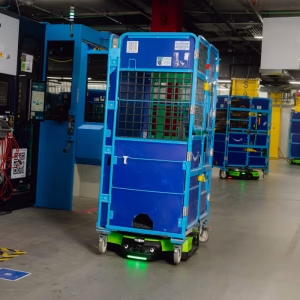
 Workers complained of speed-up, work intensification, and work degradation. Now this appears to be happening with A.I. in one of the fields where it has been most widely adopted: coding.

 Temple U. Professor Misty Blessley shares her insights today, on Black Friday.
 Supply chains have stabilized after years of disruption. Thus, core products have been efficiently moved from warehouses to retail locations to ensure availability for traditional retail customers. Additionally, e-commerce channels are poised to efficiently fulfill customer orders. Many retailers are adopting cost-effective delivery strategies tailored to peak shopping events like Black Friday and Cyber Monday. Instead of defaulting to same- or next-day shipping, retailers are spreading deliveries over several days to reduce costs and balance labor.
 In the fiercely competitive retail segment, three factors drive consumer choices: product availability, price and delivery speed. Minor variances in delivery time can considerably sway customer decisions.