Guest Post: Food Processing Ingredients

Prof. Howard Weiss shares his insights monthly. Howard created the Excel OM and POM software that we provide free with our book.

A recent Philadelphia Inquirer article (February 19, 2026) reports that “The grandson of the inventor of Reese’s Peanut Butter Cups has lashed out at the Hershey Co., accusing the candy company of hurting the Reese’s brand by shifting to cheaper ingredients in many products.” 

In prior years consumers expressed dissatisfaction when Nutella reduced the amount of cocoa in its product. One reason for the change in the recipes for these two products is the high cost of cocoa. Clearly, a change in a recipe will affect inventory, material (ingredient) costs, and the supply chain.
The most infamous recipe change is probably “New Coke” which was introduced in 1985. Consumer backlash forced Coke to revert to its original recipe. Recently, Coke announced it will add a new product made with cane sugar rather than corn syrup.

Food taste and recipes can vary for a number of legitimate reasons. The recipe for Twinkies was changed in order to extend its shelf life from 25 days to 45 days. Butterfinger took an alternative approach and double-wrapped its candy. Several food processors have changed recipes in order to eliminate certain food dyes or additives or reduce sodium, including Kraft Macaroni and Cheese and Turkey Hill ice cream.

The same product may have a different recipe for sales at bulk stores rather than supermarkets. Colas may have a different amount of corn syrup in bulk stores.

Sometimes recipe changes are inadvertent. In one case consumers complained about the taste of meals they cooked using 4C Italian Bread Crumbs. 4C investigated and found that trace amounts of cinnamon were in the bread crumbs and should not have been. There are many examples of bacteria being in processed food which would affect the health of the person eating the food. This is different. There is a processing problem but it will NOT cause health issues just taste issues.

The repercussions of food quality are different than the repercussions of food safety. Food safety problems can lead to recalls, liabilities, brand damage and penalties. Failure to maintain taste can result in brand damage and product returns.

Classroom discussion questions:
1. Identify other products in which change resulted in complaints or safety issues.

2. What are the main changes these days to food products?


OM in the News: The Inventory Return Scam

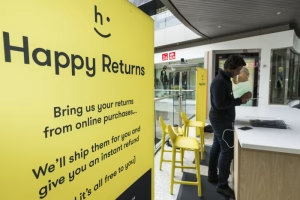
Retailers nationwide have seen online returns skyrocket over the past four years after rolling out generous returns policies to attract customers amid a pandemic-driven surge in e-commerce. The returns policies have helped change shopping habits: Consumers have grown accustomed to ordering items online in several sizes and colors, then returning what they don’t want.

Shoppers last year returned 17.6% of items they purchased online, valued at more than $247 billion and more than double the percentage of goods returned in 2019. Returns have become such an entrenched part of online commerce that companies have sprung up to handle the growing business. UPS acquired one of those specialized operators, Happy Returns, for $465 million.

The ease of shipping goods back has also given criminals new tools to exploit in an online environment in which buyers don’t need to interact with store employees–and the scale and organization of the fraud is getting more ambitious, and organized.  More than $100 billion in merchandise was returned fraudulently in the U.S. last year, estimated to be 9-15% of the $850 million returned goods retailers received in 2024-2025, reports Supply Chain Brain (Feb. 2, 2026). 

Organized criminal groups “are taking advantage of the omnichannel retail environment,” said on industry expert. In some cases, fraudsters are returning knockoffs in place of designer goods and sending back boxes full of bricks or other filler rather than the original items. Others are manipulating shipping labels to receive a refund just from mailing back an empty envelope. Fraudsters marketing their services on Telegram and through other websites often sell their services in return for a cut of customers’ refunds.

Apparel retailer PacSun recently noticed a sharp increase in returns of online purchases, including one customer who had returned some 250 orders worth $24,000.  PacSun had issued the refunds, but the company never received the actual merchandise at its warehouse. Instead, workers found “used or different merchandise returned in the box, or even empty shoeboxes.”

Some retailers such as Amazon are taking legal action. It just sued the refunding-services group REKK that it claimed was “responsible for stealing millions of dollars of products from Amazon’s online stores through systematic refund abuse.”

Classroom discussion questions:

  1. How can the quality control inspections engaged during returns processing be defrauded?
  2. How has e-commerce made this fraud easier?

Guest Post: Omnichannel Operations–Where Technology Meets Retail Strategy

Dr. Prince Vijai is Assistant Professor of Operations at IBS Hyderabad, India. This post is based on his recent presentation at the DSI meeting in Orlando.

In today’s retail world, customers expect a smooth and unified experience across both online and offline channels. This customer expectation has turned omnichannel inventory management into a strategic necessity. By integrating supply chain management, information systems, and analytics, retailers can ensure that products are available where and when customers need them – across stores, warehouses, and digital channels.

Centralized inventory visibility is the key enabler of this unified commerce inventory strategy. Instead of managing separate stock pools, leading retailers maintain a unified view of inventory across all sales channels. This reduces overstocking, prevents stockouts, and supports flexible fulfillment options, such as ship-from-store, click-and-collect, buy online pickup in-store (BOPSIS), and dropshipping.

To achieve this omni-channel inventory visibility, real-time data synchronization is essential. Technologies like Shopify APIs and AWS Lambda update stock levels instantly as purchases occur, ensuring accuracy across systems. NoSQL databases, such as DynamoDB or Firebase, provide the scalability and speed necessary for these continuous updates.

Leading retailers clearly demonstrate the benefits of such integrated omnichannel operations. Zara uses RFID for item-level tracking, enabling rapid replenishment and online fulfillment from its stores. Nike uses a unified commerce platform to synchronize data across its physical and digital channels. Amazon exemplifies data-driven order routing and fulfillment efficiency.

As omnichannel operations mature, the role of the Omnichannel Planner is emerging. This is a professional skilled in analytics, ERP, and API integration who aligns supply with demand across channels. Such expertise ensures a balance between operational efficiency and superior customer experience.

The key omnichannel retail trends include unified commerce integration, adoption of practical generative AI, enhanced inventory visibility, flexible fulfillment options, and personalized in-store experiences. These strategies aim to strike a balance between customer value and operational efficiency, driving agility and competitiveness.

Ultimately, omnichannel inventory management represents more than just logistical coordination – it’s a foundation for business agility and customer satisfaction. Retailers mastering this capability gain a decisive edge in speed, accuracy, and trust in a competitive, data-driven marketplace.

 Classroom Discussion Questions

1.How does real-time data synchronization enhance both customer experience and retailer performance?

2. What future technologies could further improve omnichannel inventory visibility?


MyOMLab: Simulation Updates for Fall 2024

We want to let you know that our five simulations, which students really enjoy, have gotten these valuable enhancements. If you are not using them, checkout the features. The five are: supply chain management, quality management, forecasting, inventory management, and project management.

OM in the News: CVS Aims to Make Inventories Leaner

CVS Health is restructuring its distribution network, reports The Wall Street Journal (Aug. 7, 2024), as the pharmacy chain seeks to speed up the flow of goods to its stores and online customers. It has closed 3 of 33 warehouses, automated one of its largest distribution centers and is opening a building dedicated to bulky items this fall, part of a multimillion-dollar plan to upgrade its supply chain to cut costs and improve profit margins.

The chain’s efforts in distribution operations that handle goods from general merchandise to pharmaceuticals are meant to” (1) help restock its stores faster and (2) free workers to help customers in stores and fill online orders for pickup and delivery.

CVS operates more than 9,000 retail locations nationwide, and 85% of the U.S. population lives within 10 miles of a store. The company wants to use that proximity to shoppers to its advantage. CVS has been squeezed by rising drug costs and lower foot traffic while sales of Covid vaccines and test kits have waned.

CVS joins other retailers, including Target, Walmart and Walgreens, that have focused on fulfilling more online orders from stores to speed up shipments, streamline inventory and make more use of bricks-and-mortar sites. It recently spent millions of dollars to automate a 1.2 million-square-foot warehouse in N.J. serving stores in the Northeast.

The automated storage and retrieval system there brings items bound for stores directly to workers, who no longer must walk warehouse aisles to retrieve merchandise. Workers then hand the products to an automated system that sorts items into bins based on destination.

CVS previously would send half-empty bins to stores throughout the day, taking up space in stores as well as workers’ time as they unpacked multiple shipments. The company now waits until bins are full and then groups them by store. The change has reduced bins it ships containing beauty products by 42%.

The tactic has also trimmed the time it takes to replenish a store down to a single day rather than several days. Moving merchandise faster allowed CVS to cut $2.5 billion worth of inventory since 2022. CVS plans to double the size and volume of the new warehouse system next year and roll the technology out across other warehouses.

Classroom discussion questions:

  1. Why is CVS trying to become “leaner”?
  2. What is the goal of the new automated warehouse in N.J.?

OM in the News: GE Appliances’ Supply Chain Overhaul

GE Appliances, one of the largest home-appliances manufacturers in the U.S., says a $2 billion effort to remake its supply chain has helped it double revenue since 2017. The Louisville-based company, now a subsidiary of China’s Haier Smart Home, has added manufacturing capacity, opened seven new distribution centers and implemented digital tools to knit together operations from production through to delivery. It is an example of how companies are resetting their supply chains to be more flexible, moves that come after retailers and household goods companies navigated disruptions, shipping delays and dramatic shifts in consumer demand during a chaotic period marked by waves of stockouts and overstocking.

“A lot of companies are really striving to create increased visibility in their supply chains and also to build greater resilience in their supply chains,” said an N.C. State professor. That includes efforts to “improve coordination and integration and scheduling, and at the same time, try to reduce their inventory.”

One of the biggest changes has been to bring more manufacturing into the U.S. from Asia, reports The Wall Street Journal (July 8, 2024). GE has added 4,000 manufacturing jobs across its nine U.S. plants over the past seven years. Shifting production from overseas has cut shipping costs by reducing the number of bulky appliances that are sent across the Pacific Ocean and has given GE more control over production. When you have something that’s in a container on a boat for six weeks, it’s difficult to change your orders and be able to adjust to shifts in demand.

GE also measures inventory differently today than before the pandemic. The appliance company previously tracked “weeks on hand,” which measures finished products relative to how many units typically sell in a given week. It now tracks customer orders delivered on-time and in-full, a measure that prioritizes existing orders so the company doesn’t spend time manufacturing items that aren’t in demand. To accommodate that change, GE installed digital tools that allow factories to see upcoming customer orders. The plants can then manage production schedules to ensure orders are ready on time, but not too early. Storing bulky, fragile appliances in a warehouse for a long time eats up space, adds storage costs and increases the risk of damage.

Classroom discussion questions:

  1. What is the difference between “weeks on-time” and “on-time and in-full”? Hint: See our Feb, 25, 2024 blog
  2. What major OM moves ae described in this piece on GE Appliance?

OM Podcast #20: Manufacturing and Operations at Nautique Boats

In our latest podcast Barry speaks with VP of Operations at Nautique, Kris Hanigosky, about operations for this luxury ski boat manufacturer (known for its iconic Ski Nautique). They discuss maintaining the highest levels of quality, the importance of accuracy in forecasting and inventory management, and innovative approaches to employee retention through upskilling.


Did you know our podcast is now available on Apple podcasts? Just go to your Apple podcasts app, search “Heizer Render OM Podcast,” and subscribe to get all our podcasts on your mobile device as soon as they come out!

Transcript

A Word document of this podcast will download by clicking the word Transcript above.

Instructors, assignable auto-graded exercises using this podcast are available in MyLab OM. See our earlier blog post with a recording of author and user Chuck Munson to learn how to find these, or contact your Pearson rep to learn more! https://www.pearson.com/en-us/help-and-support/contact-us/find-a-rep.html

OM in the News: Shein Markets Its Supply-Chain Technology to Global Brands

China-founded Shein has built a bargain fashion empire with a pioneering small-batch manufacturing model, reports The Wall Street Journal (March 21, 2024). Now it is planning to open that up to global brands and designers. It is calling the new initiative “supply chain as a service.”

Shein contracts with thousands of factories in China that churn out tens of thousands of new styles daily.

The move represents a shift in business strategy as Shein faces challenges in the U.S., its biggest market.  Under the plan, Shein would make its supply-chain infrastructure and technology available to outside brands and designers, allowing them to leverage Shein’s system for testing out new fashion items in small batches and track how popular they are with consumers.

Shein has rapidly expanded from a discount Chinese apparel seller to a global fashion brand with the help of its small-batch, on-demand manufacturing model, and now sells to more than 150 countries. It has revolutionized fashion manufacturing as it contracts with thousands of factories in China that churn out tens of thousands of new styles daily. It places orders to suppliers to be delivered in days, relies on real-time data to quickly analyze demand and replenishes orders as needed. That cuts down on the cost for storage and limits inventory waste, a primary reason for its ultralow prices.

By making its supply-chain ecosystem more widely available to brands, Shein is refocusing on its powerful capabilities to manufacture and distribute fashion products efficiently.

Shein’s popularity in the U.S. has drawn the attention of lawmakers, who have pressed Shein to address whether it sources cotton from China’s Xinjiang region, where the U.S. has accused Chinese authorities of committing genocide and of using forced labor in its repression of mostly Muslim Uyghurs, allegations Beijing denies. Shein has said it has a “zero-tolerance policy” for forced labor.

Classroom discussion questions:

  1. What is “supply chain as a service”? Why is Shein offering this service?
  2. How has Shein revolutionized the apparel industry?

OM in the News: Walmart and “On-time, In-full” Shipments

This is the latest shift in a logistics effort that has historically left companies scrambling to meet the retail giant’s demands.

Walmart wants suppliers to deliver shipments on time 90% of the time and in full 95% of the time, down from a 98% benchmark for both measures set in 2020 amid a surge in consumer demand. The change marks a significant lowering of Walmart’s “on-time, in-full” (or OTIF) thresholds that are meant to increase the efficiency of Walmart’s sprawling U.S. logistics network of distribution centers serving the company’s thousands of stores.

Walmart has been working to get tighter control over its inventory as it fulfills more online orders from its stores and competes on home-delivery speed with e-commerce giant Amazon.com. Vendors that fall short of Walmart’s on-time, in-full targets face fines worth 3% of the cost of the goods that didn’t arrive on time or in full.

Walmart last shifted its thresholds in September 2020, when it tightened the requirements as supply-chain disruptions left many store shelves empty of high-demand products during the Covid-19 pandemic. The latest change comes as the retailer returns to more normal ordering patterns after years of struggling with sharp fluctuations in stocking levels during the pandemic. The greater equilibrium in supply chains has helped relieve pressure on suppliers.

Consumer packaged-goods vendors delivered an average of 84% of orders on time in 2023. Walmart’s lowered thresholds should be welcome news to vendors that have struggled to meet the 98% benchmarks. “Very, very rarely do things go perfectly as planned with deliveries. Trucks break down or get caught in traffic, and orders are sometimes packed with the wrong quantity and mix of items, such as orange-flavored soda instead of grapefruit,”  said one industry expert.

Classroom discussion questions:

  1. Why is Walmart changing its OTIF policy?
  2. How does impact suppliers?

OM in the News: Fast Fashion, Shein, and Inventory

Fast fashion was invented by companies such as Zara, and to a lesser extent H&M, in the late 1990s, when the companies took the latest styles seen on the catwalk and brought similar products to market. For companies such as Zara, it took 3-4 weeks to bring a simple T-shirt from design to the stores and 6-8 weeks for a jacket or a dress. But the category fell out of favor in recent years as consumers became more critical of the apparel industry’s impact on the environment.

If what Zara did in the ’90s was fast fashion, Shein’s version is “ultrafast fashion,” reports The Wall Street Journal (May 31, 2023).  Shein’s inventory on average takes around 40 days to turn over. That is about half of what it takes for Zara. The quick-turn strategy goes against industry trends. In general, apparel companies’ inventory turnover has lengthened over the past two decades. (Last year Shein accounted for 1.7% of apparel-industry sales in North America, making it the fourth-largest clothing seller behind Nike, Old Navy and Lululemon).

Shein’s pop-up store in Paris

With its supply base in China, Shein has a well-oiled test-and-scale model: It produces 100 to 200 pieces of any given product at launch and then increases production only if demand is strong. That results in little excess inventory, which in turn helps its bottom line. On the supply side, it milks efficiencies by using a digital manufacturing system. The system asks Shein’s extensive supplier base to share real-time capacity and tags each of them based on category strengths and weaknesses. To minimize costs, Shein selects master fabrics and requires designers to choose from the pool.

Shein’s meteoric rise shows that trendy and cheap have enduring appeal. While Gen Z cares about sustainability, it also values self-expression. Even though the company has said it has no suppliers in Xinjiang, China, where there are allegations of forced labor, the company is hedging its bets with plans to source more fabric from India.

Environmentally friendly resale platforms such as ThredUp and The RealReal made their debuts to great fanfare, but their appeal among shoppers has proven transitory. Allbirds, a footwear brand that boasts environmentally friendly practices, has seen its popularity fizzle, too. Shoppers like to see green credentials, but Shein’s popularity has shown that cash always looks greener.

Classroom discussion questions:

  1. What is Shein’s inventory advantage?
  2. Describe the firm’s production strategy.

Guest Post: Why Does the U.S. Keep Stockpiles?

Prof. Howard Weiss shares his insights with us monthly.

Your Heizer/Render/Munson text inventory chapter (Ch. 12) discusses the use of safety stock. While companies use safety stock, so too does the U.S. maintain safety stock, termed stockpiles, for several different types of products. The most well-known stockpile is that of the Federal Emergency Management Agency (FEMA) which was most recently used due to the damage caused by Hurricane Ian. FEMA stockpiles commodities such as food and water and equipment such as generators across eight distribution centers.

The Strategic National Stockpile (SNS) was created in 1999 for the storage of medical supplies. It has recently been in the news because at the end of 2022, the SNS released flu medication due to the high number of patients with flu across the country. In addition to medication, the SNS contains masks, gloves, gowns, respirators, face shields and other emergency supplies. These supplies are stored at secret locations. Your textbook discusses preventive maintenance in the Maintenance and Reliability chapter, and one other aspect of storing the ventilators is that they each must undergo annual preventive maintenance.

Since 1975, the U.S. has maintained a Strategic Petroleum Reserve (SPR) to be used in the event of a disruption in the flow of oil. The oil is stored in underground tanks in Texas and Louisiana. In November of 2021, oil was released due to the rising cost of gasoline and in March of 2022, oil was released due to the invasion of Ukraine. The reserve is currently at its lowest level since 1983. In addition to the SPR there is a separate stockpile of home heating oil maintained in Boston, New York and Groton, Connecticut for the Northeast section of the country because the Northeast has the majority of homes that use heating oil.

In 1925, the U.S. authorized the creation of the National Helium Reserve in Texas. Helium was used for blimps by the military and has other uses, including medical ones. In 1996, plans were created to move control to the private sector by 2023. In 1977, the government began to purchase the milk that dairy farmers could not sell. It converted the milk into cheese and other products and ultimately stockpiled over 500 million pounds located in 35 states.

Not surprisingly, the U.S. stockpiles weapons and ammo and rare earth materials used for weapons. Currently these stockpiles are low due to release of the stockpiles to the Ukraine.

Classroom discussion questions:
1. What are some of the items that individuals stockpiled at the beginning of COVID?
2. What is another downside to stockpiling equipment in addition to having to maintain the equipment?

OM in the News: The Impact of Inventory “Shrinkage”

A massive rise in theft is chipping away at an advantage brick-and-mortar retailers have over e-commerce companies: the ability to touch the merchandise, reports The Wall Street Journal (Dec. 24-25, 2022). Brick-and-mortar retail’s indisputable edge over e-commerce is that consumers can get what they want immediately, and can touch and feel the product before buying it. Rising theft—and stores’ measures to prevent it—could dull that edge.

Products displayed in locked security cabinets at a Walgreens in San Francisco

Shrink—an industry term for loss in inventory—amounted to 1.4% of retail revenue in 2021, or $94.5 billion. Most of that shrink is caused by theft. Walmart’s CEO said that if the retail theft issue is not addressed over time, “prices will be higher and/or stores will have to close.”

Covid-19 has worsened the risk of crime, partly because labor shortages have made it difficult to fully staff stores. Moreover, supply-chain shortages made certain products more susceptible to theft because they fetched high value in secondary markets. Supply-chain delays during the pandemic also meant more cargo was sitting around, leaving it more vulnerable to theft.

Shrink can have a substantial impact on already thin retail margins. At Dollar Tree, shrink shaved 1.7% off operating margins this quarter–substantial for a firm whose operating margin was 5.5% that same period. Drugstores are especially susceptible because they are located and designed for convenience. It’s a quick in, quick out layout with valuable electronics, over-the-counter drugs, cosmetics and beauty care, which are desirable and mobile items. Walgreens estimates that shrink amounts to 3.25% of the company’s revenue.

Mitigation measures can range from the most basic physical ones—such as locking up items—to more technologically sophisticated ones, such as video surveillance with facial recognition. Some measures are designed to make the product less valuable for theft. These include ink tags, which stain clothes when removed, and products that must be activated by the cashier in order to be used. Some cordless power tools will only start functioning if the firmware is activated at the point of sale. More subtle measures include placing high-value items further away from the entrance or having employees stand close to those products.

Classroom discussion questions:

  1. What do some retailers (like Costco and Sam’s Club) do to reduce shrinkage?
  2. Discuss some techniques to deal with this issue? (Hint: see “Control of Service Inventories” in Chapter 12 of your Heizer/Render/Munson text)

OM in the News: Did the Pandemic Kill JIT?

Retailers struggle with an inventory glut and overstocked warehouses

Just-in-time supply chains took a lot of heat during the pandemic after empty shelves laid bare the pitfalls of ordering as little inventory as possible in the name of efficiency. But, with retailers now struggling with too much inventory, can the lean model, our topic in Chapter 16,  be making a comeback?

Experts are mixed: While some believe that JIT has no place in the supply chains of the future, others say a modified version of the strategy will still be necessary to maintain resilience while keeping costs down. Here are the responses of three SCM experts as reported in Supply Chain Dive (Nov. 29, 2022):

CEO of LMA Consulting. JIT is not dead; however, the days of taking the concept literally and ordering inventory to arrive ‘JIT’ is dead. If ordering strategic inventory from China, you should account for likely demand and supply volatility and stockpile inventory appropriately. But most businesses took JIT literally, assuming the supply chain would continue to support their needs. They did not adjust their inventory profiles and were left empty handed during the pandemic. They are now assessing supply chain risk, reevaluating their supply chain footprint, dual sourcing key products and determining where to locate strategic capacity and inventory.

CEO of Assoc. for SCM. The pandemic blew a fuse, revealing flaws to JIT. JIT promotes efficiency and product quality, but sometimes at the expense of resilience, and therefore isn’t equipped to manage the turbulence of global events, like COVID-19, weather disasters and the Russia-Ukraine conflict. Now, around 64% of companies are pivoting from JIT to just-in-case to circumvent liability. This system depends on extra stock and buffers for high-demand products. A modified version of JIT can help where companies only stockpile certain vulnerable items to avoid fallout from potential disruptions. Consumers still have an expectation of high variety, rapid delivery and reasonable cost that defined JIT supply chains.

SCM Professor at Michigan State U. What we are seeing is the decision to reevaluate safety inventory levels. Safety inventories are a function of uncertainty of demand as well as uncertainty of supply. COVID-19 has exacerbated both forms of uncertainty, which results in companies holding more safety inventories to achieve the same target service levels. As we see supply chains normalize through 2023, we would expect companies to reduce their levels of safety inventory to correspond to the “new normal” levels of demand and supply uncertainty.

Classroom discussion questions:

  1. Explain the difference between JIT and “just-in-case” inventory.
  2. What was the impact of the pandemic on JIT?


OM in the News: Nike Overhauls its ERP System

Nike just announced it will launch its new ERP system across its global network this year in a bid to increase inventory visibility and productivity, reports Supply Chain Dive (July 11, 2022). The system is the company’s biggest investment in its digital transformation, and is set to go live in China this month, and in North America in 2024. The ERP system will be “foundational for increasing speed and agility across our supply chain as Nike leans increasingly into direct-to-consumer sales,” says the firm’s CFO. The investment involves shifting its ERP onto the SAP S/4 HANA platform.

The ERP launch comes as the retailer continues to face elevated in-transit inventories and extended lead times to get products to market, issues that the new technology system could be instrumental in tackling. Transit times remain at roughly two weeks longer than pre-pandemic levels and aren’t expected to improve significantly through the end of 2023. In China, the extended transit times and factory closures have left Nike with bloated inventory reserves, with seasonal products arriving behind schedule. The firm says it is “recalibrating” its supply and demand in the region in response to shifting market conditions.

Nike has been planning an ERP overhaul since 2020, part of a strategy to more effectively service online customers and unify financial and inventory views across the company’s ecosystem. As part of the retailer’s acceleration of its direct-to-consumer strategy, the CFO noted that the revamped digital system should help fuel profits in China. “And our ERP is frankly the backbone that’s going to enable us to take advantage of those opportunities at a more significant way,” he said.

As we discuss in Chapter 14, ERP tools can make or break a business — they track and manage inventory, procurement, supply chain and other core business operations. Systems need to efficiently enable massive transaction volumes at global scale. But the enterprise technology landscape is riddled with ERP failures. Waste Management, for example, spent $100 million on its ERP failure.  Nike itself is also still somewhat scarred by its 20 year-old reputation as the poster child for bad ERP implementations, having spent $400 million on that earlier failed system.

Classroom discussion questions:

  1. What are the advantages and disadvantages of an ERP system?
  2.  Why do many systems fail and why are they so expensive?

OM in the News: Why is There a Baby Formula Shortage?

A baby-formula shortage has led to empty store shelves, product restrictions and panic among parents.

Baby formula shortages have left parents scrambling, in some cases driving hours to find stores stocking the particular brands their infants need because of dietary restrictions. Nationwide, 43% of the most popular baby-formula brands were out of stock in the week that began May 1, up from 31% a month earlier. A normal rate is less than 10%.

The products have been in shortage for months partly because of supply-chain issues caused by the pandemic, reports The Wall Street Journal (May 17, 2022). The situation worsened after Abbott, one of the leading formula makers, recalled some products and shut down its plant in Sturgis, Mich., making Similac and other brands.

The FDA said it found a germ called cronobacter, which can be deadly in infants, in the Sturgis plant. Abbott said there isn’t evidence linking its formula products to illnesses resulting in the hospitalizations of 4 infants, including 2 deaths. The CDC also said the strains of bacteria at the plant didn’t match those involved in cases.

Federal prosecutors allege Abbott didn’t comply with conditions and practices designed to ensure the quality and safety of baby store formula, including steps to protect against contamination by bacteria such as cronobacter. Abbott agreed to hire an outside expert to help bring the plant into compliance with FDA rules, and said it could begin formula production again at its Sturgis plant within 2 weeks of the FDA signing off on the facility’s reopening. It would then take 6-8 weeks for products to be available on store shelves.

Meanwhile, rival Enfamil products experienced delays in shipments and transportation earlier in the year as the pandemic continued to disrupt the food supply chains. (The 2 firms are responsible for 80% of U.S. infant formula sales). Many retail chains are continuing to ration supplies by placing strict limits on orders, while others are trying to find substitutes with little success. Abbott said it is bringing products from its factory in Ireland to the U.S. but added that it will take weeks before the Irish plant’s products are on store shelves.

Meanwhile, everyone from frustrated parents to lawmakers on Capitol Hill have called for inquiries into why shortages have been difficult to resolve.

Classroom discussion questions:

  1. What other products are seeing inventory shortages?
  2. How do they differ from the baby formula issues?