Good OM Reading: Model Thinking for Everyday Life

Every day operations managers face decisions, some simple and some complex. Our text focuses on these decisions with real world examples and hundreds of mathematical models to help guide decision making. But all too often students look for “the answer” on a search engine (or now on ChatGPT), learning nothing from the process. 

A new book, called Model Thinking for Everyday Life, by well-known MIT professor Richard Larson, asks readers to undertake a major mind shift in everyday thinking. The answer to many operations problems lies in the process that leads us there. Model Thinking helps develop critical thinking skills, using a framework of conceptual and mathematical concepts to help reach full comprehension and better decisions. 

Prof. Larson’s innovative approach to model thinking encourages:

  • Active learning with pencil and paper (no computer), which requires readers to immerse themselves in puzzles and life’s paradoxes.
  • No heavy math – complex technical issues are addressed in a simple, entertaining way.
  • Seeing the world  in terms of models, learning something new every day.

Here is an example: Suppose you need to be on today’s only ferry to Martha’s Vineyard, which leaves at 2 p.m. It takes about 30 minutes (on average) to drive from where you are to the terminal. What time should you leave?

In this example, a key concept at play is uncertainty. Accounting for uncertainty is a core challenge faced by operations managers. We need to see that:

  • an average of 30 minutes would cover a range of times, some shorter, some longer;
  • outliers can exist in the data, like the time construction traffic added an additional 30 minutes
  • “about 30 minutes” is a prediction based on past experience, not current information (road closures, accidents, etc.); and
  • the consequence for missing the ferry is not a delay of hours, but a full day — which might completely disrupt the trip or its purpose.

Without doing much math, we calculate variables, weigh the likelihood of different outcomes against the consequences of failure, and choose a departure time. Larson’s conclusion is one championed by model thinkers everywhere: Leave on the earlier side, just in case.

“Everybody uses models, whether they realize it or not,” Larson says. “When someone is shopping for groceries and thinking about how much of each product they need — they’re basically using an inventory management model of their pantry.”

Guest Post: Temperatures–A Decision Table Example

Our Guest Post today comes from Howard Weiss, Professor of Operations Management at Temple University.

I use the following example in my OM class to discuss maximin and minimax in a context the students readily understand and to demonstrate several Excel functions to my student. (It is based on a piece in Interfaces in 1990). Prior to class I search for the daily high and low temperatures in the previous month and copy them into a spreadsheet. The results appear in columns A and B.

Ultimately, I will ask my students which day was the hottest in that month and which day was the coldest. First, though, the average highs and lows in column B need to be converted to individual numbers which will be placed in columns D and E. Identifying the High temperature from column B gives me the opportunity to
• Show students Excel’s LEFT function
• Show students that the results of the LEFT function are characters, not numbers
• Show students Excel’s VALUE function to convert the characters to numerical values.
Identifying the lows is slightly more complicated due to the degree sign on the right of the values in column B which precludes us from using Excel’s RIGHT function. This gives me the opportunity to show students Excel’s MID function to pick out characters 5 and 6 from the high/low string and convert it to a numerical value.
At this point, I ask the students which date was the hottest and which was the coldest. Several use Excel’s MAX and MIN functions to find the date with the highest high temperature and lowest low temperature. Some average the high temperature and low temperature for each day and base their answer on the highest and lowest of the averages.
I then suggest that perhaps the hottest day is the day with the highest low (maximin) temperature because it is most difficult to sleep on those nights (without AC) and that the coldest day is the one with the lowest high (minimax) temperature because it is the worst day to go swimming. I also show them how to use Conditional Formatting to identify the highest and lowest temperatures in columns D and E as shown to the left.

Finally, I have the students graph (not shown) the temperatures in these two columns. It gives me the opportunity to show that it can be valuable to modify the minimum and the major units on the y-axis to make it easier to find the highs and lows.

I really like using an exercise that gives me the opportunity to display a maximin and minimax explanation and to show the students some Excel functions and features.

In Memorium: Prof. Howard Raiffa

raiffaProfessor Howard Raiffa, a co-founder of the Kennedy School of Government at Harvard and a member of Harvard’s business school faculty for 37 years, passed away last week at age 92. Younger academics in our field may not remember Prof. Raiffa, but he was recognized as the founder of the field we call decision science. His original work encompassed negotiating techniques, conflict resolution, risk analysis and game theory.

Raiffa was an innovative theoretician, but he applied his ideas to real-world cases of conflict, cooperation and compromise in planning curricula, publishing guidebooks and making videos. He was also the founding director, in 1972, of the International Institute for Applied Systems Analysis, a joint U.S.-Soviet organization that explored energy, pollution and other issues as a cooperative venture during the Cold War.raiffa2
    Among his 11 books were Games and Decisions: Introduction and Critical Survey, Applied Statistical Decision Theory (which I studied from in grad school), The Art and Science of Negotiation, Decision Analysis, and Smart Choices: A Practical Guide to Making Better Decisions. 
    The best practical advice, Professor Raiffa wrote, is “to maximize your expected payoff, which is the sum of all payoffs multiplied by probabilities.” He explained that “the art of compromise centers on the willingness to give up something in order to get something else in return.” Raiffa’s negotiation analysis course became one of the most popular at Harvard. In it, his thrust was not simply “how to win,” but how to create joint value.

Good OM Reading: The Hard Work Behind Analytics Success

mit sloanThe hype around business analytics, our topics in Modules A-F, has reached a fever pitch. From baseball to biomedical advances, stories abound about data scientists applying their wizard like talents to find untapped markets, make millions, or save lives. Data has been described as the new oil, the new soil, the next big thing, and the force behind a new management revolution. Despite the hype, the reality is that many companies still struggle to figure out how to use analytics to take advantage of their data. The experience of managers grappling, sometimes unsuccessfully, with ever-increasing amounts of data and sophisticated analytics is often more the rule than the exception, concludes a new MIT Sloan Management Review study (March, 2016).

Five key findings came from the research:

  • Competitive advantage with analytics is waning. The percentage of companies that report obtaining a competitive advantage with analytics has declined significantly as increased market adoption of analytics levels the playing field and makes it more difficult for companies to keep their edge.
  • Optimism about the potential of analytics remains strong, despite the decline in competitive advantage. Most managers are still quite positive about its potential. They’ve seen increased interest in analytics over the past few years, and they expect its use to continue to grow.
  • Achieving competitive advantage with analytics requires a sustained commitment to changing the role of data in decision making. This commitment touches many organizational aspects, from revamping information management to adapting cultural norms.
  • Companies that are successful with analytics are much more likely to have a strategic plan for analytics, and this plan is usually aligned with the organization’s overall corporate strategy.
  • Most companies are not prepared for the investment and cultural change that are required to achieve sustained success with analytics, including expanding the skill set of managers who use data and broadening the types of decisions influenced by data.

OM in the News: The Probability of a Disaster

probabilityLet’s say Bob is jetting from Heathrow to JFK on a Virgin Airways A330. Chance of crashing? One in 5.4 million. That means that he could apparently expect to fly on the route for 14,716 years before plummeting into the Atlantic, writes The Economist (Jan.29, 2015). The 14,716 years figure might cause your students a bit of confusion.  It’s the average length of time people will fly before crashing, if lots and lots of them do it every day. An alternative way of expressing it would be to say that if you were to arrange to fly this route every day for the next 10,210 years, your chance of dying would be 50%. And if you wanted to book enough flights to be almost certain of crashing, you reach a 99% probability at 67,833 years of daily flights.

Safety statistics collated by IATA, the airline association, show that in 2013 more than 3 billion people flew on commercial aircraft. During that time, there were 81 accidents and 210 fatalities. What is more, this figure has been falling for years.  By way of comparison, the World Health Organisation says there were over 1.2 million road traffic deaths around the world in 2010. It is the leading cause of death among 15-29 year olds. Oxford University calculates that in 2006, a British resident had odds of 1 in 36,512 of dying in a motor accident and 1 in 3.5 million dying in a plane crash.

The deadliest plane crash in history occurred in 1977 in Tenerife when 583 people were killed after two jumbos collided on the runway. Yet, that many people die from heart disease in the U.S. every 8 hours. As the book How Risky Is it, Really explains, air crashes are considered catastrophes while heart attacks are not, because they fulfill 3 criteria: “A catastrophe has to be big, it has to happen all at once, and something about it has to be calamitous—disastrous—really bad. A plane crash kills a lot of people all at once, in one place, and in a really horrific way. But heart disease meets only one of those criteria.”

Classroom discussion questions:

1. How does this concept impact supply chain disruptions that we discuss in Supplement 11?

2. Why are probabilities such as these important in operations management?


OM in the News: Killing Off Game of Thrones’ Characters

Jon_snowIf you are a fan of the HBO show, Game of Thrones, this post may be of great interest!  The show kills off almost as many characters each season as it introduces. The most iconic scenes, like “The Red Wedding,” are ones in which the show mercilessly kills off beloved characters quickly and without warning. We fans love to guess who will die next.

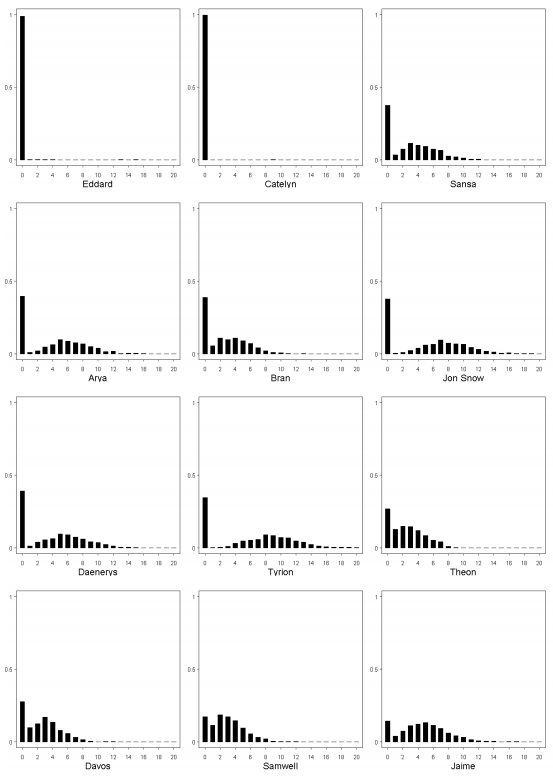
Game of Thrones is based on the Song of Ice and Fire books by George R.R. Martin. As the series is a fairly faithful adaptation, fans of the show often look to the books for clues about what will happen in the upcoming season. Now a professor at the University of Canterbury has applied statistics to analyze the books and establish probability distributions for who will die next (Vox, Oct. 2, 2014). For example, there’s a 38% chance that Jon Snow will have no chapters in the next book, but a 67% chance in the 6th book, meaning that Jon Snow may be dead by the end of the 6th book. The graphs below show a prediction of how many chapters each character will get in Winds of Winter.

Classroom discussion questions:

1. Does Jon Snow have about as much chance of survival as the other major characters?

2. What are the weaknesses of this model?

 GOT shot


OM in the News: How Analytics Will Change Day-to-Day Decisions

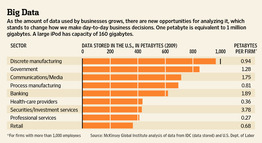
A few months ago, we reviewed an excellent new book called Thinking, Fast and Slow (Oct.22, 2011)  in which author Daniel Kahneman talks about how we make decisions. We see what we want , ignore probabilities, and, as Kahneman writes,  “we are often confident even when we are wrong”. But The Wall Street Journal’s  (Jan.4, 2012) article “What’s Your Algorithm”, says the important theme in business for 2012 will be “how analytics harvested from massive databases will begin to inform our day-to-day business decisions.  Call it Big Data, analytics, or decision science. This will change your world.”

The new algorithms can help us reduce the human decision-making biases that Kahneman fears. These software systems can chew through billions of bits of data, analyze them, and package the insights for immediate use. For example, crunching millions of data points about traffic flows, an analytics system might find that on Fridays a delivery fleet should stick to the highways–despite your devout belief in surface road shortcuts.

Until recently, we have been stymied by the cost of storage, slower processing speeds and the flood of data itself, often spread across different corporate databases. “A few years ago it might take a month to run a project involving 30 billion calculations. Today it can be done in 2 or 3 hours”, says Opera Solutions’  CEO.  HP just spent $11 billion to buy Autonomy Corp., which vacuums up “unstructured data” then applies analytic approaches to it.

Analytics (or as we called it, OR, MS, QA, or Decision Sciences when studying in grad school) is becoming mainstream WSJ reading.

Discussion questions:

1. How has IBM taken a leading role in business analytics?

2. How can massive number crunching help the operations manager?

Good OM Reading: Analytics–The Widening Divide

Why don’t more managers embrace the business analytic tools we use in so many aspects of our OM courses?  A new report by MIT Sloan Management Review (Nov.8, 2011) answers the question with a survey of 4,500 executives regarding the integration of analytics in their enterprises. The report,  Analytics: The Widening Divide,  concludes that cultural biases, such as the need for new management competencies and organizational resistance to new ideas –more than technological hurdles–are the primary barriers.
First, a definition of business analytics: “the use of statistical, quantitative, predictive, and other models to drive fact-based planning, decisions, execution, management, measurement, and learning. Analytics may be descriptive, predictive. or prescriptive”.

The MIT Sloan report breaks companies down into 3 categories: Transformed (heavy users), Experienced (moderate users), and Aspirational (companies least experienced in the use of business analytics). The good news is that the number of firms in the 1st two categories, who use analytics for competitive advantage, has surged by 57% in the past year. The Aspirational group’s use of analytics actually declined by 5%. Transformed organizations have set the pace in expanding use of analytics and were found to be 2.2 times more likely to substantially outperform industry peers.

The Transformed group keenly appreciates the value of precise and real-time decisions, and is 3 times more likely to focus on speed of decision-making than Aspirational firms. This means managing operations and improving output levels based on real-time supply and demand management. Inventory replenishment processes, for example, are automated and production is optimized in these companies. As a case study, the report follows McKesson, which processes 2 million hospital orders per day. McKesson does so by embedding algorithms into customer orders to manage the inventory process without human intervention.

When students ask you why analytics are important in your OM course, this report provides a ready response.

Teaching Tip: Helping Your OM Students Find Jobs with Business Analytics

Just a day or two ago, I got a nice email from our colleague Barry Spraggins, who is Chair of the Managerial Sciences Department at the University of Nevada-Reno.  Barry uses our text Operations Management, 10th ed.,  and noted that he teaches heavily from all the Quantitative Modules, including Decision Making Tools (Module A), LP (Mod. B), Transportation (Mod.C), Queuing (Mod.D), Learning Curves (Mod.E), and Simulation (Mod.F). He writes: “I still think these are relevant components”. Not by coincidence, we find that The Wall Street Journal (Aug. 4,2011), Jay and I,  and IBM all agree.

The Journal reports that finding qualified graduates in business analytics has proven difficult–and colleges are finally stepping up to meet industry demand. IBM, which spent more than $14 billion since 2005 to buy a flock of analytics companies, has now teamed up with over 200 colleges to develop analytics courses. Fordham and Indiana U. are unveiling analytics curricula, as well as certificate and degree programs. Indiana, for example, is offering certificate programs in business analytics to both Deloitte and Booz Allen employees. Fordam has a required course called Marketing Analytics for MBAs. U. of Virginia, also working with IBM, is introducing an analytics track this fall.

“Analytics is certainly one of the top five things executives are worried about and investing in heavily”, says the president of Teradata. “Industry is going to demand it. Students are going to demand it”. As IBM and other big firms drive the software implementation process to the board room, we in academia may very well see a resurgence of demand for the very topics Prof. Spraggins has long espoused. In a tough job market, this is one way to help our students gain competitive advantage.