OM Podcast #48: Cold Storage, AI, and the Future of Industrial Facilities

In this episode of the Podcast, Professors Barry Render and Misty Blessley sit down with David Aschenbrand, Executive Managing Director at Newmark, to explore how cold storage and temperature‑controlled facilities are evolving in today’s operations and supply chain environment. Drawing on his background across logistics, transportation, warehousing, and industrial real estate, David explains how cold storage facilities support food, pharmaceutical, and other temperature‑sensitive supply chains, and what clients look for when developing or operating these specialized buildings.

The conversation highlights how facility design decisions—such as location, building footprint, dock configuration, and proximity to ports—can directly affect labor availability, transportation efficiency, and long‑term operational performance. David shares insights on the growing role of automation and AI in industrial facilities, while emphasizing the continued importance of skilled trades and hands‑on roles that support these operations.
The episode concludes with a discussion of what rising labor costs mean for cold storage operators. Together, the hosts and guest offer a practical look at how operations management, facility design, workforce trends, and technology intersect in modern cold chain and warehouse environments.


TRANSCRIPT LINK
A Word document of this podcast will download by clicking the word Transcript above.

Prof. Barry Render
Prof. Misty Blessley
Dave Aschenbrand

Have you subscribed to this podcast on Apple Podcasts?
Just open your Apple Podcasts app, search “Heizer Render Munson OM Podcast,” and subscribe to get our newest episodes as soon as they’re released!


Instructors: assignable auto‑graded exercises using this podcast are available in MyLab OM. To learn more, view our earlier blog post featuring Chuck Munson or contact your Pearson representative: Find your rep

OM in the News: Amazon’s AI-Robotics Warehouse Revolution


Amazon is rapidly transforming its e-commerce fulfillment operations through a bold integration of artificial intelligence (AI) and robotics, reports The Wall Street Journal (Oct. 23, 2025). The company’s vision is clear: make human workers more efficient while automating repetitive, menial tasks. At the heart of this shift is Amazon’s Shreveport, Louisiana facility, which now boasts ten times as many robots as a typical warehouse. This leap in automation enables packages to move through the system 25% faster, with anticipated cost savings passed on to customers.

Safety and efficiency are top priorities. Robots now handle tasks such as sorting packages, transporting carts, and retrieving out-of-reach items. Amazon is also investing in its workforce, offering apprenticeships to train employees in managing these advanced systems. The company’s latest innovations include Blue Jay, a robot arm designed for sorting in tight spaces, and Eluna, an AI agent that helps managers optimize staffing and avoid bottlenecks. Blue Jay’s rapid development—just over a year, compared to 3 years for previous models—was made possible by generative AI, which allowed for virtual prototyping.

The company aims to deploy Blue Jay robots in urban, space-constrained warehouses, enabling same-day delivery networks that are both faster and more cost-effective.

These advances could save Amazon billions annually. By the end of next year, nearly 40 fulfillment centers will be equipped with robots, with an estimated to $4 billion in yearly cost reductions. This automation trend is expected to reduce the need for both warehouse and white-collar workers. In fact, the average number of workers per facility dropped to around 670 in 2024, the lowest in 16 years.

Amazon is testing augmented-reality glasses 

Amazon’s automation push extends beyond warehouses. Augmented-reality glasses are being tested for delivery drivers, helping them identify packages and navigate routes more efficiently.

Amazon’s journey began with its $775 million acquisition of Kiva Systems in 2012. Today, three-quarters of its deliveries involve some form of robotic assistance. The company’s latest announcements—Blue Jay, Eluna, and AR glasses—signal a new era where AI and robotics are supercharging logistics, reshaping the future of retail fulfillment.

Classroom discussion questions:

  1. How does Eluna work?
  2. Why is Amazon trying to eliminate warehouse jobs?

OM in the News: Amazon Is on the Cusp of Using More Robots Than Humans

The automation of Amazon facilities is approaching a new milestone: There will soon be as many robots as humans. The e-commerce giant, which has spent years automating tasks previously done by humans in its facilities, has deployed more than one million robots in those workplaces, reports The Wall Street Journal (July 1, 2025). That is the most it has ever had and near the count of human workers at the facilities.

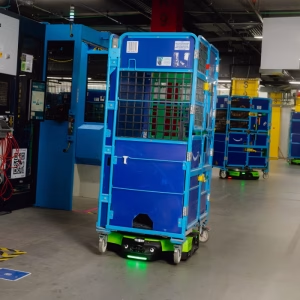
Mobile robots reposition package carts

Company warehouses buzz with metallic arms plucking items from shelves and wheeled droids that motor around the floors ferrying the goods for packaging. In other corners, automated systems help sort the items, which other robots assist in packaging for shipment.

One of Amazon’s newer robots, called Vulcan, has a sense of touch that enables it to pick items from numerous shelves. Amazon has taken recent steps to connect its robots to its order-fulfillment processes, so the machines can work in tandem with each other and with humans. Now some 75% of Amazon’s global deliveries are assisted in some way by robotics. The growing automation has helped Amazon improve productivity, while easing pressure on the company to solve problems such as heavy staff turnover at its fulfillment centers.

For some Amazon workers, the increasing automation has meant replacing menial, repetitive work lifting, pulling and sorting with more skilled assignments managing the machines. Amazon has trained more than 700,000 workers across the world for higher-paying jobs in mechatronics and robotics apprenticeships.

The number of packages that Amazon ships itself per employee each year has also steadily increased in the past decade to 3,870 from 175, an indication of the company’s productivity gains.

Amazon is also rolling out artificial intelligence in its warehouses to improve inventory placement, demand forecasting, and the efficiency of its robots. Amazon said it will cut the size of its total workforce in the next several years.

Classroom discussion questions:

  1. Research Amazon’s history of using robotics.
  2. What are the advantages of introducing more robots?

OM in the News: The Holy Grail of Automation–Now a Robot Can Unload a Truck


The robots are coming for the last human warehouse jobs.  Loading and unloading a truck is backbreaking, mind-numbing work that retailers and parcel carriers have tried to solve for years. Workers may not stay long in these jobs. Summers and winters are particularly grueling for anyone stuck in a metal trailer, slinging heavy boxes. Injuries are common.

Automating this process has long been the holy grail of warehouse logistics, writes The Wall Street Journal (June 24, 2025). When loaded, packages must be fitted together to fill the available space and be sorted by weight—with the heaviest items on the bottom—so they don’t topple or break. Unloading them is challenging, too, because the unloader must move in and out of a trailer, ferrying packages of different sizes and weights.

On a typical warehouse floor today, every task might be heavily automated—except for workers loading and unloading the trucks. People who have worked these jobs say they have to stand for extended periods, hefting boxes as heavy as 70 pounds. New advances in robotics are changing that.

Improved sensors and algorithms, advancements in AI and faster image-processing technology are making these robots proficient players in tasks that are like a game of 3-D Tetris. This shifts the burden of physical lifting from humans to robots. Proponents of the technology say it will mean more efficiently packed pallets, fewer damaged items and a lot of time saved. The machine-learning algorithm isn’t aware of what’s inside each package, but does know the item’s weight, approximate center of gravity and how fragile it is.

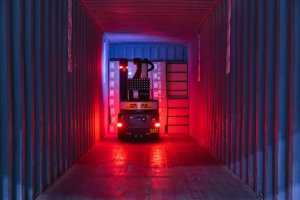
DHL’s Stretch robot can unload 580 cases an hour, twice the rate of a human unloader.

The robot will use the information it has on an item to choose the optimal pallet and determine where the it should be placed to minimize damage, but still allow the highest possible number of boxes to be packed in the given space.

DHL just signed an agreement with Boston Dynamics for 1,000 of these robots. United Parcel Service is also increasing automation at its facilities, including for loading and unloading trailers—a move that will help the company cut costs. FedEx has been testing and refining the truck-loading process in one of its facilities since 2023. Walmart also has introduced robots that can unload a truck.

Classroom discussion questions:

  1. Why is this an important OM advancement?
  2. How else are robots now being used in warehouses?

OM in the News: 3-D Printed Homes and Disaster Areas

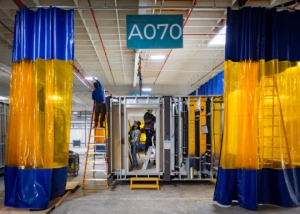
A SoLa Impact modular housing unit is assembled at a Los Angeles factory

After Jerry Camarillo’s home in Altadena, Calif., burned down, he was determined to rebuild the ranch house exactly as it was before the L.A. wildfires. But the home’s insurance policy would cover only a fraction of the $700,000 estimated cost to rebuild. Then he found Hapi Homes, a company that builds prefabricated homes as pieces in factories and then assembles them on-site. The company could build his home for $200,000 less than the cost of traditional construction, and do it in less than half the time.

Companies that use modular construction, 3-D printing or other nontraditional methods have existed for decades on the fringe of home building, often tainted by previous missteps. (Off-site factory home construction has historically been used for lower-budget homes, leaving many people with the preconception that it tends to be of lesser quality). Now, these firms are breaking into the mainstream by offering a faster and less costly alternative for rebuilding in cities ravaged by natural disasters, reports The Wall Street Journal (June 3, 2025).

An ICON system uses 3-D printing to add concrete to the framing of a home

Many of the thousands of displaced homeowners in L.A., Hawaii and the Southeast are giving these businesses a look. Victims of hurricanes, wildfires or other disasters can be desperate to rebuild, but their insurance payouts are often well short of what is needed to cover traditional construction costs. Will disasters be the turning point for the wider adoption of factory-built housing?

 ICON, a company that makes 3D-printed homes, uses giant 3-D printers to squeeze layers of concrete into the framing for a house. Reframe Systems  builds homes in robotic, artificial-intelligence-powered microfactories. Offsite-factory construction can accelerate the building process because fewer workers are required and materials are often purchased in bulk. The shorter timeline can sharply reduce carrying costs for a project. And in disaster areas, where many builders are competing for construction labor and materials, factory-home manufacturers have an edge because they can access less crowded supply chains in other cities and states.

Classroom discussion questions:

  1. How do 3-D printing and factory home-building differ?
  2. What did an industry CEO meant when he said: “Never let a crisis go to waste?”

OM in the News: Building Airplanes Quickly–A Bit of History

When I worked at McDonell Douglas (now Boeing) in St. Louis in the late 1960’s, the Viet Nam war was in full swing. The demand for F-4 Phantom Jet fighters was strong and we managed to move the assembly line fast enough to produce two jets a day. It was quite a feat.  But it didn’t compare to the Michigan factory that produced one B-24 bomber an hour during World War II. This was one of the most astonishing tales of ingenuity in manufacturing history, writes The Wall Street Journal (May 14, 2025).

1942 B-24 Willow Run assembly line

As 1939 began, the U.S. had fewer than 2,000 military aircraft. With war looming, President Franklin D. Roosevelt knew the country desperately needed to remedy the situation. He turned to America’s top manufacturers for help. One of them was the Ford Motor. In 1940 workers began constructing an enormous manufacturing-and-assembly plant and an airfield called Willow Run near Detroit. It was finished within 6 months.

After the Pearl Harbor attack, the plant was ready to mass-produce B-24 Liberators: bombers that weighed 18 tons, were 67 feet long and had wingspans of 110 feet. Could massive warplanes be built with the same assembly-line method as family automobiles? It had never been tried before.

Ford’s production genius, Charlie Sorensen, was put in charge. Soon 42,000 workers filled the factory floors in around-the-clock shifts. With so many Americans off fighting in Europe and the Pacific, some of the men and women at Willow Run had never done manufacturing jobs before. So a school was set up near the plant: Some 8,000 employees a week were taught to build airplanes.

Those four-engine B-24s each contained 1.2 million parts held together by more than 300,000 rivets. “Rosie the Riveter” entered the American lexicon, as women who had never before done such work helped manufacture the Liberators.

How long should it take to build an airplane? By the time Willow Run was operating at full capacity, a B-24 was rolling off the mile-long assembly line every 55 minutes. The nation needed those planes, and it got them. By war’s end, factories across the U.S. had built nearly 300,000 military aircraft.

Classroom discussion questions:

  1. Why does it take so much longer to build planes today?
  2. Which of the 10 Operations Management decisions (that your Heizer/Render/Munson text is built around–see Table 1.2) do you think were faced by Sorenson?

OM in the News: AI and Warehouse Supply Chain Disruptions

The ability to react quickly to supply chain disruptions is critical, and companies are under increasing pressure to predict and prevent them before they occur. Instead of managing reactively, firms are turning to artificial intelligence (AI) and predictive analytics to revolutionize operations, writes Material Handling & Logistics (Feb. 13, 2025). AI provides the tools and insights to anticipate disruptions and optimize processes in real-time.

By analyzing vast amounts of operational data, AI can identify patterns and trends that may indicate potential bottlenecks. This allows companies to foresee bottleneck issues such as labor shortages, equipment breakdowns, or delayed shipments before they occur, giving them time to adjust and implement preventive strategies.

At the heart of this proactive approach is predictive analytics, our topic in Module G. Predictive analytics uses historical data, machine learning algorithms and statistical models to forecast future events and behaviors. For example, if a shortage is predicted, the system can recommend adjusting staffing levels or reallocating resources to avoid delays. Similarly, predictive analytics can predict when certain equipment may require maintenance or inventory levels are likely to drop below critical thresholds, allowing a business to take preventive actions and avoid disruptions.

Bottlenecks are among the most significant threats to warehouse efficiency. These disruptions can lead to delays, increased costs and missed deadlines, impacting customer satisfaction and profitability. Predictive analytics allows businesses to foresee bottlenecks before they become critical. For example, suppose analytics indicate that a certain shipping lane will be delayed due to increased demand or reduced capacity. In that case, a warehouse can reroute goods to avoid congestion.

To summarize, there are four  key advantages of using AI in warehouse operations: (1) Improved Resource Allocation, (2) Increased Labor Efficiency, (3) Reduced Downtime and Delays, and  (4) Enhanced Decision-Making.

With real-time data and forward-looking forecasts, operations managers can make better, more informed decisions about handling day-to-day operations and long-term strategies. This leads to better outcomes and improved performance across the entire supply chain.

Classroom discussion questions:

  1. How can AI be used to improve warehouse operations?
  2. What is the difference between descriptive analytics and predictive analytics? (See Module G of your Heizer/Render/Munson text)

OM in the News: The End of the Forklift?

Some of America’s biggest manufacturers are backing away from forklifts, reports The Wall Street Journal (Jan. 5, 2024).  The vehicles have been integral to factories and warehouses for more than a century, but now companies are aspiring to go “forklift-free” to improve productivity and safety. Each year around 7,500 workers are injured in forklift-related collisions, tip-overs and other mishaps, while nearly 100 are killed. Orders for forklifts dropped 28% in 2023.

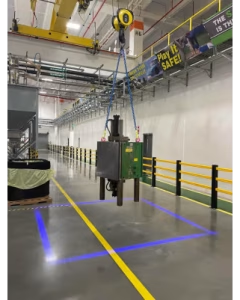
Ipex designed its new factory to rely on overhead cranes and hand-pushed electric pallet jacks

Plastic-pipe manufacturer Ipex designed its new factory in North Carolina to minimize the use of forklifts. That made the plant, which opened in 2023, a safer, quieter and less stressful workplace. “Employees feel like they can walk anywhere within the interior shop floor and not have to look out for forklifts,” said Ipex.

Mercedes is also reducing forklifts in its U.S. plants, replacing some with autonomous vehicles. Tesla is making a similar effort, using push carts and trailer-hauling “tuggers” inside its factories to cut down on traffic and injuries. Whirlpool’s washing-machine factories have been eliminating forklifts from production areas, and use robotic tuggers to deliver parts to assembly-line workers.

Forklift makers say they have added numerous safety features to their vehicles. These include high-visibility seat belts that make it easy to see whether an operator is wearing it, lighting that warns pedestrians a forklift is coming and sensors that slow the vehicle before a collision takes place. Forklift manufacturers say there is high turnover among drivers and lament what they call the glorification of unsafe operation. Dozens of TikTok and YouTube accounts feature videos showing drivers skidding, crashing and dropping oversize loads that smash across warehouse floors.

Classroom discussion questions:

  1. Why will it be difficult to totally replace forklifts?
  2. What are the safety issues that are frequently seen in factories with many forklifts?

OM in the News: Amazon’s New Robotic Warehouse and Humans

Amazon just opened its most-automated warehouse yet. But underneath the robotics and artificial-intelligence technology at the site, the facility will still rely on thousands of employees, writes The Wall Street Journal (Dec. 7, 2024). The 3 million-square-foot building in Shreveport, La., is Amazon’s first warehouse to use automation and AI at every step of the fulfillment process and be able to handle one million orders a day.

Amazon’s Sparrow device uses suction cups to lift items and artificial intelligence software to identify objects by color, shape and size

The facility shows how companies are spreading automation through their distribution centers to get online orders to consumers at an ever faster pace. The sprawling site also demonstrates the challenges Amazon and other companies face as they seek to turn over some of the most physically demanding and repetitive warehouse tasks to robots.

Amazon hired more than 1,400 people at the Shreveport distribution center and plans to eventually employ 2,500 workers picking orders, loading and unloading trucks and managing the robotics systems. The idea is to speed up operations, save on labor costs and make warehouses safer for the workers that remain. Amazon has been the subject of government scrutiny over the treatment of the workers at its facilities. The warehousing sector had one of the highest rates of injuries and illnesses in the U.S., with 4.7 cases recorded per 100 workers compared with the national average of 2.4 cases per 100 workers.

Some traditional warehouse roles have proved too difficult for Amazon to fully automate, however, partly because the company sells more than 400 million widely varied products that range in size, weight and fragility, from dog toys to toaster ovens. Humans can easily look into a storage container packed full of goods, identify a particular item and know how to pick it up and handle it, whether it is a bottle of shampoo or a sweater.

 “The tactile grasp that the human hand has, and the situational awareness and the perception of the human brain, is unmatched,” said Amazon’s chief technologist. Instead, robots at the facility carry storage containers full of merchandise to human employees who look inside and pick out the item a customer ordered, then place that item into a tote box that goes onto a conveyor belt and is taken to be packaged.

Classroom discussion questions:

  1. What are the advantages and disadvantages of automating warehouses?
  2. Why do warehouses have high injury rates?

OM in the News: Fighting for Shelf Space

The contest for supermarket and grocery shelf space is heating up as brands—including more lower-cost offerings from grocery stores themselves—vie for a shrinking number of spots in the aisles. Grocers are trimming both the number of items they stock and their overall physical space, reports The Wall Street Journal (Aug. 16, 2024).

Which products are placed where on shelves can move sales up or down significantly.

 U.S. consumers are looking for ways to cut grocery bills that have soared. In response, supermarkets and grocery stores are becoming more selective as they stock their shelves with an eye toward reining in prices for shoppers.  Between 2009 and 2023, square footage in supermarkets decreased 3.3%. Meanwhile, between 2020 and last year, retailers cut unique products by nearly 9%.

A confluence of factors influences which brands make the cut. Among them are brand recognition and whether brands’ products are selling, or are expected to. Retailers also charge slotting fees, a topic in Chapter 9 of your Heizer/Render/Munson text, for aisle space.

The fees, which food companies pay retailers in exchange for shelf space for their goods (and a topic of negotiation), depend on the retailers and brands, as well as on categories. Most companies think of slotting fees as a cost of entry for shelf space. The fees can add up quickly, on average ranging anywhere from around $100 per item per store to five or even six figures. Leading brands may also influence what is on shelves as so-called “category captains,” which are generally a retailer’s top sellers of goods such as coffee, snacks and cheese.

The aim behind these actions isn’t to get just any shelf space—it is to be in a prime location, which is around eye level. Having the choice placement, referred to with descriptors such as the “strike zone” or the “bull’s-eye,” can be significant for sales. “We want to be right there in your sightline…because that really drives consumption,” said one product exec. “If you’re up in the gutter or down in the crack, it’s harder to get the consumer to know you’re even there.”

Once on a shelf, major shelf resets generally follow a strict schedule. Stores usually assess their shelves to determine whether they have the right mix of products and brands just once a year. Minor product changes happen midyear.  If a product doesn’t get its space, then it must wait for the next reset.

Classroom discussion questions::

  1. Slotting fees put small and local companies at a disadvantage. Are they ethical?
  2. What are the sellers options in getting shelf space?

OM in the News: Why Cold Food Storage is Hot

Fresh lobster from Maine. Bags of frozen peas. Racks of ribs, shrink-wrapped in plastic. Americans have come to expect that with a click of a button, almost any item, perishable or not, can be delivered to their homes the next day. The companies that makes this all possible are logistics operators, such as Linage and Americold, that most of us have never heard of but all of us depend on daily.

The cold-storage industry dates back to the 1800s, when a booming business selling blocks of ice enabled developers to build warehouses that could preserve food and extend its shelf life, writes The Wall Street Journal (July 27-28, 2024).

Technological breakthroughs in the early 1900s led to mechanical cooling systems that created more reliable, long-lasting cold storage. The invention of refrigerated shipping containers, trucks and railcars lengthened the food supply chain, enabling goods to travel around the world under safe conditions.

Frozen, concentrated orange juice hit U.S. grocery shelves after World War II and pushed more Americans to buy home refrigerators and freezers. What came swiftly after it was the fish stick and the TV dinner. And because then everyone had a freezer, the food companies start making stuff to put in it.

Sprawling cold-storage warehouses were built farther outside cities as Americans moved to the suburbs and began shopping at supermarkets weekly, rather than picking up fresh food daily. “The way our modern food system works is based on refrigeration,” said an industry expert. Cold storage is “the reason you can have tomatoes in the winter.”

The specialty warehouses also enabled the growth of the pharmaceutical industry in the U.S. The importance of cold storage was highlighted during the effort to distribute Covid-19 vaccines as drugmakers rushed to get shots that required storage at ultracold temperatures into the world.

The pandemic also changed the way Americans eat. Consumers over the past four years have switched to eating more meals at home as they cope with rising food costs. Shoppers are ordering ready-made meal kits and eating more frozen food. Frozen-food sales rose to $74 billion in 2023, up 33% above 2019. More than 18 million square feet of new temperature-controlled space has been built across the U.S. since 2019.

Our Podcast #14 “Feeding the World Through Complex Supply Chains” also deals with this topic.

Classroom discussion questions:

  1. How does this industry differ from traditional supply chains?
  2. What other reasons exist for the growth in demand for frozen foods?

Video Tip: Inside Amazon’s Strategy to Redefine Fast Shipping

In the fiercely competitive retail segment, three factors drive consumer choices: product availability, price and delivery speed. Minor variances in delivery time can considerably sway customer decisions.

Consumers often pay a premium for quicker delivery. This trend is particularly stark in the U.S. Here, e-commerce companies grapple with Amazon’s evolving delivery benchmarks, shifting from 3-day to 2-day, to 1-day and now same-day delivery in many areas. Amazon’s speedy delivery consistently outpaces other retailers, being powered by advanced robotics automation.

But to stay ahead of Target and Walmart, Amazon is overhauling its distribution network. The Wall Street Journal just visited a same-day facility to explore the company’s fast-shipping strategy and produced this excellent 8-minute video  that your students will enjoy.

Amazon launched Prime in 2005, with a revolutionary free Two-Day Shipping  on 1 million items. Today, Prime has more than 300 million items available with free shipping and tens of millions of the most popular items available with free Same-Day or One-Day Delivery. Across the top 60 largest U.S. metro areas, more than half of Prime member orders arrived the same or next day.

Here is how Amazon did it:

“Regionalizing” U.S. operations network They divided the country into 8 smaller, easier-to-reach regions with a broad selection of inventory in each region, making it faster and less expensive to get those products to customers. Previously, the firm fulfilled orders from operational sites across the country.  Over 76% of customer demand is now fulfilled within their region.

Selecting the Right Items Amazon uses increasingly advanced machine learning algorithms to better predict which items customers in various parts of the country will want and when they will want them, and then works with vendors to store those products closer to customers. This helps to ensure that we have the right inventory, in the right places, at the right time. Each same-day facility stores the top 100,000 items sold in the region.

Growing the Same-Day Delivery network Same-Day facilities are smaller buildings situated close to the large metro areas they serve, which decreases the distance to customers. These buildings are designed for speed with smaller footprints, streamlined conveyors, and picking directly to pack stations. As a result, the average time from picking a customer’s items to positioning the customer’s package on the outbound dock is 11 minutes in Same-Day facilities, more than an hour faster than traditional fulfillment centers.

Note that we highlight Amazon’s inventory practices in Chapter 12’s Global Company Profile on pages 490-491.


OM in the News: Dancing Pods at Amazon’s Warehouse

“At Amazon’s fulfillment center in Carteret, N.J., the workers don’t walk to and from shelves,” writes The Wall Street Journal (Sept. 5, 2023). The shelves come to workers. (Click on the 7 second video below).  About 45,000 pods—the name given to the four-sided shelving units—are shuffled around the 1.3-million-square-foot facility on self-driving units that hoist and carry them to workers in a kind of choreographed waltz. Those workers either fill the pods with arriving goods or empty them to build packages for shoppers.

Most of the facility’s 3,000 employees, including the top manager, aren’t allowed to enter that area, even to lean over to retrieve an item they have dropped. The specialists permitted to move amid the shuffling units must don a specialized vest that syncs up via radio and acts almost like a sort of electric force field, helping direct the pods around them. An AI system situated in the cloud helps oversee the pods’ movements.

Amazon calls the approach of moving the shelves a “goods-to-person” strategy. The design, which uses artificial intelligence and sensors, is meant to promote a mix of efficiency, ergonomics and safety, with the thinking that it is ultimately better to have shelving units, rather than employees, scurrying around its cavernous facilities. Globally, Amazon has about 750,000 autonomous robots to move around its shelving pods. Though most operate in specialized zones, its newest design is intended to mingle with workers and move around them as though navigating a cocktail party.

Amazon said its lost-time injury rate has fallen 69% from 2019 to 2022. Last year, lost-time injury rates were 21% higher at sites that didn’t use robotics technology. Proponents of the technology say it can help prevent injuries that can be ruinous for workers and costly for employers. Some workers say they find the technology creepy, but others say it can keep them out of harm’s way, preventing some of the costs—financial and otherwise—associated with a workplace injury.

Amazon has ample resources to put toward safety initiatives—the company has about 8,000 staff who work on safety matters.

Classroom discussion questions:

  1. Why is Amazon changing the warehouse order-filling process?
  2. What are the advantages and disadvantages of this new “moving shelves” approach?

OM in the News: The Changing Layout Landscape at McDonald’s

We open Chapter 9 (Layout Strategies) in our text with a Global Company Profile featuring McDonald’s and its continuous changes to achieve competitive advantage through innovative layout. Its most recent model a few years ago was an unprecedented redesign of the layout of all 30,000 stores to create a contemporary dining area (at an average renovation cost of $300,000-$400,000 per outlet).

McDonald’s last major layout change gave a fresh dining room appearance.

But Americans are eating their burgers, fries and nuggets at home, in their cars and at the office—increasingly anywhere but at the fast-food restaurants themselves. At McDonald’s and Burger King, booths are often empty. Customers pick up their orders and head out. People sitting at tables sometimes are workers on their breaks. Dine-in customers now represent less than 10% of visits in most U.S. McDonald’s restaurants, compared with around a quarter of domestic sales before the Covid pandemic, reports The Wall Street Journal (Aug. 8, 2023).

The pandemic accelerated a shift toward to-go that was already under way. Owners serving the bulk of their orders to-go found that they were more profitable and efficient to run, needing less maintenance work and staff. (It is often cheaper and less labor-intensive to pack food into bags to be eaten elsewhere than keep a dining room clean).

Some franchisees say the fast-food business is permanently shifting toward drive-through, delivery and to-go orders. They started speeding up investments in drive-throughs and online ordering. McDonald’s and other chains are developing new restaurants centered around drive-throughs and carryout, with very little or no dine-in option. “You don’t necessarily need the big dining rooms that you needed in our traditional restaurants,” said McDonald’s CEO last month.

A number of U.S. McDonald’s operators in 2018 formed an independent group to help advocate for franchisees’ interests. The group has pushed back at the burger chain on some of the remodeling requirements.  U.S. franchisees are expected to freshen up their dining rooms, front counters and bathrooms with approved designs every 10 years.

Classroom discussion questions:

  1. Why are most fast-food restaurants reluctant to give up on the dining room?
  2. What will be the design of the next generation McDonald’s?

OM in the News: Walmart’s Warehouse of the Future

Leland Geiger transitioned from unloading trucks manually to using an autonomous forklift

Walmart is in the process of automating or partially automating many of its hundred-plus U.S. warehouses in the coming years. The shift means Walmart can use fewer people to process more goods and make stocking shelves at stores more efficient. To keep their jobs, many of the company’s tens of thousands of warehouse workers need to retrain for new roles. Some will leave. Warehouses will also need to hire people with new skills, such as technicians.

Large companies such as Walmart and Amazon that rely on massive warehousing networks have worked for years to automate more of their supply chains to increase the volume of packages they can process and reduce labor costs, writes The Wall Street Journal (July 29, 2023). Because of Walmart’s scale, its plan to make automation standard in more of its supply chain is likely to affect how smaller competitors invest in their own facilities and what a U.S. warehouse job becomes.

“What this technology does for us is increases capacity, increases the accuracy of our loads, increases the speed of the supply chain and lowers cost,” said the VP of supply chain for Walmart. It is “also completely reshaping the way that our associates work within the distribution center.”

In Walmart’s Central Florida warehouse, as sections of robotic arms and screens are gradually installed across the more than 1millionsquare-foot facility, some of its 900 workers say they are skeptical about transitioning to new roles that require different skills. Transferring from unloading trucks manually to what Walmart calls an “automated cell operator” is easier physically but harder mentally.

Skepticism and fear of layoffs among workers are common when a warehouse first transitions to automation. Many workers are excited about a new challenge, but others leave. Employers automate, in part, to cut labor costs, so losing some workers during the process helps avoid the need for layoffs. At warehouses, managers are emphasizing that the new roles require less manual labor and offer more mental stimulation and potential longevity. Some of the jobs offer a pathway to higher-paying automation roles such as systems operators.

Classroom discussion questions:

  1. What are the advantages of an automated warehouse such as the one in Florida?
  2. Disadvantages?