Guest Post: Martin Guitars and Operations

Prof. Howard Weiss, retired from Temple U., illustrates his wide range of interests.

Martin is a guitar manufacturer that began operations in 1833. Martin specializes in acoustic guitars which account for about half as many guitars as electric guitars in the global guitar market. It is one of the most popular brands along with Fender, Gibson, Yamaha, Ibanez and Taylor.  

Location: Martin began its operation in Manhattan. In 1839 Martin opened a plant in Nazareth PA, 90 miles due west of its NYC plant. In 1989 Martin opened a plant in Sonora, Mexico in order to make guitars that were more affordable. It is worth noting that two of Martin’s competitors, Fender and Taylor guitars also have plants in Mexico. These guitars are commonly referred to as MIM (Made in Mexico). See Ch.8.

Capacity: Martin has made over 3 million guitars since its inception, including one million since 2016. It currently produces a total of 500 guitars per day, 6 days per week, at the two plants. (See Supp. 7)

Forecasting: Clearly demand has been increasing. Martin’s forecasting needs to consider historical and causal analysis (see Ch. 4) since certain events can spike or drop the sales. For example, sales increased more than usual during the folk music craze and also when MTV was running its Unplugged series (featuring acoustic guitars). At first, COVID caused a decline in sales due to cancelled concerts and closed stores. But then there was an increase in demand, especially for beginner guitars since people were looking for activities while at home and could order guitars online.

Supply Chain: The supply chain (Ch. 11) begins in the forest and at the lumber facilities both in the U.S. and India.

Layout: Martin uses process layout–see Ch.7. Most of the work is done by hand but there are robots in the factory.

Safety: With all of the woodwork that is being performed the major safety concern is that of sawdust.

Quality Control: The incoming wood is inspected by humans because machines cannot pick up defects in the wood. Each guitar is checked for tone. The guitar gets put in a case, but then sits for 4 days and then undergoes rigorous testing to make certain the guitar parts, e.g. neck, bridge, tuning pegs, still work. (See Ch. 6).

Classroom Discussion Questions

  1. How could Martin use the Quality Control techniques discussed in Ch. 6 of your text book?
  2. What are some possible reasons Martin relocated from Manhattan to Nazareth, PA?

OM in the News: Aggregate Planning Using Seasonal Workers

Every year, hundreds of thousands of U.S. workers take on seasonal jobs during the holidays. This is one of the most popular aggregate planning strategies that firms use to deal with capacity, as is noted in Chapter 13 of your Heizer/Render/Munson text.

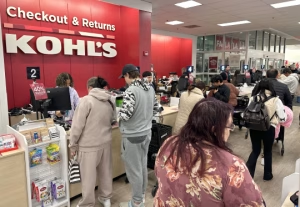
Holiday shoppers crowded a Kohl’s store in Wisconsin last year.

The retail and transportation-and-warehousing sectors typically rush to hire as they staff up for the holidays and let those workers go once the season is over. In the final three months of last year, the two sectors added 912,000 jobs. They then shed 858,000 jobs over January and February.

While the jobs are temporary, they provide an important source of income for low-wage workers, many of whom move from job to job over the rest of the year, writes The Wall Street Journal (Nov. 12, 2025).

This year, some of the companies that do the most holiday hiring have broken from their usual practice of advertising how many holiday workers they plan to hire. United Parcel Service, for example, said last year that it would hire 125,000 workers in its “holiday hiring spree.” This year, it hasn’t made an announcement. Also holding off: Macy’s, which said in 2024 that it would hire more than 31,500 seasonal workers, and Target, which said last year that it would add 100,000 seasonal jobs. (Both UPS and Target have laid off regular employees this year.)

Through October this year large companies have announced plans to hire 372,520 seasonal workers. That compares with 660,150 at the same point last year.

 But Portugalia Marketplace in Fall River, Mass., which nets about 30% of its annual business in November and December, calls for “all hands on deck”—as it wrote in a recent seasonal hiring posting for its warehouse that fills online orders. The grocer’s staff typically grows from 50 people to 60 near year-end as families shop for holiday groceries and the store hosts more events to attract visitors.

Classroom discussion questions:

  1. What other capacity options do firms have?
  2. Why is seasonal hiring slowing this year? Is it an AI issue?

Guest Post: The Natural Gas Supply Chain

Prof. Howard Weiss shares his insights with our readers monthly.

Natural Gas is a resource with several uses and, in fact, almost 50% of U.S. homes use it for heating. This figure shows the supply chain for natural gas.

Resource location Natural gas is extracted from rock formations, wells and coalbeds.

Pareto Principle Natural gas is produced in varying amounts in 95 countries. The U.S., Russia, Iran, and Qatar produce half of the natural gas worldwide. Five states, Texas, Pennsylvania, Louisiana, W. Virginia and New Mexico, produce over 60% of the total natural gas in the US. Thus, both U.S. and worldwide production follow the Pareto principle as explained in the quality chapter (Ch. 6).

Transportation The supply chain chapter (Ch.11) lists six major means of distribution – trucking, railroads, airfreight, waterways, multimodal and pipelines. Unlike oil, before natural gas is processed it can only be transported through pipelines.

Project Management. Building the pipeline is a project with two major parts. The pipeline company does not own the land where the pipeline is, but rather needs to get legal access to the properties. The second part is the construction of the pipeline itself. This involves digging and bending pipes to fit the planned route of the pipeline. Companies install about one mile of pipe per day. The U.S. has more than 300,000 miles of main pipelines, while Russia has more than 100,000.

Quality control After construction the pipeline is testing using water piped at a higher pressure than the gas will be transported.

Processing The gas goes to a compressor station (where impurities are removed) and then is pressurized to move it post-processing.

Post Processing Transportation The gas is then moved at 25 miles per hour through pipelines. Some gas is liquefied by chilling it to -263 degrees Fahrenheit so it can be shipped by special tanker ships and rail cars. Natural Gas is 600 times more in volume than liquefied natural gas. LNG can also be shipped to places that do not have pipelines.

Storage Currently there are 400 storage sites for natural gas in the U.S.

Classroom Discussion Questions:
1. Does your residence use natural gas? If so, what are its uses?
2. Some natural gas that is discovered is not sold but rather is burnt off at the site where it is found. Why do you think the gas is wasted rather than being sold?


Guest Post: Electricity Power Lines and Operations Decisions

Prof. Howard Weiss survived the recent hurricane that hit Florida and shares his thoughts about losing power.

The two recent hurricanes, Helene and Milton, have devastated power lines in many places but especially in Florida and N. Carolina. Florida Power estimates that underground lines fared 12 times better than lines that were overhead during the hurricanes.

There are two situations utilities face, depending on whether it is a new installation or a change from aboveground to underground. In either case there are several OM factors that are discussed in your textbook that are relevant when deciding whether to use overhead lines are below ground lines.

Fixed costs In general, underground lines require trenches and manholes which are more expensive to build than erecting pylons/poles for overhead wires. Also, underground wires require special insulation. The cost of installation can vary depending on the locality. Underground lines cost 5-10 times as much as aboveground lines–$1.5 to $3 million per mile compared with $285,000 to $800,000 per mile for above ground lines.

The first overhead lines and poles were built in 1844 and at that time underground lines were tried but they failed.

Variable costs The major variable costs are for maintenance and repair. Underground lines are more difficult to maintain or repair. The major direct cost to consumers is the cost of being without electricity. Ultimately all of the costs will be borne by the consumers.

Capacity Above ground cables have roughly 6 times as much capacity as underground lines.

Reliability While below ground lines are not 100% reliable, they are more reliable than overhead lines. Above ground power lines can be felled by wind, ice storms, falling trees and damaged by squirrels. Below ground power lines can be washed away or corroded along coastal areas due to storm surges. In Winter Park, Florida, where 80% of lines are underground, 98% of customers had power during Hurricane Milton.

Lifespan Aboveground lines have twice the lifetime, 70 years, compared with belowground lines.

Risks Aboveground lines can spark and cause fires. Pacific Gas & Electric paid $55 million after its power lines started a destructive brush fire. Also, sometimes power needs to be shut off to prevent any fires.

Aesthetics Clearly, belowground lines lead to a more pleasing appearance than overhead lines.

Classroom Discussion Questions
1. Does your community have underground or overhead wires or both?
2. What analysis could be done to make the decision between overhead or underground lines?

Guest Post: The Panama Canal Backlog

Prof. Howard Weiss shares his OM insights with us monthly.

Recently, there has been a bottleneck of ships waiting to go through the Panama Canal with over 120 ships waiting, reports Institute for Supply Chain Management (Aug. 29, 2023). The main cause is that there has been a drought, lowering the canal’s water level which reduces its capacity. (This also happened in 2016 and 2019). Normally, 36 ships would pass through the canal every day. At the moment the limit is 32 ships. The waiting time average is roughly 10 days rather than the 6 days it had previously been. Shipping companies have three options to mitigate the problem.

Reduce ship weight Some companies have reduced the number of containers on a ship. This reduces the ship’s weight which reduces its “draft”. The reduction in containers can take place at the ship’s origin or in Panama by placing the containers on the Panama Canal Railway which runs across the country. As a result of this reduction, shippers have been adding surcharges to their clients. For example, Hapag-Lloyd has added a $500 per container fee on Asia to US east coast routes.

A caravan of cargo ships sits in the Pacific Ocean last week, waiting to enter the Panama Canal

Use a different route There are several alternatives both by sea and land to avoid using the Panama Canal, each with its own advantages and disadvantages. By sea, a ship can go around South America. While the distance is considerably longer, the ship can make stops at major ports in South America such as Brazil, Argentina and Chile. The Suez Canal may be a less expensive option to the Panama Canal as the Asia to U.S. East Coast distances are roughly the same as when using the Panama Canal. Going around South Africa is another option. Land routes include the Panama Canal Railway.

Increase priority at canal In order to use the canal, shippers need to reserve a slot. The fee depends on the type of ship and other factors and ranges from $10,500  (small vessels) to $400,000 (largest vessels fully loaded).  A few daily slots are left open and auctioned off through the “Transit Slot Auction” which essentially allows ships to jump the line. This auction fee is paid in addition to the normal fee. The base price for the auction is $100,000 and recently a company paid $2.4 million.

Discussion Questions:
1. Cite a waiting line situation where one can improve his/her place/priority in the line.
2. What other operations decisions require examining time and cost tradeoffs?

Guest Post: Curbside–The New Greyhound Location

Prof. Howard Weiss has developed the Excel OM, POM, and Active Model software that comes free with our text.

The Location chapter (Ch. 8) of your Heizer/Render/Munson textbook discusses the location of a new facility but a related question is the closing of a current facility. Figure 8.1 lists as its first factor for determining the site as : “size and cost”.

Recently, Greyhound has decided that one way to reduce costs is to close its bus terminals. It has closed terminals in Philadelphia, Knoxville, Louisville and Houston, where riders are dropped off and picked up at the curb; in Tampa where riders are dropped off in a parking lot; and in Columbus which now uses a public bus terminal.

Of course, curbside or parking lot usage leads to a number of difficulties for passengers. In many cases there is no shade, no heat or air conditioning, no food, no place to sit, nor any restrooms. In addition, buses idling at the curb takes away a lane for cars or bikes. There are several reasons that bus terminals are being closed.

Relocation Often times a facility will be closed because it is being relocated to another location. This is true in some cases for Greyhound which recently moved its downtown Cincinnati station to the suburbs. This relocation did hurt riders who needed a more central location.

Condition of Terminal In midtown Houston the Greyhound bus station is an old, dilapidated station and for sale. However, the area around the station is improving, as new apartment buildings, restaurants, bars and grocers open.

Property value One main reason for leaving the bus terminals is to sell the properties which have become very valuable. In addition to Houston, the Louisville site will be turned into a 256 unit apartment complex. In Chicago, which serves 500,000 passengers each year and 55 busses per day, the station is for sale, with no replacement in the plans.

One stated reason for closure of terminals is because there will be a new bus terminal. But in Louisville construction has not started on the new terminal, even though the old terminal is closed. Greyhound is not alone. In Minneapolis, the Uptown Transit Station closed months ago and a facility will not reopen until Spring 2024. The station has been beset with vandalism, drug use and other activities which make it unsafe.

Classroom Discussion Questions:
1. How can bus terminals be made safer?
2. What other facilities have been sold due to the value of the land?

OM in the News: Electric Big Rigs Hit the Street, but Chargers are Scarce

Heavy-duty electric trucks are rolling out across the country. But “the electric grid upgrades and equipment needed to plug them in aren’t,” writes The Wall Street Journal (July 17, 2023).

California plans to require new trucks to be zero-emissions by 2036.

As automakers deliver new electric trucks to fleet customers, parking lots that once needed enough power for a few floodlights now might need to draw as much power as a skyscraper. But the necessary grid improvements could take years.  In January, California utility PG&E told some large fleet customers they wouldn’t be able to charge trucks for a few years during summer afternoons when California electricity use peaks. Capacity upgrades would take at least until 2026, said PG&E.

Similar issues are popping up across the U.S. as firms place larger EV truck orders.  “One or two trucks, everybody’s got. It’s when they try to do their fleets,” said the CEO of Exelon, an eastern U.S. utility company.

The challenge is especially acute in California, where drayage trucks, which carry containerized cargo to and from ports and rail centers, face a looming deadline. The state will require any new drayage trucks to run on electric batteries or hydrogen fuel cells. California also plans to phase out sales of new gasoline-powered passenger cars, pickup trucks and SUVs by 2035 and require all new medium- and heavy-duty truck sales be zero-emissions by 2036.

Electric trucks have the potential to reduce air emissions for communities by eliminating diesel use. Trucks represent 6% of the vehicles on California’s roads, but a quarter of the state’s on-road greenhouse-gas emissions. California forecasts it will have 180,000 medium- and heavy-duty zero-emission vehicles by 2030 that would need 157,000 chargers, many of those at depots operated by the fleet owners. There are fewer than 700 chargers at depots now.

Fleet owners must figure out how to install chargers at their depots, a complex engineering and power management task. Chargers will also be needed on the road but there is no network of electric truck stops yet. California has the most EV fast chargers for regular passenger cars nationally, but those sites aren’t designed to fit industrial vehicles. As fleets add trucks they will need to draw at least 6 to 8 more megawatts of power. That’s about 1,000 homes.

Classroom discussion questions:

  1. As a fleet manager, what is your strategy?
  2. As a power company such as PG&E, what is your capacity strategy?

OM in the News: The Green Transition Challenge

Copper is the new lithium, writes The Wall Street Journal (April 19, 2023). But a lack of new mining activity has added to worries that there won’t be enough of the red metal for the energy transition to electric vehicles.

Sheets of copper cathode at a mine in Chile.

Copper is used in wiring and construction as well as EVs, solar panels and other green technologies. Electrification is expected to increase annual copper demand to over 36 million metric tons by 2031, with supply forecast to be around 30 million tons, creating at least a 6 million ton shortfall at the start of the next decade. In 2021, refined copper demand stood at 25 million tons.

South America currently dominates copper production and Chile is the largest mined producer. Increasing mine output has proved a challenge, warning of a serious supply shortfall over the next decade. Some projects are coming online in Peru and in Chile, which will add incremental supply, but there is little in terms of pipeline for the long run. Copper metal exports from Congo and Zambia, the two other sources, totaled 2.3 million tons in 2022, up slightly from 2021, but less than half of Chile’s output.

“There’s a narrative around resource scarcity and the green transition with EVs and renewables as well as the build-out of electricity grids. On paper it’s quite a substantial supply gap opening up over the next 10 years,” says an industry expert. And there is no slack in the system.

“Green” uses of copper now account for about 4% of consumption, but this is expected to rise to 17% by 2030. A “net-zero emissions” path would mean the world would need an additional 54% of copper by 2030 on top of that forecast. EVs cannot take off before the charging infrastructure is set, and the necessary electrification is very copper intensive. Copper features heavily in energy transition proposals.

Sales of electric cars in 2022 in creased 55% over 2021 to bring the total number of EVs in the world to around 26 million. That means the EV-charging ecosystem will have to be significantly ramped up.

Classroom discussion questions:

  1. Why is this an OM issue?
  2. What might be done to solve the problem?

Guest Post: Lumber, Sawmills, and Location Decisions

Prof. Howard Weiss is providing blog posts while I am travelling.

The Location Chapter of your textbook (Ch. 8) notes that “goods for which there is a reduction in bulk during production (such as a sawmill cutting trees to lumber) typically need facilities near the raw material.” While sawmills need to locate near the trees for economic reasons, the lumber industry itself has made location decisions since colonial times for other reasons.

The lumber industry in the U.S. began with New England colonies providing much of the lumber. The lumber was used in the colonies but also exported to Great Britain. By 1830, more lumber was being shipped out of Maine than any place in the world. Lumber is still exported from Canada and the U.S., which account for 12% and 8% of world lumber exports, respectively. China is the number one exporter and accounts for 13% of world exports.

As lumber supplies, i.e. trees, dwindled in New England, logging moved to New York and Pennsylvania and then to the Great Lakes region. By the beginning of the twentieth century, Midwest supplies were not sufficient and logging moved to the Pacific Northwest.

Recently though, the warmer weather in the Pacific Northwest and Canada has led to insect infestations and wildfires forcing lumber producers to move elsewhere, namely, into the South. Since 2021, 4.54 million board feet of capacity have been added to Southern States whereas Eastern Canada, British Columbia and the US West have all lost capacity.

In addition, the replenishment time for forests in the south is 20-30 years, which is less than for other areas. Major lumber companies have also moved south to Alabama, Georgia, Florida, Texas and the Carolinas because wood there is plentiful and inexpensive.

The figure below displays the number of lumber mills closed in the Northwest and the number of lumber mills in the South.

The move from the Northwest to the South means that different trees will be providing lumber. The Northwest forests were mainly Douglas firs whereas the Southern forests are Southern Pine trees. Southern Pine is not as straight as Douglas fir and is more prone to warping. This affects the choices of wood and design by the major users of lumber – the construction industry.

Classroom discussion questions:
1. What are the by-products from a sawmill?
2. Draw a figure of the supply chain for lumber, similar to the supply chain figure for soft drinks given in Figure 1.2 of your Heizer/Render/Munson text.

OM in the News: Airlines and a Slew of Operations Issues

“Airlines have found that they can’t sustain the higher levels of flying they had hoped to offer to capitalize on rising demand,” writes The Wall Street Journal (July 22, 2022). Staffing shortfalls, training logjams and constraints at overwhelmed European airports in particular are stifling their resurgence and forcing them into more restraint. Airlines are reining in their schedules for at least the rest of this year—not because they can’t fill their planes, but to avoid costly OM stumbles.

Airports in disarray

American’s travel has surpassed 2019 levels and remains strong. But its third-quarter flying capacity will be 8% to 10% lower than in 2019 as the airline pulls back capacity to build additional buffer into its schedule. The weather in June was challenging, with significant issues on 27 days that overwhelmed the airline. It canceled over 5% of flights that month.

United and Delta have also said they would cap growth in the coming months to run more reliably. Those pullbacks and efforts to avoid delays and cancellations add to the cost pressures. Delta expects to pay $700 million in overtime and premium pay to help avert disruption, and United will stay overstaffed while it gives priority to reliability over growth. “There is weather, and people do call in sick, and and stuff happens. And the system just doesn’t have any buffer to deal with that,” United’s CEO said.

Carriers needed to bring on thousands of workers to replenish their ranks after offering buyouts and early retirement packages to slash costs in 2020. While their staffing levels are once again nearing prepandemic levels after a recent hiring spree, airlines have are finding that is no longer enough as they work through big backlogs of training requirements and adjust to a workforce comprised of less experienced employees to get back up to full force.

Air-traffic control is also short staffed, leading to problems in highly trafficked corridors such as Florida and New York. And acute staffing shortages at major European hub airports have been a big source of the summer’s chaos. London’s Heathrow Airport is capping the number of departing passengers and asked airlines to stop selling new tickets from the airport for the summer season.

Classroom discussion questions:

  1. Outline the operations issues that airlines are currently facing.
  2. In Supp. 7 (Capacity and Constraint Management in your Heizer/Render/Munson text), we we discuss ways to manage capacity and demand. Which can be employed here?

Guest Post: Shoe Capital of the World

Our Guest Post comes from Prof. Howard Weiss, who created the ExcelOM and POM software that we provide free to our readers.

Lynn Massachusetts In colonial days shoemakers had a capacity of roughly 5 shoes–not pairs–per day. The industrial revolution moved shoe manufacturing to factories, increasing capacity to 50 pairs per day. In 1883, Jan Matzeliger of Lynn, Massachusetts patented a machine that would use a wooden mold to form the leather top of the shoe and then attach it to the bottom. The new machine replaced this step (called lasting) which was performed by hand by skilled shoemakers. And it increased the capacity to 750 pairs per day while reducing the price of shoes by 50%.

 Figure 8.1 of your Heizer/Render/Munson textbook mentions several factors for a successful location which we examine now with respect to shoe manufacturing.

Labor talent Due to the continuous flow of skilled shoemakers into the state, 234 shoe manufacturers chose Lynn as their location and manufactured over 1,000,000 pairs per day. This made Lynn the Shoe Manufacturing Capital of the World. The state of Massachusetts produced more shoes than anywhere else in the U.S. through World War I. 

Matzeliger’s lasting machine

Leon, Mexico Today, however, over 90% of shoes bought in the U.S. are not manufactured here. One of the major manufacturing locations is Leon, in the state of Guanajuato, Mexico which currently has over 3,000 shoe manufacturers including Nike, Converse, Crocs, Skechers and New Balance. This makes Leon the current Shoe Manufacturing Capital of the World. There are several reasons for this:

Location of markets Leon is located roughly 250 miles northwest of Mexico City and has easy highway access to other cities in Mexico and to the U.S. through the 45 U.S.-Mexico border crossings. Mexico’s infrastructure is in excellent shape as are its highways. Shipments by truck to the U.S. take no more than 3 days, and to Latin America no more than 7 days. Guanajuato has an international airport with flights to cities in Mexico and L.A., Houston, Chicago and Dallas. Shipments to Europe take less than 2 weeks.

Labor talent again Mexico has had large influx of skilled leatherworkers from Europe.

Proximity to raw materials/supply chain One of the key materials needed to manufacture shoes is leather and there are nearly 700 leather tanneries in Guanajuato providing this raw material.

Classroom discussion questions: 

  1. What major manufacturer or service organization is located near your home or school and what were the factors for selecting that location?
  2. What is the effect of NAFTA in selling shoes manufactured in Mexico in the United States?

OM in the News: Amazon’s Capacity Issues

Amazon’s growth has skyrocketed throughout the pandemic, doubling the size of its operations and nearly doubling its workforce over a two-year period. While some of Amazon’s fulfillment network hires during the quarter covered employee absences amid the omicron variant surge, the company quickly transitioned from being understaffed to being overstaffed, resulting in lower productivity, reports Supply Chain Dive (April 29, 2022).

“Capacity decisions are made years in advance, and we made conscious decisions in 2020 and early 2021 to not let space be a constraint on our business,” said Amazon’s CFO. “During the pandemic, we were facing not only unprecedented demand, but also extended lead times on new capacity, and we built towards the high end of a very volatile demand outlook. ”

The tide has turned, however, as consumers have slowed their e-commerce spending activity in recent months. Net sales at Amazon’s online stores dropped 3% last quarter, while Amazon’s fulfillment expenses jumped nearly 23%. UPS, which counts Amazon as its largest customer, reported an unexpected drop in home delivery volume as March e-commerce sales saw their weakest gain in more than three years.

Amazon aims to rightsize its massive fulfillment network in response to demand now falling back to pre-pandemic levels. But this process won’t happen overnight. It will take several quarters for Amazon to grow into the current capacity it has built out. In July, the company was focused squarely on adding capacity to meet the current high customer demand. Three months later, labor was the company’s primary capacity constraint, creating $4 billion in added costs. In early February, omicron added to Amazon’s staffing challenges.

“We hired more people and then found ourselves overstaffed when the omicron variant subsided rather quickly, at least from our standpoint in warehouses,” said the CFO. “So, the issue has switched from disruption to productivity losses to overcapacity on labor.”

One issue that has been present throughout the past year is inflation, specifically for transportation costs and wages. The war in Ukraine has amplified inflationary pressures as fuel costs have climbed, and Amazon is looking for ways to offset the higher prices. This year, it hiked the price of its U.S. Prime membership and introduced its first fuel and inflation surcharge for sellers using its fulfillment services.

Classroom discussion questions:

  1. Summarize Amazon’s capacity issues and their genesis.
  2. Which of the 6 tactics for matching capacity to demand listed in Supplement 7 of your Heizer/Render/Munson text might Amazon apply?

Guest Post: Emergency Services and COVID

Professor Howard Weiss, recently retired from Temple University, looks at quality issues arising from COVID.

Several sources have reported that due to COVID there has been a decrease in Emergency Services quality. In Philadelphia, the average police response time, the time between a police dispatcher receiving the call and the arrival of the police, was 20% higher in 2021 than in 2020.  In Los Angeles, response times to emergencies increased due to over 200 firefighters missing their shift. In San Diego, response times for its most urgent calls for service rose from 21 minutes in 2018 to 28 minutes in 2020. The problem, of course, is not limited to the U.S. Police response times have also increased in England, and Bermuda has had 48 officers unable to work as opposed to a more normal 16 officers. In addition to delayed response times, no-shows of police, has become more common since the onset of COVID.

The major reasons for the increase in response time are:

  • Unavailable emergency personnel because they have been stricken with COVID or quarantined because they were with someone who had COVID
  • Layoffs of emergency personnel who are not vaccinated
  • Staffing shortages in the 911 call centers
  • A spike in crime
  • Technology issues

A major concern, if the slow response times continue, is that if police do not respond in a timely fashion then people will stop calling the police at all.

Chapter 13 of your Heizer/Render/Munson textbook notes that “Police and fire departments have provisions for calling in off-duty personnel for major emergencies. Where the emergency is extended, police or fire personnel may work longer hours and extra shifts.” To increase capacity, some cities have done this and some cities have relaxed quarantine rules so emergency personnel can get back to work more quickly. Others have canceled vacation times for personnel. Some cities have brought in others to increase capacity. Another option is to put a web site in place for minor problems such as losing a driver’s license in order to reduce the demand for emergency services.

Not all increases in response times have been due to COVID. For example, in Montreal, response times are slower due to the merger of two police stations. Ft. Worth, Texas, which has the highest response time goal of Texas’ five major cities, had response times that were deemed too slow prior to COVID.

Classroom discussion questions:

  1. As a manager in your town, how would you address this concern?
  2. What other fields are experiencing the same issues?

Guest Post: Superbowl Footballs

Our Guest Post comes from Professor Howard Weiss who is the developer of the ExcelOM and POM software that we provide free with your text.

Superbowl LVI is quickly approaching so this is an opportune time to discuss the footballs that will be used. All NFL footballs are manufactured by the Wilson Sporting Goods Company at its factory in Ada, Ohio. Wilson is a Chinese-owned subsidiary that has been manufacturing footballs for over 60 years and currently makes 700,000 footballs per year. Wilson has continuously improved its manufacturing process over that time leading to the current five step manufacturing process followed, of course, by quality control. 

While there is a straightforward sequence when manufacturing a football, Wilson does not use an assembly line. One advantage of its process layout is that it allows Wilson to pay its workers by piece.

Cutting: Each football consists of four equal ellipsoid parts that Wilson cuts from a large piece of leather using a cookie-cutter style mold. The Horween Leather Company has been supplying leather to Wilson, its largest customer, since 1941 for both footballs and basketballs. One of the four pieces is stamped with the appropriate Logo for the organization that will use the footballs.  Each seamstress has a capacity of roughly 150 footballs per day.

Sewing: Wilson applies a backing and then sews the top two panels together and the bottom two panels together using sewing machines that seem to be the same as those used when Wilson first started manufacturing footballs for the NFL in 1941. After sewing, the seamstress punches the holes for the laces.

Turning: Wilson then softens the leather and turns the footballs rightside out with the help of a steel bar.

Lacing: Following turning, Wilson inserts a bladder into the football and then laces the football.

Molding: The last step is to mold the footballs into their shape and to inflate to 13 pounds per square inch. This is the standard PSI for NFL footballs (unless you are Tom Brady).

Quality Control: The quality control inspector checks that the seams are perfect and that the footballs are consistent and feel the same to every player

The footballs with their special Superbowl stamp are then ready for the big game.

Classroom discussion questions: 

  1. Given the information above, how many seamstresses need to be employed to meet the annual production rate?
  2. What are other advantages, aside from paying by the piece, are there in using a process layout rather than a product layout?

OM in the News: The Shortage of Valentine’s Chocolate

Hershey says it lacks manufacturing capacity and labor to meet demand

Hershey said it is running low on Valentine’s Day candy this year, thanks to a shortage of labor and factory capacity. Many grocery shelves already are bare where heart-shaped chocolates should sit, and Hershey said it would likely stay that way leading up to the holiday.

Hershey said it has added production lines recently and hired more workers, but it hasn’t been enough to keep up with America’s appetite for its Reese’s chocolates, Jolly Ranchers candy and other treats. Hershey has sent salespeople to stores to help restock shelves and the inventory issues vary by retailer.

The candy aisle at the average store is currently out-of-stock of 20% of its items—compared to 12% out-of-stock for the whole store, reports The Wall Street Journal (Feb. 4, 2022). The whole industry is having supply challenges. Consumers also have been buying more sweets, increasing pressure on candy supplies. Many retailers are carrying fewer sizes and varieties of candy than they used to; some have received incomplete orders for Valentine’s Day despite booking farther in advance.

The B&R Stores chain is receiving under 60% of its candy orders. In the Midwest, Festival Foods stores have been ordering about 25% to 30% more candy supplies than usual in recent months and are still experiencing inventory issues. The broader food supply chain continues to have hiccups, as U.S. manufacturers and retailers grapple with labor shortages and employee absenteeism. Pet food, cereal and refrigerated dough are among many items in tight supply, and the candy supply remains tight ahead of Valentine’s Day and Easter.

Hershey and some competitors have cut back on advertising in recent months, to avoid boosting demand while they struggle to fill orders from retailers. The candy makers, along with other U.S. food makers, are also raising prices to offset some of the higher costs they face for raw ingredients, trucking, labor and packaging. That hasn’t dented demand yet.

Classroom discussion questions:

  1. In Supp. 7 of your Heizer/Render/Munson text, we discuss tactics for matching capacity to demand. Which apply in this situation?
  2. What is the long-term solution?