OM in the News: The Inventory Return Scam

Retailers nationwide have seen online returns skyrocket over the past four years after rolling out generous returns policies to attract customers amid a pandemic-driven surge in e-commerce. The returns policies have helped change shopping habits: Consumers have grown accustomed to ordering items online in several sizes and colors, then returning what they don’t want.
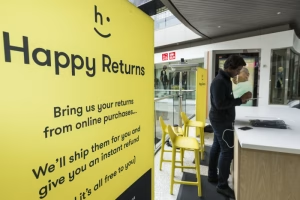
Shoppers last year returned 17.6% of items they purchased online, valued at more than $247 billion and more than double the percentage of goods returned in 2019. Returns have become such an entrenched part of online commerce that companies have sprung up to handle the growing business. UPS acquired one of those specialized operators, Happy Returns, for $465 million.

The ease of shipping goods back has also given criminals new tools to exploit in an online environment in which buyers don’t need to interact with store employees–and the scale and organization of the fraud is getting more ambitious, and organized.  More than $100 billion in merchandise was returned fraudulently in the U.S. last year, estimated to be 9-15% of the $850 million returned goods retailers received in 2024-2025, reports Supply Chain Brain (Feb. 2, 2026). 

Organized criminal groups “are taking advantage of the omnichannel retail environment,” said on industry expert. In some cases, fraudsters are returning knockoffs in place of designer goods and sending back boxes full of bricks or other filler rather than the original items. Others are manipulating shipping labels to receive a refund just from mailing back an empty envelope. Fraudsters marketing their services on Telegram and through other websites often sell their services in return for a cut of customers’ refunds.

Apparel retailer PacSun recently noticed a sharp increase in returns of online purchases, including one customer who had returned some 250 orders worth $24,000.  PacSun had issued the refunds, but the company never received the actual merchandise at its warehouse. Instead, workers found “used or different merchandise returned in the box, or even empty shoeboxes.”

Some retailers such as Amazon are taking legal action. It just sued the refunding-services group REKK that it claimed was “responsible for stealing millions of dollars of products from Amazon’s online stores through systematic refund abuse.”

Classroom discussion questions:

  1. How can the quality control inspections engaged during returns processing be defrauded?
  2. How has e-commerce made this fraud easier?
OM in the News: The Holy Grail of Automation–Now a Robot Can Unload a Truck


The robots are coming for the last human warehouse jobs.  Loading and unloading a truck is backbreaking, mind-numbing work that retailers and parcel carriers have tried to solve for years. Workers may not stay long in these jobs. Summers and winters are particularly grueling for anyone stuck in a metal trailer, slinging heavy boxes. Injuries are common.

Automating this process has long been the holy grail of warehouse logistics, writes The Wall Street Journal (June 24, 2025). When loaded, packages must be fitted together to fill the available space and be sorted by weight—with the heaviest items on the bottom—so they don’t topple or break. Unloading them is challenging, too, because the unloader must move in and out of a trailer, ferrying packages of different sizes and weights.

On a typical warehouse floor today, every task might be heavily automated—except for workers loading and unloading the trucks. People who have worked these jobs say they have to stand for extended periods, hefting boxes as heavy as 70 pounds. New advances in robotics are changing that.

Improved sensors and algorithms, advancements in AI and faster image-processing technology are making these robots proficient players in tasks that are like a game of 3-D Tetris. This shifts the burden of physical lifting from humans to robots. Proponents of the technology say it will mean more efficiently packed pallets, fewer damaged items and a lot of time saved. The machine-learning algorithm isn’t aware of what’s inside each package, but does know the item’s weight, approximate center of gravity and how fragile it is.

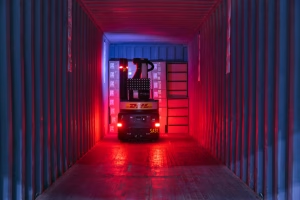
DHL’s Stretch robot can unload 580 cases an hour, twice the rate of a human unloader.

The robot will use the information it has on an item to choose the optimal pallet and determine where the it should be placed to minimize damage, but still allow the highest possible number of boxes to be packed in the given space.

DHL just signed an agreement with Boston Dynamics for 1,000 of these robots. United Parcel Service is also increasing automation at its facilities, including for loading and unloading trailers—a move that will help the company cut costs. FedEx has been testing and refining the truck-loading process in one of its facilities since 2023. Walmart also has introduced robots that can unload a truck.

Classroom discussion questions:

  1. Why is this an important OM advancement?
  2. How else are robots now being used in warehouses?

Guest Post: Using Data Analytics to Optimize Operations Management

Charlie Render is CEO of Render Analytics, a Florida-based data analytics consulting firm. He can be reached at https://www.renderanalytics.net/

Harnessing the power of data has emerged as a critical OM strategy for gaining competitive edge. Data-related technologies are being employed to elevate supply chain logistics, manufacturing efficiency, and overall operations.

Data analytics, the topic of Module G in your text, involves the systematic exploration of datasets to glean meaningful decision making insights. In the OM/SCM context, it encompasses the analysis of such diverse data points as order volumes, lead times, transportation costs, inventory levels, and customer behavior trends. This fusion is a natural convergence, given the voluminous data generated at each juncture of the supply chain. 

Here are four real-world examples:

 Amazon’s Demand Forecasting   By meticulously analyzing historical sales data, seasonal patterns, macroeconomic indicators, and even external factors like weather events and cultural trends, Amazon employs advanced predictive models. This enables the firm to anticipate product demand with remarkable accuracy. As a result, it can adjust inventory levels dynamically, minimize excess stock, and ensure the timely availability of popular products. The outcome is not just optimized inventory costs but also a seamless customer shopping experience.

UPS’s Route Optimization  UPS harnesses data analytics to refine its delivery routes. By integrating real-time traffic data, intricate delivery schedules, fuel costs, and even road closures, it constructs a comprehensive algorithmic approach. This approach identifies the shortest, most fuel-efficient routes for its fleets. The outcome is not just a reduction in fuel consumption and operational expenses, but also better on-time deliveries, positively impacting customer satisfaction.

Toyota’s Proactive Quality Assurance Toyota exemplifies how data analytics can revolutionize quality control within assembly lines. By tapping into data generated by sensors embedded within production equipment, Toyota has pioneered real-time quality assurance. This enables the detection of deviations from predefined quality benchmarks throughout the manufacturing process. Swift identification of potential defects lets Toyota rectify issues promptly. This means a reduction in defective units, lower warranty claims, and enhanced customer satisfaction.

Maersk Line – Transforming Container Shipping  Maersk  demonstrates the impactful combination of data analytics and sustainable supply chain practices. With the aim to minimize emissions and optimize routes, Maersk uses data analytics to study factors such as weather patterns, sea currents, and fuel efficiency. By leveraging these insights, it optimizes vessel routes, reducing fuel consumption, and subsequently decreasing greenhouse gas emissions. This data-driven approach not only aligns with a commitment to sustainable shipping, but also helps achieve substantial cost savings.

Guest Post: Seasonal Employees

Professor Howard Weiss shares his insights with our readers monthly. This topic is especially timely.

Chapter 13 in your Heizer/Render/Munson text, Aggregate Planning, discusses temporary workers as one strategy to use to adjust for changes in demand. This is a useful strategy when the size of the labor force is large. Thus, using seasonal workers is the appropriate strategy for UPS to follow– and it does. This year, beginning now in October and ending in January, UPS plans to hire over 100,000 employees to meet the December holiday demand when the volume of packages doubles. One benefit to the seasonal workers who are hired is that 35% of them will later be hired into full time positions as package handlers, delivery drivers, tractor-trailer drivers, and driver helpers.

Many other organizations also require seasonal workers. Retail stores clearly have the same seasonality as UPS. Spirit Halloween is a company that sells Halloween costumes, decorations, props, and animatronics and has over 1,400 stores open in September and October in all 50 states and in 9 provinces in Canada. Summer is a season rife with seasonal jobs. Philadelphia and many other cities hire seasonal workers for the summer for parks and recreation. Summer camps do the same, as do zoos. Barnes & Noble hires seasonal workers for the beginnings of semesters at universities. H&R Block hires seasonal workers in the winter for tax preparation. Seasonal fruit pickers are hired during harvest times. Landscapers hire workers seasonally.

Your textbook notes the downside of hiring seasonal employees is that “new employees need to be trained, and productivity drops temporarily.” In addition, the training may not be as complete as training for full time employees. The book further states that “layoffs or terminations lower the morale of all workers and also lead to lower productivity.” In addition, seasonal workers may be less committed and less loyal than full time employees.

Of course, there are several advantages to using seasonal workers, the most obvious of which is the flexibility it affords to handle increased seasonal demands and keep wages and benefits costs as low as possible since the seasonal employees are not full-time employees. In addition, if there is an issue with a seasonal employee, it is easier to dismiss the employee. Or on the optimistic side, if a seasonal worker is excellent he or she can be hired full time, as is the case with UPS.

Classroom discussion questions:
1. How else can seasonality of demand be approached?
2. What products/services not mentioned above require seasonal employees?

OM in the News: UPS Says No!

“No exceptions,” said the message from UPS to its drivers. As we enter a holiday season when retailers are increasingly dependent on delivery companies to move online orders, we see a dynamic that has shifted power significantly. United Parcel Service, reports The Wall Street Journal (Dec. 3, 2020), imposed shipping restrictions on some large retailers this week, an early sign that the pandemic-fueled online shopping season is stretching delivery networks to their limits.

The company on Cyber Monday notified drivers across the U.S. to stop picking up packages at Gap, Nike, L.L. Bean, Hot Topic, Newegg, and Macy’s. The move comes as UPS and rival FedEx have raised prices and promised to hold merchants to volume agreements. It is a sign that UPS is metering the flow of packages into its network to preserve its performance during one of the busiest shipping weeks of the year. 

FedEx and UPS both prepared their customers for tight capacity for this holiday season, as consumers, fearful of venturing out to stores due to the virus, are stocking up on household essentials from online merchants at the same time the holiday shopping season kicks off. The combination is expected to create a surplus of as many as 7 million daily packages between Thanksgiving and Christmas.

FedEx and UPS for months have been processing packages at levels more common during the Christmas season and were preparing to layer another surge of orders on top of that. They have responded with restrictions on capacity and surcharges to offset higher costs from hiring tens of thousands of workers and renting extra equipment. UPS picked up 81% of packages on the day they were ready between Nov. 15 and Nov. 21, compared with 95% for FedEx.

Abercrombie & Fitch tells online shoppers to place their orders by Dec. 4 if they want items to arrive by Christmas using its standard shipping option.

Classroom discussion questions:

  1. What techniques can UPS apply to handle this capacity issue? (Hint: see p. 312 in your Heizer/Render/Munson OM text).
  2. Compare this capacity problem to that facing airlines today.

OM in the News: Shipping Capacity Sold Out for the Holidays

One holiday item is already sold out: shipping capacity. Both FedEx  and UPS have told shippers that most of their capacity is already spoken for, and that any extra trailers with holiday orders will have to wait to be picked up.

“There will be days within the holiday season where the industry will be over capacity,” said one FedEx exec. The outlook has sent retailers on the hunt for alternatives with little luck. Smaller carriers also booked up their capacity for the holidays months earlier than usual and aren’t taking new customers.

The capacity shortfall could average 7 million packages a day between Thanksgiving and Christmas, reports The Wall Street Journal (Oct.19, 2020). Total shipping capacity for the industry will be 79.1 million parcels a day during that period, with 86.3 million packages looking for space.

Carriers and their shippers spend months planning for the holiday season and hone their forecasts for the number of packages they expect to ship. The two sides decide items like weekly shipping forecasts and how many trailers the carriers may need to pick up from their loading docks each day. Any deviation from the estimate can result in higher rates per package or penalties to compensate the carrier for needing to marshal more resources.

In previous years, shippers could usually find space to ship if online sales blew through expectations, though it would come at a premium to rates that had been negotiated. Now that doesn’t exist. The primary reason for this year’s capacity shortage is that carriers already have been operating near maximum capacity for months as consumers stayed home, avoided stores and shopped online.  Carriers can’t quickly boost capacity with new facilities as it often requires a multiyear planning process.

Classroom discussion questions:

  1. What might carriers do to “manufacture” some extra capacity? (Hint: see the section called Capacity on pages 308-313 in Supp. 7 of your Heizer/Render/Munson text).
  2. What can retailers do?

OM in the News: Supplying and Shipping Take on New Importance

Companies like UPS are experiencing a boom in home deliveries

Just a few weeks ago, many people would have been hard-pressed to talk about the nation’s supply chain, writes The New York Times (April 1, 2020). But with shortages of protective gear for medical workers and basics like toilet paper and hand sanitizer, the inner workings of transporting goods from manufacturers to consumers, medical professionals and other businesses suddenly has taken on new importance.

“Shippers are facing huge challenges to ensure that they have the tools and have capacity,” said the CEO of an online trucking marketplace. “And the truckers had enormous pressure as well because they can’t work from home and are constantly on the road.”

Some manufacturing plants and warehouses are understaffed, so the truckers that went expecting a quick turnaround for loading could wait as much as 15 hours for their cargo. Pennsylvania briefly decided to close all of its rest stops in a move intended to protect travelers, but the closures also impeded long-haul shipping without roadside facilities, so some were later reopened. And there are driver shortages, compounded by the aging population of truck drivers, whom some deem to be more at risk to die from the virus than those who are younger.

Delivery companies like FedEx and UPS are experiencing a Christmas-like boom in home deliveries, while shipments to business, which have closed by the thousands on government orders, have deteriorated. One estimate shows that  business-to-business shipments could decline up to 25% for months. Delivering to homes is generally less profitable because drivers ferry fewer packages across many more stops.

Classroom discussion questions:

1. What are the challenges facing shippers?

2. How are each of the six shipping systems described in Ch.11 (in the section on Logistics Management) impacted by the current crisis?

OM in the News: Delivering With Drones and Shooting Down Drones–2 Views

Two very interesting articles just appeared regarding the future of drones.

The first, in The Wall Street Journal (Oct. 2, 2019), notes that UPS is now cleared to deliver with drones, with federal approval to start setting up a fleet of unmanned aircraft to deliver health supplies and eventually consumer packages potentially throughout the U.S. The company obtained an immediate green light to ship products in North Carolina hospitals. This broad approval for an entire fleet of future drones and pilots on the ground opens the door for many other types of longer-range applications spanning rural and suburban areas. The first phase includes 100 or more hospital complexes. As delivery options expand, UPS says future steps may include a single operator on the ground controlling multiple flights, or using drones to supplement traditional package delivery by trucks in rural areas. Its goal is to be the first drone operator to operate on a sizable scale.

The second article, in Businessweek (Oct. 7, 2019), is titled “Tech’s Most Controversial Startup Now Makes Drone-Killing Robots.”  Here we learn that the Pentagon has spent years searching for reliable ways to combat consumer drones that have been repurposed as reconnaissance craft or bombers. (The use of miniature quadcopters

Anduril’s Interceptor

for spying or terrorism has long concerned the U.S. The fear was underscored this year when military-grade drones were used in attacks in Saudi Arabia and the Strait of Hormuz, and last year during an assassination attempt in Venezuela using hobbyist drones).

Now, Anduril Industries, a 2-year-old Calif. startup, has begun shipping dozens of its drone-destroying Interceptors to military clients in the U.S. and the U.K.; and has hundreds more in production, with contracts to deploy Interceptors to overseas conflict zones. The Defense Department has pursued various remedies, including jamming drones’ signals and netting them like butterflies. But the idea of electronically disabling or ensnaring a drone without destroying it seemed ludicrous to Anduril. “Why not just shoot it down? All the soft kill systems are a waste of time,” says the firm’s CEO.

Classroom discussion questions:

  1. Make the case for and against commercial drones in The U.S.
  2.  Why is Anduril called a controversial company?


OM in the News: The Roads Will Be Crowded on Sundays With UPS Trucks

UPS will start delivering packages on Sundays next year, following the move of FedEx as the two package giants battle to control the nonstop demands of online shopping. UPS, which currently delivers and picks up 6 days a week, will switch to 7 days in January. It will be assisted by the U.S. Postal Service, which delivers some UPS packages to homes for the final leg of a package’s journey.

UPS notes that Americans shop online 7 days a week and that there is increasing demand for deliveries every day. Amazon, one of the biggest package shippers, is building out its own transportation operations and fleet of local delivery vehicles. “The changes illustrate a grand realignment of America’s parcel delivery apparatus as companies try to determine how best to deliver packages for insatiable online shoppers at the lowest cost possible,” writes The Wall Street Journal (July 24, 2019).

UPS recently negotiated a union contract with its workers that created a new type of driver that would work weekend shifts at a lower pay scale than its regular delivery drivers. The company is taking additional steps to meet shipping challenges, including teaming up with the retailers CVS, Michaels. and Advance Auto Parts to use 12,000 of their stores as new drop-off points for deliveries and returns. More of these access points help lower delivery costs because its cheaper to deliver multiple packages to one location instead of singular deliveries to multiple homes.

FedEx itself has pushed ahead into expanding its own onsite network, recently announcing that it would work with Dollar General to use 8,000 of the retailer’s stores as drop-off and pick-up locations. UPS and FedEx both say that more than 90% of Americans will live within 5 miles of a drop-off location in their networks.

Classroom discussion questions:

  1. Referring to Figure 2.4 (Achieving Competitive Advantage Through Operations), which strategy is UPS following?
  2. What steps is UPS taking to compete successfully on Sundays?

OM in the News: FedEx Goes the “Last Mile” on Sundays

FedEx just announced it would start offering Sunday deliveries to most U.S. homes, the latest sign that online shopping habits are pressuring companies to revamp their operations to fulfill orders as they are placed. With people ordering everything from saunas to sandwiches online and expecting to have them quickly appear at the door, retailers and carriers are racing to adapt to service the last mile, writes The Wall Street Journal (May 31, 2019).

And Amazon, whose sprawl of warehouses has upped the ante, is promising 1-day delivery on many items later this year. “Online shopping is 7 days a week,” says FedEx’s CEO. “So there is increasing demand from online shoppers and e-commerce shippers for 7-day service.”

With the change, FedEx plans to deliver many of the packages it currently drops at local post offices. The shift will seek to lower costs by building density along FedEx Ground routes, while also shifting 2 million packages daily out of the U.S.P.S’s network.

FedEx and UPS have invested heavily in recent years to manage the volume of e-commerce packages moving through their sorting facilities. Until recently, the companies have taken steps to outsource last-mile delivery to the Post Office, worried that home deliveries would be less profitable than shipments between businesses. But as the volumes climb—to 50 million domestic packages a day—the companies are adjusting their operations to boost market share and handle weekend deliveries. They are also experimenting with more immediate delivery options, including drones and robots (both the subjects of recent blogs).

At the same time, FedEx’s traditional business of rushing deliveries by jet across the globe has slowed. Amazon, Walmart, and others have expanded their warehouse networks, adding locations near more U.S. cities where they can store goods and ship them shorter distances.

Classroom discussion questions:

  1. What major market shifts caused FedEx to add this Sunday service?
  2. What new OM issues will FedEx face now?

OM in the News: UPS, Capacity, and a Busy Holiday Shipping Season

UPS is counting on a big boost in shipping capacity to avoid logjams in its network during the peak holiday shipping season, and the delivery giant is raising prices to help offset those investments. The company is planning to deliver 800 million packages in the U.S. between Thanksgiving and Christmas, up from 750 million last year, reports The Wall Street Journal (Oct. 25, 2018). Nearly every delivery day during that stretch will see volume of more than 30 million packages!

To handle the surge in packages driven by online shoppers, UPS is building more automated sortation hubs, including its 3rd-largest U.S. facility that just opened in Atlanta. UPS says it has added 7 times more processing and sorting capacity this year than it did in 2017. To offset those costs, it is pushing up prices on domestic deliveries and adding surcharges on oversize packages. In the U.S. business, revenue per piece rose 4.8% in the 3rd quarter, the fastest growth since 2011.

UPS also working closely with more of its largest shipping customers, like Amazon, on better forecasting demand during the period, including predicting volume based on where it’s shipped from and coordinating with shippers when they have promotions. The company hopes to avoid unexpected volume surges that caused delivery delays in the past. “The last couple (years) we’ve been constructively dissatisfied,” UPS’s COO said. “Our goal is to have this peak be the peak we all want it to be through the eyes of our customers.”

UPS is addressing its recent declining profit by trying to woo more higher-quality businesses—including small- and medium-size customers and health care companies—to offset predominantly lower-margin shipments tied to e-commerce.

Classroom discussion questions:

  1. What tactics for matching capacity to demand that we discuss in Supplement 7 is UPS employing?
  2. How might UPS’s moves impact profit and revenue?

OM in the News: UPS Forecasting Project Will Improve Logistics Planning

Packages at the new UPS hub in Paris

United Parcel Service is working on an ambitious analytics and machine learning project to gather and consolidate data from various applications within the company’s logistics network to better predict package flow, volume and delivery status, writes The Wall Street Journal (July 17, 2018). The predictive analytics tool will gather and analyze more than 1 billion data points per day at full-scale, including data about package weight, shape and size, as well as forecast, capacity and customer data. This allows UPS to know exactly what’s going where, and when it’s going to arrive, much more accurately than before.

The project is an example of how UPS is upgrading technology systems as it faces heavy competition from rivals including FedEx and Amazon as well as ever-growing e-commerce shopping demands. The company still relies on some outdated equipment and manual processes, but it’s opening new automated facilities and working on technology upgrades, such as this one, as part of a $20 billion capital spending plan.

It will give staff more accurate forecasts about the package volume that needs to be processed at UPS facilities on any given day. That will give employees enough lead time to determine whether they need more resources at package and sorting facilities in the event of a higher-volume day. Predictive analytics also could help eliminate bottlenecks in the supply chain because of unforeseen weather or emergency situations. Knowing how upcoming inclement weather will impact the supply chain days in advance will result in better planning.

Developing the tool was an ambitious feat because of how many hundreds of millions of data points needed to be consolidated into one single platform. Until now, forecast, capacity, customer and package data was housed in different applications. The tool is expected to be available to UPS employees by the end of the year via a smartphone, desktop and tablet application.

Classroom discussion questions:

  1. Why is this project so important to UPS?
  2. Why is the forecasting system so complex?

OM in the News: Fuel Alternative Trucks Aid Sustainability at UPS

UPS is boosting its fleet of compressed natural-gas vehicles by about 19%

United Parcel Service Inc. is growing its fleet of alternative-fuel trucks as the delivery giant pushes to reduce fuel costs and vehicle emissions. The parcel carrier is spending $130 million to buy 730 compressed natural-gas vehicles, boosting its current CNG fleet by about 19%, and to add five CNG fueling stations to its existing network of more than 50 stations. The UPS investment is part of a broader effort to trim the company’s greenhouse-gas emissions from its ground operations by 12% by 2025, reports The Wall Street Journal (June 20, 2018).

Fuel is historically the biggest expense for transportation companies. While diesel prices dipped in 2015 and 2016, the cost has been climbing again. Companies are exploring alternatives. In recent months, trucking operator U.S. Xpress and beer-maker Anheuser-Busch, have reserved hundreds of hydrogen-electric trucks from Nikola Motor. Companies are also lining up to test out Tesla Inc.’s all-electric Semi big rig, Still, alternative-fuel vehicles account for a slim portion of the overall truck market. New models provide significantly better fuel economy than a decade ago.

In UPS’s case, by 2020 the company aims to have one in four new vehicles purchased be an alternative fuel or advanced technology vehicle, such as a hybrid truck or one incorporating lightweight materials that improve fuel efficiency. It also wants to swap out 40% of all fuel for its ground operations with sources other than conventional gasoline and diesel. Between 2008 and 2018 UPS will have invested more than $1 billion in alternative-fuel and advanced-technology vehicles and fueling stations. The volume of goods moved by truck continues to grow in the U.S.

Classroom discussion questions:

  1. What model in Supplement 5 of the text can trucking companies employ in decisions such as these?
  2. Why is UPS spending so heavily on its fleet?


OM in the News: Is UPS Stuck in the 20th Century?

Hundreds of workers just streamed in for the shift at UPS’s Mesquite, Texas local package-sorting facility, one of dozens nationwide that help it move millions of parcels daily, writes The Wall Street Journal (June 19, 2018). A 30-year-old analog control panel about the size of a chest freezer monitors operations, with rows of green and red lights indicating when something goes awry in the building’s web of conveyor belts. “Thirty years ago, this was top-notch,” UPS plant manager said of the control panel. “Today, the computing capabilities can probably fit on your phone, and not even a good phone.”

Workers sort packages the old way at UPS’s Mesquite facility, left, while machines do the job in at its Fort Worth site (right photo).

The site, and other similar UPS facilities, haven’t automated much over decades—despite a rush of new warehouse technology in many industries. Today, the company is paying a price. As UPS tries to satisfy America’s 21st-century shopping-and-shipping mania, parts of its network are stuck in the 20th century. The company still relies on some outdated equipment and manual processes of the type rival FedEx discarded or that newer entrants, including Amazon, never had. UPS says about half its packages are processed through automated facilities today. At FedEx, 96% of ground packages move through automated sites.

Now, the century-old delivery giant is playing catch-up. As part of that effort it plans capital spending of more than $20 billion over the next 3 years. Much of that will go toward opening new automated facilities and technology upgrades to route packages around bottlenecks.

A medium-size package at Mesquite gets four “touches” (acts of handling.) Each touch adds a chance for a sorting error or damage. With 40,000 pieces processed an hour, even rare human misfires can add up. Mis-sorted packages can add an extra day to a delivery. All FedEx ground hubs are automated. FedEx workers touch most packages twice—for the unload and the load.  Amazon’s operations, too, bristle with automation. It has been years ahead of many logistics firms in warehouse automation, from driverless forklifts to robots that bring shelves to workers.

Classroom discussion questions:

  1. Why must UPS automate?
  2. What advantages does Amazon have in this field?

Video Tip: Why UPS Drivers Don’t Turn Left And You Probably Shouldn’t Either

Vehicle routing problems involve finding the best route between points

It might seem strange, but UPS delivery vans don’t always take the shortest route between stops. The company gives each driver a specific route to follow and that includes a policy that drivers should never turn through oncoming traffic unless absolutely necessary. This means that routes are sometimes longer than they have to be. So, why do they do it?

Every day, along with thousands of other companies, UPS solves versions of the vehicle routing problem (see Online Tutorial 5). In these mathematical problems, you are given a set of points and the distances between them, and you have to find the best route(s) to travel through all of them. Best is usually defined as the route with the shortest overall distance. Vehicle routing problems are used to organize many things, from coping with more delivery trucks in cities and hailing taxis to catching chickens on a farm.

UPS has designed its vehicle routing software to eliminate as many left-hand turns as possible. Typically, only 10% of the turns are left turns. As a result, the company uses 10 million gallons less fuel, emits 20,000 tons less carbon dioxide and delivers 350,000 more packages every year. The efficiency of planning routes this way has even helped the firm cut the number of trucks it uses by 1,100, bringing down the company’s total distance travelled by 28.5 million miles – despite the longer routes. The TV series Mythbusters tested this idea and confirmed that, despite many more turns, the policy of only turning right does save fuel.

Here is an entertaining 1 minute video illustrating the point. You could show it when discussing sustainability (Supp.5) or process analysis (Ch.7).