Teaching Tip: Assigning Case Studies through MyOMLab

With close to 100 short  (1/2 -1 1/2 page) case studies in our text and on MyOMLab, Jay, Chuck, and I are big believers in the benefit of cases for both undergrad and MBA students. They bring a real world sense to the classroom and encourage students to analyze OM issues on a deeper level than that in homework problems. But, of course, grading case study solutions in a large class is an onerous task that may detract from the advantages of assigning them. So, for fall semester, we propose a solution. We have selected 1-2 case studies in each chapter and created four multiple choice MyLab questions for each case. The questions are not trivial and require a thoughtful analysis before responding. The idea is to provide you with more pedagogical options. And if you like the idea, please email us (or comment below) and we will add this feature to all of the text’s cases. Here is a list of the MyLab coded cases available by chapter:

Ch 1 Zychol Chemical

Ch 2 Rapid-Lube

Ch 3 Southwestern University: (A)

Ch 4 Southwestern University: (B)

Ch 5 DeMar’s Product Strategy

Ch 6 Southwestern University: (C) and Westover Wire

Supp. 6 Bayfield Mud Co.

Ch 7 Rochester Manufacturing’s Process Decision

Supp. 7 Southwestern University: (D)

Ch 8 Southern Recreational Vehicle

Ch 9 State Automobile License Renewals

Ch 10 Jackson Manufacturing

Ch 11 Premier Bicycle’s COVID Problem

Supp. 11 JIT after a Catastrophe

Ch 12 Zhou Bicycle Co.

Ch 13 Andrew-Carter

Ch 14 Hill’s Automotive

Ch 15 Old Oregon Wood Store

Ch 16 Mutual Insurance

Ch 17 Worldwide Chemical

Module A Tom Thompson’s Liver Transplant

Module B Coastal States Chemicals

Module C Custom Vans

Module D New England Foundry

Module E SMT Negotiation with IBM

Module F Alabama Airlines’ Call Center

Guest Post: Online vs. Face-to-Face OM in Fall

Our Guest Post today comes from Dr. Lynn A. Fish, who is Professor of Management in the School of Business at Canisius College

lynn-fish

The pandemic has led higher education to use online education more. It’s important for instructors to understand and develop student expectations for our classes and modes of teaching. With the change to online classes, do instructors and students have the same perceptions of online versus face-to-face education?

Forthcoming research completed at an AACSB Jesuit, Catholic University with a strong focus on teaching face-to-face classes revealed that during the pandemic with instruction mainly online, instructors and students still prefer face-to face instruction on most individual factors (specific to the student or instructor) and program factors (decisions that the instructor makes in developing the course) studied.

However, the instructor and business student perspectives differ on many factors. In general, both groups are more positive toward face-to-face education. Contrastingly, instructors and students who have not experienced online were very homogenous in their perspectives on all factors. In post-pandemic education, as instructors we need to address student expectations versus our own and use online components that may complement our classrooms in ways that we may not have understood prior to the pandemic. For example, in my operations management classes during the pandemic, over 80% of students rated the MyOMLab homework experience positively. Students are interested in keeping the pandemic instructor-developed video lectures available for review. However, they are frustrated with online testing and wish to return to traditional pencil-and-paper.

Future course offering will adjust accordingly to meet their expectations. However, not all institutions are the same and the key is to understand and manage these expectations at your institution after the pandemic. As instructors, it’s important to define and meet student perceptions as we enter the post-pandemic education world.

Teaching Tip: Reaching Your On-Line Students

Teaching online well is harder than teaching face to face.  For some of you, it has meant learning new systems. For others, it has meant redesigning how we will engage the OM material. We are all challenged to find new ways of connecting with and keeping students engaged.

Students are struggling with the same mechanics we are; managing their workload in a new environment. Some of our students are feeling adrift. They have been struggling with the perception that their classes are now just independent studies, that some teachers have ceased teaching, and that we don’t care about them. This perception challenge is real. Here are a few suggestions borrowed from colleagues around the country: 

Ask Your Students What is Working We are using different formats for connecting with and engaging our students: MyOMLab, discussion forums, group activities, zoom, videos, email discussions, etc. Some of these work well for some classes and not so well with others. Ask your students how the different formats are working.

Engaging Students and Providing Brief but Frequent Communication Some profs have their students interact with class members or the whole class and make a point to communicate with them daily. If students fail to participate, you can reach out to them to find out what is going on. Ask how they are doing and if they need some help navigating the material. If they know that their participation is being noticed and matters, they will make more effort.

Creatively Connect with Students Have you tried offering zoom office hours or designating some time in zoom classes for social interaction. Or you can use lower tech versions following up with students via email and phone conversations. Students are losing out on all the positive social interaction they usually have with us in and out of class. Contact during social isolation is good for them and us too.

Guest Post: Taking OM Online at Canisius College

Our Guest Post today comes from Dr. Lynn A. Fish, who is Professor of Management at Canisius College

The second week of March 2020 was a transitional week for my undergraduate Operations Management class at Canisius College, a private, Jesuit Catholic University in Buffalo, NY. I met face-to-face with my class on Thursday for the last time. The class used the Heizer/Render/Munson Operations Management textbook and Pearson’s MyOMlab for homework. I informed the class that if we needed to transition online, I would keep the ‘class as close to what they were accustomed to as possible and distributed the remaining handouts for the semester. Within days, the President of Canisius College announced that we would be going online immediately.

I kept my word as the class format remained as close to what the students had prior to the transition as possible. The class lectures were made into short videos and posted to our Desire2Learn platform. I reminded students that they needed to: (1) read the textbook, (2) use the class notes that I provided them along with the corresponding videos, (3) complete the corresponding MyOMlab homework that was assigned, and (4) study for the regular quizzes and exams.

The textbook and MyOMlab sites provided a stable framework for the students. I’ve always found that this is a sound undergraduate text which provides my students with current information.

My end-of-the-semester survey revealed that students had very few issues with using the MyOMLab site and rated the overall experience as “very good”. As an instructor, the randomization of the problems on MyOMlab enabled students to complete the same problems, but with different numbers. This feature allayed some of my fears regarding cheating on online quizzes and exams as I incorporated MyOMlab problems into these instead of stagnant problems on Desire2Learn. When final student grades were calculated, I was relieved to see that my students passed the course (65% average).

Teaching Tip: Simple Strategies to Reduce Cheating on Online Exams

The end of the academic term, of course, brings final exams and cumulative assessments to test students’ knowledge of OM course materials. With so many college students taking online courses (and that number expeditiously increasing) so will the need for administering exams within the online learning environment, writes Faculty Focus (May 11, 2020). Even without expensive virtual proctoring tools, there are many ways that instructors can leverage the inherent features within their institution’s Learning Management System (LMS) and within MyOMLab to decrease cheating during online examinations. Here are 6 ways to do so:

  1. Use varied question types. Refrain from having an exam with all multiple choice or true and false questions. Our MyOMLab’s algorithmic problems are a perfect complement to these questions.
  2. Creatively remind students of academic integrity policies. Create and post a video explaining the guidelines for the online exam and review the institution’s academic integrity policy and consequences that are listed in the course syllabus.
  3. Require students to sign an academic integrity contract. After reviewing the academic integrity reminder video, have students electronically sign a contract that lists what the university considers cheating.
  4. Restrict testing window. Similar to how on-campus final exams have a designated testing slot for each course, create the same online. Have every student start the exam around the same time and limit how long each student will have to take the exam. If you have students in different time zones, consider offering three sets of tests, at 3 different start times.
  5. Change test question sequence. In the test settings, have the order of test questions be different for each exam along with the order of answer choices for each test question.
  6. Delay score availability. Set a later date after the testing window ends for students to see their score and feedback and do not make the score available for immediate view after test completion. This way, one student who finishes early cannot see their score and then advise students who have not completed the test yet.

These are just a few ideas. Care to share your own tips with a comment below?

Teaching Tip: Going On-Line with Your OM Course this Week

Jay, Chuck, and I put our 100+ years of teaching experience together to try to help as we all begin this transition to a coronavirus semester. If you are not using MyOMLab yet, we strongly encourage you to sign your students up (90 day free period if you are using our Heizer/Render/Munson texts). More ideas will follow this week.

  1. Teaching online is not the same as teaching face to face. Be proactive with communication, schedules, and assignments.
  2. Accept that your course will not be exactly as you planned….. and adjust.
  3. Details we assume in the classroom become important with remote students: Maintain context; identify the question, the problem, the post, include the date and time.
  4. Consider how your course material might best be captured: assigned readings, written out mini lectures, screen captures, short videos, etc.
  5. Videos:  If you make and post a video, shoot for 6 minutes or less. Or instead consider using the videos that come with our text (46 company video case studies, 90+ Solved Problem videos, 12 recent grad videos about OM careers).  It’s also possible to have students post their own videos, either recorded through Panopto or even their own phones. This allows for mini-presentations that other students could comment on.
  6. Don’t reinvent the wheel: Use existing resources that come with the text; Power points, videos, existing problems, etc.
  7. Participation: There are multiple ways of encouraging participation online: skype; face time;  group work through discussion forums; Zoom video conference.
  8. Make a schedule … your schedule and the student’s schedule. Be specific about deadlines. be clear about content and time expectations for their posts to each other in discussion forums. Let students know how they can raise questions and when you will be responding. Any online synchronous activities should be scheduled at the same time that the live class had been meeting prior to moving to distance.
  9.  Hybrid approach  You might try recorded lectures for more quantitative content but still have the class meet through Zoom, say, once per week for more discussion-based topics. Zoom’s screen share feature works quite well during a live class. Students primarily focus on the instructor’s computer screen with a small video of the instructor in the corner. And it’s easy to switch from a Power Point slide to Excel to showing a video, etc.
  10. Communications: Remember, the students may be new to this too, so continuing communication is important. Check your email more often than usual. Students may be asking questions at any time of day.

Teaching Tip: Coronavirus and Your OM Class

It might be premature, but Chuck, Jay, and I have a suspicion that numerous live classes across the country may be pushed online after students return from spring break infected with the coronavirus. They’ve already done that for at least two weeks at the University of Washington and Stanford. Here are our thoughts about how our MyLabOperations Management can help.

 MyLab is actually perfect in situations like this. Not only can homework, quizzes, and tests be assigned and graded, but instructors may want to turn to other tools to help replace some normal classroom content. This could include the simulations but also assigning quite a few more of the company videos with cases and even referring students to our Solved Problem videos to help explain some of the mathematical content.

Self-contained Powerpoint slides are also available to all students and could be easily accessed. Instructor notes for those slides are contained in our Instructor’s Resource Manual (which is available to instructors on-line through the resource center), as are a number of suggestions for assignments outside of the classroom. Instructors might also wish to use features that they may not have in the past, such as our Active Learning Modules. For discussions and potential real-time interactions with students, instructors can access the MyLab Discussion Board feature or explore the possibilities of “virtual clickers” and other features available within “Learning Catalytics” (see the bottom of the home page in each MyLab course).

We believe that most students would be adaptable enough to move to an online course in the middle of a semester. And we are here to help instructors make the transition. If the switch to online eventually occurs at your school, MyLab has many features that can help.

Here are our emails if you need some help along the way: ProfRender@gmail.com; Munson@wsu.edu; and JHeizer@tlu.edu.

Guest Post: Student Perspectives on the MyOMLab Inventory Management Simulation

Wende Huehn-Brown is Professor of Supply Chain Management at St. Petersburg College in Florida. She continues her review of our five OM simulations.

In prior guest posts, I evaluated 3 of the 5 simulations that are available free in MyOMLab with the Heizer/Render/Munson text. Today, I look at the Inventory Management simulation. I like that it deals with the retail industry, from the store manager perspective, because students feel more comfortable thinking about the physical needs of products in a retail scenario. The simulation quickly takes them from that initial comfort level as they get calls, emails, etc. about issues to manage decisions. Finding that balance between too much and too little inventory to achieve profitability goals is key in this simulation, just as in many real businesses.

This simulation requires students to apply holding and ordering costs, as well as watch for sales trends and think about forecasting orders. Many students often buy too much or too little until they start to think about EOQ and ROP to find a rhythm. They also see how their decisions impact profits as they work toward a $1 million goal. While difficult, students often say it is the best of the 5 MyOMLab simulations. Some even use the word fun!

Why? Because they feel the practical aspect of a simulation experiencing the needs and issues in these kinds of positions, with a chance to practice and not impact actual money. Inventory is always a delicate balance to keep customers happy and align to profit goals. Students often do this simulation more than once to challenge themselves to get the best results–building pride and confidence in making these managerial decisions.

Many students have work experiences in retail or hospitality and easily relate to this simulation. For example, this product does not perish as food items, so the cost of having too much inventory is a bigger challenge for them. Others find the simulation helps to refresh their skills or builds on past experiences to further learn some key skills employers need. Be sure to include these simulations in your lessons!

Guest Post: Student Perspective on the MyOMLab Forecasting Simulation

Wende Huehn-Brown is Professor of Supply Chain Management at St. Petersburg College in Florida.

This post is a followup on my prior Guest Post (April 15, 2019). Today, I would like to share my students’ perspective on the forecasting simulation in MyOMlab. It deals with the retail industry as operations consultant. The students enjoyed this because of their own experiences in retail and as customers.

I teach this class online and having further online resources in MyOMlab to enable student learning is great! Sure, I have hundreds of pencasts and tutorials on doing the analytics, but the simulations are a practical approach to learning the lessons. Do you remember using a graphing calculator? I don’t, so was surprised to have 40% of the students talking about that old forecasting method! They also commented on how they learned to use ExcelOM and found it more accurate and faster with less steps.

Not only does the simulation provide students with further insight on applying the lesson and using technology for analytics, but also the events that happen during the simulation are realistic. Many of my students commented on connecting this simulation to the real world was quite enlightening to consider how the events may affect supply and demand–such as how external conditions can affect market prices.

They also got quite excited when they saw their accuracy improve, even to 0% error. If you can keep the MAPE relatively low, you even get a $10,000 bonus in the simulation. 60% of the students commented on how this imaginary bonus helped to motivate them and keep them focused on achieving the 10% MAPE goal. I guess even in a simulation incentives are motivating!

Students enjoyed how the simulation made learning fun. Several students commented how they want to plan more time to do it again to further improve. One student reflected on a on a key lesson he learned regarding wasting time with non-algorithmic solutions. The simulation showed him to have more faith in his spreadsheet modeling skills.

MyOMLab: MyOMLab Enhancements for Fall

We are pleased to announce a new way this fall to navigate MyOMLab and gain deeper insight into student performance. The changes will reduce the time it takes to set up and navigate MyOMLab. We have also enhanced the eText experience for your students. A quick summary of updates follows (click here for more details):

New Instructor Home: The Instructor Home simplifies MyOMLab navigation. It’s comprised of four tiles: 1. Welcome 2. Gradebook 3. Assignments 4. Enrich your course.  Each tile has direct links to the most highly utilized features for course administration, so you can get where you need to go in one click.

Welcome tile: The first tile provides general administrative options including: ● Current course time zone ● Standard/Coordinator settings ● Announcements.  The Welcome Tile also allows you to return to whichever MyOMLab screen you last visited.

Gradebook tile: With one click, you are able to access the most highly used gradebook management features including: ● Send email reminders for students to complete assignments ● Manage gradebook ● Manage incompletes ● All assignments results ● Change weights

Assignments tile: Similarly, you have instant access to the most highly utilized assignment management features including: ● Manage/edit assignments ● Settings for multiple assignments ● Individual student settings

Enrich Your Course tile: The final tile allows you to easily discover and implement teaching and learning features that meet the needs of your course. The Enrich Your Course page, accessed from the instructor homepage, provides you with an overview of some of the most important features and a guide to get started using these features quickly.

New student performance analytics: Performance analytics will allow you to have a quick glance of the overall course performance, or the ability to click on a name to drill down on an individual student performance. Accessed through your gradebook, performance analytics give you an easy way to engage directly with students based on insights.

eText Enhancements: The eText update includes: ● Syncing of notes across all devices ● A new look for the table of contents ● Faster load times ● Improved browser compatibility ● Access to the new eText Notebook


Teaching Tip: Unlocking the Promise of Digital Assessment with MyOMLab

For many profs, student assessment is one of the most labor-intensive components of teaching a class. The work continues as the tests are scored, papers read, and comments shared. Performing authentic and meaningful student assessment takes time. Consequently, some instructors construct relatively few assessments for their courses.

Unfortunately, this practice limits our ability to reliably assess student learning. If a course grade is a mosaic, then each assessment is a tile. A mosaic with just a few tiles only presents a part of the picture. “We can improve the quality of our assessment mosaic by increasing the number of performances we assess,” writes Faculty Focus (Oct. 30, 2017). These smaller and more frequently administered snapshots of student learning are called “formative assessments.” The integration of frequent formative assessments improves the validity of course assessment and has been demonstrated to have a variety of benefits, including improving student achievement and helping students develop more agency over their own learning.

Our MyOMLab assessment tool allows for automatic grade responses to algorithmic homework and test questions, to multiple choice questions, and to video and OM in the News questions. In addition to simplifying formative assessment, the use of this tool has been shown to amplify student engagement. Tech-enhanced formative assessments produce actionable data that can help students learn more efficiently. (MyOMLab also automatically calculates means and medians for every assignment and exam, and, in fact, metrics for every question are summarized, including number who attempted it, number correct, number with partial credit, number incorrect, and average time spent. Plus, that information can be retained in the MyOMLab system for several years as long as the course hasn’t expired yet).

Over 60% of our text adopters have implemented MyOMLab into their OM courses. It’s easy to do (learning takes less than an hour) and Pearson’s reps are always available for one-on-one training. Here is a link to locate your local Pearson representative:  http://www.pearsonhighered.com/educator/replocator/.

Guest Post: MyOMLab and Partial Credit

howardweiss2Our Guest Post today comes from Howard Weiss, who is Professor of Operations Management at Temple University. Howard has developed both POM for Windows and Excel OM for our text.

I have used MyOMLab with the Heizer/Render/Munson text for over 6 years now. One option on assignments in MyOMLab is to “Allow partial credit on questions with multiple parts.”  In other words, a student does not need to get every part correct on a question to receive credit. This is only one aspect of partial credit and because I use MyOMLab for exams I need to allow for other types of partial credit.

For example, I commonly see students making these mistakes:  Forgetting the initial inventory in aggregate planning;  Maximizing instead of minimizing in LP;  Entering the service time instead of the service rate in waiting lines;  Not converting one time unit to another in line balancing;  Not converting months to years in inventory; Not multiplying by the cost per unit in layout.

For some of these mistakes, all answers would be incorrect and MyOMLab would give the students a zero for each problem. When I used to grade exams by hand, I would typically identify the mistake and give the student partial credit on the problem.

I now tell the students that they must save all of their work on the problem, which in my case is an Excel file. I encourage the students to review their exam results and to send me an email if they think they deserve partial credit on the problem. They must include their original Excel file with the incorrect work so that I can see that it matches the answer they entered into MyOMLab, an explanation of the mistake that they made, and the correct way to solve the problem. I typically give half credit on the part of the question for students who successfully do this. Many of my students take advantage of this option. They, of course, want the exam points and, I, of course, want them to learn from reviewing the exam.

Teaching Tip: Our New Quality Management Classroom Simulation

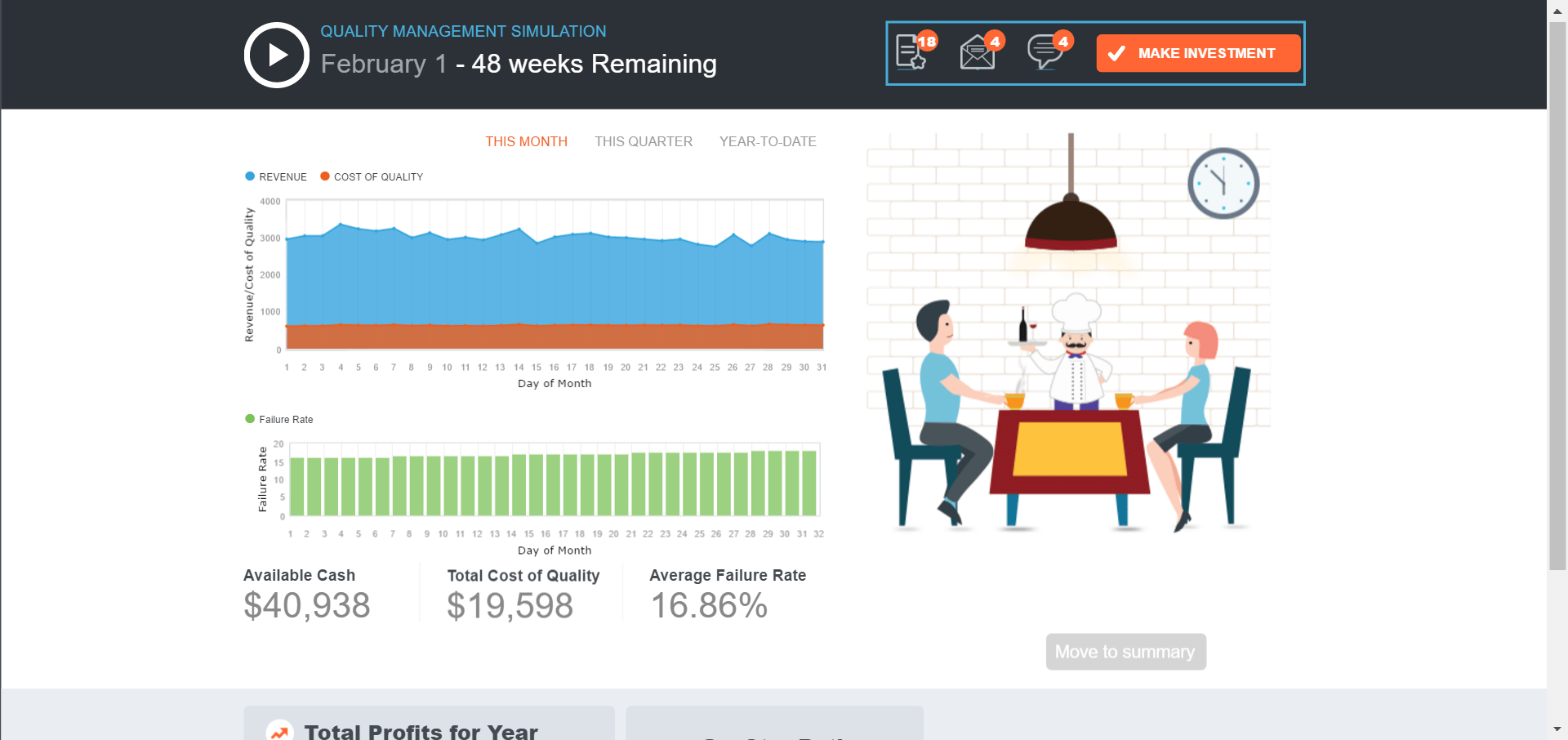
Quality Management Simulation is the 3rd of our four new classroom gaming exercises. It accompanies Chapter 6, Total Quality Management, and is free within our MyOMLab learning system.

Goal: Make quality investments with good ROI in terms of profits and customer ratings.

You are the manager of Cibare, one of the hottest Italian restaurants in town. You manage a full service staff and work closely with the Chef and the restaurant owner to ensure Cibare is providing a high-quality experience for customers. It is your job to make sure daily operations are running smoothly and that the investments you make to improve or maintain quality provides a return that exceeds the cost.

Learning Objectives

  • Understand that quality is an investment. There is a cost to investment and often a return. When managers allocate resources appropriately, the return on an investment should exceed the cost.
  • Understand that quality is a continuous pattern of activities and not a one-time event.
  • Develop a more complete understanding of total cost concepts.
  • Help the student realize that exact numbers and are not always available as on an exam and acknowledge that outcomes have uncertainty associated with them and that decisions must be made with imperfect information.

    Industry: Food service/ Hospitalityquality simulation

Teaching Tip: Our New Project Management Classroom Simulation

This Project Management Classroom Simulation is the 2nd of our new classroom gaming exercises. It accompanies Chapter 3, Project Management, and is free within our MyOMLab learning system.

Activity Brief

Select and manage subcontractors to achieve schedule and profitability goals of home-building project.

You are the general contractor for a high-end, private residence construction job. You manage teams of subcontractors who work on various aspects of the house, from plumbing and electrical to drywall and landscaping. The homeowners, Robert and Maggie Applebaum, want to be in their new house in 7 months and will check in with you regularly about its progress. It is your job to make sure daily operations at the site are running smoothly and that the house is completed on time and within budget, without negatively affecting your other building projects

 Industry: Constructionproject managemnt sim 2project management sim 1

Teaching Tip: Our New Forecasting Classroom Simulation

This Forecasting Classroom Simulation is the 1st of our new classroom gaming exercises. It accompanies Chapter 4, Forecasting, and is free within our MyOMLab learning system.

Activity Brief

As an operations consultant, you have just signed a 2 year contract to provide monthly forecasts of customer demand for a new gas station.  The gas station will sell 3 types of gas: Regular, MidGrade, and Premium. The gas station will have a total of 8 pumps offering all three types.

The gas station will also have a modest convenient store with a standard selection of snacks, beverages, and other miscellaneous items. However, the ownership group believes the station will attract business primarily due to its prime location near a major highway. Pricing for gas will be comparable to alternatives in the area and will predominantly be driven by market conditions relating to the price of crude oil per barrel.

The ability to forecast the next month forecast is critical for the station’s inventory management and other business planning. It will be necessary to gather various sources of information and ultimately analyze data in order to make the best forecast for each of the 24 months of the contract.

Your performance will be based on the collective mean absolute percentage error (MAPE) among the three types of gas. If you are able to forecast at less than or equal to 5% MAPE, you will receive a $10,000 bonus for your work. If your forecast are between 5% and 20% MAPE, you will not receive the bonus, but you will secure the position and receive a contract renewal. If the MAPE exceeds 20%, you will not receive a contract renewal.

Learning Objectives

  • Understand and break down patterns of customer demand
  • Generate forecasting models based on judgement, causal, time-series methods, or seasonal methods
  • Evaluate the quality of a forecast model using error metrics (specifically mean absolute percentage error).
  • Help students understand the distinction between the “signal” and the “noise” (Students are encouraged to also read The Signal and the Noise: Why So Many Predictions Fail, but Some Don’t. by Nate Silver). Many aspects of customer demand variation are explainable – the signal, but there needs to be an acceptance of unexplainable variation – the noise. In other words, students have to make a concession that their models will not predict customer demand with 100% accuracy.

Industry: Retailforecast sim 2forecast sim 1