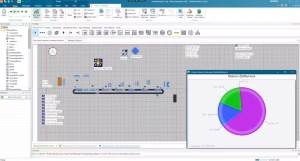
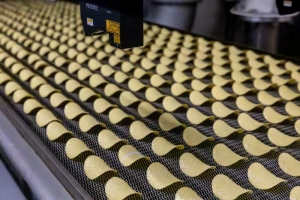
OM in the News: PepsiCo Turns To Digital Twins To Rethink Plants

We posted recently about the joint nuclear fusion digital twin work of Siemens and NVIDIA. Today’s news is that PepsiCo is working with the same two firms  to change how it designs, tests, and expands its plants and warehouses using AI and digital twins. “Physical industries are entering the age of AI. For companies with real-world assets, digital twins are the foundation of their AI journey,” said NVIDIA’s CEO.

By modeling factories and distribution centers digitally before making physical changes, PepsiCo hopes to cut down on costly mistakes while improving speed and capacity.

With AI-driven digital twins, teams can simulate plant layouts, equipment movement, and supply chain operations in detail, reports SupplyChain (Jan. 7, 2026). Instead of expanding facilities the old way, which can be slow and expensive, they can test changes virtually and see what works before spending money on physical upgrades.

“The scale and complexity of PepsiCo’s business is massive—and we are embedding AI throughout our operations to better meet the increasing demands of our consumers and customers,” said PepsiCo’s CEO. The digital models recreate machines, conveyors, pallet routes, and even worker movement, helping teams spot problems early and test different setups in weeks instead of months.

By finding bottlenecks and unused capacity in a virtual setting, teams increased throughput by 20%. The same approach has also shortened design cycles and helped cut capital spending by 10-15%. Testing ideas digitally first, teams can plan ahead, compare options, and move faster without the usual surprises that come with physical expansion.

Classroom discussion questions:

  1.  How is PepsiCo employing digital twins?
  2. How do AI and digital twins work together?

OM in the News: Digital Twins and Nuclear Fusion

Digital twins, which we cover in Module F (Simulations and Digital Twins), is a big topic at Nvidia and Siemens as they work together to make nuclear fusion a commercial reality. In that chapter (see p. 847), we define a digital twin as:  “an electronic virtual replica of an operation that allows organizations to mimic how a product, process, or system will perform.”

Workers at Commonwealth Fusion Systems’ campus in Devens, Mass

Fusion engineers at the Nvidia/Siemens venture, called Commonwealth Fusion Systems (CFS), will use its digital twin to run simulations, ultimately to hasten the goal of producing fusion energy at a commercial scale. CFS “will be able to compress years of manual experimentation into weeks” with the AI assistance, said its CEO.

Nuclear fission, which splits atoms to produce energy, is already in use in power plants, reports The Wall Street Journal (Jan. 7, 2026).  But many companies see fusion, the energy process that powers the sun by joining atoms together, as a longer-term bet because it can provide much more energy in a cleaner process. Nuclear energy appeals to tech giants because it releases minimal carbon emissions while providing round-the-clock power—particularly as they look to fuel their AI ambitions.

CFS said it was working with Google on an AI project, and explained that that effort has created something like a co-pilot for its fusion machine, while the digital twin plan “is the virtual airplane.” Google also recently signed a power purchase agreement with CFS to secure energy from what could be the first grid-scale fusion plant.

“The race is on for AI. Everyone is trying to get to the next frontier,” said Nvidia’s CEO.

Classroom discussion questions:

  1. Provide other examples of how digital twins can be used.
  2. Why is this fusion project so important as an OM tool?

Guest Post: Random Number Prediction–A Class Exercise

Prof. Andrew Stapleton at the U. of Wisconsin-Lacrosse shares a teaching tip when discussing random numbers.

Predict a “random number” by alternating four-digit contributions. Start by determining a 5- digit number and writing it down in dark ink on a large piece of paper and sticking it in your briefcase. I act like I am picking random numbers, but I know exactly how to get to the number I have pre-determined.

Here is an example: I tell my class, “Let’s pick some numbers, I’ll start”: 4729 Mine I already know that the final number – the one written on the large piece of paper in my briefcase is 24727.

I then ask for two students to give me each a two-digit random number. The greater the number of participants the greater the impact. Student one chooses “58” and Student 2 chooses “32.” So 5832 yours

4167 Mine I act like I am thinking about another random four-digit number, but what I am doing is making their digits and mine add to 9999. (i.e., 5832 + 4167 = 9999)

I again ask two different students to each give me a two-digit random number. One gives me “69” and the other “02”. So 6902 yours

3097 Mine Again I make theirs and mine add to 9999, but I don’t do it right away. In fact, I act like I am really just pulling my digits out of thin air.

Sum = 24727. I then add all of these together. I tell them I had a dream about what number we would collectively come to in this exercise and wrote it down on a piece of paper and I get it out and unfold it. Once they see it matches, they are baffled and are eager to learn how I did it.

Solution: I simply take my original 5-digit number and subtract 2 from the last digit and put it in front of the first. This is because whatever you choose – I will choose digits that add to 9. So, the second set adds to 9999 and the third set adds to 9999 – just shy of 20000, in fact 19998. So, I subtract those two from the end and stick the “2” in the front.

OM in the News: How the Famous Book, “A Million Random Digits,” Wasn’t So Random

“A Million Random Digits” was the largest table of random digits ever published

For 65 years, Rand Corp.’s reference book “A Million Random Digits with 100,000 Normal Deviates” has enjoyed a reputation as the go-to source for random numbers. Simulation and sampling problems are facilitated by these random numbers, as are many problems in our text. (See Table F.4 on page 799 of Module F, Simulation, for a small excerpt).  As Gary Briggs of Rand Corp. noted in The Wall Street Journal (Sept. 25, 2020) “it was really hard to get really high-quality random numbers.”

Well, after all of these years and worldwide usage, Briggs found some errors. While many of us would consider the errors minor, he found them “soul crushing,” adding, “the idea that I’m finding errors that we’ve ignored for 65 years is upsetting.” Before modern computers, he says, “it was really hard to get high-quality random numbers.” The book changed that for a generation of pollsters, lottery administrators, market analysts and others who needed means of drawing random samples.

Here is a bit of history: Rand collected a million digits using Douglas Aircraft Co.’s machine that registered random fluctuations in voltage and converted them into strings of 1s and 0s. A circuit board converted sets of 1s and 0s into digits 0 to 9, which a third machine translated into holes punched into 20,000 computer cards. Technicians fed the cards into an IBM data-processing machine, which generated a million-digit number filling 400 pages of tables.

How did the digits lose their “randomness?” Briggs thinks a technician dropped cards and put them back in the wrong order!

“A Million Random Digits,” by the way, became less relevant as powerful computers generated instant randomness.

Classroom discussion questions:

  1. How much difference would such errors in the Rand book make in your problems in Module F?
  2. Why are random numbers an important tool?

In Memorium: Prof. Jay Forrester

forresterMIT Prof. Jay W. Forrester, whose insights into both computing and organizations more than 60 years ago gave rise to a field of computer modeling that examines the behavior of things as specific as a corporation and as broad as global growth, died this week at age 98. Working at MIT in the 1950s, he developed the fields of system and industrial dynamics modeling to help corporations understand the long-term impact of management policies.

System dynamics, Forrester wrote, “uses computer simulation to take the knowledge we already have about details in the world around us and to show why our social and physical systems behave the way they do”.  Forrester expanded his approach in the late 1960s to consider social problems, including urban decay. In his 1971 book “World Dynamics,” he developed global modeling, which examines population growth and industrialization in a world with finite resources.

forrester-bookSystem dynamics came to him shortly after he joined the MIT business faculty, when he took on a project for G.E. The company was grappling with big fluctuations in stock levels and work force numbers at an appliance plant in Kentucky. His breakthrough came after he interviewed plant managers. He discovered that the fluctuations had been caused not by external factors, as the managers thought, but by a dynamic system of internal factors that included policies for inventory control and hiring. He then developed computer simulations of the G.E. case, planting the seeds for the field.

Forrester was also one of the inventors of magnetic core memory, a form of computer memory that dominated the computer industry for decades. His obituary appears in the New York Times (Nov. 17, 2016).

MyOMLab: Some Exciting New Resources for Fall 2016

There have been many enhancement to MyOMlab that we will share with you in the coming days. Here are just two that we are very excited about. If you have not tried out MyOMLab as a learning and assessment tool, let your Pearson rep (or me) know and we will set up a private tutorial for you. More than half of our adopters are using this fantastic package already.

Dynamic Study Modules help students study effectively on their own by continuously assessing their activity and performance in real time.

  1. Instructors now have the ability to remove questions from a module to add additional personalization.
  2. Changes are now retained when copying a course for future semesters.

OM Simulations
Interactive and robust, these simulations were designed for our Operations Management students to provide hands-on experiences in real-world roles, helping them to link course concepts to on-the-job application.  Using real-life myomlab simulationsituations, students evaluate information and then engage in decision-making and critical analysis.

  • Four new simulations are available this month as part of MyOMLab: Inventory Management (Chapter 12), Quality Management (Chapter 6), Forecasting (Chapter 4), and Project Management (Chapter 3).
    • 90% of students who piloted the simulations in 2016 would recommend their instructors use them in the course.

Good OM Reading: The Hard Work Behind Analytics Success

mit sloanThe hype around business analytics, our topics in Modules A-F, has reached a fever pitch. From baseball to biomedical advances, stories abound about data scientists applying their wizard like talents to find untapped markets, make millions, or save lives. Data has been described as the new oil, the new soil, the next big thing, and the force behind a new management revolution. Despite the hype, the reality is that many companies still struggle to figure out how to use analytics to take advantage of their data. The experience of managers grappling, sometimes unsuccessfully, with ever-increasing amounts of data and sophisticated analytics is often more the rule than the exception, concludes a new MIT Sloan Management Review study (March, 2016).

Five key findings came from the research:

  • Competitive advantage with analytics is waning. The percentage of companies that report obtaining a competitive advantage with analytics has declined significantly as increased market adoption of analytics levels the playing field and makes it more difficult for companies to keep their edge.
  • Optimism about the potential of analytics remains strong, despite the decline in competitive advantage. Most managers are still quite positive about its potential. They’ve seen increased interest in analytics over the past few years, and they expect its use to continue to grow.
  • Achieving competitive advantage with analytics requires a sustained commitment to changing the role of data in decision making. This commitment touches many organizational aspects, from revamping information management to adapting cultural norms.
  • Companies that are successful with analytics are much more likely to have a strategic plan for analytics, and this plan is usually aligned with the organization’s overall corporate strategy.
  • Most companies are not prepared for the investment and cultural change that are required to achieve sustained success with analytics, including expanding the skill set of managers who use data and broadening the types of decisions influenced by data.

OM in the News: How the McLaren Racing Team Sped Up Heathrow Airport

mclarenThe McLaren Formula 1 Racing Team has long had a reputation as a data-obsessed racing operation, writes BusinessWeek (Oct. 6-12, 2014). So the company decided 5 years ago that the highly specialized expertise it’s developed in data analysis, simulation, and decision support is something that businesses would profit from and pay for. Among its projects, McLaren’s Applied Technology Group has designed health monitoring systems for sick children, helped data center operators to better manage spikes in demand, and created a scheduling system for Heathrow Airport that reduces flight delays.

Air travel, like racing, is a realm where things often don’t quite go right. The limited supply of Heathrow airport gate slots and runway space and the inevitability of poor weather combine to create a tightly coupled network where delays and bottlenecks can quickly ripple across continents. The managers at airports who coordinate arrivals and departures have to deal with planes that took off the day before—some already late or rerouted—and to figure out how best to bring them in. Heathrow presents a particularly intricate puzzle. It moves more people than all but a couple of airports in the world, yet it has only 2 runways—Chicago’s O’Hare, by comparison, has 8. And local environmental and noise regulations restrict flights to between 6 a.m. and 11 p.m.

Prior to McLaren, scheduling had relied on a computer program that looked at a few “study days” from the past season, usually idealized days in which little went wrong. McLaren created a software tool that models bad days as well as good ones and simulates the effects on global air traffic of events such as a blizzard in Frankfurt or fog in Singapore. That’s enabled the airport to better plan for delays and, as a result, to increase its capacity.  For example, if it becomes clear by midafternoon that Heathrow simply won’t be able to handle all of its remaining scheduled arrivals before the 11 p.m. cutoff, the software will recommend how to proceed based on Heathrow’s priorities. Cancel the fewest flights? Preserve the most connections? Favor long-haul flights over shorter ones?

Classroom discussion questions:

1. To what other elements of airport operations can simulation be applied?

2. Why is simulation important to McLaren?

OM in the News: Can You Help TSA Shorten Security Queues?

TSA checkpoint in Atlanta

In anticipation that more fliers will be eager to pay for expedited checkpoint screening, the Transportation Security Administration has promised to award $15,000 in cash prizes to whomever can design a faster waiting line system, reports Nextgov (July 18, 2014). The competition is on InnoCentive, a website for crowdsourcing solutions to problems, which enables individuals and teams to submit proposals. “There is a guaranteed award,” the contest overview states. “The total payout will be $15,000, with at least one award being no smaller than $5,000.”

The challenge aims to solve expected problems with TSA PreCheck, a program where passengers who undergo a background check and pay $85 get access to fast lanes that don’t require removing shoes, coats, liquids and laptops. “Current queue layouts at TSA Pre✓ airports will need to adapt to support the increasing population of TSA Pre✓ passengers,” the competition states. “TSA is looking for the Next Generation Checkpoint Queue Design Model to apply a scientific and simulation modeling approach to meet queue design and configuration needs of the dynamic security screening environment with TSA Pre✓.” TSA also is asking for approaches that would help speed standard, “free” waiting lines.

Competitors must supply a proposal that considers physical logistics, peak hours and staffing schedules, among other constraints. The “line” extends from the point where a passenger joins the end of the queue to the metal detector or body scan machine. Wait times cannot be more than 5 minutes for PreCheck and 10 minutes for standard lines. Also, the model should enable TSA to apply a “Computer Aided Design drawing to define the physical space available for queuing.”

Competitors are required to provide an animation of a computer screen that shows passengers flowing through lines. It must display real-time reporting during the animation, and allow a user to pause a simulation run when necessary for analysis or evaluation. What a great example of a complex, real-world queuing problem to ask your students to discuss!

Classroom discussion questions:

1. Why is TSA turning to crowdsourcing?

2. What ideas do you have for speeding the lines?


Good OM Reading: A Million Random Digits With 100,000 Normal Deviates

million random digitsJay just called from the snowy Denver POMS meeting, asking me to review the new edition of this classic book that we reference in Module F, Simulation. The book is Rand Corp.’s 600-page paperback, “A Million Random Digits With 100,000 Normal Deviates” (which delivers exactly what it promises), selling for $64.60 on Amazon.com. Exhibiting the great sense of humor that OM profs have, 400 people have submitted online Amazon reviews, writes The Wall Street Journal (May 1, 2013). Most of them mocked the 60-year-old reference book for OM professors, pollsters and lottery administrators.

“Almost perfect,” said one reviewer. “But with so many terrific random digits, it’s a shame they didn’t sort them, to make it easier to find the one you’re looking for.” Five stars from this commenter: “The first thing I thought to myself after reading chapter one was, ‘Look out, Harry Potter!’ ”

Several reviewers complained that while most of the numbers in the book appeared satisfactorily random, the pages themselves were in numerical order. Rand said its long list of random numbers, first published in 1955, is one of its all-time best sellers. “It’s a tool of some sort, but it’s beyond my clear understanding,” a Rand spokesman admitted.

One Amazon reviewer panned a real-life copycat publication called “A Million Random Digits THE SEQUEL: with Perfectly Uniform Distribution.” “Let’s be honest, 4735942 is just a rehashed version of 64004382, and 32563233 is really nothing more than 97132654 with an accent.”

“We are always amazed by the creativity of our customers,” said an Amazon spokeswoman.

Guest Post: Teaching Simulation at Goldey-Beacom College

Today’s Guest Post, by Dr. Robert Donnelly, Professor of Management at Goldey-Beacom College, in Delaware, describes how he teaches simulation (Module F). Bob is the author of a new Business Statistics text appearing in 2012, published by Prentice-Hall.

Simulation is one of my favorite topics in the OM course here at Goldey-Beacom College. Students seem interested in learning how many relatable applications involve simulation. I use the video sports games as an example. I also show them Strat-O-Matic baseball cards which is a dice game based on actual player performance from the previous season.

I like to schedule this topic at the end of the semester because it allows me to revisit the EOQ and waiting line problems that I cover earlier in the course. I present simulation as an alternative approach when the assumptions for the EOQ and waiting line models don’t hold true. Then I apply simulation to the overbooking problem with airlines and hotels. As consumers, most students don’t realize the benefits to overbooking until they work through a simulation model.

I also demonstrate Extend, which is simulation modeling software. I set up the queuing model with this software in class (Problem F.8) and simulate 40,000 customers and compare these results with what we found doing it on the board. I show them an Excel file that simulates the inventory problem from the Render-Stair  Managerial Decision Modeling book (Chapter 10) and compare that to what we did in Module F. We wrap up the topic by talking about two actual business examples where the simulation model resulted in significant savings for the companies.

I like this topic because it catches the students’ attention and, for the most part, they do well solving these types of problems on  exams.

Good OM Reading: Analytics–The Widening Divide

Why don’t more managers embrace the business analytic tools we use in so many aspects of our OM courses?  A new report by MIT Sloan Management Review (Nov.8, 2011) answers the question with a survey of 4,500 executives regarding the integration of analytics in their enterprises. The report,  Analytics: The Widening Divide,  concludes that cultural biases, such as the need for new management competencies and organizational resistance to new ideas –more than technological hurdles–are the primary barriers.

First, a definition of business analytics: “the use of statistical, quantitative, predictive, and other models to drive fact-based planning, decisions, execution, management, measurement, and learning. Analytics may be descriptive, predictive. or prescriptive”.

The MIT Sloan report breaks companies down into 3 categories: Transformed (heavy users), Experienced (moderate users), and Aspirational (companies least experienced in the use of business analytics). The good news is that the number of firms in the 1st two categories, who use analytics for competitive advantage, has surged by 57% in the past year. The Aspirational group’s use of analytics actually declined by 5%. Transformed organizations have set the pace in expanding use of analytics and were found to be 2.2 times more likely to substantially outperform industry peers.

The Transformed group keenly appreciates the value of precise and real-time decisions, and is 3 times more likely to focus on speed of decision-making than Aspirational firms. This means managing operations and improving output levels based on real-time supply and demand management. Inventory replenishment processes, for example, are automated and production is optimized in these companies. As a case study, the report follows McKesson, which processes 2 million hospital orders per day. McKesson does so by embedding algorithms into customer orders to manage the inventory process without human intervention.

When students ask you why analytics are important in your OM course, this report provides a ready response.

OM in the News: Calculus for Truckers

As a former math major, it was hard to skip over the article by this title in Forbes (Sept. 12,2011) which describes the multimillion dollar simulation software created by Schneider National to manage its massive trucking business. With 13,000 drivers, 10,050 trucks on the road at any one time, and over 33,000 trailers waiting to be hauled, this 76-year old, $3.1 billion company faces many daily decisions regarding scheduling of drivers and equipment. For example, drivers are on the road between 4 days and 3 weeks at a time, and then must be back home by a certain date. The government regulates driver breaks and hours per day at the wheel (11 max). And customers are only open during certain hours.

Prior to hiring Princeton prof Warren Powell to build its fleet-wide “tactical planning simulator” (which is actually based on dynamic programming algorithms), Schneider relied on pilot projects to answer key logistical questions. A group of, say 20, drivers was carved out, experimented with, and results were drawn–at a cost of $100,000’s each time. But too often a system that worked well on the small sample did not scale well for the whole company. Sometimes the pilot even cost more than the money saved with the policy change.

The simulation model works like this: it runs forward in time 3 weeks to set the value of having a truck and driver at a certain location at a certain time. Then it runs backward in time to the “present”, reconciling the results with those that happened in the simulated future. It runs forward 3 weeks again and then backward, continuing to improve its estimate. When the schedule “converges” after hundreds of thousands of  decisions, the process is complete. Schneider has saved tens of millions of dollars with the new system, which not only schedules, but helps determine price hikes, hiring patterns, and fleet size.

Discussion questions:

1. What other aspects of OM can Schneider use the simulator to analyze?

2. Why is simulation such a valuable tool in OM?

Teaching Tip: Helping Your OM Students Find Jobs with Business Analytics

Just a day or two ago, I got a nice email from our colleague Barry Spraggins, who is Chair of the Managerial Sciences Department at the University of Nevada-Reno.  Barry uses our text Operations Management, 10th ed.,  and noted that he teaches heavily from all the Quantitative Modules, including Decision Making Tools (Module A), LP (Mod. B), Transportation (Mod.C), Queuing (Mod.D), Learning Curves (Mod.E), and Simulation (Mod.F). He writes: “I still think these are relevant components”. Not by coincidence, we find that The Wall Street Journal (Aug. 4,2011), Jay and I,  and IBM all agree.

The Journal reports that finding qualified graduates in business analytics has proven difficult–and colleges are finally stepping up to meet industry demand. IBM, which spent more than $14 billion since 2005 to buy a flock of analytics companies, has now teamed up with over 200 colleges to develop analytics courses. Fordham and Indiana U. are unveiling analytics curricula, as well as certificate and degree programs. Indiana, for example, is offering certificate programs in business analytics to both Deloitte and Booz Allen employees. Fordam has a required course called Marketing Analytics for MBAs. U. of Virginia, also working with IBM, is introducing an analytics track this fall.

“Analytics is certainly one of the top five things executives are worried about and investing in heavily”, says the president of Teradata. “Industry is going to demand it. Students are going to demand it”. As IBM and other big firms drive the software implementation process to the board room, we in academia may very well see a resurgence of demand for the very topics Prof. Spraggins has long espoused. In a tough job market, this is one way to help our students gain competitive advantage.

OM in the News: Marriott’s Simulation Game Lets Students Run the Hotel

Marriott International has just rolled out a new hotel-themed online game this week, which it hopes will attract students to positions in the hotel industry. The Wall Street Journal (June 6, 2011) describes “My Marriott Hotel”  as a realistic game that puts the player in charge of running the hotel kitchen (the company will roll out games depicting other aspects of the hotel business next year). The social media game, debuted on Facebook, puts the player in charge of buying ingredients, after being given an array of options in quality and price. The player also hires staff (based on experience and salary), and buys kitchen equipment. The players have to direct tickets to cooks and inspect orders before sending them to the customer.

Unlike  commercial simulations, like “Farmville” (by Zynga), Marriott is using computer gaming as a recruiting tool– to help fill  50,000 hotel positions this year. “Our game is so appealing”, says a Marriott exec. “Not only am I having fun but I am actually getting an understanding what it takes to run a kitchen”.

The model follows the  wildly popular “America’s Army”, introduced a decade ago by the US military. This effective recruiting tool cost little and led to a whole genre of industry simulation  games generally played on a mobile device. Siemens AG just bought “Plantville”, which simulates  being a manager for a bottling facility, a vitamin factory, or a plant that builds trains. Similarly, PlayFirst owns “Hotel Dash”, which simulates luggage delivery, room service orders, and hotel renovations. Marriott claims its game “will be more realistic”. But a Wharton prof says creating an effective game to help recruit “so far remains elusive”. It has to be both fun and realistic.

Discussion questions:

1. How can these games be effective OM learning tools?

2. Why did Marriott decide to provide this simulation at no charge?