OM in the News: Walmart’s Automation Journey Reveals the Real Challenges of Warehouse Transformation

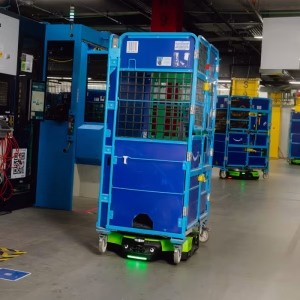
For years, automation has been promoted as the future of warehouse operations. Walmart’s ongoing multibillion-dollar effort to automate its supply chain demonstrates both the promise and the reality of large-scale operational transformation. Walmart relies on over 140,000 warehouse workers to keep goods moving. It isn’t an easy job. A worker might walk 20,000 steps a shift.

The retailer is modernizing a network that supports more than 5,000 U.S. stores while attempting to keep nearly 200 supply chain facilities operating, reports The Wall Street Journal (Oct. 9, 2026). What sounds like a straightforward technology upgrade has turned into a decade-long lesson in OM.

Warehouse processes that seem simple to humans are often extraordinarily difficult to automate. Tasks such as removing products from cartons, sorting individual items, building store-ready pallets, and handling irregularly sized products require flexibility that robots still struggle to replicate consistently.

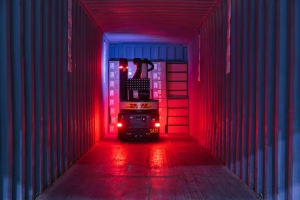
Walmart has invested heavily in automated storage systems, robotic arms, autonomous mobile robots, and advanced software. These technologies promise faster inventory movement, improved accuracy, lower stockout rates, and more efficient store replenishment. Yet implementation has revealed many operational hurdles. Robots require maintenance, packaging must be redesigned, legacy facilities need retrofitting, and suppliers must sometimes modify products so automated systems can handle them properly.

An interesting operations challenge is that Walmart is redesigning warehouses while they remain in service. Unlike a greenfield facility built specifically for automation, most of Walmart’s distribution centers were constructed decades ago. Integrating new technologies into existing operations adds substantial complexity and risk.

The case also illustrates a broader lesson about process improvement. Automation does not simply replace labor with machines. Instead, it changes the nature of work. While some manual tasks may decline, demand grows for technicians, engineers, and operators who can monitor, troubleshoot, and optimize increasingly sophisticated systems.

Walmart’s experience highlights that automation is a strategic capability, not a quick fix. Competitors such as Amazon have raised industry expectations for speed and efficiency, creating an automation arms race. Companies that pursue automation should be prepared for experimentation, setbacks, and continuous learning.

Walmart’s journey is a reminder that successful automation is not primarily a technology challenge. It is an operations, process design, workforce, and change management challenge.

Classroom Discussion Questions

  1. Walmart chose to automate existing warehouses while keeping them operational rather than building entirely new facilities. What are the advantages and disadvantages of this strategy from an OM perspective?
  2. Automation can improve productivity and accuracy, but it also introduces new costs such as maintenance, energy consumption, and specialized labor. How should managers evaluate whether an automation investment is truly successful?

Guest Post: Robots as a Service– Is Warehouse Automation Going Subscription?

 Dr. Jon Jackson, Associate Professor of Operations Management at Providence College, raises an interesting issue regarding warehouse robotics. Jon has created AI classroom exercises for each chapter of our text. They are found on-line in the Instructor’s Resource Manual.

Warehouse automation typically requires a significant upfront investment. But what if companies could rent the robots instead?

A recent Wall Street Journal article (August 17, 2026) highlights the growing use of subscription-based robotics in warehouses. Instead of purchasing robots outright, companies can pay a monthly fee to use them, potentially changing the economics of automation.

North American companies ordered nearly 18,000 warehouse robots worth $1.2 billion in the first half of 2026; both figures are up from 2025. Simultaneously, the average U.S. warehouse wage reached $26.85 per hour, up 41% over the past decade. Even with the higher wages, nearly 392,000 jobs remain open in the transportation, warehousing, and utilities industries. Together, these trends create strong incentives for companies to consider greater investment in warehouse automation.

Traditionally, investing in robots means committing substantial capital to equipment that may become obsolete or may not provide enough value to justify the investment. A subscription model changes that calculation by shifting some of the financial risk from a capital investment to an ongoing operating expense. Companies can avoid much of the upfront capital expense, scale automation up or down as demand changes, and potentially gain access to newer technology as it becomes available.

This flexibility could be particularly valuable in warehouses with seasonal or uncertain demand. Rather than purchasing enough robots to handle peak demand (and leaving them underutilized during slower periods), companies could potentially add robotic capacity when they need it.

There are trade-offs, however. Subscription fees may ultimately cost more than purchasing equipment outright, and companies become dependent on the robotics provider for technology, maintenance, and service.

From an operations perspective, “Robots as a Service” raises an interesting question: Should automation be treated as a capital investment or as a variable operating expense? As robotics technology improves, the answer may increasingly depend on how much flexibility a company values.

Classroom Discussion Questions

  1. When might renting robots be preferable to purchasing them?
  2. How does a subscription model change the risk associated with investing in automation?

OM in the News: AI-Based Robots

Should companies deploy robots at their plant if they could virtually reprogram themselves to perform new and different tasks, asks Industry Week (May 13, 2026)? We’re nearly at the end of the AI hype cycle, when suggestions for how to leverage the technology become less flashy and more realistic.

Now Siemens has just revealed Eigen, an AI agent that can replace manual coding or programming for programmable logic controllers, distributed control systems, and robotics applications, updating code or instructions to reflect new priorities and goals.

Siemens says that engineering and reconfigurations constitute 70% of the entire lifecycle cost of a robot. If, however, an AI agent like Eigen can shorten the time needed to make these adjustments, it makes the robot more efficient, and small and medium-sized businesses might be better able to afford deploying the technology.

“There’s a kind of new age of automation arising, because with AI assistance to program robots and PLCs, it means you could suddenly automate much smaller lot sizes on a good return of investment,” says the firm’s CEO of its automation division.

Eigen can help manufacturers deal with a lack of coders and programmers. Another Siemens exec adds “We don’t attract the best of the programmers to the manufacturing floor. … So getting programmers to come and code our controllers or robotic systems? That was a scale up bottleneck. Bringing in AI to reprogram things, reprogram the whole process, will be more game changing in the U.S. than in Germany, where I see when people with Master’s degrees on the manufacturing floor, which is not the case in the U.S. Humans must always remain in the loop, however. Agentic AI is like an orchestra and humans the conductors.”

In short, Eigen acts as an AI-agent that handles the tedious, expensive back-end coding of robotics, making automation flexible, cheaper and more accessible to smaller firms.

Classroom discussion questions:

  1. What is Eigen‘s role?
  2. What is the roadblock to more robotic use in small manufacturers?

OM in the News: U.S. Manufacturing Resurgence Will Be Powered by Cobots

Once a luxury reserved for big manufacturers, smaller, smarter, more flexible and less expensive “cobots”—collaborative robots—are bringing automation to every fabricator, no matter the size. The slow, fragile recovery of American goods production wouldn’t be possible without them, writes The Wall Street Journal (Oct. 11-12, 2025).

The number of U.S. companies that make physical things reached a low point in 2014 and has grown since then. Yet they are trapped in a never-ending labor shortage as skilled workers age out, and young people fail to take their place.

China has the greatest number of industrial robots, including these at a factory in Nanjing.

China has become the de facto manufacturer of the world’s goods, owing not only to its enormous population of engineers, technicians and machinists but also its 2-million-plus army of industrial robots. Now the U.S. is attempting to claw back some of those contracts—called “reshoring”—and robots can in some cases quadruple worker output.

The push to bring manufacturing back to the U.S., and the demand for industrial goods to power America’s AI-fueled economy, are driving automation adoption and innovation. “Automation is key to reshoring, plain and simple,” says one CEO.

Cobots have become radically easier to program over the past decade, and now people can use a simple tablet interface to instruct them to perform specific sequences of actions. Programming the older robots common in automotive factories since the 1960s took years of training.

Cobots are part of a broader trend in robotics: Specialized robots that use sensors to safely navigate human environments. They can cope with more variability than previous industrial robots, which had no sensing abilities. This has been essential to the rise of Amazon and its superfast fulfillment, and now it’s coming to manufacturing.

China is indisputably the leader in high-volume manufacturing, and companies that want the biggest volumes of manufactured parts for the lowest possible price continue to send work there. And though many U.S. manufacturers can’t match their Chinese peers in volume, they are competing by using automation to tackle smaller batches of goods under tight deadlines. Manufacturers in the U.S. are now asking how to reshore the making of critical parts.

Classroom discussion questions:

  1. What is a “cobot” and how does it differ from a robot?
  2. Why has China become such a powerful manufacturing hub?

OM in the News: The Future of Trash Pickup and AI

Americans are among the top producers of trash per capita. Each person in the U.S. disposes of nearly a ton of refuse annually. Simplifying trash day, and diverting the 80% of reusable material that still ends up in landfills, is one key to solving our problems.

Urban planners, the refuse industry and cities across the country are reimagining how we manage and dispose of our waste, reports The Wall Street Journal (Aug. 28, 2025). The New York City and MIT are among those leveraging AI, robotics and electric power to tackle a growing garbage crisis fueled by cheap products and throwaway culture.

Most of Americans don’t recycle regularly, citing the inconvenience and confusion involved in sorting their trash. To help people up their sustainability game, sanitation engineers are promoting a new system: the single-stream model. The operation is simple—residents throw everything into one trash bin. Then, that waste is transported to a remote facility, where AI-powered cameras and robots sort it, diverting items that can be recycled. The goal is to have a system that’s more circular, that can reuse and recycle things more.

AI can also identify items such as electronics that contain hazardous or valuable materials—including copper, silver, gold and rare-earth minerals—and send them on for disassembly and harvesting before they enter the waste stream.

Individual garbage bins or piles of plastic bags aren’t only an all-you-can-eat buffet for rodents—but also malodorous, leaky and inefficient, requiring endless noisy stops from garbage trucks on collection day.

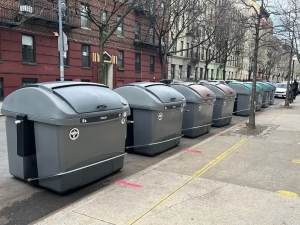
The new NYC shared Empire Garbage Bins.

To solve these problems, cities are moving toward containerization: large, centralized bins shared by a street or neighborhood. One NYC neighborhood  is already piloting a program of such containers, with plans for citywide expansion in the future.

Smart bins could even ping dispatch offices when they are ready for pickup. Large collection vehicles could be used more sparingly, and with fewer stops—thus decreasing noise, pickup time and pollution. In the future, the parameters that we use could be, ‘Is it full? Or is it smelly?’ Then collection on that bin can take place only if the contents meet those conditions.

AI-optimized routing and trash-loading technologies could also help make pickups shorter, less frequent and less disruptive.

Classroom discussion questions:

  1. How could AI be used to help recycle?
  2. What are the major inefficiencies of most garbage collection and recycling systems?

OM in the News: America’s Newest Auto Plant Is Full of Robots

Hyundai uses robotic dogs in assembly lines

At Hyundai Motor Group’s ultramodern new auto plant, robots perform a stunning array of tasks. They move materials, attach doors and do almost all of the welding. Dog-like robots, their snouts laden with cameras, prance across the floor to inspect partially built Ioniq electric vehicles.

The factory, which opened near Savannah, Ga., late last year, deploys 750 robots, not counting the hundreds of autonomous guided vehicles that glide across the floor. About 1,450 people work alongside them. That roughly 2-to-1 ratio of humans to robots compares with the U.S. auto-industry average of 7-to-1, writes The Wall Street Journal (Aug. 25, 2025).

The human workforce is sparse in much of Hyundai’s plant. Metal arms move slabs of steel through presses that stamp them into components of the frame. An array of robots weld those parts together without a person in sight.

Human beings are still in the driver’s seat for some jobs. But it isn’t until the frames emerge from the paint shop that people take over. Hundreds are stationed along two assembly lines where seats, dashboards and other components are added. They spot burrs that must be smoothed and bits of trim that need replacing. They snap fabric door panels into place with grommets, push electrical connectors together until they click and duck into places robots can’t reach to bolt down seats and attach shock absorbers.

The factory was designed so that robots do tasks that are dangerous, repetitive or physically demanding. People are left to troubleshoot, monitor quality and bring craftsmanship to the manufacturing process. “We’re not trying to minimize human involvement—we’re trying to maximize human potential,” said the CEO.

“But the minute humans become more expensive, more recalcitrant, the more automation you’re going to get,” said an industry expert. The auto industry today is heavily robotized, particularly in Hyundai’s home country of South Korea. The country has one of the world’s lowest birthrates, helping to drive its adoption of the machines.

A complete robot takeover is decades away. Robots still struggle to handle fabric and other limp materials, and performing the most complex jobs will take technological breakthroughs that aren’t yet on the radar.

Classroom discussion questions:

  1. Will robots ever take over 100% in auto manufacturing?
  2. What are the OM implications of the 2 to 1 ratio?

OM in the News: Amazon Is on the Cusp of Using More Robots Than Humans

The automation of Amazon facilities is approaching a new milestone: There will soon be as many robots as humans. The e-commerce giant, which has spent years automating tasks previously done by humans in its facilities, has deployed more than one million robots in those workplaces, reports The Wall Street Journal (July 1, 2025). That is the most it has ever had and near the count of human workers at the facilities.

Mobile robots reposition package carts

Company warehouses buzz with metallic arms plucking items from shelves and wheeled droids that motor around the floors ferrying the goods for packaging. In other corners, automated systems help sort the items, which other robots assist in packaging for shipment.

One of Amazon’s newer robots, called Vulcan, has a sense of touch that enables it to pick items from numerous shelves. Amazon has taken recent steps to connect its robots to its order-fulfillment processes, so the machines can work in tandem with each other and with humans. Now some 75% of Amazon’s global deliveries are assisted in some way by robotics. The growing automation has helped Amazon improve productivity, while easing pressure on the company to solve problems such as heavy staff turnover at its fulfillment centers.

For some Amazon workers, the increasing automation has meant replacing menial, repetitive work lifting, pulling and sorting with more skilled assignments managing the machines. Amazon has trained more than 700,000 workers across the world for higher-paying jobs in mechatronics and robotics apprenticeships.

The number of packages that Amazon ships itself per employee each year has also steadily increased in the past decade to 3,870 from 175, an indication of the company’s productivity gains.

Amazon is also rolling out artificial intelligence in its warehouses to improve inventory placement, demand forecasting, and the efficiency of its robots. Amazon said it will cut the size of its total workforce in the next several years.

Classroom discussion questions:

  1. Research Amazon’s history of using robotics.
  2. What are the advantages of introducing more robots?

OM in the News: The Holy Grail of Automation–Now a Robot Can Unload a Truck


The robots are coming for the last human warehouse jobs.  Loading and unloading a truck is backbreaking, mind-numbing work that retailers and parcel carriers have tried to solve for years. Workers may not stay long in these jobs. Summers and winters are particularly grueling for anyone stuck in a metal trailer, slinging heavy boxes. Injuries are common.

Automating this process has long been the holy grail of warehouse logistics, writes The Wall Street Journal (June 24, 2025). When loaded, packages must be fitted together to fill the available space and be sorted by weight—with the heaviest items on the bottom—so they don’t topple or break. Unloading them is challenging, too, because the unloader must move in and out of a trailer, ferrying packages of different sizes and weights.

On a typical warehouse floor today, every task might be heavily automated—except for workers loading and unloading the trucks. People who have worked these jobs say they have to stand for extended periods, hefting boxes as heavy as 70 pounds. New advances in robotics are changing that.

Improved sensors and algorithms, advancements in AI and faster image-processing technology are making these robots proficient players in tasks that are like a game of 3-D Tetris. This shifts the burden of physical lifting from humans to robots. Proponents of the technology say it will mean more efficiently packed pallets, fewer damaged items and a lot of time saved. The machine-learning algorithm isn’t aware of what’s inside each package, but does know the item’s weight, approximate center of gravity and how fragile it is.

DHL’s Stretch robot can unload 580 cases an hour, twice the rate of a human unloader.

The robot will use the information it has on an item to choose the optimal pallet and determine where the it should be placed to minimize damage, but still allow the highest possible number of boxes to be packed in the given space.

DHL just signed an agreement with Boston Dynamics for 1,000 of these robots. United Parcel Service is also increasing automation at its facilities, including for loading and unloading trailers—a move that will help the company cut costs. FedEx has been testing and refining the truck-loading process in one of its facilities since 2023. Walmart also has introduced robots that can unload a truck.

Classroom discussion questions:

  1. Why is this an important OM advancement?
  2. How else are robots now being used in warehouses?

OM in the News: Why Is It So Difficult for Robots to Make Your Nike Sneakers?

It took Nike 8 months to figure out how to automate a way to put the Nike swish on a shoe, only to move onto a new shoe line for which the method no longer worked.

A yearslong effort by Nike to shift part of its manufacturing from China, Indonesia and Vietnam to North America illustrates how tough it is for U.S. brands to wean themselves off the flexible, low-cost contract manufacturers.

In 2015, Nike poured millions into an ambitious effort to partly automate what has always been a highly labor-intensive industry. At the time, rising labor costs in China and advances in manufacturing techniques opened the possibility of finding a new way to make shoes that would rely on fewer workers. The goal: Make tens of millions of sneakers at a new high-tech manufacturing site in Mexico, by 2023.

The plant would still include thousands of workers, but far fewer than are needed in Asia to make the same number of sneakers. Nike’s competitors also sensed an opportunity to rethink a manufacturing model built around hand stitched fabrics and glued soles. The same year, Under Armour announced “Project Glory” using automation to make shoes in Baltimore. And Adidas launched “speedfactories” in Atlanta and Germany, with high-tech machinery to quickly spit out shoes, which we blogged about then.

Nike aimed for large-scale automated production in under a decade, which would save on labor costs and allow it to deliver new models of shoes to Americans faster. It established new production lines that used machines commonly seen in electronics manufacturing. The machines were supposed to build the upper part of a shoe, knit fabric, add logos and glue the sole.

The effort quickly ran into trouble, reports The Wall Street Journal (April 22, 2025). The robots struggled to handle the soft, squishy and stretchy parts that are integral to shoemaking. Another problem was the huge variety of shoes Nike produces. As a result, factory production never became as automated as envisioned. As shoe production increased, the factory personnel swelled to 5,000, twice as many as originally planned and costing more than a similar workforce in Vietnam.

All three firms surrendered in 2019 and stuck with their original Asian locations.

Classroom discussion questions:

  1. Will the threat of new tariffs mean they will ultimately have to bring shoe production back to the U.S.?
  2. Why the failure for all three firms?

OM in the News: Humanoid Robots Finally Get Real Jobs

Science fiction has long been full of robots that look, move and even think like we do. In the real world humanoid forms have, until very recently, been a nonstarter. Hard to build, expensive, slow and lumbering, they have never made sense compared with the countless other varieties of purpose-built—and vastly more affordable—robots that have multiplied rapidly in the past decade.
That’s changing. As global demand for new kinds of robots has shot up, mass manufacturing and falling costs for components are making them cheaper to produce, writes The Wall Street Journal (Feb. 27, 2025). Just as important, new kinds of AI—some close kin to the kind that has upended the priorities of tech companies and governments since the debut of ChatGPT—are animating robot bodies in ways that simply weren’t possible even a few years ago.

More than a dozen startups worldwide are now offering humanoid robots. All have grand projections of a science-fiction future of limitless human assistance from our mechanical serfs; several already have their bots undergoing testing in real-world factories and warehouses.

A key advantage that makers tout: Unlike most current automation, humanoid robots can do more than one thing. “Humanoid robots are the first category of robots that can be doing completely different tasks based on the needs of the business or the time of the shift,” says one industry exec.

Some believe that just as chatbots are soon to attain a level of ability that could allow them to perform tasks with little or no human supervision, robots will be next. Already, the latest wave of artificial-intelligence tech—both hardware and software—is enabling robots, and in particular humanoid robots, to behave in ways that were beyond the state of the art.

Classroom discussion questions:

  1. Why is the field of  humanoid robotics advancing quickly now?
  2. How are robots typically used in manufacturing?

OM in the News: The End of the Forklift?

Some of America’s biggest manufacturers are backing away from forklifts, reports The Wall Street Journal (Jan. 5, 2024).  The vehicles have been integral to factories and warehouses for more than a century, but now companies are aspiring to go “forklift-free” to improve productivity and safety. Each year around 7,500 workers are injured in forklift-related collisions, tip-overs and other mishaps, while nearly 100 are killed. Orders for forklifts dropped 28% in 2023.

Ipex designed its new factory to rely on overhead cranes and hand-pushed electric pallet jacks

Plastic-pipe manufacturer Ipex designed its new factory in North Carolina to minimize the use of forklifts. That made the plant, which opened in 2023, a safer, quieter and less stressful workplace. “Employees feel like they can walk anywhere within the interior shop floor and not have to look out for forklifts,” said Ipex.

Mercedes is also reducing forklifts in its U.S. plants, replacing some with autonomous vehicles. Tesla is making a similar effort, using push carts and trailer-hauling “tuggers” inside its factories to cut down on traffic and injuries. Whirlpool’s washing-machine factories have been eliminating forklifts from production areas, and use robotic tuggers to deliver parts to assembly-line workers.

Forklift makers say they have added numerous safety features to their vehicles. These include high-visibility seat belts that make it easy to see whether an operator is wearing it, lighting that warns pedestrians a forklift is coming and sensors that slow the vehicle before a collision takes place. Forklift manufacturers say there is high turnover among drivers and lament what they call the glorification of unsafe operation. Dozens of TikTok and YouTube accounts feature videos showing drivers skidding, crashing and dropping oversize loads that smash across warehouse floors.

Classroom discussion questions:

  1. Why will it be difficult to totally replace forklifts?
  2. What are the safety issues that are frequently seen in factories with many forklifts?

OM in the News: Leased Robots Roll In

Logistics firms looking for extra help during the holidays are leasing temporary package-handling robots, which can be returned to their manufacturers when online shopping orders cool down after the seasonal rush.

Robots from Locus Robotics await deployment

Leased robots, which have grown in popularity across the industry in recent years, can be added to existing fleets of warehouse, distribution and fulfillment center robots at any time to support an anticipated jump in demand. The robots are increasingly being used for picking up and sorting packages, receiving and unloading them, moving heavy payloads and replenishing stock shelves, among other automated tasks.

The growing demand for robots in the logistics industry is being driven by a shortage of workers, ongoing supply-chain disruptions and continued momentum from a sharp increase in online shopping triggered by the Covid-19 pandemic, reports The Wall Street Journal (Dec. 7, 2022).

Spending in the global logistics robotics market, which was valued at $2.6 billion in 2020, is expected to grow at a compound annual growth rate of 23%, reaching $11 billion by 2027. Excluding Amazon, which is by far the sector’s largest robotics user, there are more than 20,000 logistics robots of all kinds in use today. Known as robots-as-a-service, leased robots are employed widely in manufacturing, but are relatively new to the logistics industry. Under the model, users are charged a subscription-like fee from third-party robotics firms.

By leasing robots, companies are spared high upfront costs and ongoing maintenance expenses. On the downside, orders for subscription-based robots have to be made well in advance of an anticipated upturn in demand. The process of outfitting a company with a leased robot typically involves taking a 3-D scan of a facility and feeding the data into an artificial intelligence-enabled program designed to generate a mock-up of a robot’s mechanical, electrical and software systems.

Classroom discussion questions:

  1. What is the main driver of robot leasing in warehouses?
  2. What is the difference between a “service robot” and one used in manufacturing?

Video Tip: The Automated Warehouse of the Future

It is called “the hive,” or “the grid” — a huge structure that fills a warehouse the size of 7 football fields, and seems to be a huge chessboard populated mostly by robots. There are thousands of them, each the size and shape of a washing machine, and they wheel about, night and day, moving groceries. Their job is to be cheaper and more efficient than humans.

The hive-grid is the creation of Ocado, a British online-only supermarket that’s made a name for itself designing highly automated warehouses and selling the tech to other grocery chains. Ocado’s latest operation processes 3.5 million items or around 65,000 orders every week. It’s an example of the wave of automation hitting countries around the world. The tasks being undertaken by Ocado’s bots are so basic they’re best described by simple verbs — “lifting,” “moving,” “sorting” — and that means they exist in various forms in a range of industries.

Imagine a huge machine, with groceries going in one end and shopping orders coming out the other. Humans do the unpacking and packing, while in the middle, robots sort and rearrange this vast inventory 24 hours a day. Individually, the robots aren’t intelligent; they don’t make decisions for themselves. But their actions are all coordinated by a central computer. This means the robots can be used as efficiently as possible. If you want to pick a typical, 50-item Ocado order, they will help each other. A group of robots can come together in a huddle, split up, and pick that order in a matter of minutes. In a traditional warehouse where items are scattered around on distant shelves, this process can take hours.

Ocado has made deals with supermarket chains in France, Canada, and Sweden to upgrade their warehouses. Such deals should make it easier for these firms to offer online grocery shopping (the UK is a relatively early adopter of this trend) and will help stave off fears of technologically savvy rivals (such as Amazon’s Whole Foods) muscling in on their territory.

Nothing is perfect, of course, and we note that major fires have broken out at Ocado warehouses –the latest this past July when 3 robots crashed into one another.

Nonetheless, your students will enjoy this 3 minute video of one of Ocado’s automated warehouses.

OM in the News: Hotel Robots Help During Covid-19

Room-service robots like Relay reduce in-person interactions between staff and guests.

“Robots that delivered a burger and fries a few years ago were a high-tech gimmick that gave hotel guests a good laugh,” writes The Wall Street Journal (Aug. 12, 2020). Now, manufacturers are suggesting these machines could help guests stay safe during a global pandemic.

Hoteliers and robotics companies say delivery bots like Sovioke’s Relay are cutting down on potentially unsafe interactions between hotel staff and room guests, by offering contactless room service. And cleaning robots, like Maidbot’s Rosie, are vacuuming hallway floors while cleaning crews spend more time than ever sanitizing rooms.

Before the pandemic, bots at one California hotel chain would typically make 200-300 trips a month, mostly ferrying items like toothbrushes or towels from the reception desk, on to elevators, and up to people’s hotel rooms. Those same bots now make about 700 trips a month, as more guests seek to avoid interactions with hotel staff. And there are new types of robots in development that could help hotel owners during the pandemic. Maidbot vacuuming robots  are rolling out wet-cleaning and disinfecting machines to further assist housekeepers in virus-proofing room surfaces.

The use of robots in the hotel industry has concerned some that these machines could eventually be used to replace employees. Many U.S. hotels have reduced staff during the pandemic, and although hotel operators and robotics companies insist robots help rather than reduce staff, robots could limit how much extra labor hotels bring on to meet new sanitation demands.

The robots aren’t always perfect. Children can confuse them by trying to get them to move in too many directions at once, causing the bots to get stuck. And sometimes it takes patience and a few programming tweaks before the robots really learn the layout of the hotel.

Classroom discussion questions:

  1. How else is technology changing the hotel industry? (Hint: see Ch. 7 in your Heizer/Render/Munson OM text)
  2. What other tasks might hotel robots perform?


OM in the News and Video Tip: FedEx Recruits Robots

Robotic arms manufactured by Yaskawa America

Sue, Randall, Colin and Bobby are 4 of the most reliable FedEx workers in Memphis. Each clocks 8 hours a day, sorting 1,300 packages an hour. They almost never take breaks, as they are actually 260-pound industrial robot arms.

They work only about half as fast as skilled humans, but they are quickly becoming an important part of the chain that keeps packages flowing. These robots, getting both “eyes” and “brains” that allow them to sense and respond, typify an important and growing trend in automation, writes The Wall Street Journal (Aug. 8-9, 2020). They have cameras which perceive visible light and sensors to perceive depth, and their “brains” are built with machine-learning AI. This gives them a level of adaptability not before seen. (There is an excellent 6 min. video that opens this WSJ article).

But the robots are not about to steal all the jobs in these industries. For now, they’re mostly filling vacancies created by surging demand. The explosion of e-commerce means an explosion in the volume of packages shipped to homes. Some 87 billion parcels were shipped worldwide in 2018—that’s 40 a year to every person in the U.S.—and this volume will more than double by 2025.

The need for social distancing within warehouses means robots can play a role in helping workers do their jobs without being directly adjacent to one another. And logistics companies are still finding it hard to hire people fast enough. (FedEx’s air hub in Memphis currently has 500 job openings).  FedEx estimates one human could tend up to 8 robots.

The overwhelming majority of industrial robot arms in the world are still the “dumb” kind: They repeat the same action over and over again—for example welding the same parts together repeatedly on an auto production line. The holy grail of picking technology—a robot that can handle the same variety as a human—will remain out of reach for a long time, in the same way we have yet to create an autonomous vehicle that can handle the same variety of road situations a human can.

Classroom discussion questions:

  1. Why is it so hard for robots to replace warehouse workers?
  2. Why are firms like FedEx more driven to automate?