OM in the News: Agentic AI Revolutionizes the Factory

It’s 4 a.m. at a large automotive parts plant. The night-shift supervisor freezes as the dashboard flashes an alert: a critical spindle is vibrating out of tolerance. In the old world, he’d wait for maintenance to evaluate and decide. But today, an AI agent has already paused the line, checked service records and called the right technician—before he even takes a step toward the control room.

That’s the new reality for many manufacturers facing a stubborn obstacle: the ever-widening gap between data and decisive action. Now, a new class of digital entities is changing that equation. AI agents powered by decision intelligence are beginning to sense, reason and act across the manufacturing ecosystem, cutting decision latency from minutes to milliseconds.

Think of AI agents as the digital nervous system of a modern factory. They continuously sense what’s happening across machines, people and systems, then respond intelligently without losing context. Across the manufacturing stack, they’re quietly reshaping work for every role:

On the shop floor: Agents merge operations and information technology (IT) data to give operators real-time context. They can recommend optimal machine parameters, trigger tool-change schedules, balance workloads across lines or alert technicians before deviations escalate. Maintenance teams can use agents to predict component wear and plan interventions that don’t interrupt production– a topic in Chapter 17.

In production and quality operations: Agents help supervisors and quality staff detect process drift early. They analyze sensor data, images and process variables, suggesting immediate corrections or automated parameter tuning. In continuous manufacturing, this can mean fewer rejects and less rework, which we discuss in Chapter 6.

In ERP and planning: Agents connect production, procurement and finance systems. A planning agent (see Chapter 14) can run simulations of “what if” scenarios, what happens if a supplier shipment is delayed or if energy costs spike and recommend production adjustments.

Across the supply chain: Agents can constantly monitor inventory, supplier performance and logistics signals. When a potential shortage or delay is detected, they are able to trigger contingency workflows such as redistributing available stock, recommending alternate suppliers or rescheduling deliveries–see Chapters 11 and 12.

To sum it up: “Tomorrow’s factories won’t just inform — they’ll decide,” writes Industry Week (June 12, 2026).

Classroom discussion questions:

  1. Summarize what AI agents can do in a factory setting.
  2. How does agentic AI have the potential to change the manufacturing operation?
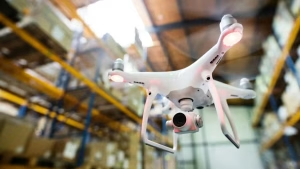
OM in the News: Drones Gain Manufacturing Altitude

Drones, in the headlines every day from Russia, Iran and Hezbollah, are also real manufacturing tools that can add valuable context and support. “They provide clear value in activities that are traditionally labor-intensive, disruptive or difficult to perform safely,” writes Industry Week (May 7, 2026).

Drones are making inroads in manufacturing in these two areas:

Inventory tracking:  Indoor drones equipped with barcode scanners and computer vision systems can perform inventory scans with minimal disruption. In large warehouses or storage areas, they can significantly reduce cycle-count time and increase count frequency. The real-time data can be integrated into corporate software platforms, reducing excess stock and decreasing production delays due to stockouts.

Inspection: Conventional industrial inspections often require scaffolding, rope access, shutdowns or travel. They expose workers to heights, to confined spaces or to environmental hazards. Drones can transform this activity. High-resolution visual, thermal, ultrasonic and lidar payloads allow inspection of hard-to-reach areas, including storage tanks and silos, pipe racks, roof structures and overhead utilities. For remote manufacturing facilities, a drone mission can eliminate days of logistics and increase safety performance.

The business impact is measurable: reduced downtime, lower mobilization costs, reduced safety risk and faster response to problem detection. In the energy and utilities sector, drone-based inspection has been estimated to reduce inspection costs by 70% and downtime by 90%.

Future innovation: The next stage in drone deployment is autonomous operation. Drones will increasingly operate from fixed docking stations, launching automatically to perform scheduled inspection missions. Data collected during these flights can be transmitted to AI-enabled analytics platforms and integrated into operational systems in near real-time. Coordinated drone swarms may be used to conduct large-scale inspections and surveys across a large infrastructure.

Challenges: Concerns about workforce displacement are common, and the increased adoption of drones is no exception. But drone programs typically augment skilled labor rather than replace it. Technicians can become certified drone pilots, remote inspection specialists, data analysts or AI-assisted defect reviewers.

Modern industrial drones are connected devices and must be treated as operational technology nodes within the broader cybersecurity architecture. A compromised drone platform presents a risk that goes beyond simple device failure. It may expose critical infrastructure data or provide a means to compromise enterprise networks.

Still, a fully scaled drone program that makes good use of its data is a significant strategic asset.

Classroom discussion questions:

  1. What other industries are already commonly using drones?
  2. Discuss their use in modern warfare.

OM in the News: 3 Core Skills for the AI Manufacturing Workforce

 Companies invest heavily in workforce development—global corporate training represents over a $350 billion market—but few can answer the fundamental question: Does our workforce actually possess the capabilities required for AI-era manufacturing? The problem, writes IndustryWeek (Dec. 16, 2025), is that firms are training for yesterday’s skills while tomorrow’s requirements remain undefined.

Manufacturing faces a dual disruption. AI, robotics and automation are reshaping production at unprecedented speed, while skilled labor shortages intensify when experienced workers retire, taking decades of knowledge with them. Most training programs rarely assess whether workers developed the fundamental capabilities needed to work effectively in AI-augmented environments.

There are the 3 Core Skills needed:

1. Human+ capability This isn’t about workers learning to code or becoming data scientists. Human+ is the ability to work effectively alongside AI and automation—knowing when to trust algorithmic recommendations, when to override them based on judgment and how to optimize human-machine collaboration for maximum productivity. Manufacturers invest millions in AI-powered quality control systems, predictive maintenance platforms, and autonomous production scheduling—then struggle to achieve projected ROI because their workforce lacks the core skills to extract value from these technologies.

2. Agentic AI orchestration As AI-era manufacturing evolves from simple automation to autonomous agents that manage complex workflows, workers need the capability to orchestrate multiple AI systems effectively. Agentic AI orchestration is the ability to coordinate these systems so they don’t work at cross-purposes. It means understanding how to deploy AI agents for quality control, predictive maintenance, supply chain optimization and production scheduling—and managing the interactions between these systems when they conflict or produce unexpected results.

3. Interoperability catalysis Modern manufacturing runs on complex networks: older machines next to new robots, ERP systems talking to manufacturing systems, logistics platforms feeding production plans, and partner data coming in from suppliers. Interoperability catalysis is the ability to make all of that actually work together:

  • Legacy and modern systems (the 40-year-old CNC and the AI-powered vision system)
  • Digital and physical environments (ERP and planning data vs. shop-floor reality)

The Path Forward: Manufacturing’s competitive advantage in the AI era won’t come from having the most advanced technology. It will come from having a workforce capable of extracting maximum value from that technology. These 3 core skills represent the foundation. Manufacturers who systematically assess and develop these capabilities will thrive as AI reshapes production.

Classroom discussion questions:

  1. Is the current workforce capable of managing AI-manufacturing demands?
  2. Are business students interested and willing to take these jobs?

OM in the News: Robots Are Remaking Chinese Industry

Sam Altman wants AI to cure cancer. Elon Musk says AI robots will eliminate poverty. China is focused on something more prosaic: making better washing machines. While China’s long-term AI goals are no less ambitious than ours, its near-term priority is to shore up its role as the world’s factory floor for decades to come, reports The Wall Street Journal (Nov. 25, 2025).

Midea, an appliance maker, deploys robots to work under an AI ‘factory brain’ that acts as a central nervous system for its plant in Jingzhou.

The Chinese push is fueled by billions of dollars in government and private development– transforming every step of making and exporting goods. A clothing designer reports slashing the time it takes to make a sample by more than 70% with AI. Washing machines in China’s hinterland are being churned out under the command of an AI “factory brain.”

Port shipping containers whiz about on self-driving trucks with virtually no workers in sight, while the port’s scheduling is run by AI.

Chinese executives liken the future of factories to living organisms that can increasingly think and act for themselves, moving beyond the preprogrammed tasks at traditionally-automated factories. This could further enable the spread of “dark factories,” with operations so automated that work happens around the clock with the lights dimmed.

The advances can’t come quickly enough for China as its population is shrinking, young people are avoiding factory jobs, and pushback against Chinese exports has intensified.

AI offers a lifeline to head off those risks, by helping China make and ship more stuff faster, cheaper and with fewer workers. China wants to deploy what is available today quicker than the U.S. can, locking in any advantages. It installed 295,000 industrial robots last year, 9 times as many as the U.S. and more than the rest of the world combined. Its stock of operational robots surpassed 2 million in 2024

Today, China’s average factory wages are far higher than in countries such as India. Many young Chinese are unwilling to work in factories.  The shortage of skilled labor in key manufacturing sectors could reach 30 million this year. Since most Chinese are optimistic about AI, this allows the government to deploy the technology quickly. About 83% of Chinese believe AI-powered products and services are more beneficial than harmful, double the level in the U.S.

Classroom discussion questions:

  1. Why the push for robotics and AI in China?
  2. What can the U.S. and Europe do to remain competitive?

OM Podcast #42: An Interview with the Founders of Canada’s Simpla Foods

We’re back with another inspiring episode of the Heizer/ Render/ Munson OM Podcast.  In this episode, Barry Render sits down with Canadian entrepreneurs Katie Wookey and Ari Davis, co-founders of Simpla Foods, a plant-based yogurt company that’s redefining sustainability and supply chain innovation in the food industry.

Ari Davis and Katie Wookey
Barry Render

Barry explores how Katie and Ari turned a personal health journey into a thriving business now sold in over 300 stores across Canada. The couple shares their experience with co-packing and contract manufacturing, explaining how outsourcing production has allowed them to scale efficiently while staying focused on product development and sustainability.


Transcript

Have you subscribed to this podcast on Apple Podcasts? Just open your Apple Podcasts app, search “Heizer Render Munson OM Podcast,” and subscribe to get all our episodes delivered straight to your device!

OM in the News: U.S. Manufacturing Resurgence Will Be Powered by Cobots

Once a luxury reserved for big manufacturers, smaller, smarter, more flexible and less expensive “cobots”—collaborative robots—are bringing automation to every fabricator, no matter the size. The slow, fragile recovery of American goods production wouldn’t be possible without them, writes The Wall Street Journal (Oct. 11-12, 2025).

The number of U.S. companies that make physical things reached a low point in 2014 and has grown since then. Yet they are trapped in a never-ending labor shortage as skilled workers age out, and young people fail to take their place.

China has the greatest number of industrial robots, including these at a factory in Nanjing.

China has become the de facto manufacturer of the world’s goods, owing not only to its enormous population of engineers, technicians and machinists but also its 2-million-plus army of industrial robots. Now the U.S. is attempting to claw back some of those contracts—called “reshoring”—and robots can in some cases quadruple worker output.

The push to bring manufacturing back to the U.S., and the demand for industrial goods to power America’s AI-fueled economy, are driving automation adoption and innovation. “Automation is key to reshoring, plain and simple,” says one CEO.

Cobots have become radically easier to program over the past decade, and now people can use a simple tablet interface to instruct them to perform specific sequences of actions. Programming the older robots common in automotive factories since the 1960s took years of training.

Cobots are part of a broader trend in robotics: Specialized robots that use sensors to safely navigate human environments. They can cope with more variability than previous industrial robots, which had no sensing abilities. This has been essential to the rise of Amazon and its superfast fulfillment, and now it’s coming to manufacturing.

China is indisputably the leader in high-volume manufacturing, and companies that want the biggest volumes of manufactured parts for the lowest possible price continue to send work there. And though many U.S. manufacturers can’t match their Chinese peers in volume, they are competing by using automation to tackle smaller batches of goods under tight deadlines. Manufacturers in the U.S. are now asking how to reshore the making of critical parts.

Classroom discussion questions:

  1. What is a “cobot” and how does it differ from a robot?
  2. Why has China become such a powerful manufacturing hub?

OM in the News: The Supply Chain of the Future

“The supply chain of the future will look like a multiheaded dragon,” said the CEO of a Vietnamese industrial-park. “The era of sourcing from one global manufacturing base in the world is completely over.”

Workers stitching apparel at a factory in Ho Chi Minh City, Vietnam

Under the current U.S. tariff plans (which are subject to change, of course), certain countries with lower tariff rates are set to emerge as relative winners. Mexico, Brazil and India would step up to a bigger role linking China’s vast supply chain to the U.S. market. Those countries would draw investment to replace the current “connector states” in Asia, led by Vietnam and Cambodia.

Products vulnerable to tariffs are toys, videogames, computer parts and smartphones. Vietnam and China supply more than half of the furniture imported by the U.S. Vietnam supplies a third of the sports shoes and a quarter of the solar cells imported by the U.S. China, Vietnam and Thailand make much of the world’s portable computers.

 Businesses such as Apple, HP and Nike have invested heavily in Asian countries outside China and moved assembly there, reports The Wall Street Journal (April 6. 2025). This strategy is termed “China plus one.” It was designed to sidestep tariffs imposed by both the Trump and Biden administrations.

Apple, Taiwan Semiconductor, and the South Korean automaker Hyundai have announced large factory investments in the U.S. this year, in line with the administration’s goal of rejuvenating American manufacturing.

But it would be unrealistic to expect labor-intensive businesses such as apparel to return to the U.S. It lacks workers skilled in those industries and a nearby supplier network to keep costs down. U.S. manufacturing employees earned around $103,000 on average in 2023 (including benefits). That is around four times the wage level in China and 2.5 times that in South Korea. Chinese factories could seek to cut costs by sourcing such components as resistors and transformers from parts of China where labor is cheaper.

Many Chinese factories have already relocated to Vietnam. The next place is jumping to India where tariffs are lower.

Classroom discussion questions:

  1. What is your supply chain strategy if you are an Asian manufacturer?
  2. What if you are a U.S. toy company with most production coming from China?

OM in the News: Is Apple Really Reshoring?


With great fanfare, Apple just announced plans to spend $500 billion (yes–that’s a half a trillion dollars!) in the U.S. and add 20,000 jobs over the next 4 years. Apple, like many of the most valuable U.S. companies, isn’t a major manufacturer. It designs products, writes software and creates chip blueprints, but outsources much of its production and markets the results.

But early in the Trump administration, Apple and other companies are trying to quickly answer the president’s call to rouse American manufacturing, reports The Wall Street Journal (Feb, 25, 2025). To do that, they are turning to investments and job growth. Apple’s new jobs promises are slightly ahead of the company’s recent 4-year pace, and the spending pledge is roughly on track with its recent investments that include previously planned spending or developments already under way.

The company has yet to spell out how many people it will continuously employ beyond saying it will create thousands of jobs. If Apple adds 20,000 jobs, it would mark only a modest increase in hiring over the 19,000 U.S. workers every 4 years since 2013.

Unclear is how much of the planned spending is actually new. Apple has spent about $1.1 trillion over the past 4 years on total operating expenses and capital expenditures, of which about $500 billion was in the U.S.  In short, Apple’s announced figure is in line with what one might expect the company to be spending anyway.

While it is still largely dependent on East Asia, and China in particular, Apple has been using more suppliers that manufacture in the U.S. since the pandemic. Its expansion includes a multibillion-dollar commitment to produce advanced silicon in a fabrication facility in Arizona, and a new 250,000-square-foot factory in Houston is slated to open in 2026 and produce servers for AI systems.

Big investment plans don’t always pan out. In 2018, electronics-maker Foxconn—one of Apple’s big suppliers—said it would invest $10 billion and create 13,000 jobs at a liquid-crystal-display plant in Wisconsin.  Foxconn later cut investment to under $700 million and 1,450 jobs.

Classroom discussion questions:

  1. Why do such announcements often not result in the advertised plans?
  2. Why is Apple moving some its manufacturing to the U.S. from China?


OM in the News: Reducing Manufacturing Waste

With inflation keeping the cost of raw materials high, it has become more important than ever for manufacturing companies to reduce waste as much as possible. Not only is this strategy good for the environment, and the company’s bottom line, but it can also boost employee well-being and morale, writes Industry Week (Nov. 12, 2024). Here are five approaches:

  1. Use Less Material. One obvious solution is to cut down on the amount of materials used. To help identify where waste is coming from – whether it is using more energy or thread than needed to produce a shirt, or printing reports that could easily be shared digitally – a thorough examination of a company’s practices is the first step. Recycling should be prioritized, including printer cartridges, old computers, monitors and batteries from small devices. Recycle containers should be near every workstation.
  2. Save Time. Time management can help cut down on waste substantially by reallocating unnecessary work to more important tasks that will help boost profit. Real-time tracking using radio-frequency identification (RFID) uses radio waves to follow a product from the beginning of manufacturing all the way through to shipping. This helps identify how to potentially streamline and speed up the production process.
  3. Embrace Artificial Intelligence. AI has the potential to discover new areas for improvement that humans may not be able to identify on their own. For example, it could be used to analyze the motion of workers and products throughout the manufacturing process. Cameras can be placed throughout a factory to capture the necessary information for the AI system to review and analyze.
  4. Optimize Workflow. Another type of waste that is important to a manufacturing company’s success is excess movement. When an employee is able to produce more without having to work as hard physically, there is less wear and tear on their bodies. This results in less injuries and sick time needing to be taken, happier employees and ultimately an increase in worker productivity.
  5. Utilize Talent. Initiating training programs to educate employees on best practices can also reduce waste. When employees perform work that unnecessarily squanders both materials and time, they need to be taught there is a better and often easier way to complete those jobs.

Classroom discussion questions:

  1. In addition to these 5 ideas in Industry Week, provide several others to reduce waste.
  2. How else can AI be used in a manufacturing process?

OM in the News: Manufacturing and Early AI Adoption

Manufacturers are betting artificial intelligence (AI) can help address pressing challenges, from supply chain volatility to the shortage of skilled workers. Three-quarters of  manufacturing executives say that adopting emerging technologies such as AI is their top priority in engineering and R&D, says Industry Week (Oct. 4, 2024)

AI is a broad term that encompasses basic data analytics (Module G in our text), machine learning, deep learning, and generative AI. Adopters are using AI to solve key problems in procurement, assembly, maintenance, quality control, and warehouse logistics. Some are deploying generative AI to synthesize huge volumes of unstructured data. Others are experimenting with AI service bots that partner with field technicians, for instance, to recognize more quickly when maintenance is required and to improve the quality of that work.

AI can also report supply chain bottlenecks in real time and predict potential disruptions in advance. In manufacturing it can include: minimizing assembly defects and improving quality control; boosting productivity; and streamlining warehouse management.

For example, one manufacturer adopted AI-based video processing to track manual assembly activities and automate quality checks of those activities,. This reduced failures in the assembly process by 70%, while also cutting down efforts for quality checks by 50%.

Another firm adopted an AI-powered industrial copilot that converts natural language into code and translates old programming languages into natural language, completing both tasks faster and better than human developers. Engineers using this AI solution were 5% more productive.

AI can also help ensure that warehouses operate at top efficiency, carrying items that meet demand and minimizing extra inventory. One company adopted an AI-based inventory management system that helped it minimize overstock while still fulfilling all orders. AI also provides more flexible job production planning so that companies can allocate specific assembly activities to the most relevant assembly expert at a given time to maximize productivity.

As a growing number of companies experiment with and deploy new AI solutions, they are raising the industry bar for productivity and performance. The article suggests that  companies that defer investing will need to run twice as fast to keep pace.

Classroom discussion questions:

  1. Summarize the AI advantages noted in the Industry Week article.
  2. Provide additional examples of potential AI use in manufacturing. In services.

OM in the News: The Fireworks Supply Chain

Last week, all across the U.S. people enjoyed the dazzling displays of Independence Day. Fireworks are pyrotechnic marvels: the heart-stopping booms, the cascade of dazzling colors, the incredible finales. Supply Chain Management Now (July 7, 2024) examines the supply chain needed to create these events:

  1. Manufacturing fireworks is quite labor-intensiveProduction requires a delicate mix of sulfur, charcoal and potassium nitrate, packed into various components including shells, fuses and aerial effects. Skilled technicians must meticulously assemble each firework to ensure a visually stunning experience while prioritizing safety and quality control.
  2. Many fireworks include extra elements to create unique sounds. Layers of an organic salt, combined with an oxidizer, burn one at a time to slowly release gas and create whistling sounds. Aluminum or iron flakes create hissing and sizzling sparkles, and titanium powder gives us those super-loud blasts. Colors too, are attributed to particular materials.
  3. Transporting and storing fireworks is a delicate process. For obvious reasons, fireworks can’t just be carried by any shipping company to the average warehouse. Fireworks-storage facilities are equipped with temperature-controlled environments and specialized storage locations to ensure different types of fireworks are separated to prevent accidental combustion. There are strict rules about transportation, and trained professionals must take precautions to prevent ignition and ensure compliance with multiple regulations.
  4. Weather plays a prominent role in fireworks demand. About 90% of fireworks in the U.S. are manufactured in China, meaning orders are placed well in advance of the 4th. But consumers tend to purchase fireworks just before the holiday, so excessive rain or drought can put a serious damper on sales.
  5. Today’s fireworks are more futuristic than ever. Drones are now commonly used to create dazzling light shows, as more and more cities are retiring colorful fireworks displays in favor of “swarms of illuminated drones.” Drone shows are safer and much more environmentally friendly, as they generate fewer emissions, increase material sustainability and reduce the need for mining operations. The market size for global drone light shows was valued at $1.3 billion in 2021 and is projected to reach $2.2 billion by 2031.

Classroom discussion questions:

  1.  Is the fireworks supply chain unique?
  2. Can the manufacturing process be automated?

Guest Post: Krispy Kreme and National Donut Day

Professor Howard Weiss always has an interesting view of operations management to share

June 2 is National Donut Day so let’s consider the operations of Kristy Kreme. 

Location (Ch. 8) In 1937, Vernon Rudolph opened the first Krispy Kreme factory in Winston-Salem, North Carolina. He mainly sold the doughnuts to local grocery and convenience stores but he also sold fresh donuts directly to customers who came into the store during early morning baking hours. Today there are over 350 locations where Krispy Kremes are produced. The company’s goal is by 2026 to have donuts available at more than 75,000 outlets including supermarkets and McDonald’s.

Global Operations (Ch. 2) In 2001 Krispy Kreme opened its first store outside of the U.S., in Canada. It now has locations in over 30 different countries.

Product Design (Ch. 5) The traditional donuts are round and have holes because they cook more evenly with holes. In 2007, Krispy Kreme began producing donuts with more fiber to match a fad in foods.

Process (Ch. 7) In the beginning, the process was manual but since the 1950s it is mostly automated with one assembly line. Originally the holes were cut out but now the dough is dropped onto the assembly line already in the shape of a donut with a hole.

Capacity (Supp. 7) In the 1950s the capacity was 720 donuts per hour. In the 1960s the process was computerized leading to a capacity of 3,000 donuts per hour.

Assembly Lines (Ch. 9) The assembly line is a relatively simple one with several steps which can be modified easily to create the non-traditional donuts. It begins with the mixer that mixes the dough which includes a secret mix for exactly 14 minutes. The dough is put in a hopper and then transferred by hand to the extruder which creates the circles of dough with the holes. The “proofer” allows the dough to rise for over 30 minutes.

Quality Control (Ch. 6) At this point a worker inspects the donuts to make certain the shape is correct. Donuts are then cooked, on both sides, in the fryer using hot oil and then cooled before they are glazed. They are then cooled some more prior to packaging.

Distribution (Ch. 11) There are 154 U.S. production locations and each serves an average of 47 sales locations.

Classroom discussion questions:

  1. Krispy Kreme insists that the donuts must be sold within 24 hours. What can be done with the leftover donuts? 
  2. Where is the closest Krispy Kreme manufacturing location to your home or school? 

OM Podcast #20: Manufacturing and Operations at Nautique Boats

In our latest podcast Barry speaks with VP of Operations at Nautique, Kris Hanigosky, about operations for this luxury ski boat manufacturer (known for its iconic Ski Nautique). They discuss maintaining the highest levels of quality, the importance of accuracy in forecasting and inventory management, and innovative approaches to employee retention through upskilling.


Did you know our podcast is now available on Apple podcasts? Just go to your Apple podcasts app, search “Heizer Render OM Podcast,” and subscribe to get all our podcasts on your mobile device as soon as they come out!

Transcript

A Word document of this podcast will download by clicking the word Transcript above.

Instructors, assignable auto-graded exercises using this podcast are available in MyLab OM. See our earlier blog post with a recording of author and user Chuck Munson to learn how to find these, or contact your Pearson rep to learn more! https://www.pearson.com/en-us/help-and-support/contact-us/find-a-rep.html

OM in the News: U.S. Manufacturing Isn’t Doing So Bad After All

A mid-20th-century IBM typewriter factory

A common perception is that the U.S. “doesn’t make anything anymore.” According to this narrative, the country is a former manufacturing titan brought low by the forces of globalization that have left the rusting hulks of once‐​humming factories in its wake.  But The Wall Street Journal (April 2, 2024), quotes a recent Cato Institute study that U.S. manufacturing accounts for a larger share of global output than Japan, Germany, South Korea and India combined.

It appears that America’s productivity is far ahead, too. In 2019, the value added by the average American manufacturing worker was $141,000, exceeding second-place South Korea by more than $44,000 a worker and China by more than $120,000.

Global markets reflect this strength. Between 2002 and 2021, U.S. manufacturing exports more than doubled, with sales second only to China, which dominated low-end production. America’s success is thanks to its ability to move from low-tech, less-productive sectors to higher-value ones such as computers, pharmaceuticals, medical and scientific instruments, aerospace, and electrical machinery. (The U.S. even understates its performance because its definition of manufacturing is old. Software, for example, now accounts for about half the value of a new car).

 American manufacturing is productive, requiring fewer workers. Consider the much-protected steel industry. U.S. steel output increased 8% between 1980 and 2017, despite a workforce 1/4 its prior size. America isn’t the only country moving to higher-productivity manufacturing with fewer workers. From 1976 to 2016, manufacturing employment fell by 1/2 in Germany and 2/3 in Australia.

The U.S. has adapted to huge economic transitions before. In 1900, some 40% of Americans toiled in agriculture. Today farmers account for 1- 2% of workers, but they grow much more food. Between 1948 and 2017, U.S. agricultural output tripled while the number of hours worked plunged 80%.

The U.S. economy’s evolution from agriculture to manufacturing and now to services, a topic we discuss in Chapter 1, reflects changes in what Americans buy. Today, that means spending on healthcare, entertainment, sophisticated equipment and education. Commercial services now account for a quarter of all exports, with computers, research and development, and health activities in the forefront.

The 21st-century economy, including modern manufacturing, will depend on innovation in AI, quantum computing and other technologies.

Classroom discussion questions:

  1. Explain the 2 models by which productivity is measured.
  2. What are the main strengths of U.S. manufacturing?

OM in the News: Dealing with Manufacturing Quality Issues

“Imagine a world in which every product that leaves a factory is flawless, every time,” writes The Wall Street Journal (March 18, 2024).  What sounds like a plant manager’s dream is the end goal of zero-defect manufacturing, a term coined by Philip Crosby (and noted in Table 6.1 on page 217). Surging recalls have cast a harsh light on the quality of American manufacturing. But some companies say a combination of technology, training and focus can eliminate errors.

At Schneider Electric, employees are encouraged to speak up about product quality, anonymously if desired.

Ford’s CEO has said the automaker must reach “a zero defect destination,” and that the company has used assembly-line AI and extensive test drives to catch problems in its trucks. Stellantis, which is similarly targeting zero defects, said more than 100 new quality standards have led to a double-digit percentage drop in auto warranty claims. Companies in industries as varied as pharmaceuticals and snack foods have also announced zero-defect goals.

More manufacturers say they are aiming for perfection as quality-control problems have mounted. In 2022, auto makers spent record amounts on warranty claims. Recalls hit a six-year high in 2023, and jumped last year among pharmaceutical and food manufacturers. Undertrained workers, the increasing complexity of products and more sprawling supply chains were contributing to quality problems.

The zero-defects philosophy took shape in the early 1960s when defense contractor Martin-Marietta sought to eliminate errors from Pershing missiles. It had relied on inspections to find problems as small as a loose valve but refocused on prevention, exhorting workers with posters and rallies to do their jobs right the first time—followed by extensive audits. Errors at Martin plunged as hundreds of employees racked up long streaks of perfection. One worker made 500,000 solder connections without a mistake, while another put together 50,000 defect-free assemblies.

While quality programs helped U.S. companies improve their products considerably in the 1980s and 1990s, the effort stalled when businesses began outsourcing much of their work to low-cost regions.

This cost of poor quality can equate to at least 10% of sales once all factors, including the time spent dealing with problems, are taken into account. Human error is a perennial cause of defects, but it can be taken out of manufacturing systems. A machine can be built so it is impossible to load a tool backward, or an adhesive dispenser designed so it shuts off when it runs dry.

Classroom discussion questions:

  1. Why do we write in Chapter 6 that “quality cannot be inspected” into a product?
  2. How do “zero defects” and “six-sigma ” compare?