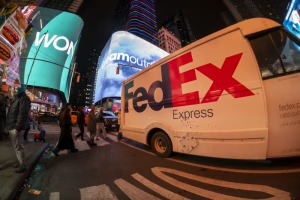
OM in the News: FedEx Is Planning an AI Agent Workforce

FedEx is building out an army of AI agents to work alongside its human workforce, positioning itself to tap the latest wave of technology crashing through corporate America, reports The Wall Street Journal (March 13, 2026).

The shipping giant, which already deploys artificial intelligence in software development and other areas, is now looking to drive AI agents further into operations, including network planning and business processes. By 2028, FedEx expects to have AI integrated into more than half of its core operational workflows.  FedEx is currently focused on setting up the underlying data and management foundation to oversee its AI bots.

Though logistics providers like FedEx are aiming to adopt AI, they’re grappling with challenges like managing numerous, disconnected data sources. “Logistics can be very fragmented—especially if you think of a global organization with their network being everywhere, it makes it difficult to standardize,” said an industry consultant.

As its underlying tech is completed, FedEx expects to roll out AI and AI agents that connect macro and microeconomic trends to better plan its network. In marketing and campaign management, FedEx will create a hierarchy in which there’s a “manager agent,” an “audit agent” and a “worker agent.” The goal of the hierarchy is to ensure that the agents have a trail of accountability for their actions.

At the moment, FedEx’s enterprise data platform, called Atlas, supports more than 200 AI use cases across the supply chain, commercial teams and enterprise functions. It has already turned on AI agents in areas such as software development, where they are developing and testing code. In operations, agents are helping customers clear customs more quickly.

Plans for FedEx’s AI agents also involve getting its humans ready to interact with the technology. the company just launched an AI education program for 300,000 of its employees, as well as a more advanced version for its technology workers. Each employee received a customized training depending on their role. FedEx says it doesn’t plan for those agents to replace its workers.

Classroom discussion questions:

  1. Why is FedEx pushing for more AI agents?
  2. How will agents be used in operations?

Guest Post: Fast or Free? The New Tradeoff in E-Commerce Shipping

Dr. Jon Jackson is Associate Professor – Operations Management at Providence College

For years, e-commerce conditioned shoppers to expect near-instant gratification. Fast shipping became the industry standard as retailers tried to keep pace with Amazon. First, it was 2-day shipping, then next day shipping, and ultimately same day shipping. But the economics behind those fast-shipping promises are starting to crack, and retailers are quietly resetting expectations, according to a recent report in The Wall Street Journal (Mar. 6, 2026).

Shipping costs have risen sharply in recent years. Major carriers such as FedEx and UPS have increased base rates annually while adding fuel surcharges, residential delivery fees, and dimensional pricing rules. As a result, retailers are increasingly shifting their focus from “fastest delivery” to “lowest cost delivery.”
Amazon now offers customers a small discount if they choose a slower delivery date. Many other retailers have followed suit by introducing “no-rush” shipping that may take a week or longer.
Interestingly, customers appear willing to wait. McKinsey surveyed over 1,000 people in 2024, and speed of delivery dropped from the #1 priority in 2022 to the #5 priority in 2024. Meanwhile, the cost of delivery maintained its high priority, with more than 95% of surveyed shoppers saying that they prefer free standard shipping instead of paying for faster shipping.
Longer delivery windows help logistics networks operate more efficiently. When retailers promise delivery in 5-7 days instead of two, carriers can consolidate shipments onto fuller trucks, lowering the cost per package. Some retailers even encourage customers to choose delivery days later in the week when shipping networks are less congested.
Another unexpected benefit: fewer returns. Retailers report that extending delivery times leads to more intentional purchases and significantly lower return rates. The era of “fastest possible shipping” may not be ending, but it is becoming just one option among many.
Classroom Discussion Questions
  1. If customers say they prioritize low shipping costs over speed, how should retailers redesign their fulfillment and delivery strategies?
  2. Do you think slower shipping could become the new norm in e-commerce, or will competition eventually push retailers back toward faster delivery times? Why?

OM in the News: AI and The Last Mile

The final mile—the last leg of the delivery process where goods are transported from a distribution center or store to their ultimate destination—is one of the most critical and cost-sensitive components of the modern supply chain. A package could end up at the wrong address, shipments could be late due to traffic, or a thunderstorm could damage a parcel left out in the rain.

Now AI and machine learning are playing a greater role in predictive analytics, helping companies anticipate delivery issues before they occur and proactively adjust.  AI can design more efficient delivery routes, improve accuracy and the customer experience, and predict errors before they might happen, writes Material Handling & Logistics  (July 22, 2025).
A new McKinsey report found that in the last decade, about $80 billion in venture capital went to logistics startups, with on-demand last-mile delivery platforms getting the greatest share of those funds.

Last-mile routes typically involve multiple stops and individual small packages — rather than one truck delivering pallets to a single warehouse — making this supply chain segment difficult to manage efficiently and expensive for the businesses involved. Last-mile delivery makes up an estimated 41% of all logistics costs in the supply chain.

AI can be  used to plan routes based on factors such as traffic, delivery windows, estimated time per stop, and driver capacity, reports Business Insider (July 15, 2025). More efficient routes can lower fuel costs, improve density, and enable more deliveries in a day, increasing revenue for providers.  Amazon just announced Wellspring, which uses AI to analyze satellite images, apartment building layouts, street imagery, consumer instructions, and photos from past deliveries. It can recommend which parking spot or apartment building entrance a driver should use to drop off a shipment.

AI can also forecast the likelihood of issues for specific routes or deliveries. Then it can make decisions based on the patterns, like moving packages to different facilities or increasing rates on a certain route, so drivers will be incentivized to pick them up earlier in the day. UPS created AI-based DeliveryDefense to analyze historic factors such as loss frequency and delivery attempts. The AI then spots areas that could be targets for porch pirates in the future.

Companies that can balance cost efficiency with delivery accuracy will be best positioned to thrive in today’s environment of volatility and heightened customer expectations.

Classroom discussion questions:

  1. How can AI be used in last-mile delivery?
  2. What are the complicating factors in last-mile deliveries?

OM Podcast #28: Thanksgiving in the Cold Food Supply Chain

Happy Thanksgiving!  In our latest podcast, Barry Render interviews Cindy Parker, Director of Operations at Americold Logistics LLC, which offers innovative supply chain solutions and cold storage.  Cindy and Barry discuss the importance of the cold food supply chain, particularly around important events like Thanksgiving.


Transcript

A Word document of this podcast will download by clicking the word Transcript above.


Have you subscribed to this podcast on Apple podcasts? Just go to your Apple podcasts app, search “Heizer Render OM Podcast,” and subscribe to get all our podcasts on your mobile device as soon as they come out!

Instructors, assignable auto-graded exercises using this podcast are available in MyLab OM. See our earlier blog post with a recording of author and user Chuck Munson to learn how to find these, or contact your Pearson rep to learn more! https://www.pearson.com/en-us/help-and-support/contact-us/find-a-rep.html

OM in the News: What is a a “Monster Train”?

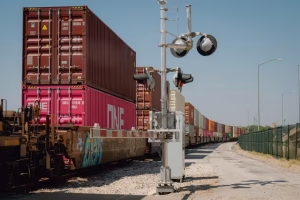
As we note in Chapter 11 (Supply Chain Management), railroads in the U.S. ship 40% of the ton-miles of all commodities, including 93% of all coal, 57% of cereal grains, and 52% of basic chemicals. But freight trains are getting longer—some of them 3 miles or more—and that is making life unpleasant in states like Texas. Sprawling rail yards, like those of Union Pacific in Houston, assemble trains that can pull hundreds of railcars that regularly cut off local roads for residents.

In Fort Worth, Texas, the fire department sometimes sends two trucks from different directions in case there is a blocked crossing

Railroaders call them monster trains. Railroad firms are making trains longer because they generate higher profits, allowing the companies to haul goods with fewer locomotives and fewer crew. writes The Wall Street Journal (Sept. 16, 2024).  Long trains are typically slower, so drivers must wait longer for them to pass. When these trains stop moving, things get worse. School buses, ambulances and firetrucks are delayed. Pedestrians and cyclists clamber under or between train cars to get across—and the results can be deadly.

Blocked crossings in Texas and elsewhere have become a more frequent occurrence. There are no federal limits on train length.  More than a dozen states, including Texas, have introduced bills to limit train length to 1.6 miles, but states can’t enforce them because they are barred from interfering with interstate commerce.

At Union Pacific, which gets the most complaints for blocked crossings, trains can reach around 20,000 feet, or 3.8 miles. Railroads, says Union Pacific’s CEO, seek to balance safety, customer demand, efficiency and the trains’ impact on communities. For his customers to beat competitors, he must maximize efficiency, he adds. “That’s the way I look at it. It’s business.”

Railroads also say the use of long trains reduces the emission of greenhouse gases. Labor unions, though, say long trains increase safety hazards and threaten their jobs.  A 3-mile train traveling at 25 miles an hour takes 7 minutes and 12 seconds to clear a crossing, plus 20 seconds for the gate warning. And monster trains also often come apart, causing crews to take a 1/2 hour to walk their length and recouple them.

Houston is the city hardest hit by blocked crossings in the country. “People can’t get to work on time in the mornings or get back home in the evenings”, says a City Council member.

Classroom discussion questions:

  1. Since trains are a backbone of shipping systems, what can be done to improve efficiency?
  2. Have you had an experience like that of Texas residents?

OM in the News: The Fireworks Supply Chain

Last week, all across the U.S. people enjoyed the dazzling displays of Independence Day. Fireworks are pyrotechnic marvels: the heart-stopping booms, the cascade of dazzling colors, the incredible finales. Supply Chain Management Now (July 7, 2024) examines the supply chain needed to create these events:

  1. Manufacturing fireworks is quite labor-intensiveProduction requires a delicate mix of sulfur, charcoal and potassium nitrate, packed into various components including shells, fuses and aerial effects. Skilled technicians must meticulously assemble each firework to ensure a visually stunning experience while prioritizing safety and quality control.
  2. Many fireworks include extra elements to create unique sounds. Layers of an organic salt, combined with an oxidizer, burn one at a time to slowly release gas and create whistling sounds. Aluminum or iron flakes create hissing and sizzling sparkles, and titanium powder gives us those super-loud blasts. Colors too, are attributed to particular materials.
  3. Transporting and storing fireworks is a delicate process. For obvious reasons, fireworks can’t just be carried by any shipping company to the average warehouse. Fireworks-storage facilities are equipped with temperature-controlled environments and specialized storage locations to ensure different types of fireworks are separated to prevent accidental combustion. There are strict rules about transportation, and trained professionals must take precautions to prevent ignition and ensure compliance with multiple regulations.
  4. Weather plays a prominent role in fireworks demand. About 90% of fireworks in the U.S. are manufactured in China, meaning orders are placed well in advance of the 4th. But consumers tend to purchase fireworks just before the holiday, so excessive rain or drought can put a serious damper on sales.
  5. Today’s fireworks are more futuristic than ever. Drones are now commonly used to create dazzling light shows, as more and more cities are retiring colorful fireworks displays in favor of “swarms of illuminated drones.” Drone shows are safer and much more environmentally friendly, as they generate fewer emissions, increase material sustainability and reduce the need for mining operations. The market size for global drone light shows was valued at $1.3 billion in 2021 and is projected to reach $2.2 billion by 2031.

Classroom discussion questions:

  1.  Is the fireworks supply chain unique?
  2. Can the manufacturing process be automated?

OM in the News: Disney World’s Start and Project Management

When Disneyland in Los Angeles opened in 1955, it was, in many ways, a disaster, writes The Wall Street Journal (Jan,6-7, 2024). There were rides out of service, restaurants that ran out of food, soft asphalt that consumed the heels of women’s shoes—all of it broadcast on national TV. Little wonder, then, that there was trepidation as the Walt Disney company approached the 1971 opening of the far more ambitious Walt Disney World, here in Orlando, especially as the word spread that it might not open in time. So, when Dick Nunis, the head of park operations, took control of the project, he was given carte blanche to do whatever it took to open the gates on Oct. 1st.

“There wasn’t anybody on that property who thought we were going to open on time,” said Dick Evans, one of the park’s managers on opening day. “And opening on time was critical to the company. We were at that point in debt up to our eyeballs. We’d borrowed close to $400 million to build phase one of Walt Disney World. And within a week of the time that he came on the property, the entire perspective changed. The energy level changed. He came in there like a tornado.”

Nunis, who recently died at the age of 91, fired contractors who got in the way, held meetings at 5 a.m. and put signs up all over the property that said the park would open on Oct. 1st. He made sure construction workers knew that their families were invited to the park a week before opening. He flew palm trees in on helicopters the night before the gates opened.

Not only did he understand the logistics of what it would take to hire thousands of employees, motivate construction workers and oversee the myriad details of opening a resort, he had worked closely with Walt Disney for a decade and knew how the company’s founder would have wanted it done.

Chapter 3 in our text deals with project management and the critical role of the project manager, Nunis, in this case. What does Disney World look like 62 years later? With 77,000 employees (called “cast members”) and six parks (Animal Kingdom, Epcot, Magic Kingdom, Typhoon Lagoon, Hollywood Studios, and Blizzard Beach), we see that the stakes in project management are high.

Classroom discussion questions:

  1. What are the responsibilities of a project manager?
  2. What are the 3 phases of the management of projects? (Hint: see page 62 in your text).

OM in the News: Weight Loss Drugs and the “Cold” Supply Chain

Complex logistics are designed to keep Ozempic and Wegovy cold.

The soaring popularity of weight-loss drugs is big business for some of the largest pharm distributors in the U.S. But the profits aren’t soaring, partly because of the complicated and costly logistics involved in shipping the refrigerated medications, reports The Wall Street Journal (Aug. 22, 2023). Drugs such as Wegovy and Ozempic cost around $1,000 for a month’s supply and are in hot demand, but their operating expenses are higher because of the cold-food supply chain nature of the product.

The medications help patients lose weight by mimicking gut hormones. The drugs are once-weekly injections that patients administer on themselves using a penlike needle, similar to using an EpiPen, that must be stored between 36 and 46 degrees Fahrenheit. For wholesalers, it means arranging industrial-scale logistics designed to keep the medications cold throughout transport and storage, including protecting the injections from unpredictable events such as a truck breaking down in a heat wave.

“You need to have the product in refrigerated trucks going from your point A to point B and then when it gets into a location, time from a material handling standpoint to collect the product and then store it in a refrigerator,” says an industry analyst. Shipping refrigerated products such as medicine and food is more expensive than moving dry goods like apparel or appliances.

Trucking companies handle the drugs on specific trucks that keep the shipments in a tightly controlled environment, ensuring temperatures are stable and the goods are also protected from odors that can affect them. The trucks must carry a higher level of insurance and are outfitted to keep the products secure to prevent theft, a particular risk with expensive drugs like Wegovy and Ozempic that are in big demand and have a high street value.

The challenges highlight the complications drug wholesalers face in building out supply chains for medications in high demand.  During the pandemic pharm companies rapidly worked to develop, manufacture and distribute highly fragile Covid-19 vaccines around the world, all while keeping the inoculations at ultracold temperatures. That involved designing special packaging to keep the vials at stable temperatures for long distances.

For additional insights into cold food supply chains, listen to our OM Podcast #7, featuring Temple U. Prof. Misty Blessley.

Classroom discussion questions:

  1. How do “cold food supply chains” differ from traditional supply chains?
  2. List a dozen products requiring a cold food supply chain.

OM in the News: Leased Robots Roll In

Logistics firms looking for extra help during the holidays are leasing temporary package-handling robots, which can be returned to their manufacturers when online shopping orders cool down after the seasonal rush.

Robots from Locus Robotics await deployment

Leased robots, which have grown in popularity across the industry in recent years, can be added to existing fleets of warehouse, distribution and fulfillment center robots at any time to support an anticipated jump in demand. The robots are increasingly being used for picking up and sorting packages, receiving and unloading them, moving heavy payloads and replenishing stock shelves, among other automated tasks.

The growing demand for robots in the logistics industry is being driven by a shortage of workers, ongoing supply-chain disruptions and continued momentum from a sharp increase in online shopping triggered by the Covid-19 pandemic, reports The Wall Street Journal (Dec. 7, 2022).

Spending in the global logistics robotics market, which was valued at $2.6 billion in 2020, is expected to grow at a compound annual growth rate of 23%, reaching $11 billion by 2027. Excluding Amazon, which is by far the sector’s largest robotics user, there are more than 20,000 logistics robots of all kinds in use today. Known as robots-as-a-service, leased robots are employed widely in manufacturing, but are relatively new to the logistics industry. Under the model, users are charged a subscription-like fee from third-party robotics firms.

By leasing robots, companies are spared high upfront costs and ongoing maintenance expenses. On the downside, orders for subscription-based robots have to be made well in advance of an anticipated upturn in demand. The process of outfitting a company with a leased robot typically involves taking a 3-D scan of a facility and feeding the data into an artificial intelligence-enabled program designed to generate a mock-up of a robot’s mechanical, electrical and software systems.

Classroom discussion questions:

  1. What is the main driver of robot leasing in warehouses?
  2. What is the difference between a “service robot” and one used in manufacturing?

Video Tip: Where New Warehouses are Booming–Loop 303

The growing logistics activity comes as many retailers and manufacturers are looking to reconfigure their supply chains, both to get closer to the big U.S. consumer markets and to get around the bottlenecks at traditional freight hubs.

The drive along the 36-mile length of the Loop 303 freeway around Phoenix takes under an hour. The trip goes fast, but not quite as fast as the land along the 303 is being gobbled up by developers and filled with massive manufacturing and logistics facilities. “Developers from all parts of the country have been planting flags in that area. For the most part, that corridor is spoken for,” says one developer.

The rush of activity along the 303 was triggered by a number of factors, chief among them being the rising costs of development in California. Slowly, companies were starting to realize they could build a distribution center or manufacturing plant in the Phoenix area for much less than a facility would cost in the major cities in California. And, the ports of Long Beach and the border with Mexico were within a few hours’ drive by truck.

“The Southwest Valley of Phoenix has always been the industrial and manufacturing corridor,” said an industry VP. “You can get to the ports in six hours, drop your shipment and get back home, all within allowable times.”

This 5-minute Wall Street Journal video (Oct. 12, 2022) takes a close look at one 17-mile stretch of Arizona’s Loop 303 highway where dozens of warehouses are springing up. Importers say regions like this one in Arizona are a good alternative to expensive and heavily-congested hubs like California’s Inland Empire, where space is scarce and comes at premium prices. Click here to watch it.

Classroom discussion questions:

  1. What are the advantages and disadvantages of opening warehouses on Loop 303?
  2. Of the 7 factors that impact location decisions discussed on pages 338-340 (see Chapter 8) in your Heizer/Render/Munson text, which applies here?

OM in the News: Trucking’s Dirty Secret

Trucks traveling empty has both financial and environmental costs.

Every day, thousands of trucks drive along miles of freeways and highways completely empty — and the distances they drive with zero cargo onboard reaches many billions of miles every year. After a truck delivers its load, it may not have any goods to carry for the return leg of its journey and drives back empty. “I don’t think it is widely known,” said an industry veteran.

The problem of empty trucks has gotten worse in Europe, with the proportion of mileage driven by vehicles with zero cargo going up, reports CNBC (Sept. 12, 2022). In the EU, trucks clocked up so-called “deadhead” distances of around 21 billion miles in 2021. This equates to more than a fifth of the total distance traveled by road freight in the bloc last year, up from 20% in 2020.

By its nature, the road freight industry is complex: manufacturers or retailers that need to transport goods are in myriad locations, shipping varying amounts of cargo to many destinations, sometimes relying on multiple carriers to do so.

Trucking companies ideally need one customer (or customers) for the outward journey and another for the return. If they don’t have two customers, vehicles run empty. But, as well as needing a shipment for the return journey, they also need a truck that matches their load, with equipment such as refrigeration or a vehicle with a fork-lift attached. Some haulers still book deliveries via phone or email. This means information about what is being sent where isn’t always centrally held, making it harder to find shipments to fill trucks for the return leg.

In the U.S., meanwhile, the distances driven by empty trucks decreased from 21% in 2020 to 15% in 2021. Under the pressure of rising fuel prices, carriers achieved some of the lowest deadhead mileage in years. But running trucks without loads is still a problem, especially since costs are going up: U.S domestic freight rates increased 28% this year (across all modes of transport including road and air), reaching a potential peak. Empty miles mean less revenue for carriers. It means increased costs because an empty truck on the road still consumes fuel, still needs a driver, and still requires regular maintenance.

Classroom discussion questions:

  1. What is the solution to “deadheading”?
  2. Why is the problem bigger in the EU than in the US?

OM in the News: Shanghai’s Covid Lockdown Leads to Logistics Disarray

Transport of goods into one of China’s biggest manufacturing and export hubs has almost ground to a halt, reports The Wall Street Journal (April 21, 2022). As Shanghai’s lockdown to stamp out a raging coronavirus outbreak extends into its fourth week, logistics services in that industrial area have faced severe disruptions.

Containers piled up at the port of Shanghai.

Trucking has been the worst hit, as strict local pandemic policies and arbitrary implementation of rules choke off the transport of goods. At Shanghai’s port, normally the busiest container port in the world, empty containers are stacked on docks waiting for trucks to deliver cargo.

The logistics snarls in and around Shanghai further add pressure to an already battered global supply chain and to rising prices of goods in the U.S. They also complicate the Chinese government’s efforts to reopen factories shuttered due to lockdowns. Logistics managers expect weeks to months before some international shipments return to normal.

On April 1, Shanghai authorities locked down the entire city to stem the spread of the virus, asking its 25 million residents to stay at home. This stringent act has had a ripple effect on businesses in the nearby region, an area of more than 160 million people. The region accounts for a fifth of China’s national gross domestic product. Daily truck volumes moving through Shanghai were down 70%  compared with last month. Trucking costs have risen significantly as requirements for a negative Covid test result within 48 hours of travel and a host of bureaucratic approvals have discouraged truckers from taking loads to Shanghai.

Completed goods are accumulating in factories because of trucking delays and warehouse closures, while others have halted production after delivery of raw materials and supplies were disrupted. The trucking snafu has spilled over into other logistics areas. While Shanghai’s port remains operational, the shortage of trucks that could deliver cargo there meant containers were increasingly lying idle.

While the lull in Shanghai’s port activity would give overworked ports in the U.S. and Europe some breathing room in the short term, in the longer term, Shanghai’s cargo buildup is a bubble waiting to burst.

Classroom discussion questions:

  1. How does this impact U.S. supply chains?
  2. Why the stringent lockdown?

OM in the News: Amazon Air’s Supply Chain Obsession

There is nothing like a pandemic and a European war to highlight the value of logistics, writes The Wall Street Journal (March 17, 2022).  Amazon’s growing fleet of planes shows that it is investing hard to deliver—probably at the expense of FedEx, UPS, and DHL.

Amazon’s cargo airline currently makes an average of 187 flights a day, compared with 85 in May 2020.

Since the Covid-19 crisis started, e-commerce purchases have skyrocketed and a lot of belly-hold space in planes has been removed. Many airfreight companies have seized the opportunity to grow. Amazon has taken the lead. It now has as many as 110 jets—less than DHL’s 202, UPS’ 289 and FedEx’s 474 but a lot more than the 50 it had at the start of 2020.

Having previously leased its planes, Amazon started buying some last year as a flood of parked jets entered the secondhand market and freighter conversions surged. This strategy of building extra flexibility and control may herald more encroachment on the territory of FedEx and UPS. Amazon already provides some “third party” services to companies, and could soon start competing head-to-head in business-to-consumer deliveries.

Even after spending heavily on its own vans, trucks and warehouses, Amazon still relies on traditional logistics firms to deliver a lot of packages, which makes for a strained partnership. But the company hasn’t used its planes much to compete directly with the likes of UPS. It typically flies inventory between warehouses on daytime flights, with a focus on two-day delivery. There are clues that this may be changing. Routes seem increasingly designed not just to align with warehouse needs but also to close geographical gaps.

A rule of thumb among OM professors is that companies have good reason to buy a supplier when sourcing a product is subject to a lot of uncertainty. (See our discussion of “vertical integration” on page 448). With uncertainty today pervading the entire global supply chain, Amazon’s logistics ambitions seem ready for takeoff.

Classroom discussion questions:

  1. What are the advantages and disadvantages of Amazon’s strategy?
  2. Provide other examples of vertical integration.

OM in the News: The Ship Backup Grows

Containers remain stacked up at California’s Port of Long Beach as supply-chain problems continue.

The backlog of container ships off the coast of Southern California keeps growing, writes The Wall Street Journal (Jan. 25, 2022). The queue of vessels waiting to enter the port complex rose past 100 during December, and reached a record 109 ships in early January.

The factors that triggered big bottlenecks earlier in 2021 have continued into 2022. Ships can’t unload quickly because terminals are full of containers. Truckers can’t pick up loads due to a shortage of drivers and the steel trailers used to pull boxes. Warehouses near the ports and at nearby logistics hubs are short workers and don’t have space for more deliveries. The backups are exacerbating supply-chain delays and driving up shipping costs that are contributing to inflation reaching its highest level in decades.

The ports (in LA and Long Beach) have made some progress in recent months in speeding up the movement of some import containers from terminals to truck yards and warehouses. Rather than freeing up space, however, the boxes filling up the dockside terminals have been replaced with empty containers waiting for shipment back to Asia. Five to 10 of the 35 ships at berths on a typical day aren’t being unloaded because terminals don’t have space to put the boxes. Congestion has gotten worse in recent weeks because of a surge of Covid-19 cases among longshore workers, truckers and warehouse staff.

The backlog in Southern California has pushed importers to search for alternate ocean gateways. FedEx recently launched a charter service carrying up to 300 containers to Port Hueneme, Calif., a small gateway 80 miles up the coast. Import volumes at Gulf and East Coast ports rose during the second half of the year as West Coast volumes declined, suggesting a shift to less congested parts of the country. Now, container ships are starting to back up at those ports too.

The Biden administration has tried for months to reduce backlogs, especially at LA and Long Beach, which together handle about 40% of U.S. container imports. Biden announced in 2021 that terminals in Southern California would operate around the clock to speed the flow of containers to manufacturers and retailers, but the initiative failed.

Classroom discussion questions:

  1. Table 11.3 in your Heizer/Render/Munson text lists 10 supply chain risks and tactics. Which apply to this situation?
  2. Which risk reduction tactic was taken by FedEx?

OM in the News: A Logistics Manager Tries to Save Christmas

MGA toys awaiting shipment fill up a rented warehouse in Shenzhen, China.

A toy traffic jam is threatening to ruin Christmas. John Baker’s job is to save the day. Baker is the logistics boss at MGA Entertainment, the company behind L.O.L. Surprise dolls, Little Tikes cars and other popular toys. His job: Retrieve the items in time for the holidays by overcoming a jammed-up global supply chain that is holding them hostage. In June, when new toys typically exit factories for cargo ships and stores world-wide, hundreds of thousands of MGA dolls, play sets and accessories were piling up in factories and rented warehouse space in and around China’s port city of Shenzhen. The waiting toys would require 1,400 40-foot containers and cargo space aboard vessels.

Baker had already faced warnings that Chinese factory owners were running out of storage space. If he couldn’t get the toys shipped out of Shenzhen soon, they would stop making any more. His supply-chain problem is testing leaders across America, from the makers of Nike sneakers to Ford pickup trucks to Whirlpool washing machines. “It’s more dramatic than what I can remember,” says Walmart’s CEO.

Since the Covid-19 pandemic, the once finely tuned world-wide assembly line has limped along, writes The Wall Street Journal (Oct. 13, 2021). Worker illnesses are shutting factories and ports in Asia, a once reliable source of inexpensive manufacturing. Floods and hurricanes are disrupting the orderly flow of raw materials. The shortage of semiconductors has limited availability of everything from cars to computers to videogame consoles. There is a shortage of cargo containers to ferry goods across seas and truck drivers to deliver them. Freight rates have hit record levels.

In a dessert town outside Los Angeles, the 62-year-old Baker tries to unravel the most complex knot of a career that began 4 decades ago, as a forklift driver moving pallets of Smurf dolls. He has been working in toy logistics his entire career and is now a VP for one of the world’s largest toy makers, which tallies more than $2 billion in annual sales.

The stakes are high this season, and the clock is ticking. Half of all retail toy sales come in the weeks leading up to Christmas. Toys that arrive too late won’t sell until they are heavily discounted after the holidays. Baker has to get MGA toys out of China and onto retail shelves with enough time for parents to buy them and put them under the tree.

This is a great story of the importance of one particular topic in Chapter 11 in your Heizer/Render/Munson text–logistics. Baker has used ships, trucks, and trains to try to get the toys to shelves. Will he succeed?

Classroom discussion questions:

  1. Why has the global supply chain weakened?
  2. What can Baker do to move toys from China to MGA’s European customers?