
The Wall Street Journal (June 18-19,2011), of all places, provides a great classroom example on the subject of capacity ( Supp. 7). The context is the California prison system, which was just ordered by the Supreme Court to reduce its prison population to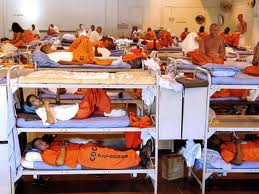 137% of capacity, citing unsafe overcrowding. Since capacity usually refers to the maximum number of units that can be produced or contained in a specific time (see our definition in Supp.7), it’s hard to comprehend filling a space beyond 100% of that limit.
But the Journal writes that “the numbers on California’s prison overcrowding were based on its penal system’s design capacity“. The state traditionally planned for prisons to hold one inmate per cell. But most facilities doubled their population almost immediately after opening because of a glut of inmates. The state claims that it has recently reduced its prison population to 179% of capacity.
California also measures its prison system by operational capacity, or the number of prisoners who can be housed given actual conditions at prisons. Because of double-bunking, the operational capacity is almost twice the design capacity, meaning the system was able to claim to be only 9% above operational capacity in 2009. (The courts rarely recognize this measure). Adding to the confusion, a 3rd measure, rated capacity, based on fire marshals’ assessments of how many prisoners can be housed safely, is also used in some states.
The prison example provides an interesting contrast to our more traditional discussion of bakery capacity in Example S1.