OM in the News: A Devastating Fire at a Major Ford Supplier

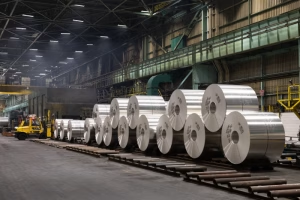
A late-night fire leveled a key part of a New York aluminum plant in hours. Its absence is going to disrupt business at Ford Motor  and other automakers for months to come.

The plant’s operator, Novelis, supplies about 40% of the aluminum sheet used by the auto industry in the U.S. Novelis said a major portion of its Oswego, N.Y., plant has been knocked offline until early next year.

Novelis produces more than 350,000 metric tons of sheet aluminum annually for the automotive industry

Ford is the biggest user of the plant. Its F-150 pickup, the top-selling vehicle in the U.S. and the automaker’s main profit driver, is one of the industry’s biggest users of aluminum, writes The Wall Street Journal (Oct. 7, 2025). The setback is severe.

“This represents a serious question for the production of F-150 because that’s the aluminum that comes out of Oswego,” said an industry analyst. Ford switched the F-150’s exterior to aluminum from steel a decade ago.

“Since the fire nearly three weeks ago, Ford has been working closely with Novelis, and a full team is dedicated to addressing the situation and exploring all possible alternatives to minimize any potential disruptions,” stated Ford.

It is the latest supply-chain snafu for the global auto industry, roiled in recent years by trade wars, a global semiconductor shortage and a potentially crippling reliance on China for rare-earth magnets used in vehicles.

Though automakers and other major industrial manufacturers worked to diversify their supply chains in the wake of the coronavirus pandemic, which shut off access to Chinese factories, companies often remain largely dependent on one or two makers for critical parts because of the high cost tied to employing multiple suppliers.

 Around a dozen automakers get aluminum from Novelis, including Ford, Toyota, Hyundai, Volkswagen and Jeep maker Stellantis.

Classroom discussion questions:

  1. Which tool(s) in Supplement 11 could be used by Ford in this situation?
  2. What do other major car manufacturers do ?

OM in the News: Ford Breaks Record—Of Safety Recalls

Ford has recorded more safety recalls in the first six months of 2025 than any car company ever has in an entire calendar year, reports The Wall Street Journal (July 12-13, 2025).

Ford just recalled 850,000 pickup trucks and SUVs because of a potential fuel-pump failure. A bad fuel pump could result in the engine stalling while a driver is operating the vehicle.

Last month, the firm said it would need to fix  200,000 all-electric Mustang Mach-E SUVs after receiving complaints from the government about customers being unable to open their doors as a result of the vehicle’s 12-volt battery dying, including cases where children were trapped inside. “There was no way for me to get inside my car without jumper cables,” a driver in Houston wrote in an April complaint. The person had to call emergency services and break into the car.

Also this year, Ford said it would need to fix nearly half a million 2016-2017 Explorer SUVs to prevent door trim from falling off. The issue was potentially creating a road hazard for other drivers.

In January  of 2025, Ford paid $65 million to the government as part of a settlement over violations of auto-safety laws, specifically over a delayed recall of 600,000 vehicles with defective rearview cameras. As part of the agreement, the automaker said it would spend an additional $45 million to improve internal systems for tracking safety issues.

Ford and its CEO  have staked out improving quality as a priority for the automaker. Improving quality will also help to reduce the billions of dollars Ford spends every year on warranty claims and safety recalls. The company hired a quality czar in 2022, and it has tied 70% of executive annual bonuses to quality. It said it has significantly improved product quality in recent years, with four new models winning accolades from a recent J.D. Power study on quality. The company has more than doubled its team of safety and technical experts and expanded testing on critical systems, such as vehicle powertrains, steering and braking.

Overall, recalls across the auto industry have been rising, with more than 1,000 recorded in 2024, compared with 800 a decade earlier.

Classroom discussion questions:

  1. What quality tools in Chapter 6 of your Heizer/Render/Munson text could Ford employ to decrease defects?
  2. Discuss Figure 17.1 in the context of Ford’s problems.

OM in the News: Retreating EVs and the Impact on Supply Chains

“Ford Motor’s decision this week to kill a highly touted future electric vehicle is a sign that the industry’s pullback on EVs is deepening,” writes The Wall Street Journal (Aug. 23, 2024).  It is canceling plans for an electric SUV once touted as a “personalized bullet train.” The move added to the drumbeat of news from carmakers of delayed or scrapped investments into EV models, factories and battery projects.

Dealers’ lots are getting pretty crowded as EVs from Tesla, Ford, Mercedes, and more fail to move.

GM, VW, Mercedes and other automakers also have curbed their EV ambitions in recent months. Taken together, the walked-back plans are an acknowledgment that the big investments outlined at the start of the decade got ahead of the consumer’s appetite for a full switch to EVs.

Delaying some EV investments will conserve cash and buy automakers time to lower their battery costs and other EV-related expenses.  EV startups including Rivian, Lucid and Polestar are laying off workers, and Fisker has declared bankruptcy.

But cuts to planned EV output have hurt the parts supplier base, which has had to adjust its business. Magna, one of the world’s largest auto-parts suppliers, had been gearing up to make battery trays, seats and other parts for Ford’s now-scrapped electric SUV. Dana, another large supplier serving Ford and Stellantis, had expected sales of battery-cooling systems and other EV-related components to jump by 1/3 this year. “Like most things that are new or disruptive, a lot of times forecasts and expectations can get ahead of some of the practicalities,” said Dana’s CFO.

The cost of batteries is so high that most big automakers are in the red on their electric offerings. Ford’s EV business is on pace to lose $5 billion this year, with losses averaging $44,000 per electric vehicle sold!

Instead of offering the electric SUV, Ford plans to produce hybrid, gas-electric versions. It also delayed for a second time the opening of a new EV truck factory, the largest investment in its history, which is now set for a 2027 opening, two years later than initially planned.

New emissions rules from the Biden administration will in effect require a heavy dose of EVs in the late 2020’s. To comply, automakers will need to introduce more plug-in hybrid vehicles. Car companies are likely to focus on fully electric systems for small- and midsize vehicles, and hybrids for larger ones.

Classroom discussion questions:

  1. Why has the shift to EVs cooled?
  2.  What is the impact on 1st and 2nd tier suppliers?

OM in the News: The F-150’s Missing Door Handles

Ford has run into another production snag building its top-selling pickup trucks—this time due to difficulties getting door handles, reports The Wall Street Journal (May 4, 2023). The auto maker temporarily halted factory work at three plants where it makes both gasoline and electric versions of the F-150 pickup truck, unable to get the right door handles.

Production has since resumed at the facilities, but now workers are building some trucks with substitute handles—including ones that are the wrong color or don’t have the proper key holes—as a stopgap measure until the correct parts are available. Factory workers need to temporarily install the substitute handles to easily get in and out of the vehicle as it moves down the assembly line and to do certain checks from inside the vehicle. The incomplete trucks are then being parked and shipments to customers put on hold until the right handles can be swapped in.

The door handle constraint is the latest in a series of obstacles Ford has faced in the past year building both its F-Series pickup trucks—among the company’s biggest moneymakers—and a new electric version, the Lightning. In September, Ford was holding back shipments of some F-Series trucks due to difficulties getting badges that display the model name and blue oval logo. Earlier this year, it halted factory work on the F-150 Lightning for five weeks, after one caught fire because of a battery defect. (Factory production of the electric pickup resumed in March after Ford determined that the root cause of the fire was related to a supplier problem that caused the affected battery cells to short circuit while at a high state of charge).

A  lack of semiconductors and other parts constraints have also disrupted factory work and resulted in it having to delay deliveries because the vehicles weren’t finished. The five-week plant shutdown hurt sales and weighed on its financial results.

Classroom discussion questions:
1. What is the solution to this supply chain problem?
2. Why is this slowdown a major concern to Ford?

OM in the News: Ford’s Latest Supply-Chain Problem

Ford held some shipments because of a lack of badges.

Ford Motor has delayed deliveries of certain vehicles because it didn’t have the blue oval badges that go on them, in another example of how supply-chain challenges have hit auto makers, reports The Wall Street Journal (Sept. 24-25, 2022). The company has run into supply constraints with the brand-name badges and the nameplates that specify the model. Both parts are affixed to the vehicle’s exterior and are important identifiers for the auto maker’s products.

Ford had considered some workarounds, such as 3-D printing the insignia until the permanent ones could be obtained. But they didn’t feel the printed substitutions would meet the bar on quality.

The company is retrofitting those built without a Ford logo and delivering them to dealers. It now has 40,000 to 45,000 vehicles in inventory that can’t be shipped to dealers because they were awaiting needed parts. Many of these vehicles are high-margin trucks (like the F-150 pickup) and SUVs. The shortages primarily involved parts other than semiconductors.

Tribar Technologies, which has made badges for Ford, had to limit operations last month after disclosing to Michigan regulators it had discharged industrial chemicals into a local sewer system. Ford’s trouble getting nameplates and badges illustrates that even the most basic parts can be hard to come by, resulting in constraints that can have larger repercussions on a company’s ability to fulfill vehicle orders.

The global auto industry has been wrestling with various supply-chain disruptions for more than a year, but most of the shortages have revolved around a lack of semiconductors. That has led car companies to build some vehicles without the needed semiconductors and then park them until they can be finished. This strategy has left tens of thousands of cars and trucks sitting at airport lots and other holding pens near assembly plants in the South and Midwest.

GM had nearly 100,000 incomplete vehicles that it couldn’t sell because they lacked the needed computer chips and other parts to deliver them to dealers. Similarly, EV startup Lucid has cited supply-chain constraints on parts such as glass and carpet as one reason it slashed production targets for 2022.

Classroom discussion questions:

  1. Table 11.3 in your Heizer/Render/Munson text lists ten supply chain risks. Which did Ford face here?
  2. As operations manager, how would you address the multitude of supply chain problems?

OM in the News: At Ford, Quality Is Now Problem 1

In May, Ford recalled some Ford Expeditions and Lincoln Navigators after reports of fires while vehicles were parked. In June, it recalled 49,000 Mustang electric SUVs over concerns that the battery contactors could overheat. In the first 7 months of the year, Ford had 46 separate safety recalls on 6.8 million vehicles, more than any other U.S. auto maker.

Once touted for its quality record—“Quality is Job 1” was its slogan for much of the 1980s and 1990s—last year Ford set aside more than $4 billion for warranty costs, up 76% from 5 years earlier. Those billions that Ford spends yearly on warranty repairs and recalls could instead have gone towards spending for new EV models, and battery and manufacturing plants, writes The Wall Street Journal (Aug. 6-7, 2022).

Ford recalled Mustang Mach-E electric SUVs.

In 2021, Ford allocated $1,041 per vehicle for covering warranty claims compared with $713 per vehicle for rival GM. This year, in addition to the recalls, auto-safety regulators also opened a defect investigation into 2021 Ford Broncos after receiving reports of “catastrophic engine failures” at highway speeds.

One of the challenges at Ford was that it tried to make too many last-minute design and engineering changes ahead of a new-vehicle launch, increasing the risk of problems down the line. Workers rallied to fix problems when they blew up, but weren’t empowered to flag them early in the process when there was still time to head them off. Consumer Reports says Ford has too many new-model launches bunched together and often makes more substantive changes in its redesigns, while other car companies use more carry-over parts.

Ford recently installed video cameras to monitor the early build of vehicles—before production—to target any steps they can eliminate or simplify. Higher tech cameras are now used to inspect the vehicles for quality, too, allowing workers to scour for an incorrectly placed hose or a paint blemish. “We are placing more time and emphasis on ensuring everything is done right upfront to prevent quality issues from manifesting later in the development process,” says Ford’s new quality czar.

How Ford compares itself to rivals in quality has changed, too. It now sets its quality targets against the benchmarks of its competitors. One example is the quality of Ford’s Bronco SUV as compared with the Jeep Wrangler.

Classroom discussion questions:

  1. Select one of the 7 tools of TQM found in your Heizer/Render/Munson text in Figure 6.5 and describe how Ford might use it.
  2. When and where should Ford inspect according to Chapter 6?

OM in the News: Ford and GM Move into Chip Making with Vertical Integration

Detroit’s two biggest auto makers, writes The Wall Street Journal (Nov. 19, 2021)—Ford and GM—are looking to get into the semiconductor business, after a year of computer-chip shortages that snarled their global factory output. Ford just announced a strategic agreement with U.S.-based semiconductor manufacturer Global Foundries to develop chips, a pact that could lead to joint U.S. production. GM said it was forging ties with Qualcomm and NXP Semiconductors, to codevelop and manufacture computer chips.

The moves are the latest examples of how pandemic-related disruptions are prompting companies to exert greater control over their supply chains by moving production closer to home, or in some cases in-house. Multinational companies got an early shock in the health crisis when border closings, local restrictions and lockdowns caused chaos. Some have decided on permanent solutions.

Businesses have also continued to face shipping delays. In the auto industry, car companies are starting to unwind decisions made over decades to outsource key components to suppliers. Recent moves by auto makers to vertically integrate (a topic in Chapter 11) by getting into battery production and semiconductors are a modern day nod to when they owned huge parts divisions and operated steel mills.

The semiconductor shortage has scuttled output of millions of planned vehicles industrywide this year. Ford’s move would go a step further by eventually bringing some chip development inhouse. It said designing its own chips could improve some vehicle features—such as automated driving capabilities or battery systems for electric vehicles— and potentially help Ford sidestep future shortages.

GM and Ford exploring the chip business shows how car companies are selectively bringing key technologies in house to develop expertise in areas they see as critical to competitiveness. Better, faster chips, for example, will be needed for everything from multimedia touch screens to remote software updates to fix defects.

The auto industry’s pivot to electric vehicles is also accelerating a shift to vertical integration, with many car companies worried they won’t be able to secure enough battery supplies and raw materials to meet their growth targets. Ford, VW, GM and other major auto makers are teaming with battery companies to build new factories that they say will give them a technical advantage and more stable future supplies.

Classroom discussion questions:

  1. What are the advantages and disadvantages of bringing chip production inhouse?
  2. Explain what is meant by “vertical integration.”

Video Tip: The Chip Shortage –A Look Behind the Scenes

A global chip shortage is affecting how quickly we can drive a car off the lot or buy a new laptop. In this 9 minute video (click the link below), The Wall Street Journal (July 2, 2021) takes us on a visit to a fabrication plant in Singapore to see the complex process of chip making and how one manufacturer is trying to overcome the shortage.

Watch Video Here

How is the shortage impacting the auto industry? Here is one example: Ford Motor Co. said it is forced it to cut output across more than a half-dozen U.S. factories in July, a sign that the supply-chain troubles could take longer to ease than auto-industry executives previously believed.

chip

Ford’s pickup truck factories in Michigan, Kentucky and Missouri will reduce or stop production for much of July, while an Explorer plant in Chicago will be idled for the entire month. Production of several other popular models also will be reduced or scrapped, including the Escape SUV and Mustang sports car.

The Chicago plant and the factories that assemble the pickup trucks—Ford’s biggest moneymaker—had cut production earlier this spring because of the chip shortage. Ford said it is giving priority to the completion of thousands of vehicles that it has assembled in recent months but parked in lots near factories as it awaits needed computer chips. It will continue to build new vehicles, but will curb production so it can move out some of those waylaid models.

Classroom discussion questions:
1. After watching the video, explain why can’t enough chips be produced immediately?

2. How did the auto industry get into this position?

OM in the News: The Ford-VW Electric Car Alliance

(From L-R) Jim Hackett, Ford CEO, Bryan Salesky CEO of Argo AI, and Herbert Diess, VW CEO.

As we discuss in Chapter 5 (see the Product Development Continuum and Figure 5.6), alliances are often appropriate for exploiting opportunities where substantial resources and risk are involved. We now see Ford and VW investing in Argo AI to pursue the market for electric and self-driving cars.

Unprecedented shifts facing the auto industry are forcing players to consider new partnerships and potential consolidation, writes Industry Week (July 12, 2019). VW, the world’s top automaker, offers the industry’s most ambitious roll-out of electric models, while Ford, also in the top 10, is developing advanced self-driving technology with Argo. For VW, the Argo investment offers an opportunity to potentially catch up with Alphabet’s Waymo, and GM’s Cruise unit. Road tests and accumulating huge amounts of data are critical for the further development of self-driving cars, and few apart from Waymo are equipped to do it alone.

Besides sharing costs for the development of self-driving cars, Ford will use VW’s electric-car underpinnings that form to backbone of the most aggressive rollout of electric cars in the industry, with VW spending $34 billion. Adding more vehicles to production lines would help gain scale and save costs, and offer Ford a platform to better comply with tougher rules on carbon-dioxide emissions in Europe. Ford will build at least one mass-market battery car in Europe starting in 2023 and deliver more than 600,000 European vehicles based on VW’s platform, dubbed MEB, over 6 years.

“Our global alliance is beginning to demonstrate even greater promise , and we are continuing to look at other areas on which we might collaborate,” said VW’s CEO.

Classroom discussion questions:

  1. Define an alliance.
  2. What are the advantages and disadvantages of an alliance such as one described above?

OM in the News: Ford Tests Walking Robot Deliveries

Walking robots deployed from self-driving vans to deliver mail parcels could soon be seen marching up to homeowners’ doorsteps. The project is the product of a new partnership between Ford Motor and Agility Robotics. The companies are aiming to deploy early next year up to 100 autonomous Ford vehicles carrying a robot that can stand upright and walk from the van to front doors, writes The Wall Street Journal (May 22, 2019).

Agility’s robots—resembling a headless human—have the ability to climb stairs and move across lawns, which should help them deliver packages of up to 40 pounds. The partnership comes as Ford ramps up its ambitions in autonomous transportation with various technologies. In 2017, Ford said it would invest $1 billion in self-driving startup Argo AI over a five-year period. Last year, the company struck a deal with delivery startup Postmates to test self-driving vehicles for delivering groceries.

Few, if any, partnerships with a major U.S. corporation are testing upright delivery robots in public. Some startups and Amazon have been using robot fleets that carry goods inside rolling robots. The Agility-Ford team will focus on mail parcel delivery, though other applications, such as grocery delivery, aren’t ruled out.

Classroom discussion questions:

  1. What factors might delay the successful rollout of this project?
  2. Why is Ford entering the delivery business?


OM in the News: Ford Discovers a Damaged Supply Chain

Ford expects to lay off several thousand workers temporarily at a Michigan factory that assembles its top-selling F-150 pickup truck after a fire last week damaged the premises of a parts supplier,” reports The Wall Street Journal (May 9, 2018). The blaze, which occurred at a Michigan plant operated by Meridian Lightweight Technologies, has already disrupted production of Ford’s pickup trucks at a factory in Missouri. Meridian is an automotive-interiors supplier owned by China’s Wanfeng Auto Group, which makes components for Ford and other car makers. Ford’s F-150 factory in Dearborn, Mich., is expected to run out of Meridian-supplied parts and halt production as early as Wednesday.

Ford’s other main F-150 plant, in Kansas City, Mo., would be idled this week because certain parts are in short supply after the fire. The two plants, which together employ 7,600 people, could face several weeks of down time as the auto maker seeks ways to make up the parts shortfall.

The F-150 is Ford’s best-selling vehicle and generates the bulk of its global profit. A prolonged shutdown of the plants could dent revenue and profit. The two plants combined produce 10,000 to 15,000 F-150s a week. The company would face cost pressures from paying workers during idle time and while ramping back up to offset lost production. The fire also disrupted production at a Fiat-Chrysler Automobiles minivan plant in Windsor, Ontario, and a BMW sport-utility factory in South Carolina.

Classroom discussion questions:

  1. What are the advantages and disadvantages of a single-source supplier?
  2. What strategy (see Supplement 11) might Ford employ?

OM in the News: Ford Goes Greener for Plastics

By 2011, all North American Fords have used soy-based foam in their seats

“What does Heinz Ketchup have to do with plastics and Ford Motor,” asks Plastics Technology (March 1, 2018). It’s not that the squeeze bottles used for the condiment are found throughout Ford cafeterias. Rather, the automaker and the ketchup maker are working together on finding the ways and means to use the skins from 2 million tons of tomatoes that Heinz processes each year as fillers in composite materials that would be used by Ford for vehicle components.

Looking for alternatives for “conventional” plastic materials is nothing new at Ford. Back in the 1940s Ford experimented with using soy beans as a source of plastics. Now, there isn’t a single new North American-produced Ford vehicle that doesn’t use soy oil for the production of foam that is used for seat cushions, seat backs and headrests. The company started using soy oil for the seats in the 2008 Mustang. This is non-trivial, because on average there are 40 pounds of foam in a vehicle.

Ford has been developing a variety of materials that are: (1) natural, and (2) not typically otherwise used. It started working with forest product giant Weyerhaeuser, which had seen the use of its pulp products in the U.S. diminish as paper production moved off shore. They began testing the use of cellulose fibers from trees, and in 2010 those fibers replaced glass in the Lincoln armrest. Not only did the material meet the functional and aesthetic requirements, but because the natural fibers are less dense, they were able to reduce the weight of the part. There are now 8 bio-based materials used in Fords. These include coconut-based composite materials and recycled cotton used for carpet and seat fabrics.

Classroom discussion questions:

  1. What other components are carmakers using that are sustainable?
  2. What are the driving factors in this endeavour?

OM in the News: Domino’s and the Driverless Car

“In the race to develop self-driving cars, much of the attention has focused on ferrying people,” writes The New York Times (Aug. 30, 2017). But delivering goods – from groceries to packages to books and more – may offer a considerable opportunity as well. The Domino’s pizza chain this week plans to start testing deliveries using a self-driving Ford Fusion sedan outfitted with enough sensors, electronics and software to find its way to customers in Ann Arbor, home of the U. of Michigan. The possibilities of pizza delivery are not hard to imagine. Americans already take delivery of billions of dollars’ worth of products sold by Amazon and other online retailers. In the future, a retailer like Home Depot could deliver building materials directly to job sites.

The Domino’s experiment offers Ford a chance to showcase its technology. As far as using such cars as a mode of delivery, Ford expects to begin producing a fully autonomous vehicle that will have no steering wheel and no pedals in 2021. Driverless vehicles are not a rare sight in Ann Arbor. The university is operating a vast pilot project to develop connected-car technologies, and self-driving Fords or Lexuses can often be seen navigating downtown streets.

Because there is no delivery person to bring pizzas to the door, customers will have to walk outside to retrieve their order. They will be alerted by text when the car is nearing their home and when it arrives. A red arrow on the car’s rear window tells customers to “start here” and directs them to a touch screen. Keying in the last four digits of the customer’s phone number causes the window to open, revealing an insulated compartment large enough to hold 5 pizzas and 4 side orders. One customer advantage of taking delivery from a self-driving car: If there’s no driver, there’s no tip.

Classroom discussion questions:

  1. What are the implications from an OM perspective of the proposed system?
  2. Do your students view this concept favorably?


Video Tip: Starting Your Semester with the History of OM and the Ford Model T

Many instructors like to start the semester with a bit of OM history (see Figure 1.4). Your students will enjoy this 5 minute video featuring the Ford Model T, which changed the way Americans live, work and travel.  Ford’s revolutionary advancements in assembly line automobile manufacturing made the Model T the first car to be affordable for a majority of Americans. More than 15 million Model Ts were built in Michigan, and the automobile was also assembled at a Ford plant in Manchester, England, and at plants in continental Europe.

The Model T was built from 1908 until 1927. It quickly became prized for its low-cost, durability, versatility, and ease of maintenance. Assembly line production allowed the price of the car to be lowered from $850 in 1908 to less than $300 in 1925.

The Model T was offered in several body styles. All bodies were mounted on a uniform 100-inch-wheelbase chassis. The car was mass-produced in only one color—black. The engine was simple and efficient, with all four cylinders cast in a single block and the cylinder head detachable for easy access and repair. The engine generated 20 horsepower and propelled the car to top speeds of 40–45 miles per hour. The engine was started by a hand crank. The transmission, consisting of two forward gears and one reverse, was controlled by foot pedals. Throttle was controlled by a hand lever on the steering column. The 10-gallon fuel tank was located under the front seat. Because gasoline was fed to the engine only by gravity, and also because the reverse gear offered more power than the forward gears, the Model T frequently had to be driven up a steep hill backward.

OM in the News: Ford Moves Its Small Car Production to Mexico

Ford’s factory in Wayne, Mich., will focus on making trucks and S.U.V.s, while production of smaller cars will be moved to a plant in Mexico

There is no doubt that Nafta played a role in the migration of many American manufacturing jobs to Mexico in the last 22 years,” writes The New York Times (Oct. 19, 2016). Before the trade agreement, U.S. automakers barely had a presence in Mexico. Now, Mexico’s car-making work force is about 675,000 strong. And in a move that has drawn fire from critics of the Nafta, Ford is giving up on making small cars in the U.S. and plans to move production of its Focus compact cars from its Wayne, Michigan factory to a new plant under construction in Mexico.

Ford’s retooling of its Wayne factory, though, is a reflection of the industry’s desire to keep pace with growing demand for high-profit trucks and S.U.V.s, while continuing to produce less expensive models at lower costs with the cheaper wages paid in Mexico. Detroit simply cannot make money producing small cars in the U.S., where a UAW union worker earns about $29 an hour, more than triple the wages of a Mexican employee.

Detroit’s Big-3 auto companies are loath to close any existing facilities, both to keep peace with the UAW and to protect their billions of dollars of assets in factories in the U.S. that are already up and running. What’s more, plants like the one in Wayne are staffed by experienced workers and able to deliver high-quality products. .

It is unlikely, though, that any Detroit automakers will invest in new manufacturing plants in the U.S.. Mexico is simply too attractive an option for carmakers looking to add to their overall production capacity. “Nine of the last 11 auto factories built in North America have been in Mexico,” said one expert. “The fact is Mexico offers high productivity and low wages, and that is a hard combination to beat.” Ford is hardly alone. G.M. is investing $5 billion to upgrade its plants in Mexico. Toyota, Volkswagen, Kia, Honda and BMW are all adding jobs and new products there.

Classroom discussion questions:

  1. Is Ford cutting U.S. jobs?
  2. What factors impact major location decisions such as this?