OM in the News: Cutting Auto Overcapacity in Europe Isn’t Easy

auto wagesWith auto makers’ collective losses of $6.5 billion in Europe last year, companies are fighting tough union regulations to cut capacity, reports Businessweek (March 11-17, 2013). But Europe’s long history of worker protections means carmakers can’t simply fire employees or close plants when business sours. Workers in France, for example, must be extensively consulted beforehand. The process can take years and often results in political pressure to delay any job curbs—as has been the case with Peugeot’s proposed reductions. German labor law grants union representatives half the seats on companies’ supervisory boards—giving them considerable power to slow job cuts. Even when an automaker stops production at a plant in Europe, shutting it can take years because of worker protection laws. Fiat, which closed its factory in Sicily in 2011, still has some 850 people on temporary layoff arrangements on its payroll.

Peugeot is struggling to push through plans to eliminate about 20% of its workers in France. Ford aims to shutter two factories. Peugeot is fighting unions in court in Paris to shut a factory and cut 11,200 jobs. Labor is also fighting GM’s plans to close a German plant. Even if automakers succeed with the 5 factory shutdowns they’ve announced, their efforts may fall short of what’s needed. With sales and capacity utilization continuing to drop, they need to close 10 factories to restore profitability. Currently, 20 European automakers are running at less than 50% of capacity.

That’s in stark contrast to what happened in the U.S. after the government rescued GM and Chrysler in 2008 with an $80 billion bailout. The American industry’s recovery was made possible by job cuts, plant closings, and a UAW union agreement to half wages for new workers and eliminate traditional pensions and retiree health care. Today the 3 American automakers run 28 assembly plants in the U.S., vs. 36 in 2007. Employment at all U.S. auto factories fell to 524,200 in 2009 from a peak of 1.16 million in 2000, but by 2013, it had recovered to 662,300.

Discussion questions:

1. Why are automakers losing money in Europe?

2. What options do operations managers have when facing overcapacity at their plants?

OM in the News: How to Keep Planes Flying 24 Hours a Day

big jetAirplanes don’t make money sitting on the  ground, so airlines do everything they can to keep planes in the air on  as many as flights as they can, writes Conde Nast Traveler (March 4, 2013).  If they can cut the turnaround time  between flights throughout the day, they can probably add an extra flight at the end of that day. But into the late-night hours, things  change. Overnight flights are routine for long-haul distances. But not many people want  to fly at night for domestic or regional travel.  Airlines also use overnight hours to perform maintenance, but not all planes that sit overnight need work. So airlines have been  getting creative in order to increase their aircraft utilization. Here’s what some are trying:

Going Cheap Spirit is known for extremely cheap fares. But to keep those fares low, it has to run  its airplanes more frequently. That has resulted in some brutal red-eyes, including the Phoenix to Dallas flight leaves at  1:55 a.m. and arrives at 5:05 a.m. If people want cheap flights, they’ll put up with the pain.

Following the Family JetBlue is known for great service, but is also earning a reputation among Caribbean families who travel back and forth between their homes in the  northeast U.S. and their relatives in the islands. It is  increasing its service this summer to include 16 daily flights from NY to  the Dominican Republic– effectively a  24-hour operation, with flights arriving at 12:50 a.m., 2:15 a.m., and 3:30 a.m., with similarly painful departure times. Seeing family means flying whenever you can get an affordable fare.

Venturing North   Demand to Alaska explodes during the summer,  and fares are high. So Jet Blue and  Virgin America are adding flights there and still making good money.  What’s more, people generally expect to fly at night in this market. You can leave the Continental U.S. when the sun is shining, see the sun set, and then see it un-set as you reach Alaska and its 24-hour  daylight.

Discussion questions:

1. Why is capacity such an important OM issue for airlines?

2. What other strategies can the industry use to increase utilization of aircraft?

OM in the News: Where To Park All The Boeing 787s?

Grounded 787s parked nose-to-tail in Seattle

The New York Times (Feb. 20, 2013) article titled “New Dreamliner Headache: Parking Space”, makes for a great classroom discussion about a wide variety of operations issues: capacity, supply chains, production scheduling, strategy, quality. With the FAAs grounding of the 787  fleet in its 6th week, Boeing faces a problem of where to store the airplanes that continue to roll off the assembly lines at its giant Seattle and Charleston factories. Reluctant to shut down its production lines, Boeing is producing 787s at a rate of  more than one a week. At the time the fleet was grounded, 50 Dreamliners were in service.  Since the 787 needs special F.A.A. permission to fly, Boeing is trying to make room for the Dreamliners by clearing out all the other models awaiting delivery. A consensus suggests, though, that it will be many months before the plane will fly again.

One reporter counted 15 Dreamliners in Seattle and noted that all the spaces on the flight line were taken. Some of those planes are positioned on a runway previously used for general aviation. Last week, a pilot calling Paine Field was reminded to heed the runway closure notice because “all the 787s are piled up there, they just keep stacking them up.”

Still, production of the 787 is continuing at the same pace at both plants. Stopping or even slowing the assembly lines would be very difficult and costly because the aircraft’s attenuated supply chain draws on parts manufactured all over the world. The engines are built in the U.K., the fuselage in Italy, and various parts of the wing are constructed in Korea, Australia and Japan. “You cannot stop factories all over the world from production,” says an MIT prof. “But everything in the end has capacity. The next step is to keep the suppliers manufacturing but not send the parts, but how many wings can Mitsubishi keep in its factory?”

Discussion questions:

1. Why is the 787 grounded?

2. What are Boeing’s options if the plane is not certified to fly for 2 more months?

OM in the News: How Delta Manages Airline Capacity

The Wall Street Journal’s (Oct.25, 2012)  two articles describing how Delta Air Lines is effectively addressing capacity issues are useful classroom tools as you cover Capacity Planning in Supplement 7. In the first, Delta describes its plan to cut $1 billion from its costs through a revamp of its domestic fleet, maintenance savings and productivity initiatives–with no layoffs. Delta has been one of the most aggressive in the U.S. industry at cutting capacity to retain pricing power.  In the 3rd quarter, it offered 1.5% less capacity than a year earlier, and it expects its capacity to fall by  1% -3% in this quarter.

Delta is also the first U.S. carrier to buy its own jet fuel refinery to reduce the volatility of its largest expense. And as part of its  realignment, Delta will begin taking delivery of used Boeing 717s next year, along with new Boeing 737-900s. It will reduce the number of unprofitable 50-seat regional jets.

The second article describes how Delta uses sports charters to help keep planes occupied in the winter, when regular passenger travel slows. The planes fly regular service in the busy summer months, then convert to charter planes. This year, Delta has been flying 21 of the 30 NBA teams, 15 of the 30 Major League Baseball teams and 15 of the 32 NFL teams. The airline also carries 2 NHL teams, 35 college football teams and 40 college basketball teams. “We wanted planes for only four months a year. It was a perfect fit,” says Delta. Delta takes 8 of its Airbus A319 jets out of regular passenger service in October and installs special interiors. Instead of 126 seats, there are only 54. The plane is segregated into three cabins—the front for players, with seats that fold out into beds,  seats in the middle for coaches, and the rest in the rear for team staff, security and reporters.

Discussion questions:

1. Why is capacity a critical OM decision for airlines?

2. What are the dangers of vertically integrating, such as buying a refinery?

OM in the News: Overcapacity Hits the European Auto Makers

About 3 years behind the crash of the US auto industry, Europe is now facing the same dramatic issue of too much manufacturing capacity, our topic in Supplement 7. Europe’s auto industry has suffered declining passenger-car sales in each year since 2008, and is on track to absorb an at least 7% drop this year. All told, auto makers there are selling about 20% fewer cars than they were in 2007, leaving many with mounting losses and far more plants, workers and production equipment than they can keep busy. “Europe is a mess,” says a leading industry consultant in yesterday’s Wall Street Journal (June 22, 2012)

please click on the graphic to enlarge

Powerful labor unions and most European governments have been fighting efforts to close plants because of the jobs that are lost. As a result, auto makers keep their factories open but cut their hours and assembly-line speeds to reduce production. About 30 of the 98 European auto-assembly plants  are operating below 70% of their capacity, levels that typically cause plants to run up significant losses.

Hyundai, an exception,  is gaining share because of its low-cost production in the Czech Republic. Manufacturing labor costs in the Czech Republic, at an average €9.90 ($12.50) an hour, are below Italy’s €26.10, €35.60 in France and €34.30 in Germany.  Hyundai’s CEO for  Europe says some of his regional rivals are struggling because they either lack the scale or “make cars in countries with expensive and inflexible labor conditions.” Renault, Peugeot and Fiat each have a glut of factory capacity. When the Wall Street financial crisis hit in 2008, the two French auto makers took government aid packages that required them to keep plants in France open. Now they have some of the least used plants in Europe, at a difficult time.  Renault’s small-car plant in Valladolid, Spain, is operating at just 38% of its capacity.

Discussion questions:

1. At what capacity should an auto plant operate? What are typical US rates?

2. Why is capacity such an important OM topic?

OM in the News: Europe’s Turn to Face Auto Plant Overcapacity

While Europe has been preoccupied with the euro crisis, another storm has been gathering that could also take a huge toll on jobs. Just as it has too much debt, Europe has more auto factories than the economy can support. With new car sales down 21% in France and 17% in Italy, “the overcapacity is not exactly a secret,” writes The New York Times (March 7, 2012). 

“All of the car manufacturers have capacity problems–all of them,” says Carlos Ghosn, head of Nissan-Renault. Government scrap programs, which promoted the replacement of older cars with new ones through the 2009-2010 downturn, are not likely to be repeated. Nations are simply not in a financial position to subsidize unproductive plants as they may have in the past. But in Europe, any attempt to cut costs will deteriorate into a political struggle among the countries that stand to lose jobs.

Sergio Marchionne, the CEO of Chrysler-Fiat, estimates the industry needs to cut capacity by 20% in Europe, a huge number when considering the 2.3 million employees making cars and parts. Unused capacity, as we saw in the US, is ruinous for automakers because idle factories cost money to maintain and unproductive workers to pay. Production capacity in Europe fell only a little after the 2009 downturn. Fiat closed a plant in Italy, Saab went bankrupt in Sweden, and Opel shut a plant in Belgium. Some companies have become better at managing fluctuations in demand. BMW, for example, makes use of temporary labor. Porsche outsources production of some models. Still, a large production overhang remains.

Discussion questions:

1. How is the US auto industry different from that in the EU?

2. In what ways can European car makers cut capacity?

OM in the News: How Airlines Match Capacity to Demand

When we think of capacity issues at airlines, it is often in the context of buying enough planes to meet forecast demand.  But the Wall Street Journal (Feb.29, 2012)  makes the important point that “many fewer people fly in the winter than during school breaks, major holidays and summer vacations.” In fact, US airlines filled  just 77% of their seats last January, compared to 87% in July. Basically, for decades, airlines have earned a lot of money in summer and then lost it in winter when they had too many planes, gates, and employees.

What OM strategies can airlines use to break the cycle?  Here are 4 ideas: (1) Schedule more airplanes for maintenance and renovations during winter months; (2) Offer workers voluntary leaves; (3) Fly the planes fewer hours; and (4) Trim the number of daily flights to many destinations.

With fuel prices hitting record highs ( fuel is more than 1/3 of  operating expenses), “it becomes more and more important not to fly that airplane if there’s no demand,” says Alaska Air’s VP-Revenue Management.  Delta has made a goal of providing 20-25% less capacity in winter than in summer–a big oscillation by industry standards.  But seasonal downsizing is tricky. Airlines can’t afford to park their planes in low season, and union contracts don’t allow them to impose staff cuts.

Alaska Air smoothed out it schedule recently when it added flights to Hawaii from its Seattle hub in winter. Delta loads up on sports charter flights and adds more flights to the Caribbean, Mexico, and Australia in the slow season. US Airways offers red-eye flights from its Phoenix hub in summer, squeezing more hours  a day out of its planes, then discontinues the flights in winter. Ryanair, Europe’s big discount carrier, simply parks 80 of its 280 planes from November to March. It still bears the ownership costs, but doesn’t have to fuel up.

Discussion questions:

1. Discuss each of these capacity strategies. Which is best?

2. What other cost-saving ideas can students suggest to deal with seasonality?

OM in the News: What Happens When Disney, Universal, and Legoland Reach Capacity

While the rest of the country is enjoying the brief holiday respite, here in Orlando–with temperatures in the 70’s– the theme parks are jammed. So much so that most reached capacity this week as crowds crushed into the parks. The Orlando Sentinel (Dec.29, 2011) reported that Legoland Florida (our newest park), Universal Studios, and 3 of Disney’s 4 theme parks  (Magic Kingdom, Hollywood Studios, and Animal Kingdom) all reached capacity this week and had to temporarily shut their gates. Traffic was so heavy that drivers were warned it would take an extra 45-60 min. just to exit Interstate I-4.

How do the companies handle the surge–and losses from turning away customers willing to pay the $85 a day admission fees?  Legoland simply closed its parking lot at 12:30 pm. It also extended its operating hours by 1.5 hours to 8:30pm. Universal similarly hit capacity at 12:30 pm and stopped admitting guests. But it set up a queue for customers to wait outside the park and allowed them to enter as early arrivals fizzled out and went back to their hotels. Universal also delayed closing, from 11 pm till midnight.

Disney’s tactic was different. It limited access to guests staying at hotels that it owns, to people with high-priced tickets (like park-hoppers or annual passes), and to those who had made dining reservations inside one of the parks. At 2:30 pm, Disney then resumed normal admission.

This can provide an interesting example of how different companies deal with capacity when you teach Supp.7. The theme parks also bring in extra workers, open more food and drink stations, add more parades and street entertainment–anything to keep the visitors happy once they enter.

Discussion questions:

1. How does this differ from issues other service firms (like hospitals, restaurants, etc.) face when they are at capacity?

2. How does Disney’s policy differ from its competitors?

Good OM Reading: RX for the Emergency Room

If you want to read an excellent article about issues of quality, capacity, and bottlenecks in hospitals, see OR/MS Today (Oct., 2011), for “RX for the ER”.  The authors (one of whom is head of the ER at New Orleans’ Ochsner Hospital), write: “As an industry, hospitals exhibit technologic excellence in terms of diagnostic and therapeutic innovations. However, service delivery has been absent. The economic incentives to develop and sustain service delivery models that are viewed by the patient as efficient, useful, and valuable have been to a large degree nonexistent in a hospital environment”.

But things may be changing. Patients are demanding relevant information, more choice and better services. As a result, healthcare in the US is beginning to embrace the OM techniques that have made other sectors of American industry competitive. ERs are the perfect place to begin. And Ocshner Hospital had no choice but to reengineer its ER after Hurricane Katrina wiped out 70% of New Orleans’ healthcare services in 2005. ER volumes ramped up overnight to 180% of pre-hurricane averages and wait times tripled. Annual revenue loss, estimated to be $500,000 for every 1% of patients who leave prior to examination, is one factor in hospitals wishing to invest in a more efficient system.

Some of the highlights of the article: (1) ER arrivals tend to follow a known demand curve at different hours (contrary to what many administrators think), making staffing much more efficient; (2) the ER bed is the major resource in the department and it runs at more than 100% capacity a large part of the  day– but 75% of patients do not need a bed and are discharged that day; (3) low risk  patients do not need the services of a highly trained ER physician, and physician assistants can provide good care at 25% of the cost; and (4) registration and triage time can be reduced by 80% with lean workflow models.

This article is full of excellent graphics (10 of them) that you can use in class to make points about lean, waiting line costs and distributions, workflow, and metrics.

OM in the News: Adding Capacity at Lufthansa Airlines

Every airline needs to manage capacity constraints (Supp.7) and there are a variety of ways to do so. Southwest, for example, squeezes seven flight segments out  of its average plane schedule per day–one more than most competitors. Quick ground turnaround has long been its strength. Delta, with excess seats since its recent merger, has cut flights to keep existing planes full. And now The Wall Street Journal (Oct.6,2011) describes how the German carrier Lufthansa has come up with a financially attractive option of adding 5-10 more seats –and fare paying passengers– per flight. How did it squeeze 8% more seats into planes without creating a rebellion among already sardined passengers?

It did so by squashing rows of new seats  2 inches closer together. But with a new generation  of ultra-thin seats, passengers find even more leg room available. Using a strong mesh, similar to that in fancy office chairs (instead of inches of foam padding), and moving magazine pockets to the top of seat backs, there is actually more space for knees than with the old chairs. The new seats look ultra-skimpy–worse than almost anything flying in the US or Europe–with a seat pitch of 30 inches. The thinner seats, though, mean the pitch is better than the traditional 32 inches. (AirTran has 30 inches, while Delta, Continental, US Air, and American have a 31 inch pitch. Jet Blue has a 34 inch pitch.)

The new configuration saves Lufthansa hundreds of millions of dollars in new-jet purchases. On the A320, for example, the carrier added two rows of seats, giving the plane 174 seats, instead of 162. For its European fleet, this is the equivalent of having 12 more  Airbus A320 jets.

The Journal article also has a 5 minute video clip on the strategy embedded in it.

Discussion questions:

1. Why don’t US and other carriers follow suit immediately?

2. What was the role of operations management in this change?

OM in the News: UPS Drivers Pick Up the Pace

In Chapter 10’s discussion of work measurement, we describe UPS as “one of the most efficient companies anywhere in applying effective labor standards”. And in Chapter 6, Managing Quality, we provide a photo of a UPS driver and talk about the 340 precise methods he is taught to correctly deliver a package. So I guess it shouldn’t come as a surprise that the company which designs its routes so drivers avoid left turns (so as not to waste time waiting for a break in oncoming traffic), has added yet a 341st time saver!

The Wall Street Journal (Sept.16, 2011) describes how UPS ‘ newest cost-savings strategy–taking away the drivers’ keys–will save $70 million a year.  Currently, drivers are required to carry key rings on their ring finger to avoid wasting time searching for them. Still, wrangling with keys can waste valuable seconds. Once a driver stops, he or she has to take the keys out of the ignition, then turn around to use them to unlock the bulkhead door that leads to the packages. Soon, drivers will wear a digital-remote fob on their belts and will be able to turn the engine off with a button that will unlock the bulkhead door at the same time.

That will save 1.75 seconds per stop, or 6.5 minutes a day per driver–and also reduce motion and fatigue. UPS’s COO acknowledged that the company is “obsessive about efficiency”. Each night, when drivers return from deliveries, UPS  industrial engineers study data from computers aboard each truck. The data show details such as how much drivers idle, how often they back up, whether they are wearing seatbelts, or whether they are going out of their way to get lunch. All this helps shape new procedures such as the surrendering of keys.

Discussion questions:

1. Name some of the (many) other UPS efficiency techniques.

2. Ask students to identify efficiency improvements they could make at places they worked.

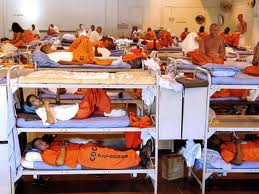
Teaching Tip: Using Prisons to Teach Design Capacity

The Wall Street Journal (June 18-19,2011), of all places, provides a great classroom example on the subject of capacity ( Supp. 7). The context is the California prison system, which was just ordered by the Supreme Court to reduce its prison population to 137% of capacity, citing unsafe overcrowding. Since capacity usually refers to the maximum number of units that can be produced or contained in a specific time (see our definition in Supp.7), it’s hard to comprehend filling a space beyond 100% of that limit.

 But the Journal writes that “the numbers on California’s prison overcrowding were based on its penal system’s design capacity. The state traditionally planned for prisons to hold one inmate per cell. But most facilities doubled their population almost immediately after opening because of a glut of inmates. The state claims that it has recently reduced its prison population to 179% of capacity.

California also measures its prison system by operational capacity, or the number of prisoners who can be housed given actual conditions at prisons. Because of double-bunking, the operational capacity is almost twice the design capacity, meaning the system was able to claim to be only 9% above operational capacity in 2009. (The courts rarely recognize this measure). Adding to the confusion, a 3rd measure, rated capacity, based on fire marshals’ assessments of how many prisoners can be housed safely, is also used in some states.

The prison example provides an interesting contrast to our more traditional discussion of bakery capacity in Example S1.

OM in the News: Capacity Slack is Tightening in US Firms

The Wall Street Journal (May 18,2011) just reported that US companies are putting the production capacity they idled during the recession back to work. Some, like DuPont and GM, have reached the point where they need to invest in new plants and equipment and hire new workers. But The Journal warns that the rising use of capacity can make it easier for companies to raise prices (creating inflation) and can lead to production bottlenecks.

The newest reading shows capacity utilization at around 77%, still well below the 81% reached before the recession hit. But it is up from a low of 67% in June ,2009. During the recession, companies held off replacing old equipment, dismantled some plants–and some, of course, went out of business. The result was a 3% drop in US industrial capacity, only the 2nd time a net reduction has been seen since 1948.

The rise in capacity utilization may prompt companies to expand capacity by investing in new equipment, hiring, and adding new shifts, as GM is doing.

Discussion questions:

1.Why is capacity utilization an important factor in business?

2. Which industries are recovering faster than others?

OM in the News: Bottlenecks in the Intensive Care Unit

The Wall Street Journal (March 28,2011) reports that reengineering  has a big  role to play in the restructuring of Intensive Care Units (ICUs) in hospitals around the country. Many hospitals battle chronic capacity shortages in their ICUs, which are designed to provide constant monitoring and intervention for patients with life-threatening conditions. These critical care beds typically cost $3,000/day, several times what a normal hospital bed costs.

With rising demand and limited resources, bottlenecks in ICUs are often the norm. And they cause backups throughout the hospital. Operating rooms may have to postpone surgeries, and ERs may have to reject trauma victims if there are no ICU beds available.

The article features the Bronx’s Montefiore Medical Center and how it  reengineered its  ICU system. With 300,000  visits annually, the hospital’s emergency room is the 2nd busiest in the US.  But Montefiore is able to get by with only 78 ICU beds (a relatively small number) and claims a 33% lower mortality rate than the average hospital.

The hospital’s makeover included these features:

(1) An update on each patient every 4 hours to see if the ICU patient is really benefitting from ICU care.

(2) Teams of critical-care specialists visit each potential ICU client to determine if they really need ICU level of care. They provide “portable” ICU team coverage anywhere in the hospital if a bed is not available.

(3) Only critical-care doctors tend to patients inside the ICU. This means family doctors are not present (which some families don’t like) but survival rates have increased from 64% to 92%.

(4)  A rapid response team ( a concept pioneered in Australia), is summoned by any hospital staff member who thinks a patient’s condition is deteriorating.

If there was ever an organization in need of OM tools and analysis, of course, it would be hospitals. Hopefully this article will generate good classroom discussion.

Discussion questions:

1. What can ERs do to improve their throughput?

2. Why don’t more hospitals reengineer their ICUs?

Teaching Tip: Computing Break-Even for an Airline Flight

 At what price does an airline break-even when it sells you a ticket to fly from Point A to Point B? It’s an interesting question and makes a good example for covering break-even in Supp.7 (see Figure S7.5).

Fortune  (March 23,2011) just provided an excellent analysis, along with an interactive pie chart that allows you to alter the price of fuel. It takes Delta’s flight from Los Angeles to La Guardia (NY), with a brief layover in Detroit, as its basis. With the average price of a one-way ticket (including 1st class) on this particular flight of $506, Delta was making a $33 profit per ticket in 2010. When fuel was pre-Mideast instability  jitters just a few months ago, $98 of the cost was in that one item, the largest of all costs incurred.

Today, the profit is down to $4! Fortune makes the point that if you fly coach on a competitive route, the carrier is probably in the red. (Hello baggage, pillow, and food fees).

Here is the cost breakdown: Labor ,$95; Plane rent/ownership, $26; Non-plane rents,$17; Nonemployee labor, $32; Payments to partners, $54; Interest, $12; Taxes/fees, $75; Other/misc., $63.

As the flight begins, with a 23 min. boarding time and a 24 min. taxi to the runway, Delta has already spent over $1,000 in labor, fuel, and maintenance. Flying to the layover in Detroit costs $11,674, and getting to the gate another $309.

I think using the interactive fuel price graph makes a point that any flying student will appreciate.