
In operations management, we often talk about efficiency, precision, and human performance. Few industries embody these principles as intensely as Formula One—and nowhere is this more evident than in how teams handle jet lag at the Singapore Grand Prix.
Each year, roughly 3,000 F1 personnel travel halfway around the world for a race that demands peak cognitive and physical performance. Instead of fighting jet lag, they engineer it, writes The Wall Street Journal (Oct. 6, 2026). Their solution is elegantly simple: don’t adjust at all.
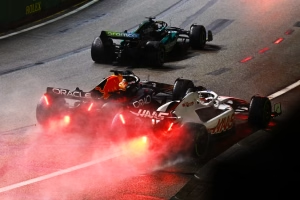 Singapore’s night race creates a unique ergonomic opportunity. Because most European races start in the afternoon, teams can maintain their home‑time schedule even while operating in Southeast Asia. Drivers, engineers, and support crews wake up around 2 p.m. local time, eat “breakfast” in the late afternoon, and work deep into the night. They effectively live in a controlled nocturnal bubble where Europe’s clock rules everything.
This approach isn’t just about comfort—it’s about performance. Racing at 200 mph requires sharp reflexes, stable mood, and predictable cognitive rhythms. By keeping circadian patterns intact, teams avoid the biological confusion that normally accompanies long‑haul travel. As one driver put it, the method is “quite pleasant,” and more importantly, it works.
The ergonomic design extends beyond sleep schedules. F1’s governing body restricts car work to afternoons, preventing overexertion and aligning labor demands with the shifted day. Track sessions are scheduled late to match European TV audiences, reinforcing the shared time illusion. Leaders like Audi’s racing director begin their “day” at 3:30 p.m., collaborate with engineers still in Europe’s daylight, and wind down around 3:30 a.m.
Light exposure—one of the strongest regulators of the human internal clock—is carefully controlled. Teams rely on blackout curtains and avoid sunlight to prevent unwanted circadian shifts. In essence, they create a fully engineered environment where human performance is protected through scheduling discipline.
This year brought a twist: a nearby Malaysian race forced teams briefly onto a daytime schedule before immediately switching back to nights in Singapore. Even F1’s best planners couldn’t fully solve that disruption.
Still, the core lesson stands: ergonomics isn’t just equipment—it’s scheduling. And when designed intentionally, it can turn even jet lag into a competitive advantage.
Classroom discussion questions:
- How can organizations use scheduling and environmental controls (like light exposure or mandated work hours) to improve employee performance during travel or shift work?
- What challenges might everyday businesses face when trying to adopt Formula One–style “time zone anchoring,” and how could they overcome them?