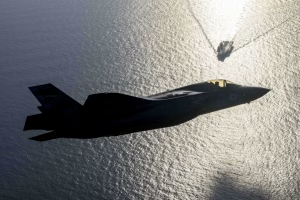
OM in the News: The F-35 Jet Fighter and Supply Chains

The F-35 has contributed to America’s dominance of the arms trade.

The F-35 is a symbol of U.S. military and technological might. With a cost of more than $2 trillion over the program’s life cycle, the F-35 has been called the world’s most expensive weapon, reports The Wall Street Journal (May 6, 2025).

Overall, the jet fighter, made by Lockheed Martin, has more than 1,900 suppliers from about a dozen countries that provide everything from tiny chip boards to the ejector seat. “Like many companies in the industry, our supply chain and customer base are global, and we import raw materials, parts and modules from around the world,” said the CEO of RTX, which makes the fighter’s engines.

The fighter has been a particularly successful export, with more than 1,100 jets sold to 20 countries since it entered service in 2015. The program was partly financed by the U.K., Italy, Norway, the Netherlands, Australia, Canada and Denmark, whose companies then won contracts to supply components. (Foreign governments increasingly seek greater involvement in the production of the U.S. equipment they buy).

British companies contribute about 15% of the value of each aircraft. Much of that is made in Britain. BAE Systems produces one of the plane’s fuselages and the pilot’s control stick in the U.K. Rolls-Royce supplies the technology that allows one variant of the F-35 to take off and land vertically. Even the jet’s ejector seat is made in Britain. Australia provides components for the jet’s avionics and propulsion systems. In Denmark, one company alone—Terma— has made 30,000 parts for the program so far, including pods that hold the machine gun.

The U.S. accounted for 43% of global weapons exports in the five years ended 2024. The U.S. accounted for about 3% of imports.

Classroom discussion questions:

  1. Will tariffs have a major impact on F-35 sales?
  2. What are the plusses and minuses of such global supply chains?

OM in the News: Boeing Has Trouble Finding a Big Parking Lot

“Boeing has a parking problem,” writes The Wall Street Journal (July 22, 2024).  Parts shortages and other issues have left the jet maker with about 200 fully or mostly finished airplanes sitting in airfields, outside plants and in an employee parking lot.  Some of the planes are awaiting interiors; others need engines. Dozens more are awaiting delivery to China.

Unable to fly, the planes aren’t delivering much-needed cash as Boeing burns through more than $1 billion a month.

Unable to fly, the planes present a host of logistical challenges. Planes sitting around too long may need software or other updates. Moving unfinished jets is tricky, especially if the part they are missing is the engine, as is the case with a handful of 777 freighters.

The predicament comes as the jet maker grapples with production slowdowns and regulatory scrutiny in the wake of January’s near catastrophe on an Alaska Airlines flight. Boeing has delivered 175 planes through June of this year, compared with 266 through the first half of 2023.

This isn’t the most dire parking predicament Boeing has faced in recent years. Following the grounding of Boeing’s bestselling 737 MAX due to crashes in 2018 and 2019, the company had about 450 of those planes stashed in its facilities. At another point, it had more than 100 787s parked, which presents a space conundrum given the planes’ size. Currently, there are 10-15 787s awaiting inspections to ensure the planes are built to specification. The company added that step several years ago after employees raised concerns about potential production issues.

“This creates constraints,” one industry expert said. “There is a cost and an operational penalty. It’s something you really want to avoid as much as possible.”  Today, more than half of the parked planes are single-aisle 737 MAX’s still awaiting delivery, some of which are now several years old.

The company says it hasn’t become so tight on space that it has to stop or slow production—what is referred to in the aerospace industry as being “jiglocked.” Supplier shortages, lingering from the supply-chain crisis born amid the pandemic, have saddled the company with planes short of parts.  Shipments of the 787 model have slowed as Boeing grapples with a shortage of cabin seating. Seat suppliers industrywide haven’t been able to keep up with demand for cabin premium offerings, amid material shortages and certification delays.

Classroom discussion questions:

  1. What are the main OM issues facing Boeing today?
  2. Boeing has faced quality issues with its fuselages. What has it recently done to solve this problem?

OM in the News: The Boeing 737 MAX and Reliability

Grounded 737 MAXs

The troubled (and grounded) Boeing 737 MAX, as widely reported, included a new system (MCAS) that automatically deployed when a single sensor detected the danger of a stall. MCAS strongly pushed the nose of the plane down, and pilots could not successfully countermand the activation unless they turned MCAS off. Astoundingly, writes MIT Prof. Arnold Barnett in OR/MS Today (Oct., 2019), “Boeing told airlines nothing about the existence of MCAS, let alone about the procedure to disable it.”  Put bluntly, says Barnett, “MCAS was directly responsible for two fatal crashes, Lion Air Flight 610 in Indonesia and Ethiopian Airlines Flight 302.”

Why did Boeing initially say nothing about MCAS?  The dependence on one sensor violates the principle of redundancy, under which no single failure can cause the loss of the aircraft. Boeing argued that redundancy did exist: the pilots (who were not even told of the existence of MCAS) were the backup system that would disable an improperly deployed MCAS.

There were actually 2 angle-of-attack sensors on the MAX, one of which did not affect MCAS. Boeing devised a cockpit warning light that would come on if the 2 sensors gave highly divergent readings. But a production error meant that the light that was supposedly a standard feature of the MAX could never come on, except when the airline customer bought some optional equipment. Boeing discovered the error in 2017 but did not mention it to airlines until after the first MAX crash a year later.

Now Boeing is fixing the problems with MCAS, with 2 sensors. If one detects a dangerous tilt while the other does not, MCAS will not deploy. But what if the erroneous sensor is the one that says things are normal? More prudent is the policy followed by Airbus, which uses 3 sensors and goes with the majority when there is disagreement. “Given that the feature is standard on Airbus planes,” writes Barnett, “it is far from obvious that having 3 sensors is infeasible or prohibitively expensive.”

Classroom discussion questions:

  1. Which formula in Ch. 17 (Maintenance and Reliability) applies to this issue?
  2.  What impact on airline scheduling is the MAX grounding having?

OM in the News: The 737 MAX’s Supply Chain Disruption

Fuselages under construction at Spirit.

The grounding of Boeing’s 737 MAX is pushing some aerospace supply chains into a slow descent. Some suppliers are reconsidering decisions to keep making parts for the plane at full steam, The Wall Street Journal (June 14, 2019) writes, as inventories swell and a timeline for recertifying the plane remains hazy.

The new look at production highlights the tough economics of shifting gears in big supply chains for high-cost manufacturing operations. The grounding of the 737 MAX is stretching into its fourth month. Suppliers have largely kept pumping out parts, betting the grounding would be relatively short-lived. Some even saw it as a chance to catch their breath after years of blistering deadlines. Stopping and restarting production can be more costly and disruptive than keeping assembly lines humming, even at the expense of building inventories, but the calculation is changing as Boeing’s jet remains in limbo.

German seat maker Recaro initially kept production lines going full throttle but now is dialing back as fewer seats are needed in the short term. CFM International, which makes the MAX’s engines, has so far kept producing at its pre-grounding target rate, but is considering slowing that down. CFM also wants to make sure the company can quickly provide technical support to airlines once the MAX is cleared to fly again. Around 500 MAX planes have been idled. Their engines will need some maintenance from CFM before airlines can use them again.

Spirit AeroSystems, which makes the 737 fuselage, is still building 52 of them a month– matching Boeing’s pre-grounding output for the plane. Boeing has since throttled back to 42 planes a month.  Boeing pays for the parts on delivery, but Spirit is keeping them at storage sites. The large fuselages are lined up outside the company’s Kansas facility. It is storing wing flaps and pylons, used to mount engines, indoors.

Classroom discussion questions:

  1. What are the OM issues involved in this production slowdown?
  2. What is the role of the engine manufacturer in the MAX shutdown and startup?