
The robots are coming for the last human warehouse jobs. Loading and unloading a truck is backbreaking, mind-numbing work that retailers and parcel carriers have tried to solve for years. Workers may not stay long in these jobs. Summers and winters are particularly grueling for anyone stuck in a metal trailer, slinging heavy boxes. Injuries are common.
Automating this process has long been the holy grail of warehouse logistics, writes The Wall Street Journal (June 24, 2025). When loaded, packages must be fitted together to fill the available space and be sorted by weight—with the heaviest items on the bottom—so they don’t topple or break. Unloading them is challenging, too, because the unloader must move in and out of a trailer, ferrying packages of different sizes and weights.
On a typical warehouse floor today, every task might be heavily automated—except for workers loading and unloading the trucks. People who have worked these jobs say they have to stand for extended periods, hefting boxes as heavy as 70 pounds. New advances in robotics are changing that.
Improved sensors and algorithms, advancements in AI and faster image-processing technology are making these robots proficient players in tasks that are like a game of 3-D Tetris. This shifts the burden of physical lifting from humans to robots. Proponents of the technology say it will mean more efficiently packed pallets, fewer damaged items and a lot of time saved. The machine-learning algorithm isn’t aware of what’s inside each package, but does know the item’s weight, approximate center of gravity and how fragile it is.
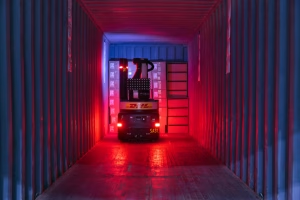
The robot will use the information it has on an item to choose the optimal pallet and determine where the it should be placed to minimize damage, but still allow the highest possible number of boxes to be packed in the given space.
DHL just signed an agreement with Boston Dynamics for 1,000 of these robots. United Parcel Service is also increasing automation at its facilities, including for loading and unloading trailers—a move that will help the company cut costs. FedEx has been testing and refining the truck-loading process in one of its facilities since 2023. Walmart also has introduced robots that can unload a truck.
Classroom discussion questions:
- Why is this an important OM advancement?
- How else are robots now being used in warehouses?
 Temple U. Professor Misty Blessley shares her insights today, on Black Friday.
 Supply chains have stabilized after years of disruption. Thus, core products have been efficiently moved from warehouses to retail locations to ensure availability for traditional retail customers. Additionally, e-commerce channels are poised to efficiently fulfill customer orders. Many retailers are adopting cost-effective delivery strategies tailored to peak shopping events like Black Friday and Cyber Monday. Instead of defaulting to same- or next-day shipping, retailers are spreading deliveries over several days to reduce costs and balance labor.