Guest Post: Omnichannel Operations–Where Technology Meets Retail Strategy

Dr. Prince Vijai is Assistant Professor of Operations at IBS Hyderabad, India. This post is based on his recent presentation at the DSI meeting in Orlando.

In today’s retail world, customers expect a smooth and unified experience across both online and offline channels. This customer expectation has turned omnichannel inventory management into a strategic necessity. By integrating supply chain management, information systems, and analytics, retailers can ensure that products are available where and when customers need them – across stores, warehouses, and digital channels.

Centralized inventory visibility is the key enabler of this unified commerce inventory strategy. Instead of managing separate stock pools, leading retailers maintain a unified view of inventory across all sales channels. This reduces overstocking, prevents stockouts, and supports flexible fulfillment options, such as ship-from-store, click-and-collect, buy online pickup in-store (BOPSIS), and dropshipping.

To achieve this omni-channel inventory visibility, real-time data synchronization is essential. Technologies like Shopify APIs and AWS Lambda update stock levels instantly as purchases occur, ensuring accuracy across systems. NoSQL databases, such as DynamoDB or Firebase, provide the scalability and speed necessary for these continuous updates.

Leading retailers clearly demonstrate the benefits of such integrated omnichannel operations. Zara uses RFID for item-level tracking, enabling rapid replenishment and online fulfillment from its stores. Nike uses a unified commerce platform to synchronize data across its physical and digital channels. Amazon exemplifies data-driven order routing and fulfillment efficiency.

As omnichannel operations mature, the role of the Omnichannel Planner is emerging. This is a professional skilled in analytics, ERP, and API integration who aligns supply with demand across channels. Such expertise ensures a balance between operational efficiency and superior customer experience.

The key omnichannel retail trends include unified commerce integration, adoption of practical generative AI, enhanced inventory visibility, flexible fulfillment options, and personalized in-store experiences. These strategies aim to strike a balance between customer value and operational efficiency, driving agility and competitiveness.

Ultimately, omnichannel inventory management represents more than just logistical coordination – it’s a foundation for business agility and customer satisfaction. Retailers mastering this capability gain a decisive edge in speed, accuracy, and trust in a competitive, data-driven marketplace.

 Classroom Discussion Questions

1.How does real-time data synchronization enhance both customer experience and retailer performance?

2. What future technologies could further improve omnichannel inventory visibility?


Guest Post: Fashion Influencers and Revamping Costly Product Returns


Temple U. Professor Misty Blessley raises an interesting inventory issue–returns.

Fashion influencers and their followers are contributing to the increase in rising product returns. According to the National Retail Federation, returns accounted for 17% of retailers’ total 2024 sales. Online purchases have a 26% return rate compared to in-store purchases (10%). Many online shoppers intentionally buy items they plan to return. Statista reports that clothing (24%), shoes (16%), and accessories (12%) are the most returned products – the exact product footprint of fashion retailers. Several recent articles shed light on the influencer effect and tips for revamping costly product returns in retail fashion. 

Fashion influencers have popularized trends that promote returns behavior:

  1. Hauls: Influencers showcase purchased fashion items, then decide whether to keep or return them based on follower feedback.
  2. Wardrobing: Influencers buy items for temporary use such as content creation and return them afterward.
  3. Bracketing: Influencers buy multiple sizes or colors of a product to find the perfect fit, with the intention of returning the rest. About 58% of consumers buy multiple sizes for this reason, with 75% of returns attributed to fit.
  4. Influencing: 56% of followers make purchases recommended by an influencer, many of which are later returned.

Returns come with significant costs, including shipping, restocking, reselling at a discount, and administrative expenses. Retailers are adopting strategies to curb or better manage returns:

  • Charging return fees: Brands like Zara and H&M now charge for returns.
  • Clarifying return policies: Shortened return windows, stricter conditions for full refunds, and more items marked as final serve to narrow return opportunities.
  • Improving sizing tools: Enhanced size charts, virtual reality fitting tools, and online fitting rooms help shoppers make better choices.
  • Implementing logistics systems: Retailers are investing in digital tools to streamline and manage returns more efficiently.

As discussed in Chapter 1 of your Heizer/Render/Munson textbook, best practice can be achieved when operations and supply chain management, marketing, and finance work together.

Classroom discussion questions:

  1. After 89% of retailers adjusted their policies to deter returns, 59% saw return rates increase. What factors could explain why these policies fail to get the desired result?
  2. The SCOR Model, discussed in Chapter 11, outlines attributes for processes like source, make, and deliver. How are the attributes for returns like or different from these processes?

Guest Post: The Supply Chains Behind a Strong Holiday Shopping Season

Temple U. Professor Misty Blessley shares her insights today, on Black Friday.

The holiday shopping season is in full swing, and companies are optimistic about their year-end financial performance. Operations and supply chain managers have a crucial role. Chapter 1 of your Heizer/Render/Munson textbook explores how marketing and operations management strategies can drive bottom-line results.

Customer spending is expected to be strong this holiday season. The National Retail Federation is forecasting winter holiday sales to rise by 2.5% to 3.5% over last year. Meeting this demand requires retailers to fulfill orders when, where and how customers want. Companies are strategically using both brick-and-mortar stores and e-commerce platforms to appeal to their customers.

Supply chains have stabilized after years of disruption. Thus, core products have been efficiently moved from warehouses to retail locations to ensure availability for traditional retail customers. Additionally, e-commerce channels are poised to efficiently fulfill customer orders. Many retailers are adopting cost-effective delivery strategies tailored to peak shopping events like Black Friday and Cyber Monday. Instead of defaulting to same- or next-day shipping, retailers are spreading deliveries over several days to reduce costs and balance labor.
Amazon bolstered its labor capacity by adding 250,000 seasonal hires. DHL’s CEO explains why spreading deliveries is a viable strategy – extending shipments by just a few days allows companies to control warehouse costs while still meeting customer delivery expectations.

OM and SCM plays a pivotal role in driving both revenue growth and cost efficiency. By offering customers flexibility in choosing their preferred shopping and delivery channels, retailers enhance the customer experience and boost sales. Simultaneously, costs are reduced by managing product delivery.

Classroom discussion questions:
1. In Chapter 6 of your textbook we learn that customer expectations are the standards against which service is judged. What is the effect of exceeding expectations on contribution? (i.e., same or next-day shipping)
2. Aggregate Planning Strategies are covered in Chapter 11. Which strategies are being used by retailers to support this holiday shopping season?

OM in the News: Retailers Check Out Automation

The Cash360 machine now in the back rooms of most of Wal-Mart’s 4,700 U.S. stores.

Shopping is moving online, hourly wages are rising and retail profits are shrinking—a formula that pressures retailers, ranging from Wal-Mart to Tiffany, to find technology that can do the rote labor of retail workers or replace them altogether. “Many U.S. retail jobs are ripe for automation, with 2/3 at high risk of disappearing by 2030,” reports The Wall Street Journal (July 20, 2017).

Self-checkout lanes can replace cashiers. Autonomous vehicles could handle package delivery or warehouse inventory. Even more complex tasks like suggesting what toy or shirt a shopper might want could be handled by a computer with access to a shopper’s buying history, similar to what already happens online today. “The primary predictor for automation is how routine a task is,” says a Citi researcher. “A big issue is that retail is a sizable percentage of the workforce.”

Nearly 16 million people, or 11% of nonfarm U.S. jobs, are in retail. Now, as stores close, these jobs are disappearing. Since January, the U.S. economy has lost about 71,000 retail jobs. Automation is filtering through many parts of retail. Tiffany is using machines to polish jewelry. Home Depot has self-checkouts in most stores and is testing scanner guns for shoppers buying bulky products like lumber.

Wal-Mart has long squeezed efficiency out of its business. Although it employs 1.5 million people in the U.S., it has around 15% fewer workers per sq. ft. of store than a decade ago. Its U.S. stores now have a Cash360 machine, making thousands of positions obsolete. Employees whose task was to count cash and track the accuracy of the store’s books have been replaced by the hulking gray machine that counts 8 bills per second and 3,000 coins a minute–then digitally deposits the money at the bank.

Classroom discussion questions:
1. What other jobs are likely to be replaced by automation in the coming decade?

2. Why is this an OM issue?

OM in the News: Penney’s Turns to the iPad For a Cash Register

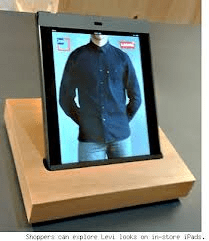
In Chapter 7, Process Strategy, we discuss the impact of new technology and equipment on the customer service experience. USA Today (July 25, 2012) provides a great example to use in class with a front page story that starting this weekend, salespeople in Penney’s new Levi’s shops will use only iPads to check out customers. All of Penney’s 1,100 stores will offer mobile checkout by the end of the year.

More than 6,000 Nordstrom salespeople are already using mobile devices to check people out, just like at Apple stores. “By the end of this year, Nordstrom salespeople will be able to do everything on their handheld devices that they can at a register,” says Jamie Nordstrom, grandson of the chain’s founder. “I believe the future of our point-of-sale systems is completely mobile,” he adds. “It’s hard to know whether it’s in one year or five years because the technology is evolving so rapidly.”

Several grocery stores — Costco and Sam’s Club are two — already use employees armed with mobile devices for “line busting.” The workers scan products for customers standing in lines and print a bar code that they can take to cashiers to pay. Nordstrom salespeople will still be able to make change, but not with the “cash registers of yesterday”. “As long as there is cash, we’ll always be happy to accept cash”, Nordstrom says.

Other stores where customers interact often with salespeople will likely start adopting mobile checkout. “If you go through the whole process of shopping with help along the way, why should you have to stop and be funneled to a line?” says an industry consultant.

Discussion questions:

1. What other technology changes are impacting OM in the retail scene?

2. How does the iPad build flexibility into the store’s operations?