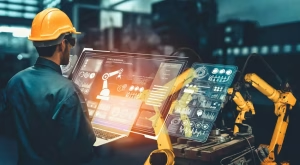
OM in the News: AI’s Big Manufacturing Productivity Gains

The efficiency and productivity improvements AI can deliver through automation and digitalization will help bridge manufacturing’s workforce gap, writes Industry Week (March 13, 2026).

Similar to the PC revolution decades ago, all signs point to AI following suit with enhanced productivity and profitability. Productivity soared when PCs became interconnected across organizations. Manufacturing will see the same breakthrough with “embedded AI”—to help ease workforce bottlenecks with specific solutions. On the shop floor, for example, predictive-maintenance AI (see Chapter 17) can analyze sensor data to forecast equipment failures and avoid labor-sapping downtime.

AI vision systems (Chapter 7) can catch defects on production lines at a pace beyond human capabilities and without the repetition-induced fatigue and employee turnover. Collaborative robots (cobots) and automated mobile robots transport material and can assist with assembly and repetitive operations. AI’s coding capabilities extend to numerical control and other industrial equipment, speeding up setup time and productivity in hard-to-fill technical positions.

The interaction of embedded AI, agent-based AI, and machine learning across different areas of an organization holds the greatest promise in solving long-term labor shortages. AI can already let a customer snap a photo of a damaged part and identify it for replacement. Its real power will manifest when AI can also determine the part’s inventory status and locations, establish shipping terms and timing, add the part to the procurement queue to replenish once it’s sold, alert engineering that a design change for a chronic defect may be in order, and propose alternative designs.

Here is a  current example involving AI across systems: the big  semiconductor company AMD is using generative AI to track down the root cause of delivery delays, simplifying complex supply chain interactions to transform a complex, specialist-dependent, labor-intensive manual process into faster issue resolution and better decision-making. The system cuts the time needed for what was a 14-step process taking 20-30 minutes by 90%, saving more than 3,100 staff hours a year.

Also coming soon to these intelligent product recommendation engines is an ability to parse what can be 50-page tender documents to extract multiple configurable products for sales quotes. That not only saves time, but also enables junior staff to handle work that has previously required experienced hands.

Classroom discussion questions:

  1. What can AI do to improve a procurement system?
  2. What does “embedded AI” mean?

OM in the News: The Megafactory Struggle to Find Workers

The U.S. is experiencing a factory-building boom as companies, burned by overstretched supply chains during the pandemic, reshore some of their operations, writes The Wall Street Journal (Dec. 12, 2023). The U.S. also has given priority to the nation’s semiconductor and EV industries, calling them matters of national security and setting aside billions of dollars in subsidies to aid their growth.

A student at Columbus State Community College studying engineering tech uses a VR headset

U.S. manufacturers have long struggled to find all the employees they need. The coming wave of megafactories, aided public incentives, is pushing the labor shortage into a crisis. The value of new manufacturing construction projects hit a record $102 billion last year, three times higher than 2019’s total. Since 2021, 33 manufacturing projects, most of them related to semiconductors or electric vehicles, have cost $1 billion or more.

More than half of the roughly 115,000 new positions expected to be created by the end of the decade could go unfilled, industry experts project. The anxiety is particularly acute in Central Ohio, where Intel is building two semiconductor plants at a combined cost of more than $20 billion, and Honda and LG Energy Solution are constructing a $3.5 billion electric-vehicle battery plant. The companies aim to hire more than 5,000 workers between them, and local suppliers that will serve the factories likely will need thousands more.

An Intel megafactory construction site in Ohio

Will students be interested? Manufacturers have tried to chip away at negative perceptions through public-awareness campaigns. “This is a different type of manufacturing,” said one 27 year old who shook off bad experiences with a previous factory job. “This is super-educated, specially trained. There’s a lot on the line for this type of work.”

Intel said its manufacturing technicians in the U.S. can earn $50,000 to $90,000 a year.

Classroom discussion questions:

  1. What are your students attitudes towards factory jobs?
  2. Why are these positions different from traditional manufacturing jobs?

Good OM Reading: Supply Chain Trends–2022

Will the supply chain world remain chaotic this year, asks Supply Chain Dive (Feb. 22, 2022)? What about shortages, scarce materials, and delivery expectations? How should companies approach their supply chain strategy in 2022? Here are 7 trends suggested in a new ebook:

TREND #1: LABOR SHORTAGE CONTINUES
The first prediction for 2022 is that the labor shortage in supply chains will continue well into 2022. There’s no area of labor left unturned – be it labor planning, employee retention, labor efficiencies, or robotics. Every strategy and profit impact option must be  rescoped.

TREND #2: NEED FOR REAL-TIME VISIBILITY
Companies are now recognizing the importance of real-time visibility in their supply chain. Disruptions are rampant and costs are soaring. Teams need to be more proactive in the way they handle their processes, people, and products.

TREND #3: RISING VENDOR EXPECTATIONS
Companies are starting to demand more from their vendors in terms of functionality, cost-effectiveness, and reliability. Supply chain teams now need tools that work, use their data in ways that haven’t been done before, and provide a competitive advantage.

TREND #4: DIVERSIFICATION
Companies should be looking at their suppliers and vendors and diversifying across their core product lines. Whether ships are stuck off the coast of LA or there’s a massive demand hike due to consumer behavior that wasn’t forecasted, manufacturers need to be able to source their core materials through other previously developed relationships.

TREND #5: BUILDING RESILIENCE THROUGH ACTIVE COLLABORATION
Teams need to be prepared for anything. Now companies are realizing that all teams (and even customers and partners) having real-time access to the same data helps each perform better.

TREND #6: MORE CONSUMERS WILL EXPECT SUSTAINABLE SUPPLY CHAINS
Consumers are holding corporations more accountable for their environmental footprints. Inefficient supply chains are not only costly, but also hurt the environment more. While the pandemic slowed or stalled many environmental trends in 2020, expect a growing resurgence toward companies investing in building more sustainable processes.

TREND #7: AN ONGOING NEED TO OPTIMIZE WAREHOUSES
Warehouses are expensive to run and maintain. With rising supply chain costs and labor shortages, it has become increasingly important for companies to find new and innovative ways to optimize the warehouse.

Classroom discussion questions:

  1. Which trends are the easiest to address?
  2. How do supply chains become more sustainable? (Hint: see Supp. 5 in your Heizer/Render/Munson text)