OM in the News: AI’s Big Manufacturing Productivity Gains

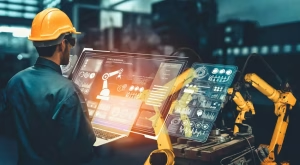
The efficiency and productivity improvements AI can deliver through automation and digitalization will help bridge manufacturing’s workforce gap, writes Industry Week (March 13, 2026).

Similar to the PC revolution decades ago, all signs point to AI following suit with enhanced productivity and profitability. Productivity soared when PCs became interconnected across organizations. Manufacturing will see the same breakthrough with “embedded AI”—to help ease workforce bottlenecks with specific solutions. On the shop floor, for example, predictive-maintenance AI (see Chapter 17) can analyze sensor data to forecast equipment failures and avoid labor-sapping downtime.

AI vision systems (Chapter 7) can catch defects on production lines at a pace beyond human capabilities and without the repetition-induced fatigue and employee turnover. Collaborative robots (cobots) and automated mobile robots transport material and can assist with assembly and repetitive operations. AI’s coding capabilities extend to numerical control and other industrial equipment, speeding up setup time and productivity in hard-to-fill technical positions.

The interaction of embedded AI, agent-based AI, and machine learning across different areas of an organization holds the greatest promise in solving long-term labor shortages. AI can already let a customer snap a photo of a damaged part and identify it for replacement. Its real power will manifest when AI can also determine the part’s inventory status and locations, establish shipping terms and timing, add the part to the procurement queue to replenish once it’s sold, alert engineering that a design change for a chronic defect may be in order, and propose alternative designs.

Here is a  current example involving AI across systems: the big  semiconductor company AMD is using generative AI to track down the root cause of delivery delays, simplifying complex supply chain interactions to transform a complex, specialist-dependent, labor-intensive manual process into faster issue resolution and better decision-making. The system cuts the time needed for what was a 14-step process taking 20-30 minutes by 90%, saving more than 3,100 staff hours a year.

Also coming soon to these intelligent product recommendation engines is an ability to parse what can be 50-page tender documents to extract multiple configurable products for sales quotes. That not only saves time, but also enables junior staff to handle work that has previously required experienced hands.

Classroom discussion questions:

  1. What can AI do to improve a procurement system?
  2. What does “embedded AI” mean?

OM in the News: U.S. Manufacturing Resurgence Will Be Powered by Cobots

Once a luxury reserved for big manufacturers, smaller, smarter, more flexible and less expensive “cobots”—collaborative robots—are bringing automation to every fabricator, no matter the size. The slow, fragile recovery of American goods production wouldn’t be possible without them, writes The Wall Street Journal (Oct. 11-12, 2025).

The number of U.S. companies that make physical things reached a low point in 2014 and has grown since then. Yet they are trapped in a never-ending labor shortage as skilled workers age out, and young people fail to take their place.

China has the greatest number of industrial robots, including these at a factory in Nanjing.

China has become the de facto manufacturer of the world’s goods, owing not only to its enormous population of engineers, technicians and machinists but also its 2-million-plus army of industrial robots. Now the U.S. is attempting to claw back some of those contracts—called “reshoring”—and robots can in some cases quadruple worker output.

The push to bring manufacturing back to the U.S., and the demand for industrial goods to power America’s AI-fueled economy, are driving automation adoption and innovation. “Automation is key to reshoring, plain and simple,” says one CEO.

Cobots have become radically easier to program over the past decade, and now people can use a simple tablet interface to instruct them to perform specific sequences of actions. Programming the older robots common in automotive factories since the 1960s took years of training.

Cobots are part of a broader trend in robotics: Specialized robots that use sensors to safely navigate human environments. They can cope with more variability than previous industrial robots, which had no sensing abilities. This has been essential to the rise of Amazon and its superfast fulfillment, and now it’s coming to manufacturing.

China is indisputably the leader in high-volume manufacturing, and companies that want the biggest volumes of manufactured parts for the lowest possible price continue to send work there. And though many U.S. manufacturers can’t match their Chinese peers in volume, they are competing by using automation to tackle smaller batches of goods under tight deadlines. Manufacturers in the U.S. are now asking how to reshore the making of critical parts.

Classroom discussion questions:

  1. What is a “cobot” and how does it differ from a robot?
  2. Why has China become such a powerful manufacturing hub?

OM in the News: Saks Pairs Robots with Workers

Staff and collaborative robots, or cobots, work together in this Saks warehouse

Seven months after launching its stand-alone e-commerce unit, Saks Fifth Avenue has started shipping online orders from a high-tech Pennsylvania warehouse, deploying dozens of autonomous robots programmed to help workers find Giambattista Valli gowns and Christian Louboutin pumps.

With its robots and new facility, both operated by GXO Logistics, Saks is aiming to keep up with skyrocketing online sales, reports The Wall Street Journal (Oct. 28, 2021). Like many other retailers, Saks has been flooded by stay-at-home shoppers since Covid.

“Advances in robotics, coupled with AI and machine learning capabilities, have created exciting possibilities in automated warehouse design,” said GXO’s CIO. Many of these advances enable fulfillment-center operators to boost efficiency and speed up deliveries, he said. “Technology is enabling greater precision in inventory management. Pairing workers with robots is a winning combination.”

Robots being used by Saks—known as cobots, because they collaborate with human workers—stand 4 feet tall and move about the warehouse on wheels. They are equipped with large computer screens, which are used to display images of items that workers need to gather for an order. The robots rapidly cross-reference incoming orders with a map of product locations in the warehouse and quickly guide workers to the items. From there, workers pick up the items and route them to the appropriate delivery bay.

The system helps move goods through the fulfillment process twice as fast as manual processes alone. That kind of speed will be crucial for online retailers, like Saks, as they gird for what is expected to be a busy holiday shopping season.

The move to the new high-tech facility is part of a broader plan to boost the retailer’s use of advanced digital technology to support an aggressive growth strategy. “We are focused on elevating the entire experience,” said Saks’ VP, “from how customers discover our offering, to how they engage with us, to how the product arrives at their home.”

Over the past 2 years the e-commerce unit’s sales increased 82%. Even as vaccines make it safer to return to physical stores, many customers are sticking to online shopping habits picked up during pandemic lockdowns.

Classroom discussion questions:

  1. How does this warehouse differ from that of an Amazon center? (Hint: see the Global Company Profile for Ch. 12 in your Heizer/Render/Munson text)
  2. Describe the technology used at this Saks facility.


OM in the News: The Rise of the “Cobot”

The holiday hiring frenzy is under way and robots are joining the rush to seasonal jobs, reports The Wall Street Journal (Oct. 29, 2019). Retailers and logistics operators facing a tight labor market are ramping up automation at warehouses for the holidays, when online order volumes can surge tenfold as consumers load up digital shopping carts in the weeks around Thanksgiving and Christmas. To cope, some businesse are ordering up extra fleets of collaborative robots, or “cobots,” that use cameras, lasers and sensors to navigate warehouse aisles and lead workers to the right shelves or to shuttle bins full of products between workstations.

Two Locus Robotics robots at work

France-based Geodis SA is boosting its robotic workforce by 75% to help workers at its U.S. warehouses fulfill fast-fashion orders during the holiday peak. This year the company, which plans to bring on between 6,000 and 7,000 human workers for the holiday period, is placing a total of 281 robot units at 5 locations. XPO Logistics, which is hiring 20,000 humans for the seasonal rush, is advancing its purchase of millions of dollars’ worth of robots the company expects to need next year so it can use them now to manage the spike in e-commerce orders. Locus Robotics said demand for “surge robots” to bolster the armies of seasonal warehouse workers has grown this year, and the company is sending more than 500 of them to its logistics and e-commerce customers.

Although most warehouses still rely largely on people pulling carts or driving forklifts, scarcity of labor and the push for faster delivery are accelerating automation at warehouses. By 2025 about 28% of warehouses globally will deploy commercial robots, compared to around 3% in 2018. The companies are looking for help in the labor-intensive business of storing, sorting and packing goods for shipment, especially around the holidays, when retailers and logistics providers add tens of thousands of extra workers.


Classroom discussion questions:

  1. In what ways can cobots help the logistics industry?
  2.  What exactly is a collaborative robot?

OM in the News: The Rise of the Cobot (Collaborative Robot)


The robotic arm at Mofongo’s Distillery in Holland helps bartenders and draws in curious customers

Robots are moving off the assembly line, writes The Wall Street Journal (June 11,2018). Collaborative robots that work alongside humans—“cobots”—are getting cheaper and easier to program. That is encouraging businesses to put them to work at new tasks in bars, restaurants and clinics. In the Netherlands, a cobot scales a 26-foot-high bar to tap bottles of liquor so that bartenders don’t need to climb ladders. In Japan, a cobot boxes takeout dumplings. In Singapore, robots give soft-tissue massages.

Cobots make up just 5% of the $14 billion industrial-robot market, but sales will jump to 27% of a $33 billion market by 2025 as demand for the robotic arms rises. About 20 manufacturers have started selling such robots in the past decade. Smaller businesses are using more cobots as labor costs rise. Artificial intelligence software is making it easier to teach them repetitive tasks. The latest models are sleeker and safer than their predecessors, which were often confined in cages to protect them from injuring nearby humans. Cobot arms brake when they touch humans, and don’t have “pinch points” that could snag fingers and skin.

“Robots are now crossing the chasm from a niche to a mass market,” said a Credit Suisse expert. He likened the current adoption of robotics to the introduction in the late 1990s of smaller handsets that launched mobile phones into wider use. The slew of newer cobot makers has driven down prices, providing buyers with alternatives that sell for $18,000-$26,000.

Still, cobots can’t do everything a person can. Robots are getting good at repetitive work, freeing up humans for other activities, but have a hard time with more complicated actions.

Classroom discussion questions:

  1. What is the difference between a robot and a cobot?
  2. How are cobots an improvement over traditional industrial robots?