
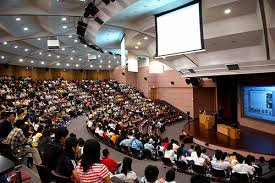
 A recent article about MOOCs, by the American Society of Engineering Education, has interesting implications for those of us interested in flipped teaching or teaching with technology, two big trends in higher education. The 1st conclusion is that teaching MOOCs is not at all like lecturing, even when literally delivering lectures online. Recording a 50 minute lecture for a MOOC will make for an unpopular online course. Teaching to the iPhone generation means that short segments of 6-9 minutes are mandated.
To teach to a diverse audience, “it’s good to have bite-sized content,” advises a Georgia Tech prof who has distilled his topics into short modules and “edu-bytes” of no more than 10 minutes. A Cal-Berkeley prof has reorganized his 90-minute lecture into 8-to-12-minute video segments, or “lecturelets”, each covering a topic with 1-2 self-check questions. Evidence from the field suggests shorter is sweeter. New data from edX, a nonprofit MOOC provider created by MIT and Harvard, for instance, put the optimal length for lecturelets at 6 to 9 minutes. Median viewing time, where half the students watch the entire clip, peaks at 6 minutes, then falls rapidly.
MOOCs require “a huge amount of work,” adds a UC Davis prof who devotes two full days preparing each 60-to 90-minute lecture. To maximize his instruction time, he writes 8 pages covering not only exactly what he will say, including jokes, but what he will draw. It takes 8 hours to record the lecture, stopping, starting, and rewriting as necessary. The editing crew needs 32 hours to synchronize the audio, screen casts, and video into a complete lecture. It takes 5 to 10 hours to produce each hourlong lecture video.
We are all well aware of the need to spark up our lectures, be they in a small class, a lecture hall, or on-line. Jay and I believe our 35 short company videos and many of the exercises we note in this blog (look back to the scores of Teaching Tips posts over the past 3 years) may help create an exciting classroom atmosphere.