
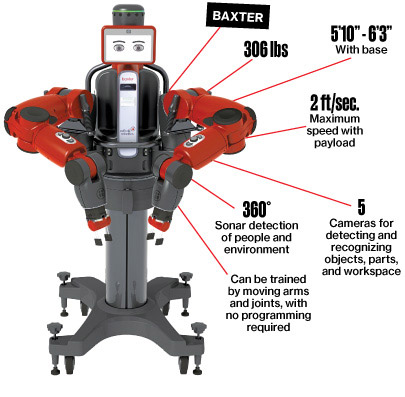
 Robots are always an interesting technology topic in Chapter 7, and the latest Businessweek (Sept. 23-30, 2012) describes Baxter, a super smart robot that Rethink, Inc. believes will spark a manufacturing revolution. The firm hopes the robot, adept at the mindless repetitive tasks common on most assembly lines, can increase the productivity of U.S. manufacturers and help them retain business that would otherwise migrate overseas.
With 5 cameras, a sonar sensor that detects motion 360 degrees around it, and enough intelligence to learn tasks within an hour, Baxter is designed to work safely alongside humans and do simple jobs such as picking items off a conveyor belt. It’s also cheap enough, at $22,000 a unit, so that the investment math works: If Baxter performs 3 years of 8-hour shifts, it’s the equivalent of labor at $4 an hour. “We are spending hundreds of billions of dollars doing this kind of work in China,” says Rethink’s chief technical officer. “We want companies to spend that here, in a way that lets American workers be way more productive.”
Traditional assembly line robots made by companies like ABB in Switzerland and Yaskawa Electric in Japan, which can cost more than $200,000 apiece, do a few things extremely well, such as painting and welding, but require carefully organized and controlled environments. Most wouldn’t know if a human wanders close by, so they are often isolated in cages away from employees. Baxter, though, sits on a gurney and can be set down safely just about anywhere on a factory floor. Its eyes are on a swiveling computer screen and greet any worker who approaches. To teach Baxter a job, a human simply grabs its arms, simulates the desired task, and presses a button to set the pattern.
Discussion questions:
1. How can Baxter change manufacturing?
2. What is Rethink’s plan for the next generation robot?