OM in the News: The Navy’s Project Management Struggle

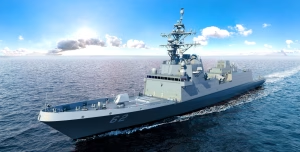
A rendering of what the USS Constellation will look like. The frigate is still under construction.

Managing large projects (see Chapter 3) is usually a difficult task. And this is certainly true in the case of the U.S. Navy’s construction of the new frigate, the USS Constellation. Physical construction of the ship began in mid-2022, and after more than 2½ years, the project is only 10% complete, reports The Wall Street Journal (March 22-23, 2025).

At this pace, including the 2 years of design time before building began, the ship will be completed in a total of 9 years—around twice as long as it took an Italian shipyard to build the vessels it is based on. The Constellation, the first in what is expected of 20 to be built, will cost $600 million more than its original estimate of $1.3 billion.

Most countries are faster at building. Of 20 different frigates made recently or set for completion soon in 10 different countries, all but one were or will be built in less time than the Constellation. (Frigates are the medium-size warships).

The Navy has made so many changes in the Constellation that a ship that was supposed to share 85% of the design of its Italian parent now has just 15% in common. “We have an insatiable demand for capabilities at times…we struggle to say stop,” says a Navy administrator.  More changes came as the building progressed.  The overall changes caused the ship to gain weight, to 10% above the initial plans. That means the Constellation will be slower than the original design for the ship.

U.S. naval shipbuilding has fallen behind in some key metrics. In the 2000s, attack submarines that used to take 6 years to build now take 9, and aircraft carriers that used to take 8 years now require 11. The delays have contributed substantially to massive cost overruns, only 1/3 of which can be attributed to shipbuilding inflation.

The Navy complains U.S. shipyards don’t invest enough in staff and equipment, much of which is decades old, some harking back to before WW2. Shipyards also struggle with labor shortages, especially in the skilled trades.

Classroom discussion questions:

  1. Summarize why U.S. shipbuilding projects do not meet project schedules.
  2. If you were project manager for the Constellation, what might you do differently?

OM in the News: The Navy’s Learning Curve Problem

Huntington Ingalls., the sole U.S. builder of aircraft carriers, continues to fall short of the Navy’s demand to cut labor expenses to stay within an $11.39 billion cost cap mandated by Congress on the second in a new class of warships, reports Industry Week (Aug. 17, 2018). With about 47% of construction complete on the USS John F. Kennedy, the Navy figures show the contractor isn’t yet meeting the goal it negotiated with the service: reducing labor hours by 18% from the first carrier, the USS Gerald Ford, which at $13 billion has become the costliest warship ever. They’re the first two of a planned, 4-vessel, $55 billion program.

USS Gerald R. Ford at Newport News Shipyard

It took about 49 million hours of labor to build the Ford. The Navy’s goal for the Kennedy is to reduce that to about 40 million hours. Huntington Ingalls’s performance “remains stable at approximately 16%” less, said spokesman for the Navy. “Key production milestones and the ship’s preliminary acceptance date remain on track” and there are “ample opportunities for improvement with nearly 4 years until contract delivery and over 70% of assembly work remaining on the vessel.” Navy officials have cited what they describe as progress on the Kennedy as one justification for buying the 3rd and 4th Ford-class carriers under a single contract.

The Navy assesses that, although difficult, the shipbuilder can still attain the 18% reduction goal, said a spokesman. The Navy Secretary, who’s been closely monitoring the carrier program, said that Huntington Ingalls has been on “an impressive learning curve” in reducing labor costs. But a director with the GAO, who monitors Navy shipbuilding, said “with so much of the program underway, it is unlikely that the Navy will regain efficiency. In later phases of a shipbuilding contract, performance typically degrades, not improves.”

Classroom discussion questions:

  1. Why are learning curves so important in ship construction?
  2. What learning curve is the goal? What is the current rate?