OM in the News: What is a a “Monster Train”?

As we note in Chapter 11 (Supply Chain Management), railroads in the U.S. ship 40% of the ton-miles of all commodities, including 93% of all coal, 57% of cereal grains, and 52% of basic chemicals. But freight trains are getting longer—some of them 3 miles or more—and that is making life unpleasant in states like Texas. Sprawling rail yards, like those of Union Pacific in Houston, assemble trains that can pull hundreds of railcars that regularly cut off local roads for residents.
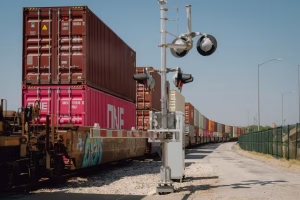
In Fort Worth, Texas, the fire department sometimes sends two trucks from different directions in case there is a blocked crossing

Railroaders call them monster trains. Railroad firms are making trains longer because they generate higher profits, allowing the companies to haul goods with fewer locomotives and fewer crew. writes The Wall Street Journal (Sept. 16, 2024).  Long trains are typically slower, so drivers must wait longer for them to pass. When these trains stop moving, things get worse. School buses, ambulances and firetrucks are delayed. Pedestrians and cyclists clamber under or between train cars to get across—and the results can be deadly.

Blocked crossings in Texas and elsewhere have become a more frequent occurrence. There are no federal limits on train length.  More than a dozen states, including Texas, have introduced bills to limit train length to 1.6 miles, but states can’t enforce them because they are barred from interfering with interstate commerce.

At Union Pacific, which gets the most complaints for blocked crossings, trains can reach around 20,000 feet, or 3.8 miles. Railroads, says Union Pacific’s CEO, seek to balance safety, customer demand, efficiency and the trains’ impact on communities. For his customers to beat competitors, he must maximize efficiency, he adds. “That’s the way I look at it. It’s business.”

Railroads also say the use of long trains reduces the emission of greenhouse gases. Labor unions, though, say long trains increase safety hazards and threaten their jobs.  A 3-mile train traveling at 25 miles an hour takes 7 minutes and 12 seconds to clear a crossing, plus 20 seconds for the gate warning. And monster trains also often come apart, causing crews to take a 1/2 hour to walk their length and recouple them.

Houston is the city hardest hit by blocked crossings in the country. “People can’t get to work on time in the mornings or get back home in the evenings”, says a City Council member.

Classroom discussion questions:

  1. Since trains are a backbone of shipping systems, what can be done to improve efficiency?
  2. Have you had an experience like that of Texas residents?

OM in the News: Bullet Trains and Freight Trains

 Japan Railway’s maglev train set a speed record when it hit 366 mph near Mt. Fuji
Japan Railway’s maglev train set a speed record when it hit 366 mph near Mt. Fuji

Fortune‘s latest issue (June 15, 2015) contains two separate articles that tie together our discussion of railroads in Chapter 11, Supply Chain Management. The contrast between bullet trains and freight trains in the U.S. is evident. The 1st article, “Super Fast Trains on a Roll Globally”, notes that over the past decade, China has built the world’s biggest high-speed-train network, with some 6,900 miles of track. Since the service was first launched in 2007, the number of passengers riding each day has risen from 237,000 to 2.5 million. To give you an idea of the scale, China is investing more than $128 billion in domestic railway construction in 2015–adding another 4,700 miles of passenger tracks this year alone. By comparison, the U.S. invests $1.4 billion annually in Amtrak. Amtrak’s Acela Express is America’s fastest train, yet its average speed is only 68 mph on the trip between Boston and Washington, D.C.  The train does hit 150 mph along a few stretches of straight track.

In contrast, America’s freight rail industry is flourishing. The 2nd article, “Profit Engines on the Rails,”  describes the 153-year-old Union Pacific, which is beating almost every other industrial company in the Fortune 500. The old-economy warhorse generates profits at a rate that rivals those of the best tech, pharmaceutical, and financial services companies. There are 3 reasons. First, Union Pacific’s central tenet is network planning, which mean that every outlay for new track, locomotives, or terminals must yield a return of at least 15%.

Union Pacific's dispatch center in Omaha, where workers direct as many as 1,000 trains per day across 23 states
Union Pacific’s dispatch center in Omaha, where workers direct as many as 1,000 trains per day across 23 states

Second, the railroad enjoys a big, and growing, cost advantage over trucks for long-haul shipments. Third, Union Pacific is an expert at constantly, relentlessly improving its efficiency. In a hugely capital-intensive business, that means increasing its volumes of freight far faster than it adds new employees, locomotives, and boxcars. Its capital expenditure has almost doubled, from $2.2 billion in 2006 to $4.2 billion in 2015.

Classroom discussion questions:

1. Why is the railway industry important to operations management?

2. What are the advantages and disadvantages of shipping by railroad vs. air, trucking, and water?

Existing miles of high-speed rail
China Europe Japan U.S.
6,917 miles 4,699 miles 1,655 miles 456 miles

OM in the News: Union Pacific R.R. in a High-Tech Economy

“Can a 150-year-old company be part of the modern economy,” asks Fortune (Oct.29, 2012). Apparently so. Union Pacific, America’s largest railroad, touches all parts of the economy, even globally — 30% to 40% of its shipments originate or terminate outside the U.S. In its intermodal business, where it takes containers off trucks and put them on the railroad, it had a record year– a bellwether measure for what’s happening in the economy.

Union Pacific has also started moving shale oil by rail– 2 or 3 times faster than a pipeline (and able to come out wherever companies want it). In 2010 it moved 4,400 carloads of crude oil. In 2011 it was 25,000, and 2012 will be 140,000. CEO Jack Koraleski’s take is: “If the United States can convince manufacturers that low energy prices are here to stay, then all of a sudden the U.S. starts to look a lot more attractive as a place to build that next plant. We’ve already seen manufacturers announce that they’re bringing some manufacturing back to the U.S.”

With 8,000 locomotives pulling hundreds of thousands of cars over 32,000 miles of track, Union Pacific is also an infotech company. Technology controls the movement and safety of the trains. There are 4,000 pieces of detection equipment throughout the network. As trains go over, they’re measuring the temperature of the bearings, the impact of the car as it rides on the rail and whether there’s a bump to it, the sound of the wheels on the rail for anomalies and patterns–all part of predictive maintenance on when to pull that car out and have it inspected.

Union Pacific has also tried to move up in its customer supply chain. With Shipment Vision,  Chrysler assigns a car a VIN on a manufacturing line, then Union Pacific tracks and controls that vehicle all the way to the showroom. The railroad takes technology it uses to control trains and gives it to customers to help them control their supply chain more effectively.

Discussion questions:

1. Why are railroads critical to the OM function in many firms?

2. Why has Union Pacific moved into the infotech sector?