
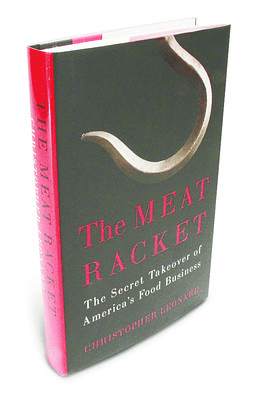
 Tyson Foods is now the largest meat-producing company in the world, the leading member of an “oligarchy” of companies whose hold on the American meat industry Christopher Leonard examines in his gripping The Meat Racket. Mr. Leonard’s focus isn’t the treatment of animals in factory farms; nor is it taste or quality, although some unpleasant facts emerge. He is primarily concerned, writes The New York Times (March 13, 2014), with how these corporations gained control of the business from farm to table. The 95% of Americans who eat chicken, he contends, support a system that “keeps farmers in a state of indebted servitude, living like modern-day sharecroppers on the ragged edge of bankruptcy.” Many chicken farmers don’t even own the chickens they raise.
As Tyson expanded, it would take over all the businesses that used to make up a small-town economy. “It owns the feed mill, the slaughterhouse, and the hatchery. It owns the trucking line and the food-processing plant where raw meat is packaged and cooked into ready-to-eat meals.” This system has “provided tremendous benefit to American consumers,” Leonard acknowledges. Chickens grow bigger faster, even while eating less feed, and meat has gotten much cheaper. Between 1955 and 1982, the time it took to raise a chicken dropped to 52 days from 73.
After pioneering their model in the poultry business—and, to their triumph, getting the chicken McNugget on the menu at McDonald’s, Tyson set out to “chickenize” first the hog and now the cattle business. It has faced fierce resistance in the latter, but its practices still help set the standard for the entire industry. Tyson was one of the first companies to use a growth hormone called Zilmax, which causes cattle to put on weight with astounding results. “The animals blow up like muscled balloons,” Leonard writes, adding that the hormone also makes the meat leaner and cheaper to produce—in other words “more like chicken.” Tyson stopped using Zilmax last year after critics raised concerns that cows were becoming paralyzed. (Chickens are bred to grow huge breasts so as adults they can barely breathe or stand).
The ethics involved in the industry makes for a good class discussion in a number of text chapters.