OM in the News: Boeing’s Supply Chain Takes a Hit

Grounder 737 MAX planes

Boeing sits atop a chain of more than 16,000 suppliers. These companies, making parts for Boeing jets, are shrinking rapidly in the wake of the travel downturn, writes The Wall Street Journal (Aug. 13, 2020). U.S. aerospace manufacturers have already shed more than 100,000 jobs since the start of the year, with the pandemic adding to existing pressures from the sharply reduced production of the still-grounded 737 MAX jet. The biggest supplier on the MAX program, Spirit AeroSystems (which makes fuselages), is cutting 8,000 jobs, around 40% of its commercial aerospace workforce. GE is shedding 13,000 from its aviation unit.

In addition to the MAX, the Boeing supply chain is taking other hits. The overall production of new jets has declined, and the big drop in flying—a 1/3 of the global fleet remains grounded—has reduced demand for spares and improvements such as new seats. The reduced workload comes as companies had invested in new equipment and hiring to support higher jet production and the steady rise in airline passengers, only for the pandemic to render their business plans irrelevant.

Boeing forecast that it would produce 240 planes this year, 2/3 lower than in 2019, and has had to twice reduce that forecast downward. It delivered just 4 jets in July and is producing only a dozen MAX a month, down 36 from a year ago. Before the pandemic, Boeing was supporting suppliers by ordering more parts than it needed and stockpiling them ahead of a planned increase in MAX production. That acceleration has failed to materialize so it has slowed orders.

Raytheon won’t start shipping parts for new MAX jets until the second half of next year. Safran, which also makes Boeing engines, said its commercial sales fell 66% last quarter. “We have a concern regarding the future of some of our suppliers and subcontractors because they are in crisis, too,” Safran’s CEO stated.

Classroom discussion questions:

  1. What supply chain dangers is Boeing facing?
  2. What can it do at this point?


OM in the News: Airbus Outgrows its European Supply Chain

Since it was cobbled together from a passel of national aerospace groups a half-century ago, Airbus has spread its operations across Europe in a delicate effort aimed at maximizing political expediency without sacrificing too much economic efficiency. There’s little industrial logic, after all, in shuttling airplane parts among 14 factories in a half-dozen countries, with some wing components crossing the English Channel 9 times before being mounted on planes.

The company’s airliner business employs more than 53,000 people across Europe, reports Businessweek (Feb. 12, 2018). And of the 11,000 passenger jets Airbus has built since it was founded in 1970, all but 400 have come out of the region’s factories. Europe, however, accounts for fewer than 1 in 5 planes in Airbus’s order book, and China, the U.S., and other countries are clamoring for a bigger share of production. A decade ago Airbus opened a plant in China, that’s expected to make 6 planes monthly by 2020, up from 4 now. Production is also ramping up at a factory in Alabama that’s been building Airbus single-aisle planes since 2015.

Airbus already has a global network of suppliers, ranging from Kansas-based Spirit AeroSystems, which produces the central fuselage of the A350, to a Korean Air Group that makes wingtip devices for the A330 widebody, to China’s Xi’an Aircraft, which manufactures wings for planes assembled at the Chinese plant. All told, Airbus has some 12,000 subcontractors in more than 40 countries from Finland to Sri Lanka.

As we note in the Global Company Profile that opens Chapter 2, Boeing also relies on vendors around the globe. The 787 Dreamliner, the first all-composite aircraft, uses components from such far-flung places as Japan and Italy, part of a plan to spread the manufacturing risk among partners.

Classroom discussion questions:

  1. Why is the aerospace supply chain so complex?
  2. What are the advantages and disadvantages of this approach?

OM in the News: The Global Supply Chain for China’s New C919 Jet

More than 1,000 flights took off or landed at Shanghai’s vast airport on May 5, 2017, but one marked the beginning of a new era in the aviation business. After years of delays, the nation’s first modern large jet, the 174 passenger C919, made its maiden flight. The C919 brings its manufacturer, Comac, in head-to-head competition with Boeing’s ubiquitous 737 and Airbus’s A320. China is making its boldest attempt yet to break the stranglehold that these two giants have on the market for big commercial airliners.

“Behind the celebrations of a Made-in-China jet is the reality that Comac was able to build its new plane using a string of Western suppliers,” writes Businessweek (May 8, 2107). At least 15 foreign partners such as GE, Safran, and Honeywell worked on components and systems of the C919. Tapping into the supply chains of Airbus and Boeing allowed Comac to bypass many of the technical challenges of making a modern commercial jet from scratch and built up the company’s expertise for future designs. Companies based outside China supply C919 systems for flight control, power, lighting, cockpit control and much more. The engines and landing gear are also from overseas manufacturers.

China will need over 6,800 aircraft valued at more than $1 trillion through 2035, and 3/4 of them will be single-aisle planes. The country’s largest carrier, China Southern Airlines, had ordered more than $15 billion of new aircraft from Airbus and Boeing since 2015. So the C919 should be a game-changer for China’s aerospace industry.

Classroom discussion questions:

1.What is Boeing doing to respond to the C919 threat?

2.Describe the new jet’s supply chain.


OM in the News: Cluster Analysis in the Mojave Desert

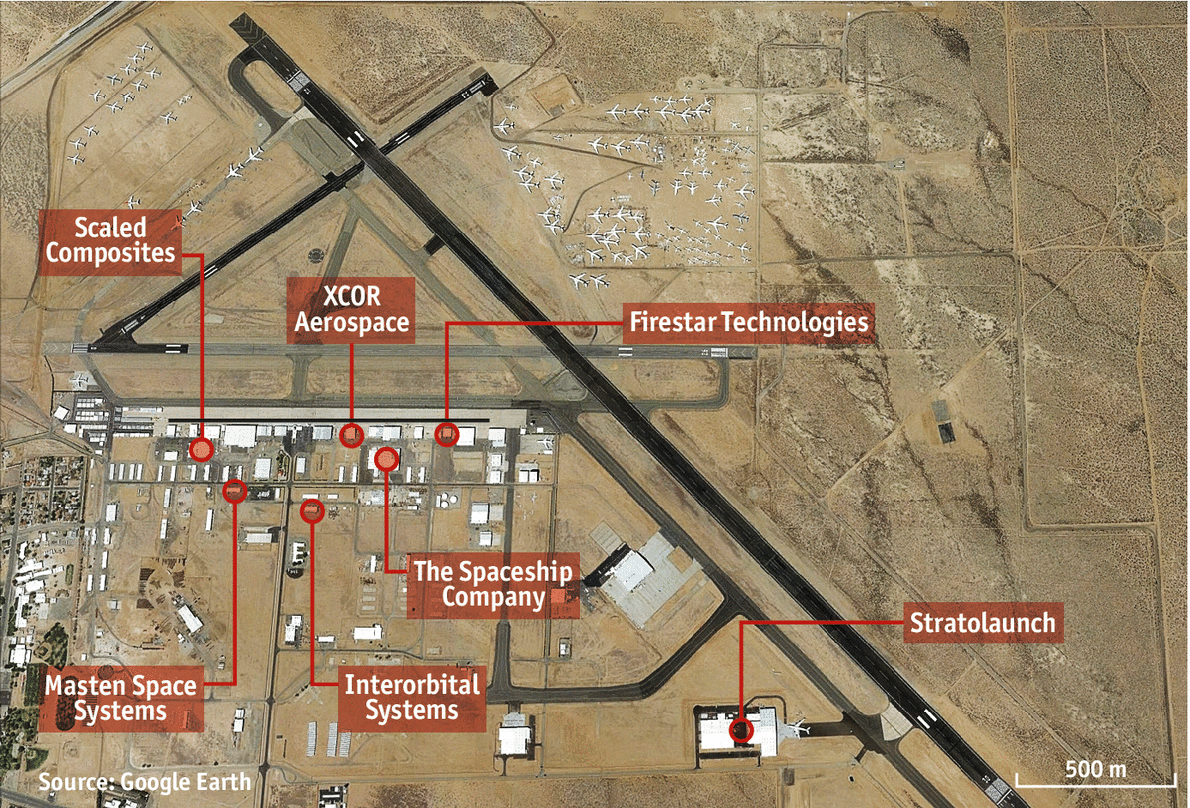
Cluster of 17 "New Space" companies in Mojave Desert
Cluster of 17 “New Space” companies in Mojave Desert

IT BEGAN with a boom. In 1947, Chuck Yeager became the first man to break the sound barrier. He flew from Edwards Air Force Base in the Mojave Desert, America’s main center for experimental military flights. This base was out-of-the-way of prying eyes and surrounded by landscape into which a crash (and there were many) would not inconvenience anyone. Now, reports The Economist (Dec.21,2013-Jan. 4, 2014), the Mojave Desert is emerging as the site of a cluster of what has come to be known as New Space.

The center of activity is 20 miles from Edwards, around the Mohave civilian airfield, now dubbed the Mojave Air and Space Port (see photo). Today, 17 rocket and space-related companies operate in the Air and Space Port. Most hope to make their money from launching satellites. Two, though, plan to enter the trade of taking tourists into space. Scaled Composites has designed and built SpaceShipTwo, a rocket plane intended to carry paying passengers to 100km above Earth using a hybrid rocket engine. Competitor XCOR’s vehicle, Lynx, plans to fly this year.  It, too, is a rocket plane, but is designed to take off from a runway under its own power.

Stratolaunch Systems proposes to take the air-launched-rocket principle and push it to the limit.  Orbital Sciences makes an air-launched rocket, Pegasus, which is used to put satellites into orbit, and the firm also has a contract to resupply the International Space Station. Firestar Technologies is developing a liquid fuel that requires only one tank and no complicated mixing mechanism in the motor, which simplifies engineering. Interorbital Systems is designing small, cheap rockets that can be strapped together in bundles, using as many as are necessary to lift a given payload into orbit.

Mojave is the U.S.’s latest technology cluster (which we discuss in Chapter 8, Location Analysis–see Table 8.3), with firms both competing and collaborating, and a mixture of large and small companies.

Classroom discussion questions:

1. How is this location cluster similar to other high-tech clusters? Different?

2. Why do these firms choose to be near one another?

OM in the News: The Explosion of 3D Printing at GE

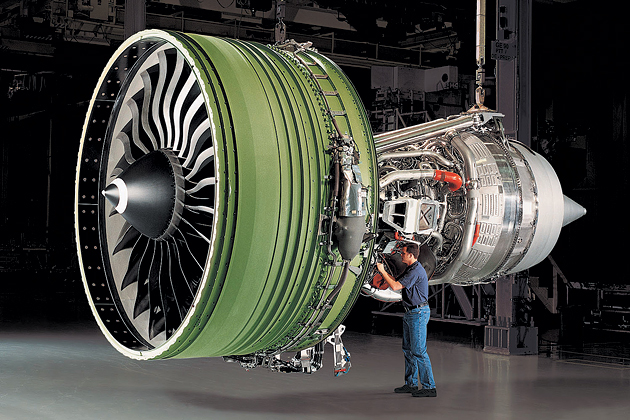
GE produces one of the world's most powerful engines
GE produces one of the world’s most powerful engines

GE, on the hunt for ways to build more than 85,000 fuel nozzles for its new Leap jet engines, is making a big investment in 3D printing, reports BusinessWeek (Dec. 2-8, 2013). Usually the nozzles are assembled from 20 different parts. Also known as additive manufacturing, 3D printing can create the units in one metal piece, through a successive layering of materials. The process, discussed in Chapter 5,  is more efficient and can be used to create designs that can’t be made using traditional techniques. The finished product is stronger and lighter than those made on the assembly line and can withstand the extreme temperatures (up to 2,400F) inside an engine. There’s just one problem: today’s industrial 3D printers don’t have enough capacity to handle GE’s production needs.

“With today’s technology, it would take too many machines,” as many as 60 to 70, to efficiently make the nozzles, says GE. As part of a $3.5 billion investment in its aerospace supply chain, GE will spend tens of millions of dollars to invest in new technology and, over the next five years, triple the size of its 70-person 3D-printing staff and expand its factory floor fourfold.

The company’s embrace of 3D printing throws the weight of the world’s largest jet-engine maker behind the technology. Today, Boeing uses the process to make plastic air-conditioning ducts for its 787 jet, and Nike has a football cleat made on 3D printers. But “GE’s investment changes everything, and it’s also unprecedented,” says an industry expert. Expanding 3D printing will give GE clout with manufacturers, an opportunity to guide the growth of the industry. “There doesn’t exist a supply chain out there right now for this kind of work,” a GE VP says. “GE has to be involved in developing it.”

Classroom discussion questions:

1. What are the advantages and disadvantages to GE’s push for 3D?

2. What role does OM play in introducing 3D printing into manufacturing firms?