Guest Post: The Importance of Shelter Location in Disaster Management

Amir Hossein Moadab is receiving his PhD at Washington State U., under the tutelage of Dr. Chuck Munson.

In late September 2024, Hurricane Helene devastated parts of the southeastern U.S., with Florida and the Carolinas suffering the greatest impact. The storm resulted in over 250 fatalities and displaced tens of thousands. Alongside other disasters such as the increasingly frequent California wildfires, this event highlights a critical question: if we can’t prevent disasters, how can we reduce their impact? One of the most important parts of disaster preparedness and response is figuring out where to locate emergency shelters, a decision that can significantly influence survival rates, response speed, and fair access to resources for everyone affected.

Shelter location isn’t just about choosing a convenient spot on a map; it’s a complex decision that involves balancing accessibility, capacity, existing infrastructure, and the needs of the community. In a real emergency, roads might be blocked, public transportation may shut down, and people with disabilities or no access to private vehicles face even bigger challenges. Overcrowded or under-equipped shelters slow things down and make it harder to meet people’s basic needs, especially for vulnerable populations.

To make shelters more effective, planners increasingly turn to social vulnerability indices (SVIs), which use demographic and socioeconomic data (like age, income, disability status, and housing conditions) to identify communities most at risk. Placing shelters closer to these communities helps ensure people can get to safety quickly. Turning that insight into action means using various planning tools and optimization models to figure out the best shelter locations.

The main methods used include: (1) models which aim to reach the largest number of people within a certain response time, (2) models which help reduce the average or maximum distance people must travel to reach a shelter, (3) models that prepare for unpredictable disruptions like blocked roads or power outages, and (4) optimization models that balance that cost, equity, and accessibility.

In the U.S., FEMA plays a leading role in this process. FEMA uses geographic tools like GIS, hazard maps, and community risk profiles to help states and cities decide where shelters should go, aiming to make them reachable, practical, and equitable. Shelter planning isn’t just a technical task, it’s ultimately about people. Done right, shelter planning saves lives, eases suffering, and builds trust. 

Classroom Discussion Questions:

  1. What are the most important key success factors in determining shelter locations during a disaster?
  2. How do disruptions affect shelter planning decisions, and how can models account for these uncertainties?

OM in the News: The Growing Cluster of High-Tech Talent

Seattle is one of 5 metro areas that have attracted the lion’s share of the nation’s tech talent

The forces that are driving the nation’s top technology talent to just a handful of cities have intensified in recent years, leaving much of the nation behind as the U.S. becomes a more digital economy, reports The Wall Street Journal (Dec. 13, 2019). Just five metropolitan areas—Boston; San Diego; San Francisco; Seattle; and San Jose—accounted for 90% of all U.S. high-tech job growth between 2005 to 2017.

The nation’s 377 other metro areas accounted for 10% of the 256,063 jobs created during that period in 13 high-tech industries such as software publishing, pharmaceutical manufacturing and semiconductor production. Among the smaller cities that gained tech jobs were Madison, Wis.; Albany, N.Y.; Provo, Utah; and Pittsburgh. The result is increased concentration of high-tech resources in just a few places and a strengthening of economic forces that are dividing the nation.

Tech industries find they are most productive when they have resources clustered in few places, a topic discussed in Chapter 8 of your Heizer/Render/Munson OM text. Such clustering allows for the fast spread of new ideas and a concentrated talent pool from which businesses recruit. But the concept runs counter to the idea that technology might allow people to work from anywhere, even in remote places.

The trend is creating problems for the cities that have these concentrations of workers and for those places that don’t. San Francisco and Boston are becoming increasingly unaffordable as home prices soar, while cities outside of these high-tech hubs are missing out on the dynamism that technology creates. “The superstar places are becoming extremely expensive, choked with traffic and struggling with big social costs like inequality gone wild and homelessness,” said a researcher studying the issue.

Some big cities were left behind. Combined, the Washington, D.C. area; Dallas; Philadelphia; Chicago; and L.A. lost more than 45,000 high-tech jobs between 2005 and 2017.  Many small cities across the heartland also lost tech jobs.

Classroom discussion questions:

  1. What are some other clusters besides tech talent?
  2. What does it take to create a tech cluster?

OM in the News: Can the Incentive Wars End?

State Line Road is the 12 mile north-south street that divides the part of the region between Kansas and Missour

States and local governments spend $45 billion annually on various economic subsidies for businesses. Concerns have mounted in recent years about the wisdom of competing for business using tax incentives. Research has shown that economic incentives make little difference in where a company ultimately chooses to locate. Despite that, localities can end up engaging in bidding wars, pushing up the cost of new jobs.

Now Kansas and Missouri are nearing a truce in an economic border war that has cost hundreds of millions of dollars and created barely any new jobs, writes The Wall Street Journal (June 26, 2019). The neighboring states would agree to cease using one of the most popular tools in the economic-development toolbox: lucrative tax breaks in exchange for a promise of investment and jobs. Politicians regularly tout the number of new jobs created under such programs.

Companies in the Kansas City region have long been able to take advantage of its unique geography, where the Kansas and Missouri border runs right through the metropolitan area. Companies could receive tax incentives for moving from one side of town to another, even if they just moved jobs from one spot to the other and didn’t create net new jobs.

Since 2011, 5,526 jobs have moved from the Kansas side to the Missouri side, with Missouri paying $151 million. In that same period, 6,729 existing jobs moved from the Missouri side to Kansas for a cost of $184 million. In total, $335 million has been spent on such company relocations. Can the Kansas City truce work elsewhere? “There are opportunities for broader regions to work together,” said one local CEO. “But at the end of the day, people want to attract companies and jobs and prosperity for the part of the country they’re responsible for.”

Classroom discussion questions:

  1. Suggestions for solving this thorny problem?
  2. Discuss some of the recent massive location incentive packages.

OM in the News: When the Location Incentives are in the Billions

The incentives offered by Wisconsin and its municipalities to Taiwan’s Foxconn Technology Group since it announced a $10 billion megaplant in the state have gone up by nearly $1 billion, writes The Wall Street Journal (June 29, 2018).The company broke ground this week, almost a year after the deal was announced as a success in the president’s efforts to bring manufacturing jobs back to America. The Apple  supplier promised to open a 20 million-square-foot complex that would build liquid-crystal display panels and committed to creating 13,000 jobs in the state.

Foxconn Chairman Terry Gou with President  Trump at the signing

In return, Wisconsin offered $3 billion in financial incentives. In an effort to land the plant, municipalities added their own sweeteners. The town and the county where the facility will be built offered a $764 million incentive package. And Wisconsin added another $134 million to the tab to improve state highways and local roads in the area around the Foxconn site. The state is on the hook for 40% of the public bonds that finance the local expenses if the project flops. If all goes well, Wisconsin taxpayers would recoup the investment in the 2042.

Ballooning costs underscore how expensive and unpredictable such projects can become for states and cities eager to attract new investments and jobs. Currently 20 states and cities are vying to win Amazon’s second headquarters, which promises a $5 billion investment and 50,000 well-paying jobs. New Jersey and the city of Newark have offered as much as $7 billion in tax incentives, while Maryland has offered $5 billion. But unexpected costs can often creep up with large projects that receive money from multiple government entities.

A professor at the University of Texas said negotiating a state deal separately from a local deal is particularly “bad practice.” It can put pressure on a locality to offer a large incentive package and also pits local communities against each other after the state has already had its own bidding war with other states.

Classroom discussion questions:

  1. What would be a better way to provide incentives from the government point-of-view?
  2. Provide an example of how massive incentives have, indeed, paid off in the past.

OM in the News: The Financial Secrecy Index

The latest Financial Secrecy Index (published by Transparency International on Jan. 30, 2018) ranks countries according to their secrecy and the scale of their offshore financial activities. Politically neutral, it is a potential location analysis tool for understanding global financial secrecy, secrecy jurisdictions, and illicit financial flows or capital flight.

From $21 to $32 trillion of private financial wealth is located, untaxed or lightly taxed, in secrecy jurisdictions (better known as “tax havens”) around the world. These countries use secrecy to attract illegitimate financial flows. Illicit cross-border financial flows are estimated at $1-1.6 trillion per year: dwarfing the $135 billion in global foreign aid.

Since the 1970s African countries alone have lost over $1 trillion in capital flight, while combined external debts are less than $200 billion. So Africa is a major net creditor to the world – but its assets are in the hands of a wealthy élite, protected by offshore secrecy. Yet all rich countries suffer too. For example, Greece, Italy and Portugal have been brought to their knees partly by decades of tax evasion and state looting via offshore secrecy.

In identifying the most important providers of international financial secrecy, the Financial Secrecy Index (FSI) reveals that traditional stereotypes of tax havens are misconceived. The most important providers of financial secrecy harboring looted assets are mostly not small, palm-fringed islands as many suppose, but some of the world’s biggest and wealthiest OECD countries. The top 7 FSI offenders ranked are: Switzerland, U.S., Cayman Islands, Hong Kong, Singapore, Luxembourg, and Germany. Click here for the full 2018 rankings of 112 countries.

The only realistic way to address these problems is by directly confronting offshore secrecy and the global infrastructure that creates it. A first step is to identify as accurately as possible the countries that make it their business to provide offshore secrecy. This is what the FSI does.

Classroom discussion questions:

  1. How does FSI differ from the two location analysis index tools in Tables 8.1 and 8.2?
  2. Explain the meaning and purpose of FSI.

OM in the News: When Wal-Mart Closes Shop

Wal-Mart’s presence in Winnsboro, S.C., a town of about 3,500 people, influenced almost every wrinkle of local business since opening in 1998.
Wal-Mart’s presence in Winnsboro, S.C., a town of about 3,500 people, influenced almost every wrinkle of local business since opening.

The arrival of a Wal-Mart Supercenter in small towns throughout the U.S. often drove out smaller stores that couldn’t compete with its selection and pricing, reports The Wall Street Journal (Jan.27, 2016). And it was no different when the giant chain opened in Winnsboro, S.C. in 1998. It was the town’s biggest employer and 2/3 of the town’s sales tax came from Wal-Mart purchases, which allowed residents to avoid paying property tax.

The Winnsboro location is one of 154 U.S. outlets Wal-Mart shut this week, the first time it has closed more than a handful of domestic stores at once. It is also one of 12 Supercenters, the roughly 180,000 square-foot discount outlets that fueled Wal-Mart’s growth for decades, being closed. But when Wal-Mart opened the store in that town, it fell in line with the company’s longtime real estate strategy of opening in rural, often overlooked areas outside of city centers. Winnsboro sits about 30 miles north of Columbia, S.C., the largest city in the state.

“We never planned on actually going into the cities. What we did instead was build our stores in a ring around a city—pretty far out—and wait for the growth to come to us. That strategy worked practically everywhere,” wrote Wal-Mart founder Sam Walton in his 1992 autobiography. But population growth flowed east and west of Columbia, not north to Winnsboro. Locals say they hope Wal-Mart’s exit will leave room for smaller businesses to thrive again. Town officials are already soliciting grocery store companies and encouraging the few remaining downtown businesses to stock a wider variety of products.

Classroom discussion questions:

  1. Evaluate Wal-Mart’s location strategy under Sam Walton.
  2. What were the advantages and disadvantages of a Wal-Mart entering a small town?

Good OM Reading: An Analysis of State-Provided Benefits in Location Decisions

Competing for businesses by offering companies targeted benefits is a popular policy among the governments of American states. As we discuss in Chapter 8, benefits come in many forms, including business tax credits for investments, property tax abatements, and reductions in the sales tax paid by the recipient businesses. Policymakers sometimes establish “enterprise zones” to facilitate these benefits, granting them to companies that hire people and invest in the zones. The purpose of benefits is to promote employment, innovation, economic growth, and revitalization.

Despite their good intentions, policymakers often overlook the unseen and unintended negative consequences of targeted benefits, according to a new study titled The Political Economy of State Provided Targeted Benefits (May, 2014). The paper analyzes two major, neglected downsides of these policies: (1) they lead to a misallocation of resources, and (2) they encourage “rent-seeking.” The authors, both at George Mason U., argue that these negative consequences of benefits are likely to outweigh any benefits.

Targeted benefits are by no means a new policy in the U.S. During the “railroad era” in the 1800s, many American cities provided subsidies to railway companies to attract their business. As railroad expansion slowed in the early 1900s, local governments’ role in luring particular companies to their locales diminished. But in recent decades, the trend has been a steady increase in the number of state governments offering various tax benefits to businesses. The 1980s has been called the “decade of industrial recruitment and state incentive packages.” Surprisingly many states do not evaluate their benefits programs consistently.

 The study examines the systemic effects of targeted benefits on market competition and the incentives facing both companies and politicians. It concludes that benefits cause a misallocation of resources as governments use them to change the composition of economic activity and to attempt to increase overall economic activity. It also finds they lead to cronyism as firms seek to secure benefits from the government.


OM in the News: Cluster Analysis in the Mojave Desert

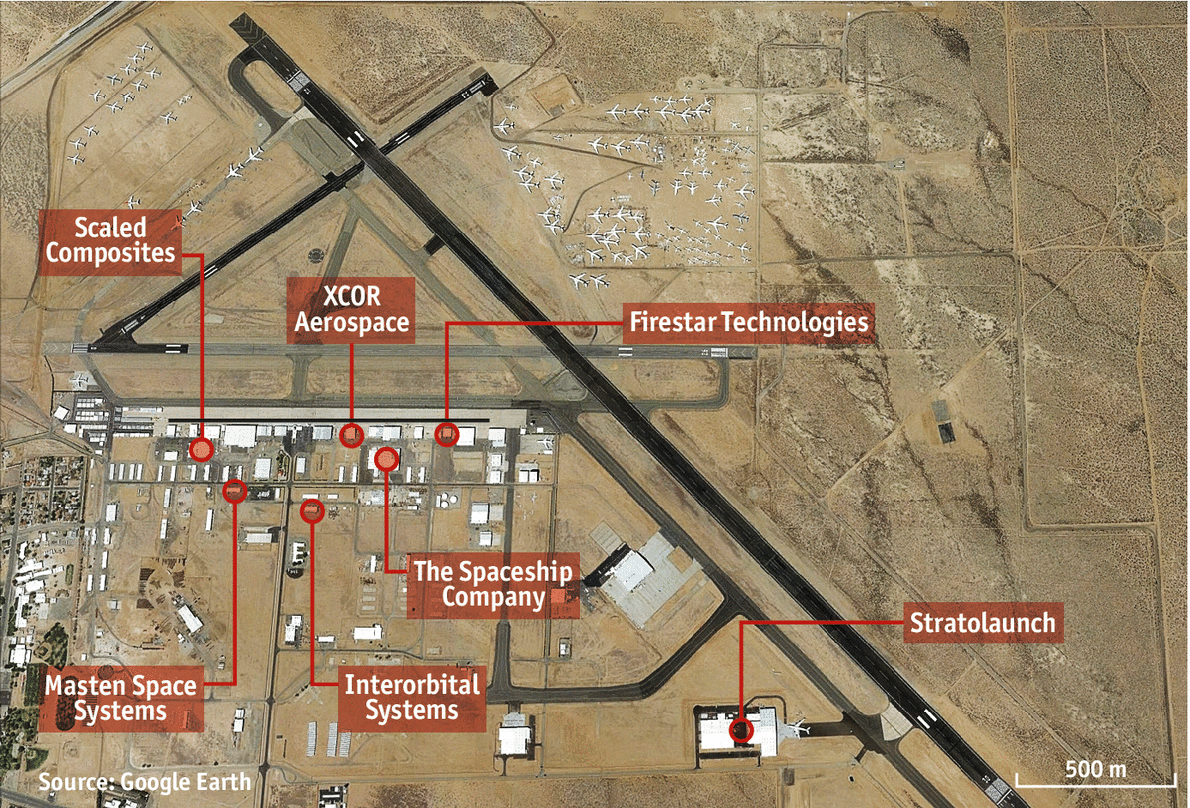
Cluster of 17 "New Space" companies in Mojave Desert
Cluster of 17 “New Space” companies in Mojave Desert

IT BEGAN with a boom. In 1947, Chuck Yeager became the first man to break the sound barrier. He flew from Edwards Air Force Base in the Mojave Desert, America’s main center for experimental military flights. This base was out-of-the-way of prying eyes and surrounded by landscape into which a crash (and there were many) would not inconvenience anyone. Now, reports The Economist (Dec.21,2013-Jan. 4, 2014), the Mojave Desert is emerging as the site of a cluster of what has come to be known as New Space.

The center of activity is 20 miles from Edwards, around the Mohave civilian airfield, now dubbed the Mojave Air and Space Port (see photo). Today, 17 rocket and space-related companies operate in the Air and Space Port. Most hope to make their money from launching satellites. Two, though, plan to enter the trade of taking tourists into space. Scaled Composites has designed and built SpaceShipTwo, a rocket plane intended to carry paying passengers to 100km above Earth using a hybrid rocket engine. Competitor XCOR’s vehicle, Lynx, plans to fly this year.  It, too, is a rocket plane, but is designed to take off from a runway under its own power.

Stratolaunch Systems proposes to take the air-launched-rocket principle and push it to the limit.  Orbital Sciences makes an air-launched rocket, Pegasus, which is used to put satellites into orbit, and the firm also has a contract to resupply the International Space Station. Firestar Technologies is developing a liquid fuel that requires only one tank and no complicated mixing mechanism in the motor, which simplifies engineering. Interorbital Systems is designing small, cheap rockets that can be strapped together in bundles, using as many as are necessary to lift a given payload into orbit.

Mojave is the U.S.’s latest technology cluster (which we discuss in Chapter 8, Location Analysis–see Table 8.3), with firms both competing and collaborating, and a mixture of large and small companies.

Classroom discussion questions:

1. How is this location cluster similar to other high-tech clusters? Different?

2. Why do these firms choose to be near one another?

Guest Post: Another Approach to Teaching the Center-of-Gravity Model

Howard WeissOur Guest Post today comes from Prof. Howard Weiss, at Temple University. Howard is the developer of the POM for Windows and Excel OM problem solving software that we provide free with our OM texts.

Your Heizer/Render textbook covers the Center-of-Gravity Method in Chapter 8. However, there is a related model that is not covered and is easy to explain to the students. Consider Example 3 in the text, on page 322, in which Quain’s Discount Department Stores is looking for a location to build a new warehouse. Suppose though that rather than seeking a “central” location, the warehouse must be built in one of the four cities that currently has a store – Chicago, Pittsburgh, New York or Atlanta.

This revised example can lead to the discussion of straight-line (Euclidean) distance as compared with city-block/taxi distance and can serve as a student reminder about the Pythagorean Theorem.  The distance computations are tedious but not difficult. Of course, using POM for Windows (shown below)

POM for Windows printout

or Excel OM (below) the students can easily identify that Pittsburgh is the city with the least total weighted movement from each of the other 3 cities with a total weighted movement of 318,692.

Excel OM screen capture

OM in the News: Using Malaysia to Balance Supply Chain Disruptions

Jay and I are just finishing up the next edition of our OM text, and have added a good deal of new material on supply chain disruptions. So The Wall Street Journal (July 19, 2012) article on high-tech manufacturers flooding into Penang, Malaysia caught my eye. The journal writes: “Hangar after hangar at the bustling Penang airport is decked out in the liveries of shipping companies DHL, UPS, and FedEx each dedicated to flying out boxes of LED displays, chip sets and other sophisticated electronics. Following last year’s earthquake in Japan and floods in Thailand, global manufacturers are looking to Penang and elsewhere to broaden their supply chains for everything from car parts to semiconductors to hard-disk drives”.

Last year was a watershed for companies operating global supply chains. At the height of the disasters in Japan and Thailand, companies relying on JIT supply chains were left scrambling for alternative suppliers. The hardware industry was hit especially hard by the months of flooding in Thailand. With China’s labor market overheated, countries like Malaysia are seeing billions of dollars in new investments from techs such as Intel, Bose, Agilent, and National Instruments.

Why locate in Malaysia? The nation does carry political risk, as it is a Muslim country entering a period of political turbulence. But as the Journal adds: “Those tensions are relatively minor compared with those of some of Malaysia’s neighbors. The country sits safely away from the so-called Pacific Ring of Fire, mostly unaffected by the earthquakes and volcanoes that can afflict  Japan and Indonesia. Malaysia also is less likely to fall victim to the kind of flooding that left Thailand’s economy flailing last year. Also helping Penang’s appeal are an international air hub and strong logistics infrastructure, including inexpensive and reliable supplies of electricity and pristine water”.

Discussion questions:

1. What location analysis factors do multinationals consider in deciding where to open a new factory?

2. What is the history of US firms locating in Malaysia?

Video Tip: Where to Put the Next Red Lobster

Jay and I have developed two video case studies to accompany Chapter 8, Location Strategies. In the first, Where to Place the Hard Rock Cafe, we describe how Hard Rock makes its future location decisions. At that company, the Director of Development has significant personal authority, using his decades of experience and “feeling” about  a city and a location in that town. Of course, he also employs demographics, but not nearly to the extent that Red Lobster and Olive Garden (both owned by Darden Restaurants) do.

In this 10 1/2 min. video, we see that Red Lobster uses trade area characteristics (like income, population density, racial makeup, average age, competition, nearby hotels, etc.), site characteristics (parking, signage, visibility, traffic flow, etc.), and real estate availability –all run through a geographic information system . The GIS (by MapInfo) provides interesting psychographic profiles for potential locations. What used to take Rob Reiner, the director of market development, 8 hours to analyze, now takes 5 minutes.

MapInfo (illustrated at the end of the chapter) segments the US into 72 “clusters”  of customer profiles, based on income and buying behavior. One such cluster, called Equestrian Heights, is detailed in the case study. The software takes into account competition, projected sales volume, cannibalizing from existing stores, and sets a minimum distances between Red Lobsters.

A great guest speaker when showing the video would be a local or district Red Lobster or Olive Garden manager.

OM in the News: Want Caterpillar’s New Plant in Your State?–Then Start Bidding

“Forget Kindle Fires and iPads”, writes The Wall Street Journal (Nov.26-27, 2011).”The holiday gift most coveted by local officials across the US is a new Caterpillar Inc. construction-equipment factory”. The planned $150 million factory (location announcement in the next few weeks) comes with 1,000 jobs– and election time bragging rights. So far, 2 dozen states, plus Canada and Mexico, have found enough cash for incentives to set off this major bidding war. Because Caterpillar is such a well-known brand with a long track record, it will be “asking for an awful lot from state and local governments”.

This is a great article to use in class when you discuss location decisions in Chapter 8.  First, we find that the firm is moving production of small excavators and bulldozers from Japan to North America –“to be nearer to customers”. Second, Caterpillar “says it is looking for good ports and other transportation links, as well as an established base of suppliers”. Third, the incentives. Caterpillar expects free land, road improvements, help with other infrastructure, tax relief, worker training programs, and cash. The firm is also adept at playing states against one another, and has released letters from governors of four states urging the company to move there. “If Illinois doesn’t want your business, Texas does”, writes Governor Perry.

Are these outrageous expectations? Electrolux AB, the Swedish appliance maker, won about $180 million in incentives from Tennessee when it located its new $190 million factory in Memphis last year. The plant created 1,200 jobs.

Discussion questions:

1. How would your state or local government justify a bidding war for a new plant like this one? Who pays the incentives?

2. Make a list of a dozen factors you think Caterpillar considers in its final selection process.

OM in the News: If China is Too Expensive, Should We Locate in Vietnam ?

With China’s minimum wage at $170 a month, and rising steadily, the decision where to locate a manufacturing plant is not as clear as it was a decade ago. We discuss this issue in Chapter 8, Location Strategies, and see that low labor cost is a major factor in country selection.  The latest Businessweek (June 23-30, 2011) reports that Vietnam, until recently the low-cost alternative to China (with a minimum wage of $85 a month), was a very attractive choice. But with 20% inflation, stoked by fuel and electricity costs, multinationals are beginning to turn away in search of yet cheaper outsourcing sites. The problem is labor strikes–336 in the 1st four months of 2011–due to Vietnamese workers who say they can’t afford the higher cost of living.

Multinationals do not have to look far away–and they are turning in increasing numbers to Laos and Cambodia, the new Vietnams of cheap manufacturing. Last month, Japan’s Minebea  broke ground for a new 5,000 worker motor production plant in  Phnom Penh. “Labor is the key focus for us in choosing Cambodia”, says the company spokesman. And Srithai Superware, a Thai tableware maker, just suspended plans for an expansion of its Vietnam plant because of  economic instability. “Production costs have gone up after two salary increase this year”, says the GM.

The strikes have dented Vietnam’s 25-year-old policy of offering foreign firms a stable and low-cost workforce . “The nation is at a crossroads”, says the World Bank’s director for the country. “Vietnam can’t assume that foreign direct investment will continue. Money can go elsewhere”.

Discussion questions:

1. If manufacturers decide China is too expensive and Vietnam is in danger of following suit, how can they predict where to outsource to?

2. What other  critical factors influence the country location decision?